Last updated: March 21, 2026
Most front-yard privacy problems are not solved by making the yard feel closed off. They are solved by interrupting sightlines at the right height and in the right place. If someone standing on the sidewalk can see straight into your front windows from about 20 to 35 feet away, the issue is usually not that you need a solid barrier.
It is that the yard is still visually open where people naturally look. Start with three checks. Measure the depth of the planting zone you actually have. If it is under 4 feet, a dense hedge is already less likely to be the right answer.
Figure out whether the exposure is into windows, across a porch, or through a driveway opening. Then decide whether privacy matters only in summer or all 12 months. That last part changes everything. A front yard can feel private in June and completely exposed from November through March.
What separates a strong front-yard privacy plan from a weak one is restraint. Backyard logic usually pushes people toward one continuous screen. Front-yard privacy works better when it feels selective: enough screening to block the view, enough openness to keep the house welcoming, and enough depth to let plants mature without turning into a trimming problem.
The front-yard privacy formula that works most often
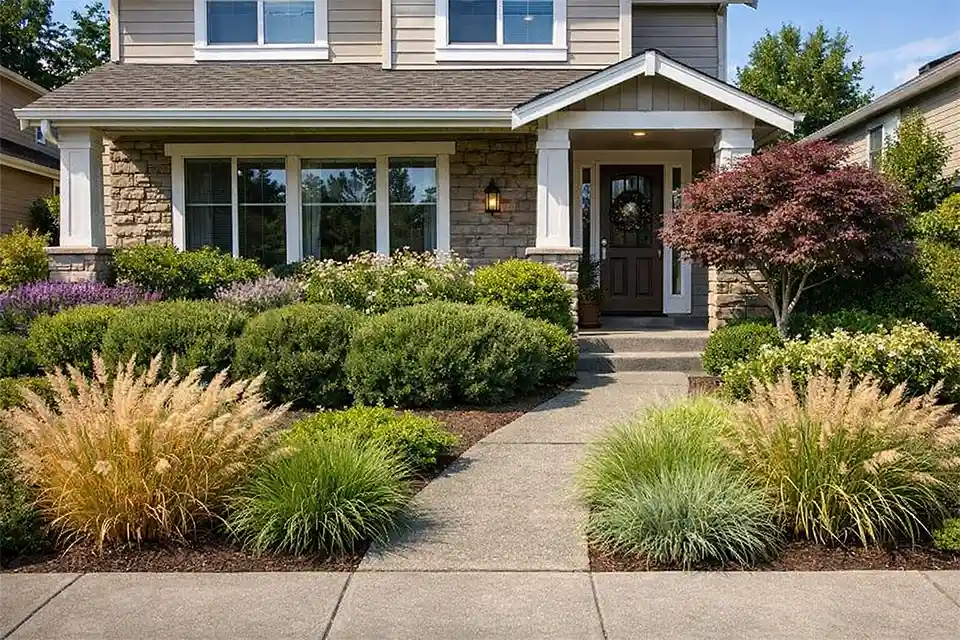
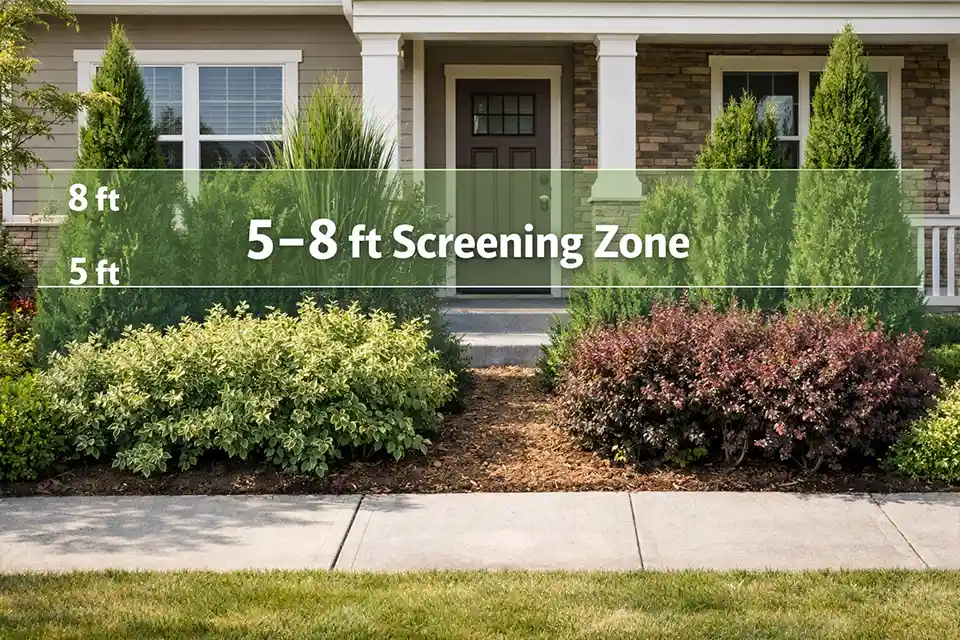
The most reliable setup is not one row of fast growers. It is a layered privacy band, usually about 5 to 8 feet deep in the part of the yard where exposure is worst. That does not mean every front yard needs a deep bed across the whole frontage.
It means the privacy zone needs enough depth somewhere to stack plants in layers rather than forcing one line of shrubs to do all the work.
In practice, that usually means low plants near the front edge, mid-height mass where sightlines pass through, and taller structural plants used only where direct window exposure or side-angle views need help. Mid-height planting is what often does the real work. People tend to overestimate tall plants and underestimate the value of a dense 3- to 5-foot layer.
That same logic shows up in Front Yard Privacy Driveway Open to Street, because privacy usually breaks down first at the opening rather than across the entire lot. It also matters in Front Yard Privacy Sidewalk Bike Lane Traffic, where moving sightlines create a different problem than a quiet street does.
| Layer | Typical height | Main job | Best use |
|---|---|---|---|
| Low edge planting | 18 to 30 inches | Defines space without closing it off | Front edge and walk edge |
| Mid-layer shrubs or grasses | 3 to 5 feet | Blocks seated views and low-angle sightlines | Main privacy zone |
| Taller shrubs or small trees | 6 to 10 feet | Softens direct window exposure | Near key windows and corners |
| Open transition zone | Kept visually clear | Preserves access and welcome | Front walk and driveway edge |
What people usually get wrong first
The first mistake is treating openness and exposure as the same thing. They are not.
A front yard can stay visually open from the street and still feel much more private if the critical view into the house is interrupted. You do not need a green wall across the whole property. You need to block the view that matters. That is a design problem, not a plant-count problem.
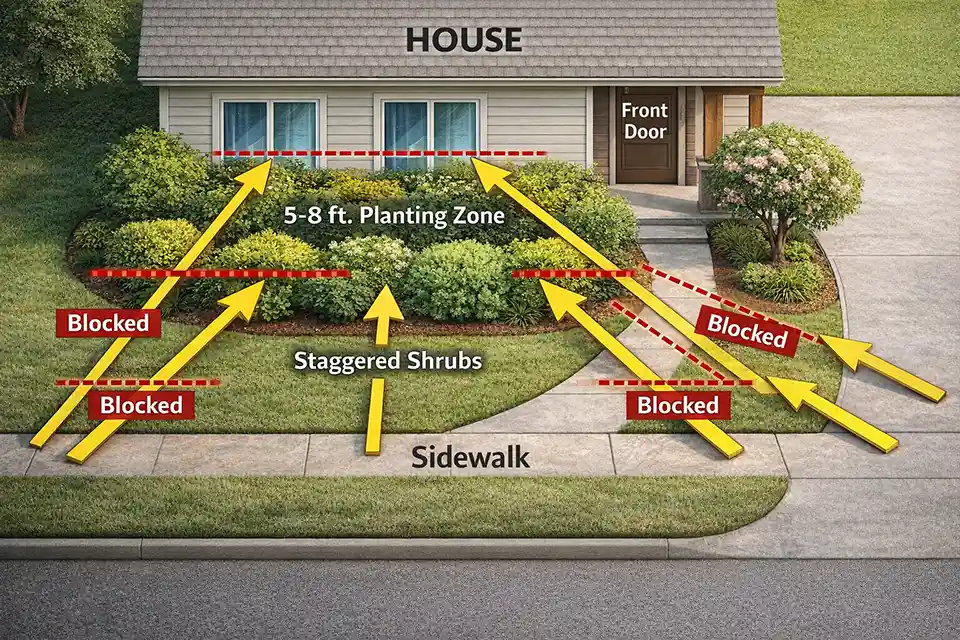
The second mistake is planting privacy evenly instead of strategically. Front yards are rarely exposed in a perfectly flat, front-facing way. Many privacy problems happen at an angle.
A side approach from the driveway, a corner-lot view, or a line from the sidewalk into one particular window can matter more than the rest of the frontage combined. In those situations, one dense shrub grouping near the porch corner often does more than a long, thinner row spread evenly across the lot.
That is why Front Yard Privacy No Setback and How to Create Front Yard Privacy When Your House Sits Directly on a Busy Street Corner solve a different version of the same problem. The shared issue is not “not enough plants.” It is exposed geometry.
The fix that wastes the most time
The single biggest time-waster is the tight row of fast-growing hedge plants.
It sounds efficient. It promises quick coverage. It also fails in predictable ways. First, it gains height faster than useful density. You may get 2 to 3 feet of top growth in a season and still have thin lower screening exactly where the view needs blocking.
Second, it often outgrows the strip it was planted in. A bed that is only 3 feet deep cannot comfortably absorb a plant that eventually wants 5 to 7 feet of width. Third, the maintenance turns into the real project. What started as a privacy solution becomes a shearing routine every few weeks during active growth.
This is where Front Yard Fast-Growing Hedges belongs in the conversation, but not as the default answer. Speed helps only when the plant also fits the bed, holds density at the right height, and does not make the entry feel pinched.
People also tend to overestimate how much a straight hedge line can solve in driveway-heavy yards. If most of the frontage is hardscape, privacy has to happen in concentrated pockets, not in a continuous strip.
That is why Front Yard Design Constraints When a Large Driveway Takes Up Most of the Front Yard is more relevant here than generic screen-plant advice.
Pro Tip: Before planting, place two stakes in the proposed bed and run string at 4 feet and 6 feet high. Then stand on the sidewalk and at the curb cut. That quick test reveals whether the planting is solving the real view or just looking like it should.
Where the privacy planting should actually go
Usually closer to the problem than people expect.
If the front windows are the main issue, the most effective planting is often associated with the house rather than pushed all the way to the front property line. If the porch feels exposed from one side, a concentrated planting mass near that approach usually works better than a balanced design that spreads everything evenly. Front-yard privacy works best when it is targeted.
That is also why scenario pages matter. Fix Front Yard Privacy Windows Facing Busy Road fits homes where interior exposure is the real problem. How to Create Front Yard Privacy on a Busy Walking Route is more useful when repeated close-range foot traffic is what makes the yard feel exposed. Front Yard Privacy Problems Near Schools Parks or Bus Stops matters when the issue is concentration of people rather than simple visibility.
A practical threshold helps here. If the planting zone is under 3 to 4 feet deep, hedge logic usually starts to break down. If you can only fit one layer without crowding the walk, the answer is often not “denser shrubs.” It is “more selective screening.”
When a hedge-only plan stops making sense
There is a point where the standard privacy fix no longer earns the maintenance it creates.
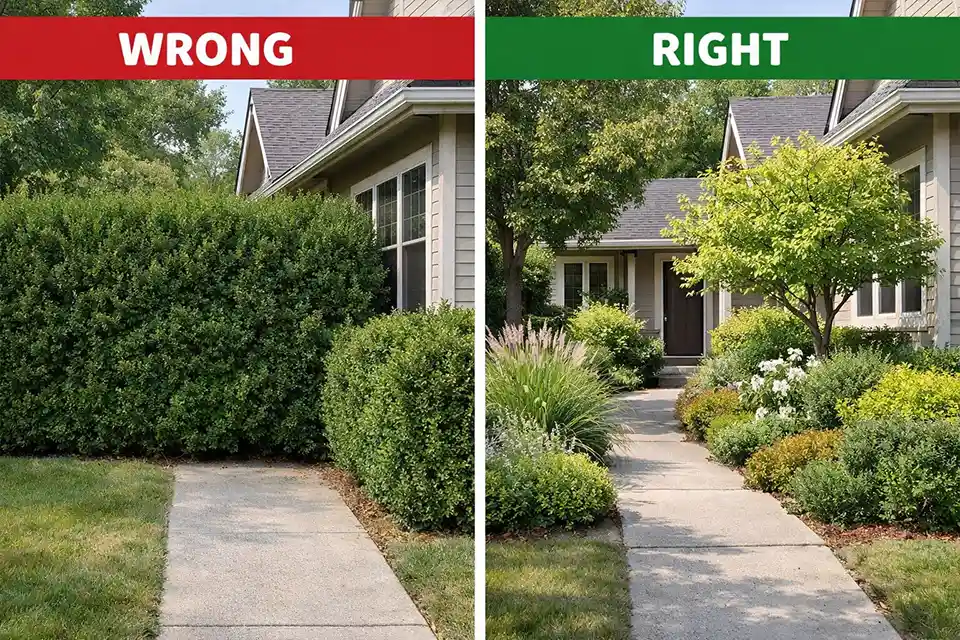
That point usually arrives when the yard is shallow, the lot is narrow, the driveway takes up too much frontage, or the front walk needs to stay visually open for the house to feel inviting. In those settings, a full hedge often solves the privacy problem too crudely.
It screens some views, but it also reduces light, crowds circulation, and makes the front yard feel heavier than it needs to.
This is where Front Yard Design Problems on Narrow Lots becomes relevant, because narrow lots leave less room for deep layered planting and make placement much more important.
It is also where Front Yard Design Ideas for Suburban Homes matters, since the real challenge is usually balancing privacy with curb appeal instead of choosing one over the other.
A good rule of thumb is that if a shrub would eventually need to sit with more than half its mature width hanging into a walkway, drive edge, or house clearance zone, it is the wrong plant or the wrong location.
That is the point where repeated trimming stops being a small adjustment and becomes proof the layout never fit.
What changes under different conditions
Climate and frontage type change the right answer more than people think.
In northern states, winter structure matters. A yard that feels private in leaf can become exposed for 4 to 5 months if too much of the screen is deciduous. In humid climates, the opposite problem often shows up first: growth is fast enough that a good plan becomes a pruning burden if spacing was too optimistic. In dry western conditions, the usual issue is slower fill-in and inconsistent density during the first 12 to 24 months unless irrigation is steady.
Street context matters just as much. Busy roads create more than visual exposure. They add dust, headlights, and a sense of motion that makes the front yard feel less protected even when a few plants are present.
That is why Front Yard Privacy Problems on Busy Streets overlaps with Front Yard Maintenance Problems Near a Busy Road With Constant Dust and Debris. The privacy fix is often doing double duty as a comfort buffer.
And if the house sits low, faces an intersection, or receives longer-duration views from stopped traffic, the real problem can be visibility time rather than visibility distance. That is where Fixing Front Yard Privacy Issues for Homes Facing Constant Traffic at a Stop Sign or Intersection becomes the better next read.
A better way to think about this topic
The useful distinction is simple: the symptom is “people can see in.” The mechanism is “the front yard is not interrupting views at the right height, depth, and angle.”
Once that becomes clear, a lot of bad advice falls away. You stop chasing the tallest plants. You stop assuming privacy has to run evenly across the whole frontage. You stop treating fast growth as the same thing as fast screening. And you start making better decisions about where the privacy band belongs, how deep it needs to be, and which parts of the yard should stay visually lighter.
That broader logic also connects naturally to adjacent design problems. Front Yard Landscaping Ideas for Curb Appeal matters because privacy that hurts the front entrance usually feels wrong.
How to Layer Plants in Front Yard Landscaping matters because layering is not styling here. It is the mechanism that makes privacy work without a fence.
Final take
The best front yard landscaping for privacy without fences does not try to imitate a fence. It works by placing the right amount of plant mass where the exposure actually happens, holding the useful screening in the 3- to 6-foot range, and leaving the rest of the front yard open enough to still feel like an entrance instead of a barrier.
For broader official guidance, see the University of Maryland Extension guide to mixed privacy screens.