Last updated: July 4, 2026
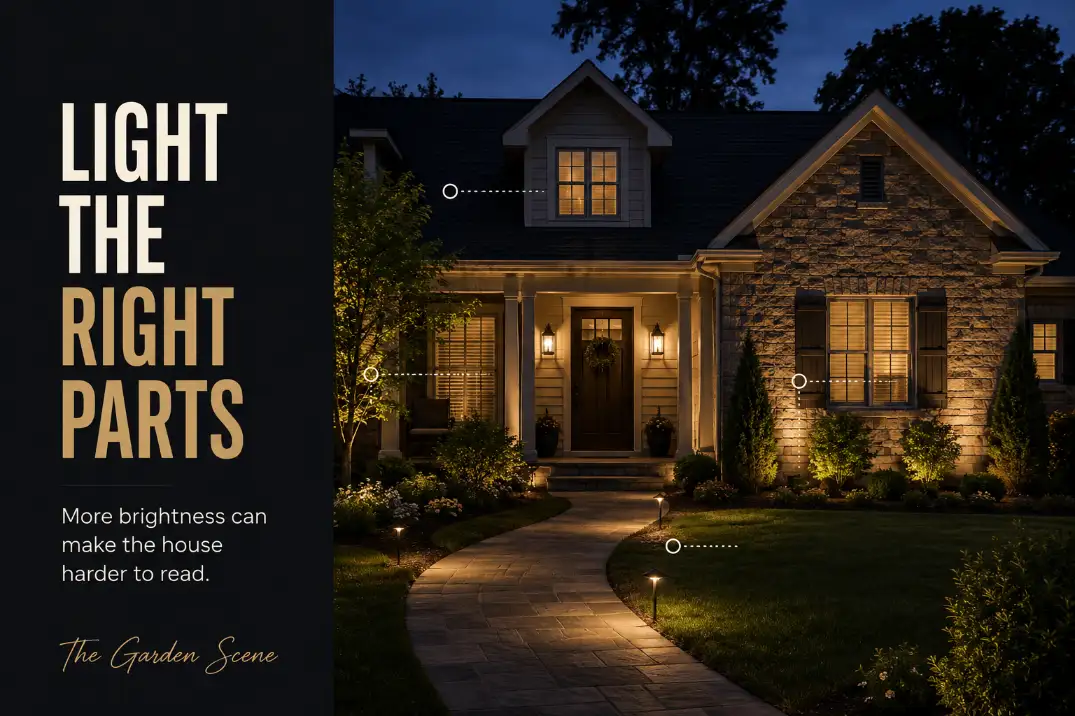
Front yard lighting improves curb appeal when it helps the house make sense after dark. It fails when it only makes the yard brighter.
That is the difference most homeowners miss. A row of path lights, a brighter porch bulb, a few uplights, and a motion floodlight can all seem reasonable on their own. But from the street, they may not answer the real question: where is the entry, how do I get there, what gives the house shape, and why does the scene feel welcoming instead of harsh?
This page is not about collecting fixture types. It is about deciding what the front yard needs to reveal at night.
A strong lighting plan usually does five quiet jobs. It makes the entry feel findable. It guides the route without tracing every edge.
It gives the facade some shape. It lets planting create depth instead of becoming a dark mass. And it controls glare, color, and spill so the whole front yard feels intentional rather than patched together.
Start by Deciding What the Front Yard Should Reveal at Night
The first decision is hierarchy. At night, the eye should not have to sort through every lit shrub, walkway edge, garage corner, and wall surface to understand the house.
During the day, curb appeal is carried by the lawn, planting, walkway, porch, roofline, facade, and front door. After sunset, much of that disappears unless the lighting gives the eye a simple order to follow.
That order should usually begin with the entry. The front door, porch, steps, house number, or landing area should be easier to understand than the outer edges of the yard. When the brightest points are scattered across random shrubs, driveway edges, and corners, the house can look busy even if each fixture looks fine by itself.
The walkway comes next. A visitor should be able to understand where to move from the sidewalk or driveway without seeing every inch of pavement lit evenly. The goal is route confidence, not a glowing border.
Facade and planting accents are the supporting layer. They help the house look dimensional instead of flat, but they should not compete with the entry. One tree, one textured wall section, one column, or one strong planting mass can do more for curb appeal than a row of equal accents on every available surface.
| Nighttime problem | Lighting move that fits | Curb appeal effect | What to avoid |
|---|---|---|---|
| The front door disappears | Give the entry the clearest warm light | The house feels welcoming and easy to approach | Bright yard edges that compete with the door |
| The route feels uncertain | Light turns, steps, and arrival points | Visitors understand how to move | Evenly tracing every walkway edge |
| The facade looks flat | Add selective facade or texture accents | The house gains depth after dark | Blasting the whole wall with light |
| Planting becomes a dark mass | Highlight one or two planting layers | Beds feel intentional instead of heavy | Lighting every shrub separately |
| The yard looks harsh | Reduce glare, spill, and color mismatch | The scene feels calmer and more refined | Adding more fixtures before controlling light |
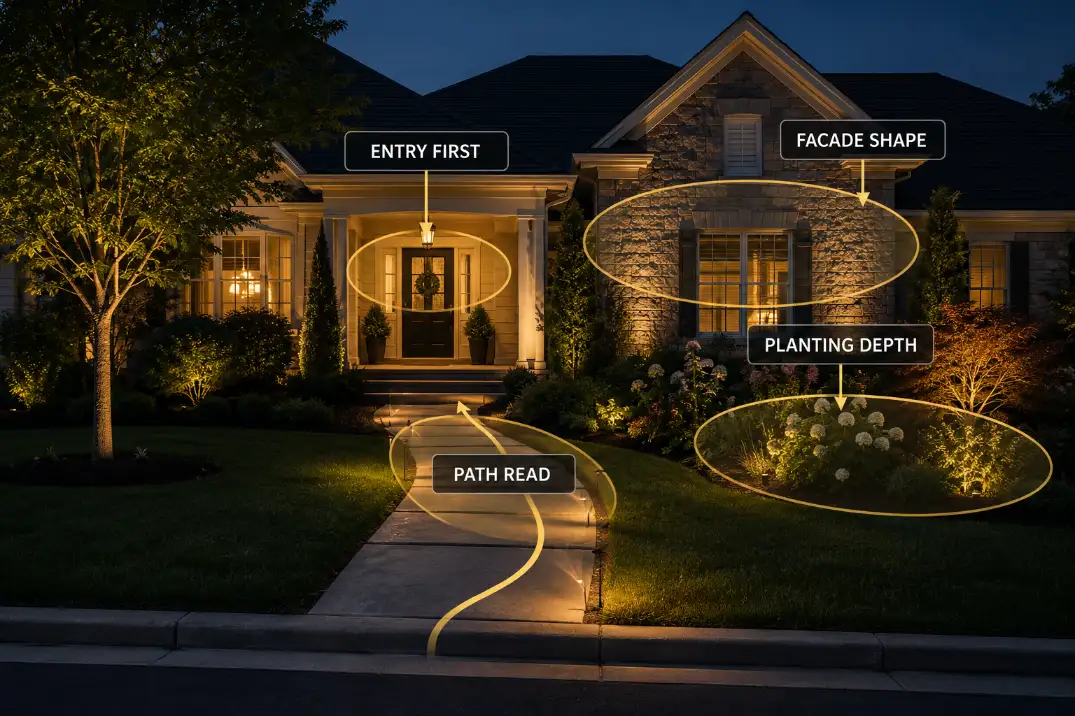
The most useful lighting ideas are the ones that solve a visible weakness. A dark front door needs a different answer than a confusing walkway.
A flat facade needs a different answer than a glaring floodlight. Once the weakness is clear, the lighting choice becomes less about adding fixtures and more about editing the nighttime read.
Make the Entry the First Nighttime Focal Point
The entry should win the first glance. If the brightest light is on the driveway, garage corner, or a random shrub, the front yard may be lit but the house still feels hard to approach.
This works best when the home has a porch, stoop, recessed doorway, visible house number, or steps that disappear after sunset. The lighting does not need to be dramatic. It needs to make the arrival point feel intentional.
A pair of sconces, a controlled porch light, soft recessed porch lighting, or subtle step lighting can all work, but the fixture type matters less than the job: make the entry findable without creating glare at eye level.
The wrong version is an entry light that shines outward like a small spotlight. From the street, that can make the porch look bright while the door itself remains hard to read. From the walkway, it can hit a visitor in the eyes and make the surrounding path feel darker by contrast.
A better entry layer is warm, contained, and slightly dominant. It should be bright enough to say “this is where you arrive,” but not so bright that every other part of the front yard disappears.
For homes with a deep porch, the light may need to reveal the back wall and door, not just the porch ceiling. For homes with a flat facade and no porch, the entry may need help from the house number, a small landing light, or a nearby planting accent that frames the door.
For homes where the driveway is the main arrival route, the entry lighting should be readable from the driveway side, not only from the sidewalk.
The test is simple: stand at the curb or driveway after dark and ask where your eye goes first. If it does not go to the entry, the lighting pattern is working against curb appeal.
Use Walkway Lighting to Guide Movement, Not Trace Every Edge
Walkway lighting should mark decisions, not decorate pavement.
The best path lighting usually belongs where movement could become uncertain: a turn, a step, a narrow point, a driveway connection, a sidewalk junction, or the final approach to the front door. Long straight sections may need much less lighting than homeowners assume, especially when the entry is already visible and the surrounding yard has soft ambient light.
This is where curb appeal and usability overlap. A walkway that feels obvious in daylight can become confusing at night if the driveway, sidewalk, and front door do not connect visually. Lighting should support the route that already exists.
If the walkway itself feels awkward, the lighting can reveal that problem instead of solving it. In that case, the better starting point may be the front yard walkway layout rather than adding more path lights.
Even spacing is not always the best spacing. A perfectly repeated line of small lights can look stiff, especially in a suburban front yard where the path curves, widens, or crosses planting beds. A calmer approach is to light the moments that matter and let some shadow remain between them.
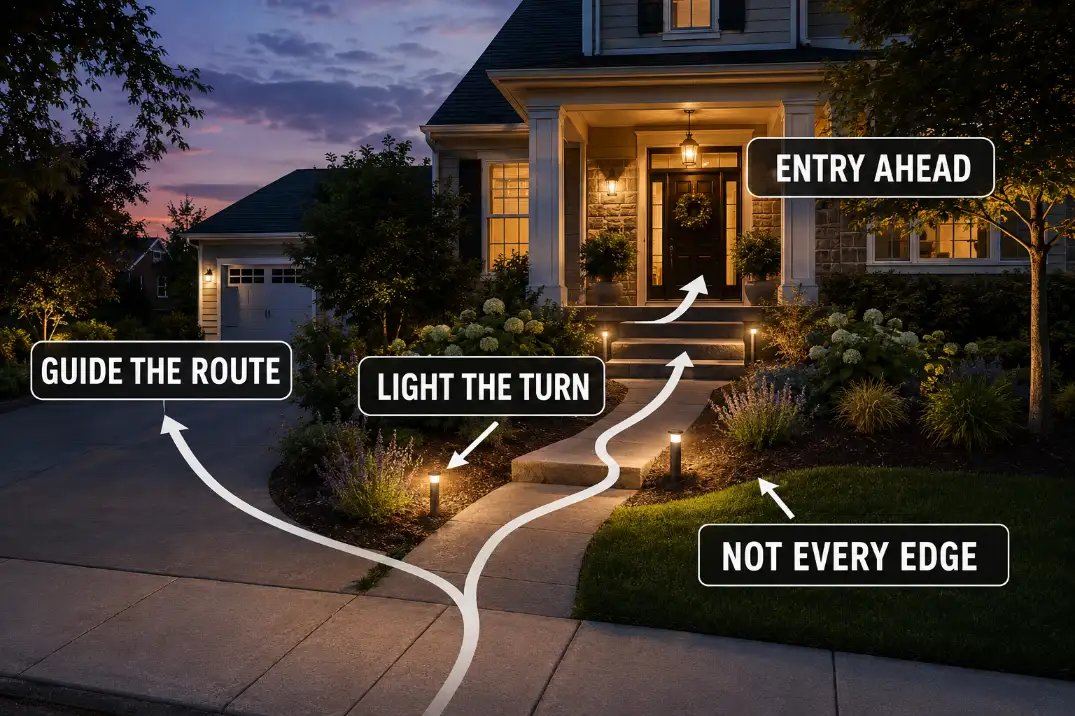
Use path lighting when the issue is movement clarity. Avoid relying on it when the real issue is that the entry is dim, the planting is overgrown, or the walkway itself is poorly placed. Lighting can guide a good route. It cannot make a bad route feel natural by itself.
Light the Facade and Planting Only Where They Add Shape
Accent lighting earns its place only when it gives the house or planting more shape. If it does not clarify the front yard, it becomes decoration that competes with the entry.
The useful version reveals a column, a textured wall, a small ornamental tree, a layered planting bed, or the rhythm of foundation planting. It gives the house and yard depth so the front elevation does not look like a flat dark rectangle with a bright porch light attached to it.
The mistake is treating every plant or wall section as something that needs its own spotlight. That creates a display-yard effect. The eye jumps from one lit object to another without understanding which part matters most.
Facade lighting works best when the house has features worth revealing: stone texture, brick, columns, a gable, a strong porch opening, or a wall plane that needs depth. Planting accents work best when the planting already has structure. Lighting a shapeless bed rarely makes it look better. It usually makes the lack of structure more visible.
That is why lighting and planting cannot be completely separated. If the bed is a scatter of small plants, accent lighting may make it look busier at night. If the bed has clear masses, height changes, and edges, a small amount of light can make it feel intentional.
For yards where the lawn has been removed or planting carries more of the front yard composition, the lighting should support the existing front yard planting structure rather than create a separate nighttime scene.
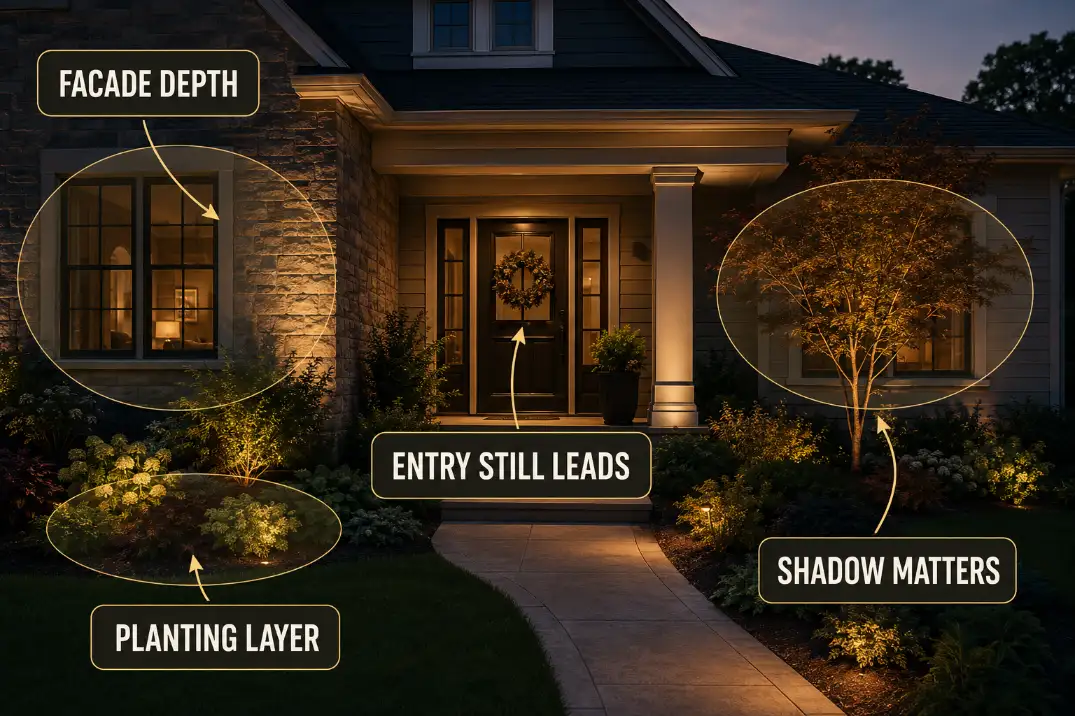
The best accent choice is usually the one that explains the house. Light the feature that helps the facade read better. Leave the rest quieter.
Keep Security Lighting From Flattening the Whole Yard
Security lighting should solve a specific use problem, not become the front yard’s main nighttime personality.
A bright floodlight may help at a driveway, side gate, garage approach, or dark corner. But when it floods the whole yard, it can flatten the facade, wash out planting, create harsh shadows, and make the entry feel less welcoming. The house shifts from warm and composed to exposed and defensive.
That does not mean security lighting has no place. It means it should have a limited job. Let entry, path, and accent lighting carry the regular nighttime appearance. Use stronger security lighting only where stronger light is actually needed.
A soft curb appeal layer says, “Here is the home, here is the route, here is the entry.” Harsh security lighting says, “Everything is bright because something moved.” Those are different messages.
For curb appeal, the regular nighttime view should still look good when no motion light is active. If the house only makes sense when a floodlight turns on, the lighting plan is not really a curb appeal plan.
Control Glare, Color, and Spill Before Adding More Fixtures
Before adding another light, check whether the existing light is working against the view. Many front yards are not underlit; they are uncontrolled.
Glare is the first problem to check. A fixture can be bright enough and still make the yard harder to read if the light source is visible from the walkway, street, front window, or neighboring property. The eye reacts to the bright source instead of the front door, path, or planting.
DarkSky International’s responsible outdoor lighting principles emphasize using light only where it is needed, directing it carefully, keeping it no brighter than necessary, controlling when it is used, and choosing warmer color where possible. That guidance matters for curb appeal because targeted, restrained light usually reveals the home better than broad uncontrolled brightness.
Color mismatch is the next issue. A warm porch light, cool-white path lights, and bluish floodlight can make the front yard feel assembled in pieces. Even when the fixtures are attractive, mixed color can make the scene look accidental. A consistent warm tone usually reads more residential and calmer from the curb.
Spill matters too. Light that pushes into a neighbor’s window, across the sidewalk, or straight through your own front windows can make the yard feel careless. Good curb appeal lighting has boundaries. It lights the entry, route, facade, or planting bed without announcing itself beyond the area it serves.
Too many fixtures create another kind of spill: visual clutter. During the day, the stakes, housings, wires, and repeated objects can make the front yard busier. At night, every lit point asks for attention. When too many of them are equal, nothing leads.
Design Caution: The most polished front yard lighting often comes from subtracting weak light, not adding another fixture. If the entry, path, and one or two accents already explain the house, extra brightness can reduce the sense of depth.
Common curb appeal lighting mistakes to check before adding more fixtures:
- Glare at eye level: The fixture is more visible than the entry or path.
- Overlighting: The yard is bright everywhere, so the house loses shadow and shape.
- Mixed color temperature: Warm, cool, and blue-white lights make the front yard feel patched together.
- Window or neighbor spill: Light escapes into places it was not meant to serve.
- Too many equal accents: Every shrub or wall section competes for attention.
A front yard can be underlit, but it can also be over-explained. When the lighting shows every edge, plant, wall, and corner, the nighttime view loses hierarchy. The house may look brighter for a moment, but less graceful from the street.
Build One Warm Lighting Pattern Across the Front Yard
The final lighting pattern should feel like one edited decision, not several separate upgrades.
Start with the entry. It should be the clearest nighttime anchor. Then support the route with path lighting where movement actually needs guidance. Add facade or planting accents only where they give the house more shape. Keep security lighting in its lane. Before adding anything else, check glare, color, spill, and fixture clutter.
A short curb appeal check can help:
- Can someone identify the front door quickly from the curb or driveway?
- Does the walkway read clearly without being traced like a runway?
- Does the facade have depth without being washed flat?
- Do planting accents support the house instead of competing with it?
- Does the yard still have calm shadow, not brightness everywhere?
This is also where restraint connects back to daytime design. If the front yard already feels crowded with decor, edging, small plants, and competing features, lighting can make that clutter more obvious at night.
A restrained lighting plan works best when it supports a clean and simple front yard rather than trying to decorate around visual noise.
Good front yard lighting is not about proving that every possible fixture has a place. It is about deciding what the home needs to reveal after dark.
Light the entry first. Guide the path where decisions happen. Add accents only where they reveal shape. Control glare before chasing brightness.
The front yard should not look lit because everything has been covered. It should look valuable because the right parts of the house are finally readable.