Last updated: July 3, 2026
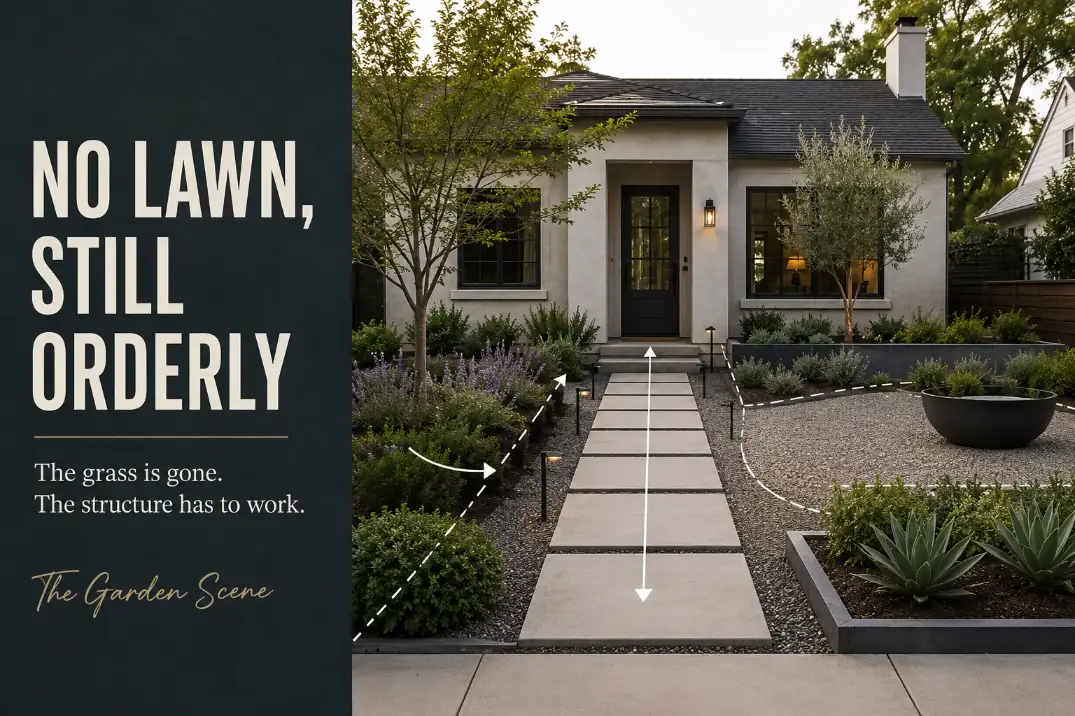
A front yard without lawn does not fail because grass is missing. It fails when nothing else takes over the organizing job the lawn used to do.
Grass is more than a green surface. In a typical front yard, it creates open foreground, separates the house from the street, makes the walkway easy to read, gives planting beds a quiet background, and keeps the front door from disappearing behind too many small decisions. When the lawn is removed, that simple structure disappears all at once.
So the first question should not be, “What can I put where the grass was?” Gravel, mulch, pavers, groundcovers, planting beds, and privacy shrubs can all work, but none of them automatically creates order. The better question is: what design structure will replace the lawn’s unifying role?
Why a Front Yard Without Lawn Needs a New Organizing Structure
Treat the former lawn as a layout job before treating it as empty square footage. If you only fill the space, the yard may become lower-maintenance in theory but harder to read in daily use.
One area becomes gravel. Another becomes mulch. A planting bed expands near the porch. A few shrubs are added near the sidewalk for privacy. Each choice may be reasonable on its own, but together they can make the front yard read as fragments instead of one arrival space.
The old lawn may have been boring, thirsty, or difficult to keep clean, but visually it connected everything. The walkway crossed it. The planting beds sat against it. The porch opened toward it. The house looked grounded because the surface in front of it stayed calm.
Once that surface is gone, the design has to reassign those jobs.
| Lawn’s Former Job | What Takes Over in a Lawn-Free Design |
|---|---|
| Open foreground | Negative space, calm surfaces, or low planting |
| Walking clarity | A readable path from sidewalk, driveway, and curb |
| Visual calm | Limited surface materials and repeated forms |
| House framing | Planting zones shaped around porch, windows, and foundation |
| Edge control | Consistent borders between beds, paths, and surfaces |
| Entry visibility | Clear sightline to the front door and landing |
This table keeps the design from turning into a replacement list. Gravel is not the answer. Mulch is not the answer. Plants are not the answer. The answer is a front yard where every surface and planting zone has a specific job.
Common mistake: filling the lawn-shaped hole
- Replacing the whole lawn with one large gravel field and trying to decorate it later.
- Cutting the yard into unrelated mulch, rock, and plant areas without a clear path structure.
- Adding privacy planting before checking whether the front door still reads from the street.
- Using too many border styles, which makes the yard look patched together instead of designed.
The strongest no-lawn front yards still have open space, movement, and visual pause. They simply create those things with a different structure.
Start With the Path, Not the Planting
The path should be the first hard decision because it tells every other element where to stop. If the route to the door is weak, planting and surface materials will only make the confusion more visible.
Start by identifying how people actually arrive. There is usually a primary route from the sidewalk or curb to the front door. There may also be a daily route from the driveway, a delivery route from the street, or a side approach from a gate. If those routes are not clear before the yard is filled, the finished space can feel awkward even when the materials look attractive.
A good lawn-free path does not have to be wide, formal, or straight. It does need to be readable. The eye should understand where to walk before the feet have to guess.
That means avoiding awkward diagonal leftovers, tiny stepping-stone puzzles, or planting beds that pinch the approach near the porch.
This is where front yard design becomes practical rather than decorative. A path that photographs well but disappears under mature planting has not replaced the lawn’s walking clarity. If the main entry route is already a weak point, solve that before choosing the surface around it.
A related walkway article can help when the real issue is how the front walk leads people to the door, but this page’s job is narrower: make the no-lawn yard readable before it becomes planted.
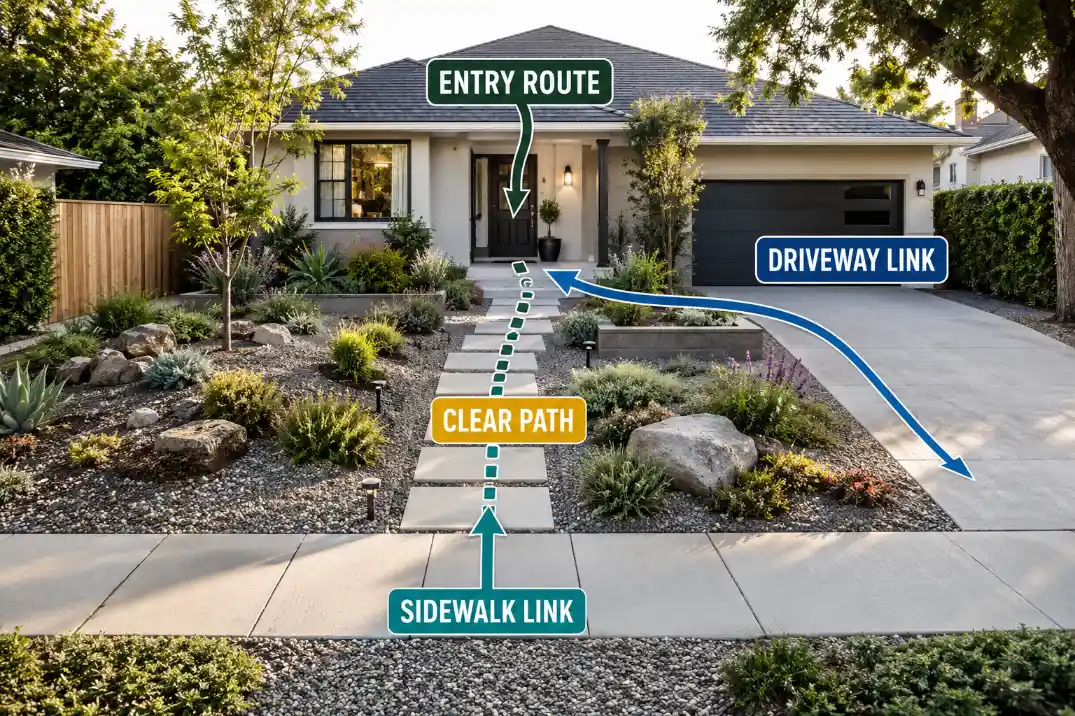
The path also decides where planting should stop. Beds can frame the route, soften its edges, or guide movement, but they should not make the route feel like an afterthought. In a no-lawn yard, planting that crowds the walkway creates more confusion than charm.
A useful field test is simple: stand at the curb and then at the driveway. If both positions clearly tell you where the front door is and how to reach it, the path is doing its job. If the route needs explanation, extra decoration, or guesswork, the structure is not strong enough yet.
Preserve Negative Space So the Yard Can Still Breathe
Negative space is not leftover space. In a lawn-free front yard, it becomes the replacement for the visual calm that grass used to provide.
This open area may be a calm gravel panel, a low groundcover zone, a simple mulch field, a broad permeable surface, or a restrained space between the path and planting. Its job is not to call attention to itself. Its job is to keep the front yard from feeling crowded.
This is the part many homeowners unintentionally lose. A lawn-free yard can become visually heavy because every area starts competing: tall plants near the house, gravel in the center, mulch along the path, stepping stones through the middle, containers by the porch, privacy shrubs near the sidewalk. Nothing is technically wrong, but the house loses its breathing room.
The goal is not emptiness. The goal is controlled openness.
A calm surface can replace lawn’s visual pause if its edges are clear and its role is obvious. A low planting area can do the same if it reads as one mass instead of scattered dots. Even mulch can work if it belongs to a defined bed rather than spreading across the yard as filler.
Layout note: In a no-lawn front yard, the area that feels “too empty” on planting day is often the same area that keeps the house readable once plants mature.

The best negative space usually sits where the lawn used to make the house readable: between the public edge and the front entry, beside the main path, or in front of the porch where the eye needs a pause. If that area gets filled too aggressively, the yard may become lower-lawn but higher-noise.
Build Planting Zones as Masses, Not Scattered Beds
Planting should create structure, not occupy every available opening. Once the lawn is gone, scattered beds lose the quiet green field that used to hold them together.
The stronger move is to build planting zones as masses. A planting mass may follow the foundation, wrap a porch corner, soften the driveway edge, or frame the path. What matters is that it has a clear shape and a clear relationship to the house.
This does not mean every bed has to be formal. Curved beds can work. Loose planting can work. Naturalistic planting can work. But the zone still needs a boundary. If plants are spread evenly across the former lawn just because there is now space to plant, the yard loses hierarchy.
A good planting zone answers one of four jobs:
- It frames the house.
- It guides the path.
- It softens a hard edge.
- It screens a specific view without blocking the entry.
That last point matters. Privacy planting is often added too early in lawn-free designs. A shrub line near the sidewalk may solve exposure, but if it blocks the front door, narrows the path, or makes the porch feel hidden, it steals the job of the entry. Privacy should be a filter inside the layout, not the main structure of this page.
If the next decision is specifically about exposure, use a focused privacy guide after the main layout is clear.
A no-lawn yard can still feel welcoming when privacy planting supports the route instead of fighting it, which is why the link between planting and front yard privacy that still looks welcoming should be treated as a later design layer, not the first move.

Plant size matters here, but not as a plant list. The design question is whether mature height and spread will still leave the path readable, the windows open, and the front door visible. A plant that looks modest on planting day can become the reason the yard feels crowded two seasons later.
Limit the Surface Palette Before You Add More Materials
The surface palette should be narrow because every new material creates another visual edge. A lawn-free front yard can become busy when one simple surface is replaced by five smaller ones.
Gravel goes in the center. Mulch goes around the plants. Pavers cross the path. River rock fills a strip near the driveway. A different border separates the beds. Each material is familiar, but together they can make the yard feel like a sample board.
Limit the surface palette before adding detail. Most front yards read better when each material has a clear job:
- A walking surface for the main route.
- A calm surface for open space.
- A planting surface for beds.
- A drainage-aware surface where water needs to move.
- An edge condition that keeps materials from blending.
That is enough. More materials do not automatically create more design.
Permeable surfaces can be useful in a lawn-free front yard, but they should not be treated as a magic fix. A permeable paver, gravel area, or open-joint surface still needs the right base, slope, and edge control. If water naturally moves toward the foundation, the surface choice alone will not make the layout safe or low-maintenance.
The maintenance pressure also changes by surface. Loose gravel can drift. Mulch can wash. Paver joints can collect weeds. Groundcovers can spread into paths. These are not reasons to avoid those materials; they are reasons to assign each one a limited role.
Use Edges to Make the Whole Yard Read as One Design
Edges are the seams of a lawn-free yard. When they are weak, separate surfaces look accidental; when they are consistent, the yard reads as one plan.
An edge does not always have to be metal, stone, concrete, or brick. A clipped planting line, a clean grade change, a repeated low border, or a consistent curve can also create an edge. The point is control. The eye needs to understand where one zone ends and another begins.
Use hard edges where material movement is likely: gravel beside a path, mulch on a slope, planting beside a driveway, or a surface transition near the entry. Use softer edges where the goal is visual blending, such as low planting meeting a calm open surface.
What you should avoid is changing the edge language too often. One style around the path, another around the bed, another around the driveway, and another around the porch can make the front yard feel patched. A lawn-free design usually needs fewer edge types, repeated more intentionally.
If shifting borders are already a maintenance issue, the problem may be bigger than style. A focused article on front yard edging that keeps shifting can help with the failure pattern, but in this design framework the edge has a broader job: it makes separate materials read as one plan.
| Main Organizing Move | Use It When | Watch For |
|---|---|---|
| Path-led layout | The front door or driveway route feels unclear | Beds and surfaces must support the route, not compete with it |
| Open-space-led layout | The yard feels crowded without lawn | Calm areas need clean boundaries or they look unfinished |
| Planting-led layout | The house needs framing or softness | Planting masses must not hide the entry |
| Edge-led layout | Materials feel chopped up or messy | Too many border styles can create more visual noise |

This decision matrix is not about choosing one perfect style. It is about identifying which element should lead the design. In one yard, the path must lead because the front door is hard to find. In another, open space must lead because the house already feels visually crowded. In another, edge control matters most because every material is spreading into the next.
The wrong move is letting all four compete at equal volume.
Let Drainage and Permeability Shape the Surface Plan
Drainage is a boundary condition, not a separate design theme. It should decide where surfaces can perform before you commit to the final layout.
Watch where water already moves from the roof, driveway, sidewalk, slope, and downspouts. A calm gravel area may look good on paper, but if it sits where runoff cuts across the yard, it may spread or rut. Mulch near a low edge may look clean at first and then wash into the path after a storm.
Permeability is useful only when the surface, base, and slope work together. A permeable surface placed over compacted soil, beside poor edging, or in a low spot with nowhere for water to go can still become a maintenance problem.
This is where the no-lawn design should stay disciplined. Do not turn the front yard into a drainage project inside every section. Let water behavior decide where open surfaces, planting beds, and edges can perform.
If the yard already has standing water, runoff, or soil-slope problems, solve that as its own next decision with a focused guide to yard drainage problems tied to soil, slope, and runoff.
In a lawn-free design, drainage is not pasted onto the end. It is one of the reasons the surface plan either holds together or starts to fail.
Keep the Entry Clear Enough to Anchor the Whole Yard
The front door is the final test. If the door disappears, the no-lawn design has lost its hierarchy, no matter how attractive the materials are.
That does not mean the entry has to be exposed or bare. It means the path, planting, surface zones, and edges should all support the same visual conclusion: this is where you arrive. The door, porch, steps, or landing should remain easy to read from the curb, driveway, and main approach.
Tall planting near the entry should be handled carefully. A shrub that feels like useful softness at the nursery can become a visual block when it matures beside the walk. Privacy layers near the sidewalk can help with exposure, but if they make the front door feel hidden, the yard may become private at the cost of welcome.
The same rule applies to containers, decorative objects, low walls, and extra bed shapes. In a lawn-free front yard, there is less visual background to absorb clutter. Every added piece shows.
A clear entry does not require a wide-open yard. It requires hierarchy. The path leads. The planting frames. The surface calms. The edges contain. The door remains the point.
The Lawn-Free Yard Should Feel Designed, Not Filled
A front yard without lawn works when the old lawn’s jobs have been reassigned. The path reads. The entry stays visible. Planting sits in controlled masses. Surfaces have limited roles. Edges hold the zones together. Water has a sensible route. Negative space gives the house room to breathe.
If those jobs are not assigned, the yard usually feels busy even when every individual choice is attractive.
That is the real test. Do not ask only whether the yard has enough plants, enough gravel, enough mulch, or enough visual interest. Ask what each part is doing.
The lawn-free front yard should not look like a collection of replacements. It should look like one design structure that no longer needs lawn to hold it together.
For stormwater context, the U.S. Environmental Protection Agency explains how permeable pavement can help reduce runoff by allowing rain and snowmelt to move through the surface.