Last updated: July 4, 2026
Front yard plant layering is not a formula of tall plants in back and short plants in front. That shortcut can look organized on planting day and still fail from the curb, where the yard has to guide the eye toward the entry, keep the house readable, and hold its shape as plants mature.
The real decision is role first, plant second. One layer finishes the ground. One layer carries the visual mass. One layer adds height and rhythm.
When those jobs blur, the front yard often becomes a flat row, a crowded foundation bed, or a planting scheme that slowly hides the door it was supposed to frame.
A good front yard layer should answer four practical questions before any plant is chosen: What does this layer do from the street? How does it affect the walkway and entry?
What will it block when mature? Does it still leave the house, windows, and front door in control?
Start With How the Front Yard Is Read From the Street
The first layout test happens away from the planting bed. Stand at the curb, across the street, at the sidewalk, and near the driveway. Those are the places where the front yard becomes a visual sequence instead of a collection of plants.
From that distance, small details matter less than order. The eye reads the entry first, then the walkway, then the base of the house, then the larger plant masses that frame the scene.
If the planting competes with that order, the yard can feel busy even when every individual plant is attractive.
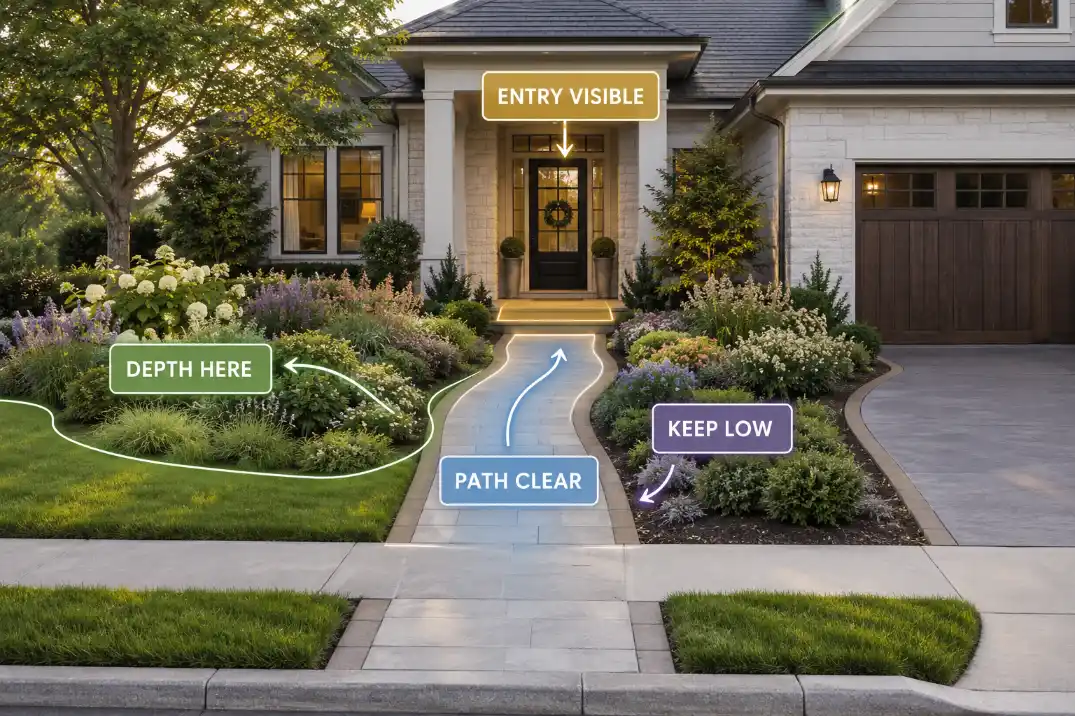
The front door should usually remain the clearest destination. That does not mean it has to be bare or exposed. It means the plant layers should guide attention toward it, not drift across it. A low ground layer can pull the eye along the path.
A mid layer can connect the porch and foundation to the soil line. A taller layer can frame a corner or soften a blank wall. None of those layers should make a visitor work to find the entry.
This is why “short in front, tall in back” is too simple. In a front yard, height also has to answer sightline, movement, and scale. A tall plant at a house corner may help the facade feel grounded. The same plant near a walkway bend may make the path feel squeezed.
A low plant near the front edge may finish the bed nicely. The same low plant scattered everywhere may make the yard look spotty instead of layered.
Layering works best when it starts with the view, then moves into plant roles.
Give Each Plant Layer a Clear Job
Each layer should earn its space before you choose the plant that fills it. Ground, mid, and upper layers are not strict plant categories; they are visual jobs in the yard.
A ground layer can be made from low perennials, groundcovers, low grasses, compact shrubs, or repeated edging plants. A mid layer might be shrubs, taller perennials, ornamental grasses, or mixed masses. An upper layer might be small trees, upright shrubs, taller grasses, or vertical accents. The exact plant type comes later. The role comes first.
Once the role is clear, choosing front yard plants by site condition becomes more useful because you are no longer asking one plant to solve edge control, visual mass, height, exposure, and long-term structure at the same time.
Ground Layer
The ground layer finishes the front edge of the bed. It covers exposed soil, softens hard edges, and keeps the eye low near walkways, driveways, and lawn transitions.
This layer should not be treated as decoration sprinkled into empty spots. When the ground layer is too random, the bed loses its outline. When it is too aggressive, it creeps into the walkway or lawn and turns a clean edge into a maintenance problem.
In a front yard, the ground layer often makes the planting feel intentional from the sidewalk. It tells the eye where the bed starts and keeps the lower edge from looking unfinished.
Mid Layer
The mid layer usually carries the most visual weight. It is the layer that makes the bed feel full, connected, and stable.
This is where many front yards fail. Homeowners often put too many small plants in front and a few larger shrubs against the house, leaving no strong middle. The result is not layered; it is separated. The lower planting looks scattered, and the taller plants look attached to the wall instead of connected to the yard.
A strong mid layer bridges that gap. It connects the foundation to the lower edge, fills the visual field without blocking the entry, and gives the planting enough mass to look calm from the street.
Upper Layer
The upper layer gives the front yard rhythm and height. It may frame a corner, soften a porch edge, mark a transition, or create a vertical pause in a long planting bed.
But the upper layer is not a privacy wall. It should not run across the whole front of the house unless the design goal is privacy, which is a different decision. In a plant-layering layout, upper plants work best as anchors: repeated carefully, spaced with purpose, and kept away from places where they block the front door, windows, or walkway movement.
| Plant Layer | Visual Job | Best Front Yard Position | What to Avoid |
|---|---|---|---|
| Ground layer | Finishes edges and keeps the eye low | Along bed fronts, path edges, driveway edges, and open soil gaps | Random dots, spreading into walkways, or becoming the only visible layer |
| Mid layer | Carries the main planting mass | Between the foundation and low edge planting | Scattered one-off plants or shrubs that grow into every other layer |
| Upper layer | Adds height, rhythm, and framing | House corners, porch edges, wide beds, and selected anchor points | Blocking the entry, hiding windows, or forming an accidental wall |

Use Height Transitions Instead of Flat Rows
Height should move the eye through the front yard, not stack the bed into stripes. A flat row can look neat, but it often makes the planting read like a border in front of a border instead of a layered connection to the house.
The problem is not always the row itself. Some front yards need a clean line. The problem is when every plant of the same height is placed like trim, then a second row is placed behind it, and a taller row is pressed against the house. From the curb, that can read as steps, bands, or a low hedge pushed in front of a higher hedge.
Layering should create height transition, not a staircase.
Avoid the Stair-Step Look
A stair-step bed usually has three signals: tiny plants in front, medium plants in the middle, and tall plants pressed against the house. It looks organized at first, but the spacing feels mechanical. As plants grow, the middle disappears, the back row gets heavy, and the front layer starts to look like trim instead of part of the design.
A better height transition lets plants overlap visually without physically crowding each other. A mid-height shrub may move slightly forward in one area. A low layer may widen near the walkway and narrow near the foundation. A taller anchor may sit at a corner instead of behind every section of the bed.
That small variation is what gives the yard depth.
Repeat Heights Without Making a Wall
Repetition is useful only when it supports the entry and facade. If every upper-layer plant is evenly spaced across the front of the house, the front door loses importance. The facade may look boxed in. Windows become interruptions instead of part of the composition.
Use taller elements where the house needs a frame: a blank corner, a tall porch column, a wide foundation bed, or the outside edge of a planting group. Then let the mid layer do most of the connecting work.
The mid layer is the quiet workhorse in front yard layering. It keeps the planting from looking flat, but it does not demand attention the way upper anchors do. If the mid layer is weak, the yard feels unfinished. If it is too bulky, the whole front bed becomes a shrub mass.

Build Depth Without Crowding the Walkway or Entry
Depth should make the yard feel more ordered, not harder to enter. The useful test is simple: if a layer makes the walkway, porch approach, or driveway edge feel tighter, it is not adding depth; it is stealing usable space.
A shallow front bed can still have depth if the layers are staggered carefully. A deep front bed can still look flat if everything is lined up in bands. What matters is whether the planting helps the eye move from the street to the entry without crowding the route.
Keep the Entry Open
The entry area should have the least confusion. If tall or bulky plants crowd both sides of the walkway near the porch, the planting may look lush, but the arrival feels tight. The visitor’s eye should not have to push through foliage to find the door.
Near the entry, keep the strongest vertical planting slightly off the direct approach unless the entry itself is large enough to handle it. A taller anchor can work near a porch corner, beside a wider landing, or at the outside edge of a foundation bed. It becomes a problem when it leans into the line between the walkway and the front door.
The same rule applies to seasonal fullness. A plant that looks controlled in spring may lean into the path in late summer. Layering should leave enough visual and physical room for the route to stay open at the plant’s fuller size.
Let the Walkway Breathe
The walkway edge is where layering often gets too charming for its own good. Low plants soften the path, but mid and upper layers should not press so close that the walkway feels like a narrow cut through planting.
A good path edge has a low layer that can be read from above and from the street. Behind it, the mid layer should pull back enough to make the path feel intentional. If people naturally cut across the front edge, the planting plan also has to account for planting near sidewalk traffic instead of pretending the bed will stay untouched.
Driveway edges need the same restraint. A layered bed beside a driveway can soften the hard line, but it should not trap car doors, hide the walkway connection, or make guests step into plants when they get out of a vehicle. Keep lower, tougher layers near the edge and reserve bulkier planting for areas where doors and feet do not need room.
Plan for Mature Size Before the Layers Touch
The planting should be laid out for its mature role, not its nursery size. A layer that looks perfectly spaced in small pots can become the failure point once the mid layer expands, the ground layer disappears under it, and the upper layer pushes forward.
A front yard layer should still have a separate job after growth. The ground layer should not vanish under shrubs. The mid layer should not swallow the low edge and touch the upper anchors. The upper layer should not become so large that pruning is the only thing keeping the entry visible.
This matters most in foundation beds, where homeowners are tempted to plant close to the house so the bed looks full right away. That can work for one season, but it often creates the long-term problem: plants pressed against siding, windows reduced to green outlines, and a front door that feels less important than the shrub mass around it.
Spacing does not mean the yard should look sparse forever. It means the open spaces on planting day should be assigned a future job. Some gaps are breathing room. Some are room for mature spread. Some are sightlines. Some are access. If every gap is filled immediately, the layers have nowhere to grow.
Restricted soil makes this even more important. In yards where roots, compacted areas, or shallow planting zones limit growth, the layer plan should be simpler and more selective. A bed with limited rooting room may need fewer upper or mid-layer plants rather than more small filler.
When root pressure is the real constraint, use a separate guide to think through planting where tree roots leave little soil instead of forcing a full layered bed into a space that cannot support it.

Keep Windows, Driveways, and Corners Visually Open
Conflict points need lighter layering than open bed areas. Windows, driveways, house corners, porch edges, and narrow approaches are where a good planting plan can start to feel heavy if every layer is allowed to perform at full strength.
Around Windows
Windows need a lower and more open layer than many homeowners expect. A plant may technically sit below the sill at planting time, but if its mature form rises into the glass, the house starts to look closed off.
Use the ground layer to finish the bed below windows. Use the mid layer carefully, especially if the window is low or the bed is narrow. If the house casts shade across the foundation, that affects plant form and density, but it does not change the layering rule: the window still needs to read as a window.
For shaded foundation zones, choose plants with the specific light condition in mind after you understand the layer role, especially when dealing with front yard planting in house shade.
Along Driveways
Driveway-side planting has two jobs that compete with each other. It should soften a hard edge, but it should not make the driveway harder to use.
Keep the layer closest to the driveway low or flexible enough that people can open doors, carry bags, and step out without brushing through plants. The mid layer can sit farther back or appear in wider pockets. Upper-layer plants belong only where they do not block sightlines between the driveway, walkway, and entry.
A driveway bed that looks beautiful from the street but annoys people every time they park is not a successful front yard layer.
At House Corners
House corners can handle more height than the middle of a window wall, but they should not become heavy bookends that overpower the front door. A taller plant at a corner can soften the architecture and make the house feel settled. Two oversized corner masses can make the house feel boxed in.
Use corners as rhythm points. Let them hold some vertical structure, then step down toward windows, walkways, and the entry. The goal is not to hide the house. The goal is to give the house a planted base that still lets its shape read.
Let Seasonal Structure Support the Layers
Seasonal interest should support the layer system, not carry it alone. A front yard can look strong in May and confused in February if every layer depends on bloom.
The ground layer may thin out or disappear in winter. Perennials may retreat. Some shrubs may lose leaves. If the entire layout depends on flowers, the bed loses its structure for part of the year.
That does not mean every front yard needs a heavy evergreen foundation. It means each layer should have a structural reason to be there even when color is quiet. The ground layer should still define the bed edge. The mid layer should still carry enough mass to connect the house to the planting. The upper layer should still frame or punctuate the view, not exist only for a short bloom moment.
Seasonal structure is especially important in visible front yards because the bed is not hidden when it rests. If the yard faces the street every day, the skeleton of the planting matters as much as the peak season.
Adjust the Layering for Sun, Shade, Wind, and Tight Soil Without Changing the System
Site conditions change which plants can perform each layer, but they should not change the logic of the layout. Shade, heat, wind, and tight soil are filters applied after the layer roles are clear.
In shade, the layers may need to be looser, lower, or more open because dense flowering forms may not hold up the same way. The ground layer still finishes the edge. The mid layer still carries mass. The upper layer still frames rather than blocks.
In strong afternoon sun, the plant choices may need to be tougher and more heat-tolerant, especially near driveways, reflected walls, or exposed walks. But the height and depth order still matters.
A plant suited to plants for blazing afternoon sun can still be placed badly if it blocks a walkway, hides a window, or grows into the wrong layer.
Wind changes the upper layer most. Tall, brittle, or top-heavy planting near an exposed corner may lean, break, or look messy after storms. In windy front yards, the vertical layer may need more flexible forms, stronger spacing, or fewer high accents. That is a plant-choice filter, not permission to turn the front yard into a dense screen.
Tight soil, tree roots, sidewalk pressure, and reflected heat all modify the plan. They may reduce the number of layers, change the spacing, or push more structure into the mid layer. The sequence stays the same: read the front yard, assign each layer a role, place the height and depth, then choose plants that can actually live in that condition.
A Simple Front Yard Layering Check Before You Plant
The final test is not whether the planting bed looks full. It is whether the layout still protects the view, route, and mature structure of the front yard.
Use this check before you buy plants or finalize spacing:
- From the curb, can you still tell where the front door is?
- Does each layer have a job: edge, mass, or vertical structure?
- Is the mid layer strong enough to connect the low planting to the house?
- Are taller plants framing the entry or competing with it?
- Can the walkway and driveway still work when plants are full size?
- Will lower windows remain visually open after mature growth?
- Are gaps left for mature spread, not just filled because the bed looks empty?
- Does the planting still make sense when flowers are gone?
A front yard layer is working when the house, path, entry, and planting all read together. The ground layer finishes the edge. The mid layer holds the design. The upper layer gives rhythm without taking over.
Mature size is the final test: if the layers will still be separate, visible, and useful after growth, the front yard has structure instead of just planting.
For mature-size and site-condition planning, University of Minnesota Extension emphasizes choosing locations that fit a plant’s mature height and width.