Last updated: July 4, 2026
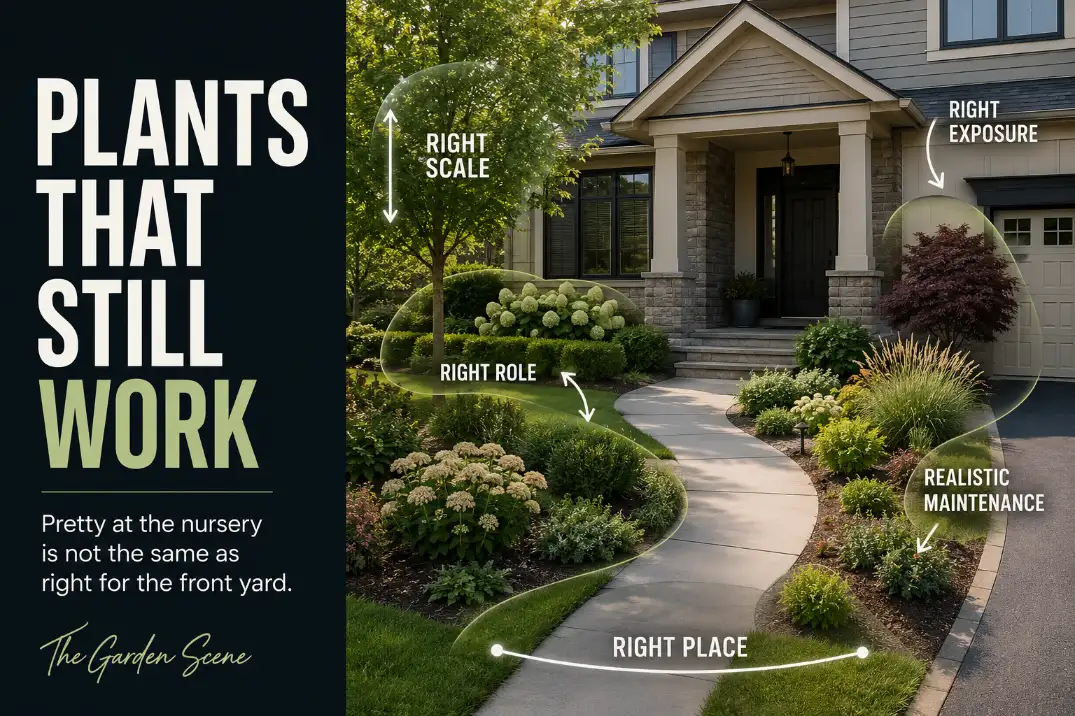
The weakest way to choose front yard plants is to start with plant names.
That is how front yards end up with shrubs that swallow the windows, grasses that lean into the walk, flowering plants that look bare for half the year, or “low-maintenance” beds that only stay neat with constant trimming. The plant may be attractive. The mistake is choosing it before the front yard’s job is clear.
A front yard is not just another planting bed. It is the public side of the house. It has to hold curb appeal, keep the entry readable, protect walkway and driveway clearance, fit the scale of the house, and stay presentable through normal maintenance lapses.
A better front yard plant choice follows this order:
- Decide the plant’s role.
- Read the site constraint.
- Check mature size and growth habit.
- Build structure and repetition.
- Match the plant to real maintenance capacity.
- Choose the plant only after those filters are clear.
That order prevents the most common front yard planting problem: buying for the plant’s best moment, then asking the yard to absorb its worst habits later.
Start With the Job the Plant Has to Do
A front yard plant should earn its place before it earns your attention. Its first test is not whether it flowers, stays green, or looks good in a nursery row. Its first test is whether it does the job that particular front yard position requires.
Near the front door, planting should support arrival. Along a walkway, it should guide movement without crowding the route. Against the foundation, it should soften the house without hiding windows, vents, steps, or porch details. At the curb, it may need to hold the front edge of the yard without turning into a visual wall.
That is why plants near the front walk have a different standard than plants tucked into a wide foundation bed. The front walk plant has to respect movement first. A foundation plant has to respect scale first. A curb-edge plant has to read clearly from the street first.
| Front Yard Role | Better Selection Filter | What To Avoid |
|---|---|---|
| Frame the entry | Upright or contained shape that keeps the door visible | Dense plants that compete with the front door |
| Soften the foundation | Mature height that fits below windows or between architectural lines | Shrubs that need constant shearing to stay in bounds |
| Guide the walkway | Low or controlled habit beside the route | Arching plants that spill into foot traffic |
| Hold the front edge | Repetition and clear massing from the curb | Random one-off plants scattered across the yard |
| Add seasonal interest | Color supported by structure | Plants that disappear visually after bloom season |
The front yard usually fails when every plant is chosen as an individual decoration. It works better when each plant has a role in the whole view.
The entry should stay in charge
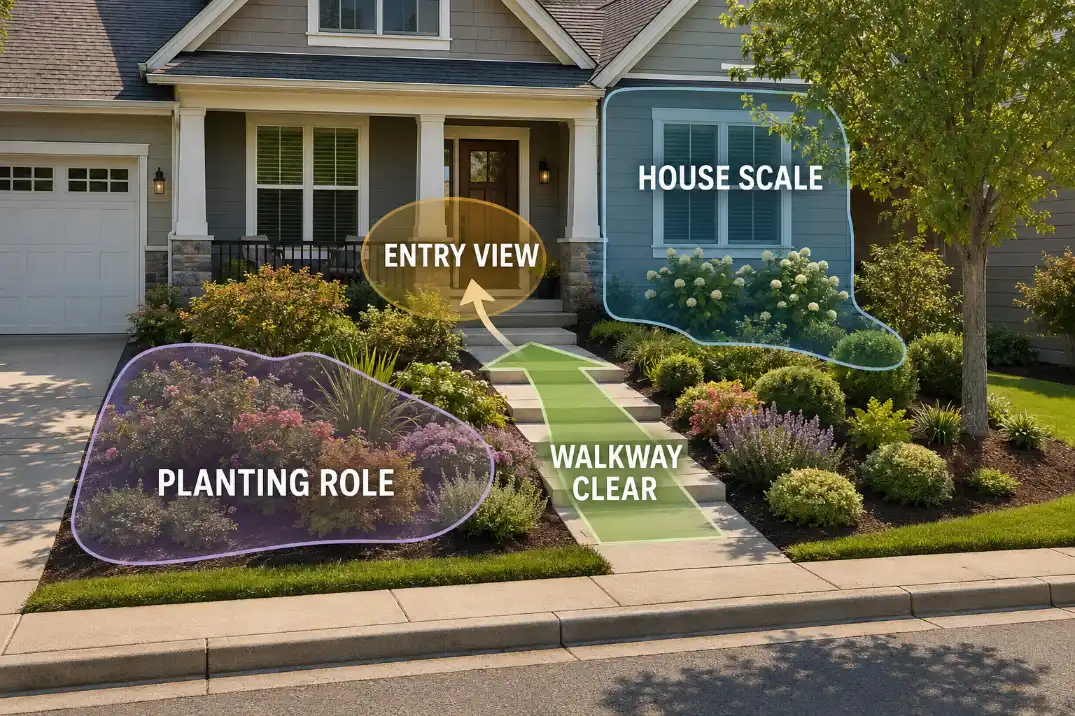
A common front yard mistake is letting planting become the focal point when the entry should still lead the eye. Tall, dense, or busy plants can make a front door feel hidden even when the yard looks full and healthy.
The best entry plants support the door instead of competing with it. They can frame, soften, or repeat the shape of the architecture, but they should not make visitors search for the route.
Movement needs more respect than color
Walkways and driveway edges are not leftover planting space. They are movement zones. A plant that leans, suckers, flops, or spreads into a walkway turns into a maintenance problem even if it is beautiful in bloom.
Before choosing a plant for any edge, picture its mature habit during its messiest season, not its best week.
Read the Front Yard Before You Read the Plant Tag
The plant tag is useful only after the site has already told you what matters.
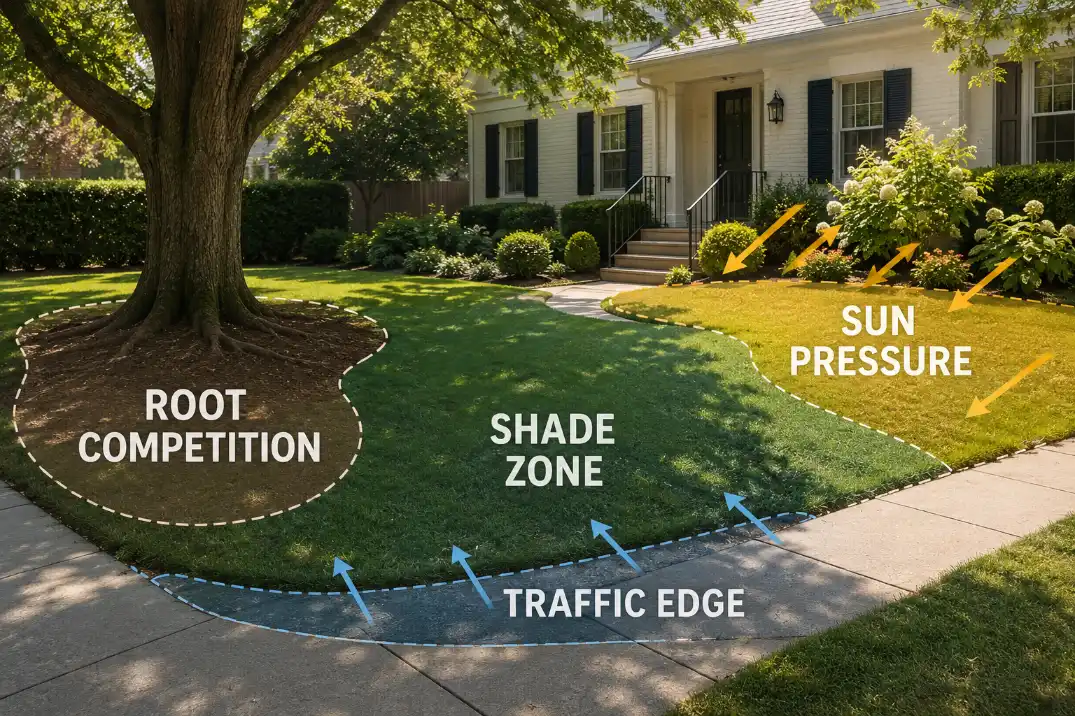
It does not know that the west side of your entry bakes in reflected afternoon heat. It does not know that your downspout keeps one bed damp. It does not know that tree roots have turned a planting pocket into thin, dry soil. It does not know that delivery drivers cut across the corner bed.
Before choosing plants, read the front yard as a set of pressures:
- Where does the strongest sun hit?
- Where does shade last most of the day?
- Where does water collect or disappear quickly?
- Where does the walkway, driveway, or sidewalk create heat?
- Where do roots, utilities, steps, railings, or porch posts limit space?
- Where do people actually walk?
This is not the moment to solve every condition in detail. It is the moment to identify which condition controls the choice.
A normal sunny foundation bed is one decision. A bed hit by harsh west sun and reflected heat is another. If that is the dominant issue, the plant choice should move into a more specific guide for front yard plants in blazing afternoon sun, not stay inside a general plant-selection list.
The same is true for shade. Light shade near a porch may still support a layered planting. Deep house shade along the foundation changes the plant palette, growth rate, bloom expectation, and moisture pattern. That kind of condition deserves its own decision path, not a quick sentence inside a parent guide.
The point is not to make plant selection complicated. It is to stop treating every front yard bed as if it has the same rules.
Choose for Mature Size, Not the Size You Buy
Nursery size is a snapshot. Mature size is the front yard decision.
A small shrub in a pot can look perfectly scaled beside a front walk. After a few seasons, the same plant may push into the route, cover the lower window line, or force you into a cycle of clipping it back every time it starts to look natural. That is not usually a maintenance failure. It is a selection failure.
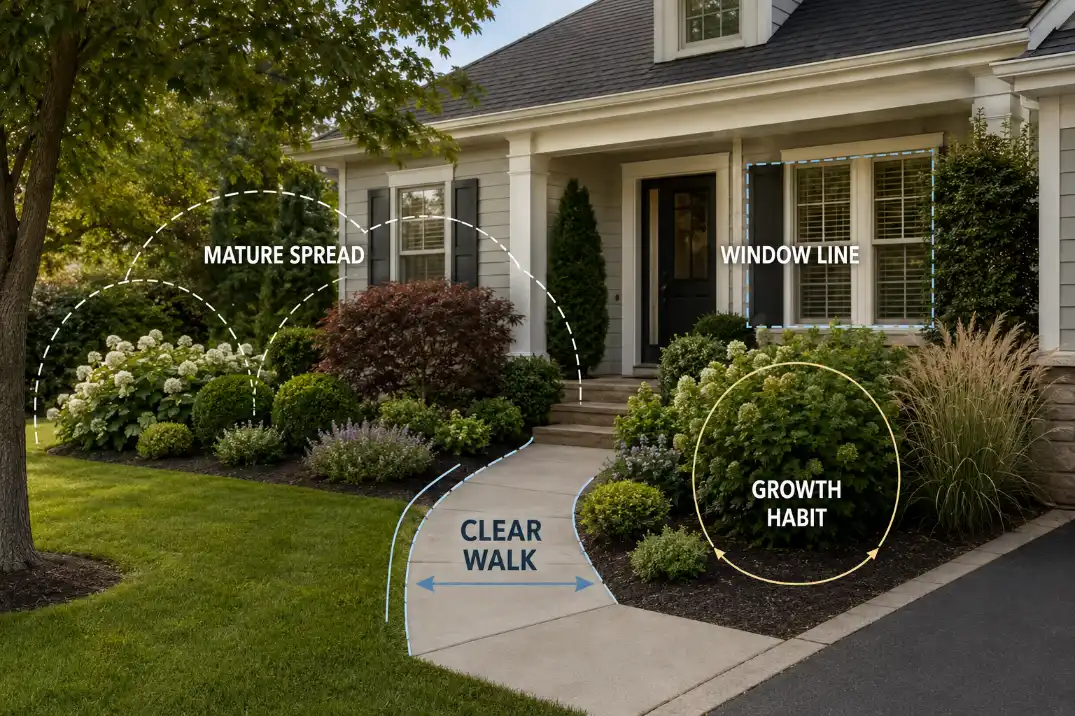
Mature height matters because the front yard has visual lines that should remain clear: windows, porch rails, steps, house numbers, lighting, and the front door. Mature spread matters because routes need breathing room. Growth habit matters because two plants with similar mature sizes can behave very differently.
An upright plant may fit beside a narrow entry better than a wide arching one. A loose plant may soften a blank wall but look messy near a formal walkway. A dense plant may create structure, but it can also block visibility. A low mounding plant may hold an edge, but it may not provide enough weight against a tall facade.
If a plant only works when you promise to prune it into a smaller version of itself forever, it probably does not fit that position.
Growth habit changes the decision
Do not judge only by height and width. Habit controls how the plant uses space.
A stiff upright shrub behaves differently from an arching shrub. A clumping grass behaves differently from a spreading groundcover. A plant with suckering roots behaves differently from a slow, contained mound.
A loose perennial may be fine inside a deeper bed, but irritating along a walkway where every floppy stem becomes a clearance issue.
Root behavior also matters at the parent level. If the front yard already has shallow roots, thin soil, or competition from mature trees, do not treat that as a normal bed. Use a more specific guide for front yard plants under tree roots and little soil when root pressure is the main constraint.
Clearance is part of curb appeal
A crowded front walk rarely looks intentional for long. It may photograph well in one season, but daily use exposes the problem: brushing past wet foliage, stepping around overgrowth, or trimming constantly to keep the route open.
For driveway edges, the same rule applies. Plants that interfere with car doors, sightlines, trash bin movement, or guest parking create friction. The front yard is allowed to be planted generously, but it should not make ordinary movement feel negotiated.
Build Structure Before You Chase Color
Color should be the reward, not the framework.
A front yard needs some structure when nothing is blooming. That structure can come from evergreen shrubs, compact woody forms, ornamental grasses with good winter presence, repeated low masses, or layered planting that still reads from the curb after flowers fade. The exact plant depends on the site, but the principle stays the same: color should ride on top of structure, not replace it.
Repetition matters here. A front yard filled with one of everything often looks busy from the street, even if every plant is attractive up close. Repeating a few forms gives the eye a pattern. It also makes seasonal plants feel intentional instead of scattered.
Think in layers rather than isolated favorites:
- A foundation layer to connect the house to the ground.
- A path layer to keep the entry route clear and legible.
- A low foreground layer to hold the bed edge.
- A limited seasonal layer for bloom, texture, or changing color.
- An accent only where the yard can afford a focal point.
This does not mean the front yard has to be formal. It means the planting should still have a readable order after the best bloom moment is over.
The sharper test is simple: if the flowers disappeared for two months, would the front yard still have shape?
Match the Plant to the Maintenance You Will Actually Keep
Maintenance is not a later chore in the front yard. It is part of the plant-selection filter.
A backyard bed can get a little loose before anyone notices. A front yard bed is seen by neighbors, visitors, delivery drivers, and anyone passing the house. That does not mean it has to be perfect. It means messy habits, constant trimming needs, seasonal collapse, or high water demand show faster in the front yard than they do in a private corner.
Low-maintenance is also not the same as no-maintenance. Some plants are low-care because they stay compact, match the site, and keep a stable form. Others are called low-maintenance only because they survive neglect, even if they spread, brown out, reseed heavily, or look tired near the entry.
Choose plants that match the level of care you will actually keep, not the level you imagine during a weekend redesign.
A plant that needs frequent deadheading may be fine in a small feature bed. A plant that drops heavy debris may be wrong beside a main walk. A shrub that needs repeated shearing to stay below a window is a poor fit, even if it is commonly used in foundation beds. A thirsty plant in a hard-to-water front strip is not low-maintenance just because it is popular.
The best front yard plant is not always the toughest plant. It is the one whose normal behavior still looks acceptable in the position you give it.
Use Specific Condition Guides Only When One Constraint Takes Over
A parent plant-selection framework should narrow the decision, not pretend every condition can be solved in one page.
If the front yard is dominated by intense afternoon exposure, reflected heat, or a west-facing wall, the main question is no longer “what looks good by the house?” It becomes whether the plant can handle heat, glare, dry soil swings, and visible stress. That is a different decision than a normal sunny bed.
If the bed sits in steady shade from the house, porch, or roofline, use a more focused path for plants for front yard house shade. Shade changes more than bloom. It changes density, growth speed, moisture behavior, and how much structure the planting can hold.
If people keep cutting across the front edge, the plant choice has to account for pressure, recovery, visibility, and edge control. A delicate plant in the wrong shortcut zone becomes a recurring repair. That is when a specific guide to plants for sidewalk shortcut pressure is more useful than a general front yard list.
Wind can also take over the decision. On open corner lots, exposed driveways, or yards with two street frontages, upright shape, flexible stems, anchoring, and winter exposure may matter more than flower color. In that case, route the decision through front yard plants for windy corner lots instead of forcing the general framework to do too much.
The parent rule is this: when one site condition controls survival, shape, or maintenance, use the specific condition guide. When no single condition dominates, use the full role-site-size-structure-maintenance filter here.
The Final Test Before You Choose a Front Yard Plant
Before choosing a front yard plant, test it against the yard it will actually live in.
- Does it have a clear role: entry frame, foundation layer, path edge, curb structure, screen, or seasonal accent?
- Will its mature height and spread still fit the window, walkway, driveway, porch, and entry sightlines?
- Does its growth habit match the position, or will it flop, sucker, arch, or spread into a problem area?
- Does it support the structure of the front yard when it is not blooming?
- Does it match the sun, shade, soil, water, root, wind, and traffic pressure of that exact spot?
- Can you maintain its normal behavior without constant corrective pruning, watering, cleanup, or replanting?
If the answer is weak on more than one of those points, the plant may still be good. It is just not good for that front yard position.
That is the real difference between choosing plants for a front yard and collecting plants you like. The front yard rewards plants that keep doing their job after the first season, after the first flush of flowers, and after the plant reaches the size it was always going to become.
For a neutral horticulture reference, University of Minnesota Extension explains that plant selection should account for site conditions such as soil, light, climate, space, and plant type in its guide to planting and transplanting trees and shrubs.