Last updated: June 29, 2026
A front yard feels different when the sidewalk acts like a school route, a park shortcut, a dog-walking loop, or the turn everyone takes on a corner lot. The problem is not one person passing by. It is the same line of movement repeating all day until the window, porch, or front walk starts to feel exposed.
That kind of privacy cannot be solved by simply adding more screening. A full hedge across the front can make the house feel boxed in, hide the entry, and still miss the exact view that bothers you most.
The better move is more selective: find the walking route, identify the repeated sightline, then interrupt that view without shutting down the whole front yard.
Why Busy Walking Routes Need a Different Privacy Plan
Occasional street exposure is broad. Busy walking route exposure is specific. People usually pass from the same direction, at the same pace, and with the same brief glance toward the house. That repeated pattern is what makes a front window, porch chair, or small lawn area feel less usable.
A school walking route may create short bursts of visibility in the morning and afternoon. A park route may be heavier on weekends.
A dog-walking loop often has slower movement because people pause near trees, corners, mailboxes, or driveway edges. A corner sidewalk can expose the yard from two angles instead of one.
That means the first decision is not “What privacy feature should I add?” It is “Which repeated view is actually making the yard uncomfortable?”
A front yard near a school, park, or bus stop may need a different privacy strategy than a yard facing general traffic, because pedestrians move slower and look from closer range.
For that specific pressure pattern, it helps to separate this article from broader front yard privacy problems near schools, parks, or bus stops instead of treating every exposed yard the same way.
What most homeowners miss:
The strongest privacy move is often not the tallest screen. It is the screen placed where the walking view crosses the living space. A 4-foot partial interruption in the right place can feel more useful than a taller barrier in the wrong place. Before choosing a fence, hedge, planter, or screen, stand where pedestrians actually walk and look back toward the house. That view tells you what needs to change.
Map the Walking Line Before You Add Screening
Start outside the yard, not inside it. Walk the sidewalk in both directions and notice when the house becomes visible. The important point may not be directly in front of the window. It may be 15 or 20 feet before the window, where a person naturally looks across the lawn while approaching.
Look for four route moments:
Where people first see in
This is the first point where a window, porch seat, or front yard activity area enters the pedestrian’s view. On a straight sidewalk, this may happen gradually. On a corner lot, it may happen suddenly as someone turns.
Where people slow down or pause
Privacy pressure is stronger where pedestrians stop. A crosswalk, curb ramp, bus stop, dog-walking pause point, school pickup path, mailbox area, or corner sign can create a longer view than a simple pass-by.
Where the view lines up with daily use
A front yard does not need privacy everywhere. It needs privacy where the walking line lines up with the living room window, porch chair, front step, package zone, or small seating edge.
When the route is busiest
Morning school traffic, afternoon pickup, evening dog walks, and weekend park use can expose different parts of the yard. If the window is only uncomfortable at night with interior lights on, test the view after dark before committing to a permanent screen.

For corner exposure, map both directions separately. A screen that works for a straight pass may fail when people turn and look diagonally across the yard.
A corner-lot situation often needs an angled interruption rather than a flat screen parallel to the house, which is why a more specific guide to front yard privacy on a busy street corner can become the better next step if the turn itself is the main problem.
Choose the View You Actually Need to Interrupt
Once you know the walking line, decide what kind of exposure you are trying to reduce. These are not the same problem.
A direct window view needs a more precise interruption. The screen must sit where it breaks the line from sidewalk eye level to the glass. If the sidewalk is only a few feet from the window, even a small mistake in placement can leave the view open.
A porch view usually needs softer privacy. You may not need to hide the porch completely; you may only need to reduce the feeling of eye contact when someone passes. A low foreground layer with a mid-height side interruption can make the porch feel more comfortable without making it feel closed.
A front-yard activity view is different again. If kids play near the front lawn, or you sit near the walkway in the evening, the privacy zone may need to protect a usable patch of yard rather than the house itself.
A pause-point view needs the most care. Someone walking by may only glance for a second, but someone waiting at a corner, tying a shoe, managing a dog leash, or standing near a bus stop can see into the same area for much longer.
If the real issue is a close sidewalk looking straight into the house, the route plan should stay narrower and more window-specific.
That is a different decision from broad curb appeal privacy, and it connects more closely with front yard privacy when the sidewalk runs only a few feet from your windows.
Match the Privacy Move to the Pedestrian Pattern
The right privacy move depends on how the pedestrian route behaves. Do not choose a screen by how it looks from the driveway. Choose it by what it does to the moving view.
Mini decision matrix:
Route pattern: Straight sidewalk pass
Main privacy pressure: Brief repeated glances across the lawn
Best layout response: A partial mid-height view break near the sightline, not a full front barrier
Route pattern: Corner turn
Main privacy pressure: Diagonal view across two exposed edges
Best layout response: Angled screening or staggered layers that catch the turn before the view opens
Route pattern: School or park rush route
Main privacy pressure: Heavy movement at predictable times
Best layout response: Durable, simple screening that protects the main window or porch without narrowing the entry walk
Route pattern: Dog-walking pause route
Main privacy pressure: Longer looks from trees, signs, corners, or curb pauses
Best layout response: Screen the pause-point view first, then soften the passing view second
Route pattern: Close sidewalk-to-window route
Main privacy pressure: Short-distance eye-level exposure
Best layout response: Tight, precise interruption between sidewalk and glass while keeping the window from feeling buried
Decision note:
A moving glance and a pause-point view should not get the same fix. If people only pass by, a partial side interruption may be enough. If people regularly stop near the curb, corner, or sidewalk edge, the screen has to work from that still point, not just from a walking angle.
The straight pass usually needs the lightest touch. A moving person does not study the yard; they catch openings as they pass. A partial screen can be enough if it interrupts the view at normal walking speed.
The corner turn is less forgiving. The person changes direction, and the view often widens. A flat hedge along only one edge may leave the diagonal view untouched.
The dog-walking route is slower. Here, a screen that works for a moving glance may not work from the pause point. If dogs regularly stop near a curb strip, utility pole, shade tree, or corner sign, test the privacy from that exact spot.
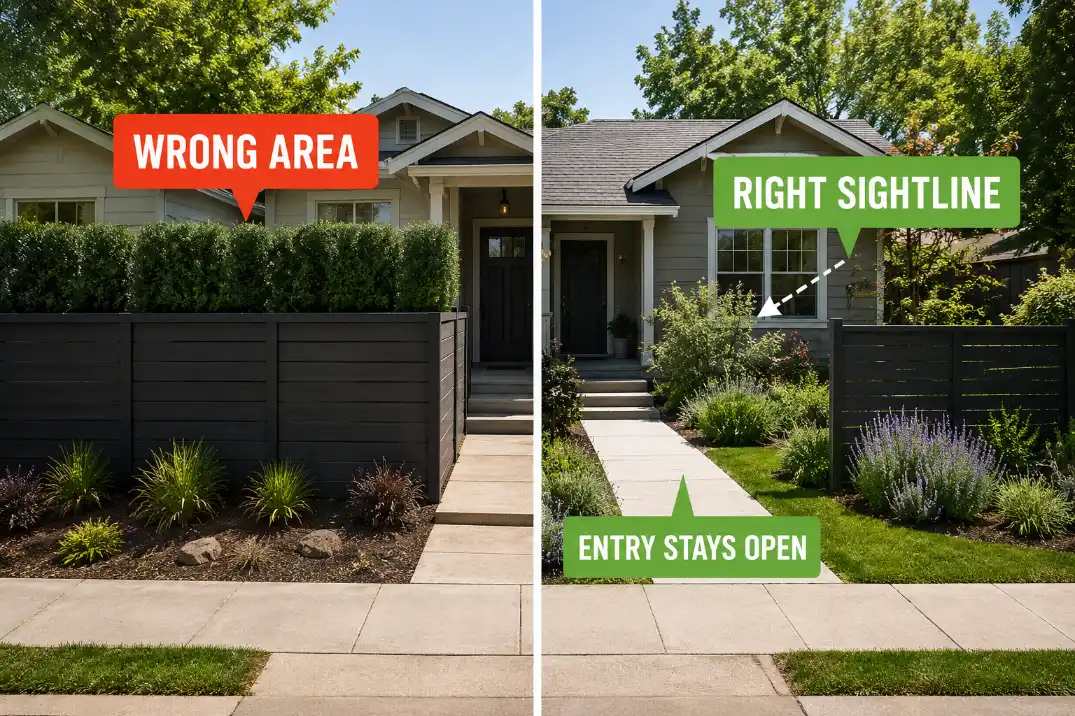
Keep the Entry Open While the Sightline Gets Blocked
A front yard has to do more than protect privacy. It still has to receive guests, deliveries, neighbors, emergency access, and daily movement from the driveway or sidewalk to the front door.
This is where many privacy fixes go wrong. They block the public-facing side so completely that the entry disappears. The yard may technically be more private, but it feels less welcoming and sometimes less safe.
Keep the front door readable from the main approach. Keep the walkway comfortable enough that visitors do not have to brush past shrubs, squeeze between planters, or step off the path. If a delivery driver naturally cuts across the lawn because the walkway feels hidden, the layout is working against the house.
A useful privacy screen should sit to the side of the route, across the sightline, or slightly forward of the exposed view. I
t should not turn the front walk into a tunnel. When the entry itself feels exposed, the better move is usually a targeted entrance solution, not a full yard barrier; that distinction matters in front entry privacy that does not feel closed off.
Common mistake box:
The most common mistake is treating the sidewalk like an enemy line and blocking everything along it. That can hide the front door, squeeze the walkway, and make the house feel defensive from the street. A busy route does not always require a continuous screen. It usually requires one or two well-placed interruptions where the pedestrian view crosses the window, porch, or sitting area. If the entry gets harder to read, the privacy plan has gone too far.
Use Layers Instead of One Hard Barrier
Layering works because a pedestrian view is not a flat photograph. It moves across the yard. A low layer near the sidewalk, a mid-height interruption set slightly back, and an offset screen near the exposed area can break the view without creating a wall.
The low layer defines the edge. It may be a low planting band, a low fence line, or a simple landscape edge that discourages shortcutting and softens the sidewalk-to-yard transition.
The mid-height layer does the privacy work. It should sit where it interrupts eye-level view from the walking line, especially toward the window, porch seat, or front-yard use area.
The offset layer adds depth. Instead of placing everything in one straight line, shift one element forward or back so the view breaks from more than one angle. This is especially useful where the sidewalk is close, the front yard is shallow, or the walking route comes from a diagonal direction.

This is also where front yard privacy can stay more natural. A single hard barrier often announces the problem.
Layering makes the privacy feel built into the yard. The article should not turn into a plant guide, but the placement logic is similar to front yard privacy layering without a fence: use depth and interruption before you rely on height.
The best layer is not always the tallest one. In a shallow front yard, a tall hedge close to the sidewalk can feel heavy and may create maintenance or visibility problems. A mid-height interruption set closer to the exposed window or porch may solve more with less mass.
Test the Layout at Walking Speed
Before installing anything permanent, test the screen zone from the route itself. Temporary markers are enough: garden stakes, empty planters, cardboard, trash bins for a few minutes, or a helper standing where the screen might go.
Use a short test sequence:
- Walk the sidewalk from the busiest direction at normal speed.
- Pause at the likely glance points, including corners, curb ramps, and dog-walking stops.
- Look toward the window, porch, or sitting area you want to protect.
- Mark only the zone that actually interrupts the view.
Then repeat the test at the time the problem happens. A front window that feels fine at noon may feel exposed at 7 p.m. when interior lights are on. A porch that feels open on a weekday morning may feel too visible during weekend park traffic.
Do not test only from inside the yard. From the porch, everything may feel exposed because you are looking outward. From the sidewalk, the actual view may be narrower. That difference is where a more selective privacy plan becomes possible.

A screen should pass three simple tests. It should reduce the repeated view from the sidewalk. It should leave the front entry easy to understand. It should still look reasonable from the street, not like an emergency patch added after the fact.
Where Other Front Yard Privacy Problems Split Off
A busy walking route is only one kind of front yard privacy problem. If the route test shows that the walking line is not the main pressure, move into the more specific problem instead of forcing this framework.
If the house sits very close to the sidewalk, the main issue may be short-distance window exposure. That needs a tighter sightline plan than a deeper suburban front yard.
If the front yard has almost no setback, the layout has to balance privacy with door visibility, curb appeal, and the risk of making the house feel crowded. That belongs closer to front yard privacy with no setback than to a broad walking-route plan.
If the porch is the uncomfortable area, focus on the seat angle, railing edge, side approach, and eye contact from the sidewalk. Porch privacy can often be solved with side interruption instead of a full front screen.
If the yard is a corner lot, treat the corner turn as the main design force. The view usually arrives diagonally, and a straight screen along one edge may not catch it.
If the homeowner mainly wants inspiration, broader front yard privacy ideas can help later. But on a busy walking route, ideas come after the route is understood. Otherwise the yard may gain more objects without gaining much privacy.
Build Privacy Around the Route, Not the Whole Yard
The best privacy plan for a busy walking route starts with movement, not materials. First, find where pedestrians actually pass, pause, and look. Then choose the view that matters most. Only after that should you decide where the screen, planting, fence section, or layered edge belongs.
When the layout is right, the yard does not have to disappear from the street. The front door can stay visible. The walkway can stay comfortable. The house can still feel neighborly. What changes is the repeated view that made the space feel exposed in the first place.
That is the standard to use before adding anything permanent: block the route’s view of the private zone, not the whole front yard.
For public sidewalk and accessible-route cautions, review the ADA Standards for Accessible Design.