Last updated: June 28, 2026
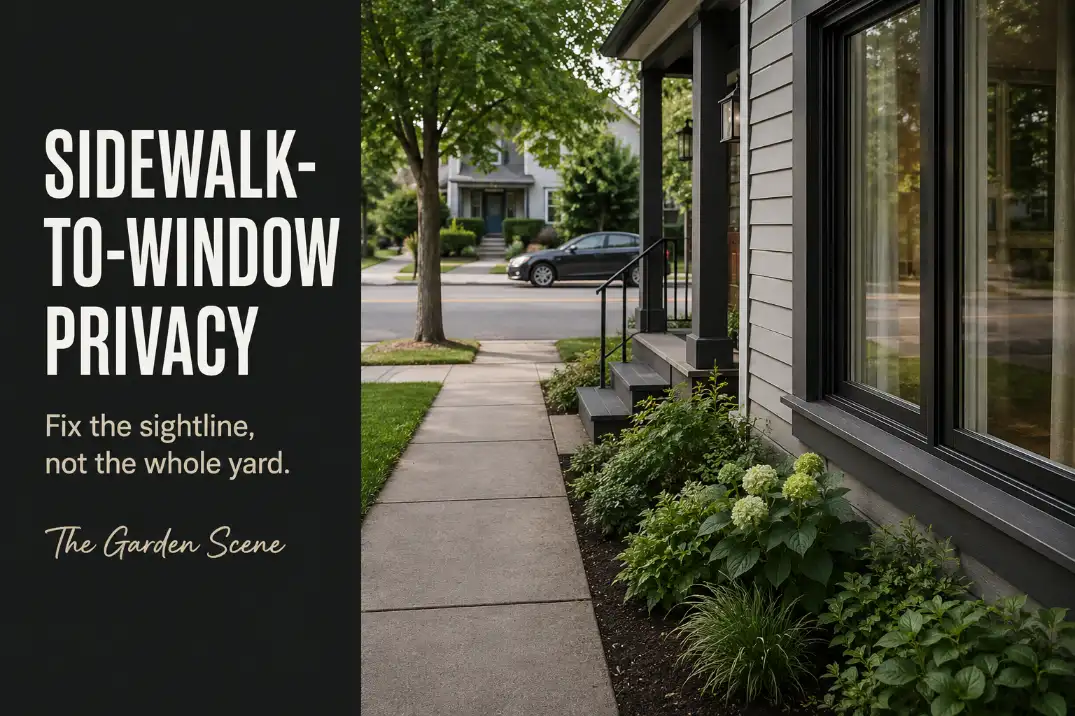
When the sidewalk sits only a few feet from your front windows, privacy fails faster than it does in a normal front yard. There is not enough depth for a wide layered planting bed to soften the view before it reaches the glass.
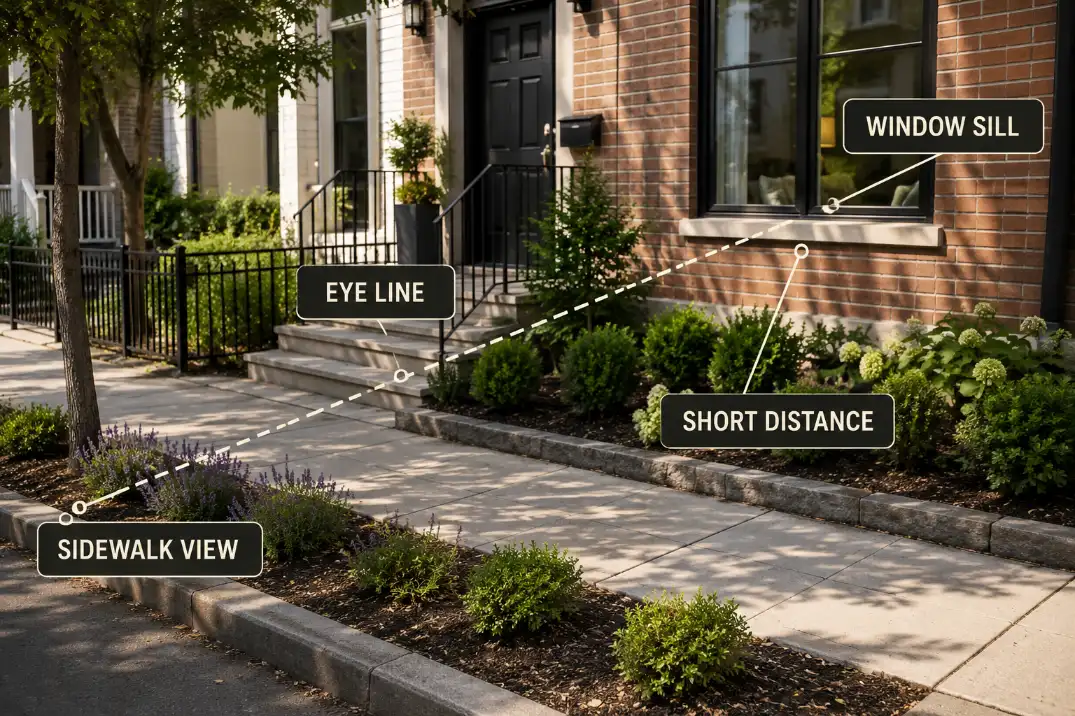
The real problem is the short sightline. A person walking past does not need to stop, lean, or stare. Their natural eye line can pass straight across the sidewalk edge, over a shallow planting strip, and into a low or mid-height window.
That is why a close-sidewalk yard can feel exposed even when it already has shrubs, mulch, porch details, or a neat front walk.
The fix is not always a taller hedge or a full fence. The better layout decision is to interrupt the pedestrian eye line at the right height, in the right short zone, without making the front door feel hidden or the entry path feel squeezed.
Why Close Sidewalk Privacy Fails So Quickly
A close sidewalk changes the privacy math because there is almost no viewing distance to absorb. In a deeper front yard, a pedestrian may be 20 or 30 feet from the window, so layered planting, lawn depth, porch railings, and angle can all reduce exposure. In a shallow front yard, the window may be only a few steps from the public walk.
That short distance makes low and mid-height windows especially vulnerable. If the sill sits near seated eye level from inside the home, someone outside may catch a clear view into the room even while walking at normal speed. The issue is not that the yard lacks landscaping. It is that the landscaping is often below the actual view path.
This is also why broad front yard privacy advice can miss the point. A general planting bed may improve curb appeal, but it may not cross the line between the pedestrian’s eyes and the exposed window.
If the larger issue is traffic, corner exposure, or constant street activity, it helps to separate this from broader front yard privacy problems on busy streets so the window sightline does not get buried inside a general privacy plan.
Quick diagnosis:
If someone on the sidewalk can see the lower half of the window without changing their pace, the first fix is usually not more planting across the whole front. It is a shorter, better-placed interruption across that one view path. The screen can be planting, a planter, a panel, or a low fence element, but it has to meet the sightline.
Start With the View Line, Not the Property Line
The first decision is where the exposure actually begins. Do not start by tracing the lot line or deciding where a fence would look symmetrical. Stand on the sidewalk and look toward the window from the places people naturally pass: directly in front of the window, near the front walk, near the driveway edge, and from the curb if parked cars or headlights matter.
The key question is simple: which part of the window is visible from normal walking height? If the lower half of the glass is the problem, a tall wall across the full frontage may be unnecessary. If the upper half is exposed from a raised sidewalk or sloped street, a low planting strip will not do enough.
Inside the home, sit where privacy matters most. A living room chair, desk, breakfast table, or sofa may sit lower than the window center. That seated indoor view matters because privacy is not just about what people outside can see; it is also about whether you feel watched while using the room.
For houses very close to the street, the better screen often sits slightly off the property-line instinct. A narrow panel or planting mass closer to the window may block the view more effectively than a thin line of shrubs along the sidewalk.
That same logic appears in front yard screening layouts close to the street, where the strongest fix is often a targeted interruption rather than a full-width border.
Check the angle, not just the distance
A window facing straight toward the sidewalk behaves differently from a window angled toward the front walk or driveway. If the view enters from the side, the screen may need to sit near the window edge rather than centered in the bed.
If the front porch rail, steps, or foundation planting already blocks part of the view, the missing piece may be only one open gap.
This is where many close-sidewalk yards get overbuilt. The homeowner sees exposure from one angle and responds by screening the entire frontage. A better read is to find the one or two narrow view corridors that actually reach the room.
Match the Screen Height to the Window Sill
Once the view line is clear, height becomes the next decision. The goal is not “as tall as possible.” The goal is “high enough to cross the pedestrian eye line before it reaches the useful part of the window.”
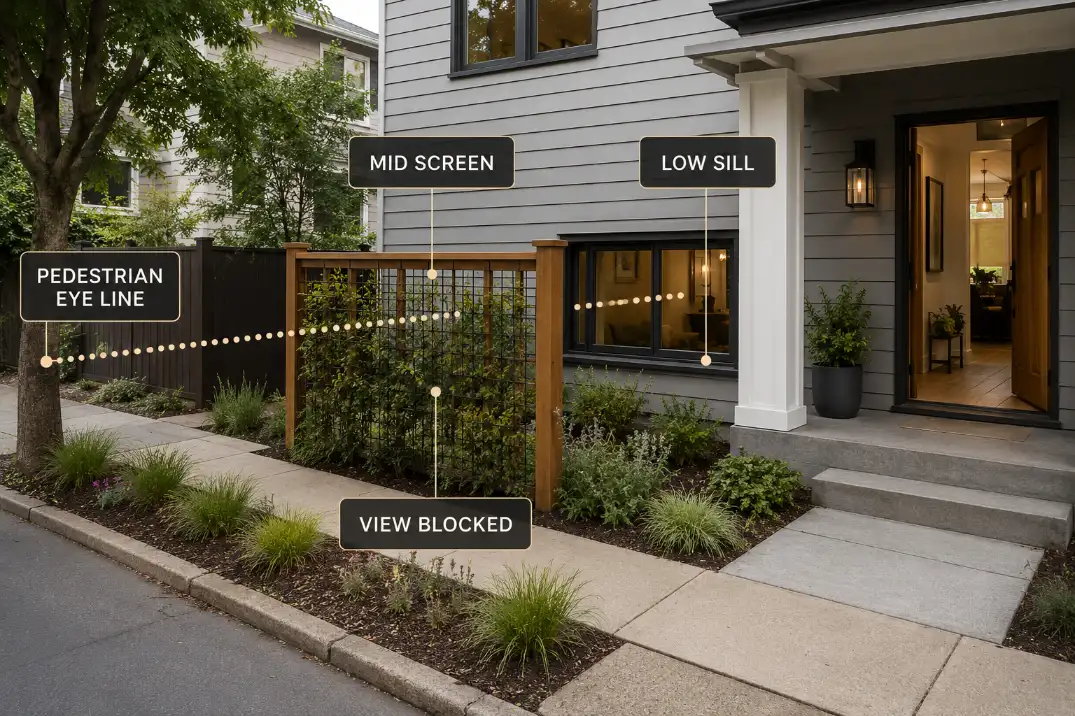
A low sill usually needs a mid-height interruption, because the outside view can enter below standing eye height and still reach the room. A raised sill may only need lower planting or a planter mass to soften the lower view. A window partly protected by a porch, rail, or deep trim may need a side interruption more than a tall front screen.
| Sidewalk/window condition | Better layout response | Watch for |
|---|---|---|
| Low sill near sidewalk | Mid-height screen close to the view line | Do not hide the whole window |
| Mid-height sill | Layered low and mid planting | Avoid a hedge that swallows the walk |
| Raised sill | Lower planting or partial planter mass | Do not overbuild for a view that is already reduced |
| Angled sidewalk or driveway view | Offset screen near the exposed side | Do not center the fix in the wrong place |
A taller screen can create a different problem: it may make the front room darker, make the entry feel defensive, or block the door from the street. That matters in a U.S. front yard because the entry still has to read clearly for visitors, deliveries, and everyday use.
Mini decision matrix
| If the window has… | Match it with… | Avoid… |
|---|---|---|
| A low sill and direct sidewalk view | A mid-height interruption across the lower glass | Only low flowers or mulch |
| A mid sill and shallow strip | Layered planting with one stronger vertical mass | A thin hedge line that needs constant trimming |
| A raised sill | Lower planting that softens the base | A tall screen that blocks light for no reason |
| A side-angle view from the walk | An offset panel, planter, or shrub group | Centering everything under the window |
Use the Narrow Strip Without Letting It Take Over the Entry
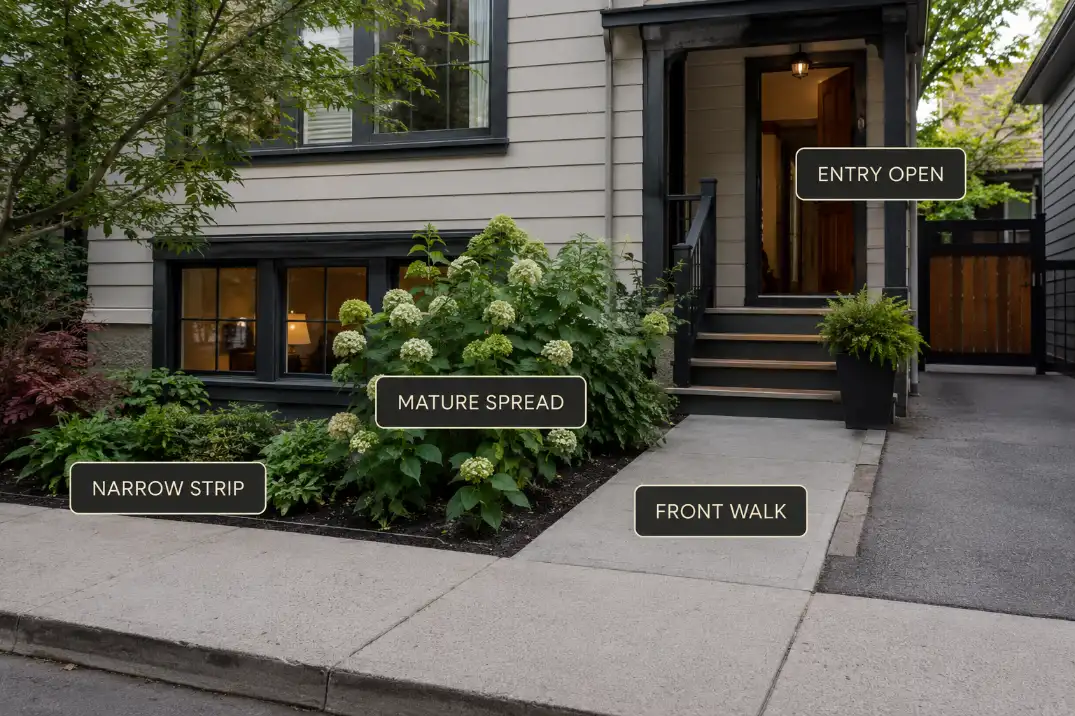
The narrow strip between sidewalk and window is usually the hardest part of this layout. It feels like the obvious place to add privacy, but it may not have enough depth for a mature shrub, planter, or screen without crowding the front walk.
Before choosing anything, mark the mature spread, not the nursery size. A shrub that looks narrow in a pot can lean into the sidewalk, cover the window, or crowd the path after a few seasons. A planter that seems modest in an online photo can feel bulky once it sits beside a small porch or short walkway.
If your planting space is truly tight, use the same logic you would use for narrow sidewalk strip layouts under 3 feet: the strip has to handle heat, foot traffic, edge pressure, and maintenance access before it can become a privacy zone. In a privacy layout, that means the screen must work without stealing the entire strip.
Protect the front walk first
The front walk is not leftover space. It is the route for visitors, packages, groceries, kids, pets, and daily entry. If the privacy fix makes people step sideways, brush against plants, or walk too close to the window, the layout has traded one discomfort for another.
Leave the door visually open from the street. A close-sidewalk yard can still feel welcoming if the privacy element protects the window while leaving a clear path to the entry. The front door, house number, steps, and landing should not disappear behind a hedge or screen.
Layout note:
A privacy screen that works only from inside the living room can still fail outside. Walk the route like a delivery driver, a guest, and someone carrying groceries. If the screen makes the entry feel like a side passage instead of the front door, it is too deep, too long, or placed too close to the walk.
Respect the driveway and curb edge
If the window sits near a driveway, the privacy element also has to avoid car-door swing, driveway sightlines, and the moment where a visitor steps from pavement to walk. A screen that works from inside the house may still be wrong if it makes backing out, walking around a parked car, or reaching the front door feel awkward.
Planter depth matters here. A deep rectangular planter can be useful when the strip is too narrow for in-ground shrubs, but it still needs stable placement and enough room around it. A planter that blocks the sightline but pinches the walkway will feel like a temporary obstacle, not a finished privacy solution.
Choose the Smallest Privacy Interruption That Blocks the Line
Once the view line, height, and strip depth are clear, choose the smallest element that does the job. That may be a partial planting group, a tall planter, a short section of low fence, a lattice panel, or a layered screen beside the exposed window edge.
A targeted window screen works best when the exposure is concentrated on one room. It does not need to run across the entire frontage. It only needs to interrupt the line between sidewalk eye height and the part of the window that feels exposed from inside.
Layered low and mid planting works when you have enough depth for plants to mature without leaning into the walk.
The lower layer softens the base, while one stronger mid-height element interrupts the view. This is not the same as filling the whole bed with shrubs. The mass should be placed where the line crosses, not where the bed happens to be widest.
Planters can help when the ground strip is too narrow, too root-filled, or too close to concrete for a comfortable in-ground solution.
The best use is targeted and stable: one or two planters that lift screening material into the view line without turning the entry into a maze.
For tighter frontage, privacy planters for front yards and patios can support the layout, but the planter still has to fit the walking route before it earns a place.
A small fence or panel makes sense when planting alone cannot cross the sightline quickly enough. Keep it partial, intentional, and tied to the window rather than stretched across the full front by default.
Common mistake: screening the frontage instead of the view
The most common overcorrection is building privacy along the whole sidewalk edge because the window feels exposed. That can make the house feel boxed in while still leaving the original view line open through the wrong gap.
In a close-sidewalk yard, the best screen may be shorter, offset, and closer to the window than expected. Test the view from the sidewalk before extending anything across the full front.
When a Full Front Barrier Makes the Yard Feel Worse
A full front barrier can solve one kind of exposure while creating several new layout problems. It can hide the front door, make the walk feel narrow, block house-number visibility, and turn a small front yard into a closed edge instead of an entry space.
This matters most when the sidewalk is already close. A hedge or fence at the front edge may feel visually heavy because there is no lawn depth between the barrier and the house. What looks like privacy from the street can feel like enclosure from the porch and living room.
If the front entry already feels tight, use the privacy fix to protect the window while keeping the door readable. A home can have window privacy without looking shut down, especially when the screen stops before the walk, steps, or porch opening.
That same balance is the core issue in front entry privacy that is not closed off, where the door still needs to feel like the main route into the house.
The difference is privacy versus blockage. Privacy interrupts a specific view. Blockage closes the whole front. In a shallow yard, that distinction matters more because every foot of space is visible and every object sits close to the house.
A Simple Test Before You Plant or Build
Before planting shrubs or installing a panel, create a temporary version of the screen. Use cardboard, stakes, a folding screen, empty planters, or even a trash can and broom handle to mark the height and location. It does not need to look good. It only needs to show whether the view line is actually interrupted.
Walk the sidewalk at normal speed and glance toward the window. Then sit inside the room where privacy matters. If the temporary marker blocks the uncomfortable lower view without hiding the whole window, the height is probably close. If you still feel exposed from inside, the screen may be too low, too far to the side, or placed along the wrong line.
Test the entry at the same time. Carry a package, walk from the driveway, approach the door, and check whether the temporary screen makes the front route feel awkward. Close-sidewalk privacy should not make daily movement feel like squeezing past an obstacle.
If evening exposure is part of the problem, repeat the test with interior lights on. A window that feels private during the day can become visible after dark, especially when the room is lit and the sidewalk is dim. If headlights sweep across the window from the street or driveway, check that angle separately rather than assuming the daytime screen solves it.
Where This Fits in a Larger Front Yard Privacy Plan
This article solves one specific condition: a sidewalk close enough to create a short view line into front windows. If that is the main problem, the strongest fix is usually a targeted screen matched to sill height and entry access.
A broader front yard privacy plan becomes useful when the exposure comes from several directions at once: street traffic, driveway visibility, porch seating, corner-lot angles, neighbor windows, or a house with almost no setback.
In those cases, a close-window screen may be one layer inside a wider strategy for front yard privacy with no setback.
Privacy landscaping also deserves its own planning when plant selection, mature width, pruning, climate, deer pressure, or HOA limits become the main decision. For this close-sidewalk window problem, do not start there. Start with the line of sight, then choose the smallest privacy interruption that crosses it.
In a shallow front yard, the best privacy fix is not the biggest barrier. It is the most accurate one: a well-placed screen that breaks the pedestrian eye line while leaving the entry open, the window usable, and the front of the house believable.
For public sidewalk and right-of-way limits, review the U.S. Access Board’s Public Right-of-Way Accessibility Guidelines before adding anything near a sidewalk.