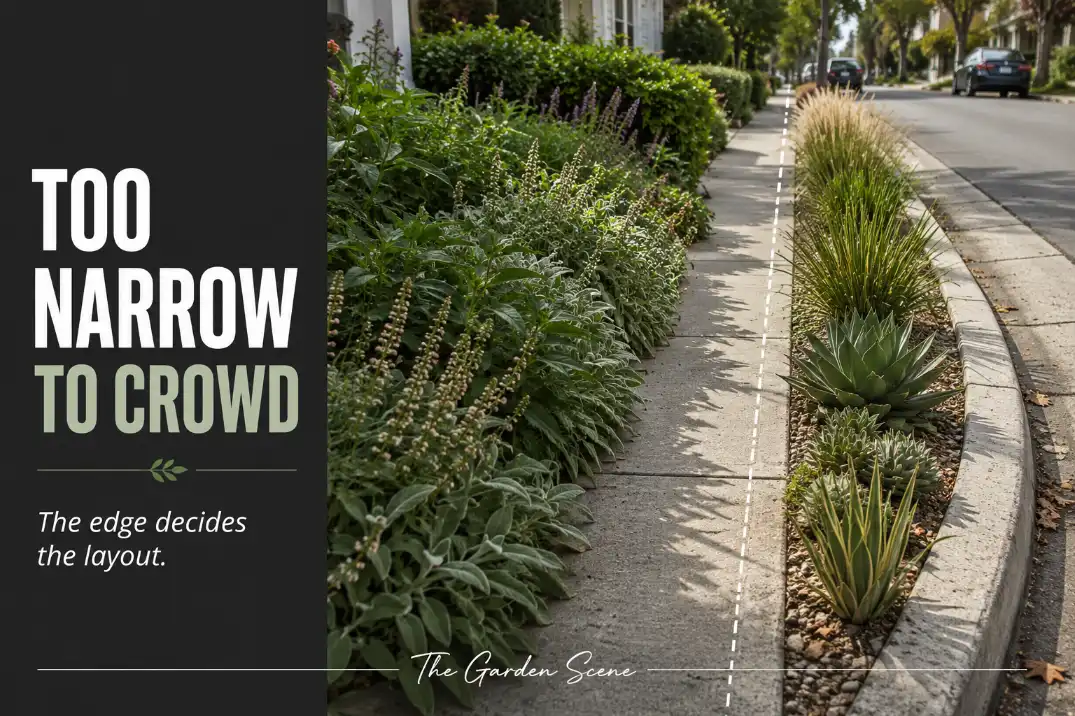
A sidewalk strip under 3 feet wide should be designed by usable width, not by the full soil strip between sidewalk and curb.
The first checks are simple: how much clear edge the walkway needs, how wide the plants will be at maturity, and where people already step through from parked cars, mailboxes, driveways, or trash-bin routes.
A 34-inch strip can quickly become an 18- to 24-inch planting zone once a real sidewalk buffer and curb stress zone are accounted for.
This is different from a normal front bed. In a narrow sidewalk strip, the visible symptom may be messy plants, kicked mulch, or bare patches.
The underlying mechanism is usually edge conflict. If the strip needs trimming every 2 to 3 weeks just to keep the sidewalk open, the layout is too crowded, not merely under-maintained.
When the Strip Is Too Narrow
Use the working width, not the tape-measure width
The biggest mistake is treating every inch of bare soil as plantable. A narrow strip has three jobs at once: protect the walkway edge, survive curbside abuse, and still leave room for plants to mature. Once those pressures are counted, the useful planting space is usually much smaller than it looks.
As a practical rule, strips under 18 inches of usable width should stay mostly low, open, or pad-based. From 18 to 24 inches, a single low plant band is usually safer than a layered design.
From 24 to 30 inches, you can begin separating a low sidewalk edge from tougher curb-side pockets. Once the strip approaches the full 30 to 36 inches, a controlled two-band layout becomes more realistic.
That does not mean filling every inch. It means the strip finally has enough room for hierarchy.
What fails first is usually the edge
Plant death is not always the first sign of a bad layout. The earlier warning sign is often sidewalk interference: stems lean into the walking path, mulch gets kicked onto concrete, or pedestrians cut through the weakest spot. Once that begins, the strip looks neglected even if the plants are technically healthy.
A cleaner layout starts with the edge, then chooses plants. For plant choices that can handle this exact exposed curbside environment, Best Plants for a Sidewalk Street Strip is the better next step after the layout width is measured honestly.
Check Rules, Utilities, and Soil Before Planting
Do not skip the right-of-way layer
Sidewalk strips often sit in a public right-of-way, even when homeowners maintain them. Local rules may limit plant height, block thorny plants, restrict hardscape, or require clear access around utilities, hydrants, signs, and driveways. I
n some neighborhoods, anything near curb corners, alleys, or driveway exits needs extra visibility clearance.
This matters more in a narrow strip because there is less room to correct a mistake later. A plant that would be harmless in a front foundation bed can become a violation or hazard when it leans over a sidewalk or blocks a driver’s view.
Test compaction before adding plants
Curb strip soil often behaves differently from normal garden soil. It may be compacted by foot traffic, construction fill, road work, repeated drying, and years of shallow maintenance.
If a trowel or long screwdriver barely enters the top 3 to 4 inches after watering, keep the layout simpler until the soil is opened.
For small plant pockets, loosen the soil wider than the root ball, not just deeper. Fixing only the planting hole can leave a soft wet pocket surrounded by hard soil, which is one reason “tough” plants sometimes fail in narrow strips.
Where compaction is severe, the layout should rely on fewer planting zones, tougher plants, and stable access points instead of dense planting.
Pro Tip: If water sits on the strip for more than 10 to 20 minutes after normal watering, fix compaction and surface flow before adding more plants.
Keep the Walkway Edge Clear
Leave a working buffer
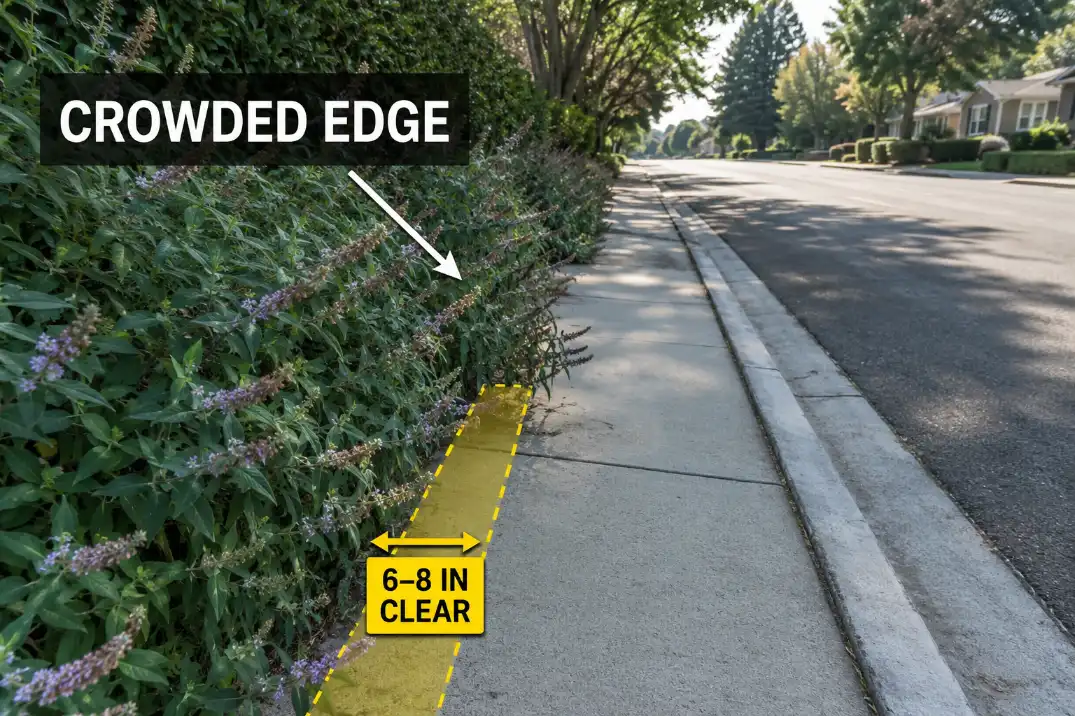
The sidewalk-side buffer should usually be about 6 to 8 inches. It can be low mulch, tight groundcover, flat edging, or a narrow stepping surface, but it should not be filled with floppy stems. A 2-inch visual gap often disappears after spring growth, summer irrigation, or one heavy rain.
This is where many attractive layouts fail. They look balanced right after planting because the plants are small. By month 3 or 4, the mature spread starts using the sidewalk as overflow space.
Constant pruning is the wrong fix when the plant’s natural width is too large. If more than one-third of the plant has to be cut back repeatedly to keep the walkway open, replacement makes more sense than maintenance.
Loose material needs the same discipline. Gravel or mulch that sits level with the sidewalk is easy to kick, wash, or sweep out. If the surface is already escaping, Sidewalk Strip Mulch and Gravel Control fits the same failure pattern from the material side.
Match the layout to the usable width
| Usable strip width | Best layout choice | What usually fails |
|---|---|---|
| Under 18 inches | Groundcover, mulch, or stepping pads | Shrub rows or mixed borders |
| 18–24 inches | One low plant band | Two-layer planting |
| 24–30 inches | Low sidewalk edge with tougher curb pockets | Wide, floppy perennials |
| 30–36 inches | Controlled two-band layout | Dense cottage-style planting |
| Heavy crossing traffic | Planned 18–24 inch access gap | Replanting the same crushed spot |
Low Plants Near the Sidewalk
Keep the softest growth closest to people
The sidewalk edge should get the lowest, softest, most forgiving plants. Compact groundcovers, low sedges, creeping thyme where climate allows, and small clumping perennials usually make more sense than shrubs or tall grasses near the walking edge.
Height is only part of the decision. Texture matters too. A stiff, scratchy, thorny, or seed-heavy plant can feel intrusive even if it stays fairly short.
The healthier condition is a strip where pedestrians can pass without brushing foliage. The failing condition is a strip where people drift away from the plant edge and gradually wear a dirt path beside it.
Low does not mean delicate
Plants near concrete still face reflected heat. In hot-summer regions, pavement can make the strip feel 10 to 20°F hotter than nearby lawn or shaded beds during the afternoon.
In northern states, the same edge may face freeze-thaw cycles, shoveled snow, salt residue, and gritty winter debris.
That is why the sidewalk-side layer should be low but not fragile. The goal is not a soft garden-bed look. It is a compact edge that stays clean after heat, rain, and routine use.
Tougher Plants Belong Near the Curb
Put the abuse-tolerant layer outside
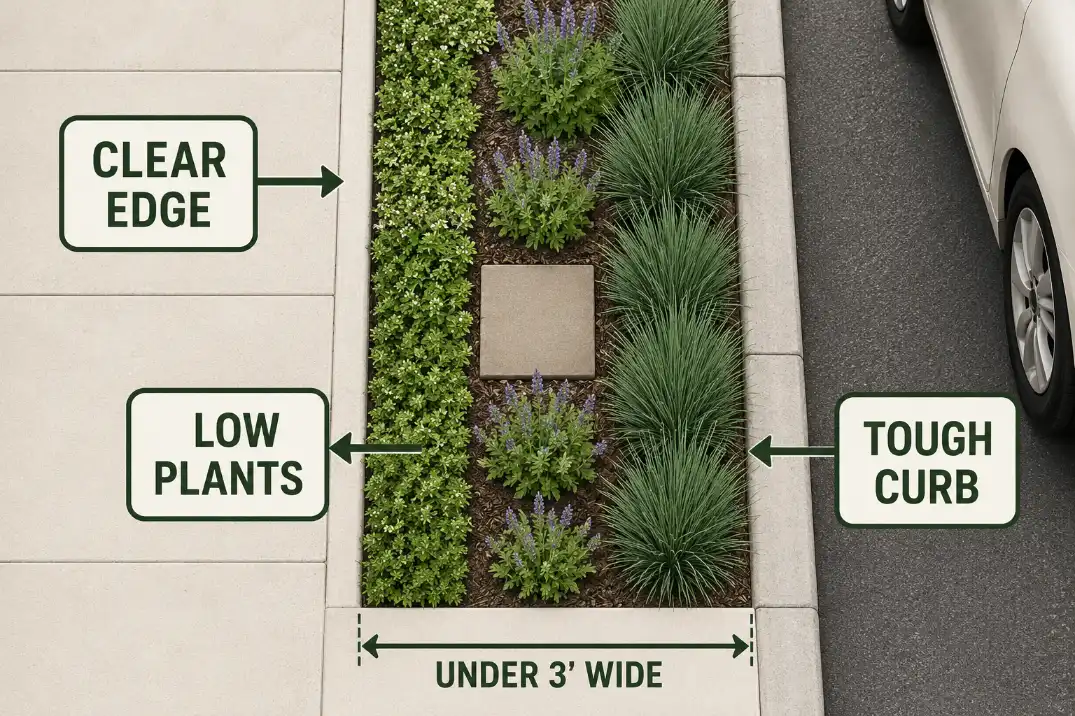
The curb side gets the harder treatment: splash, road grit, dog traffic, car-door bumps, dry reflected heat, and sometimes winter salt. If the strip is wide enough for two zones, tougher plants belong closer to the curb, while lower and cleaner plants belong near the sidewalk.
That does not mean tall shrubs along the street. In a strip under 3 feet wide, curb-side plants should still be compact. A mature height around 12 to 24 inches usually gives enough presence without turning the strip into a wall or a trimming problem.
It is tempting to blame the plant when the curb-side row struggles. More often, the plant was placed in the wrong pressure zone. If it would perform better 12 inches farther from the curb, the issue is exposure, not plant quality.
Small Access Gaps
Design the crossing before people make one
A narrow strip needs at least one intentional access gap if people step from curb to sidewalk, unload cars, reach a mailbox, move bins, or cross from a driveway.
The gap does not need to be large. An 18- to 24-inch stepping point is often enough for one person to pass without crushing plants.
This is easy to underestimate because the strip looks decorative, but it sits between movement zones. If there is no planned crossing, the weakest plant or loosest mulch becomes the crossing.
Where people already cut through the planting, replacing the same damaged plant is usually wasted effort. A small stepping pad, gravel crossing, or deliberate open break works better than replanting a spot that still receives traffic.
If that traffic is the main problem, Front Yard Plants for Sidewalk Shortcut Traffic helps separate plant failure from route failure.
Keep gaps stable without creating runoff
Access gaps should be firm enough to step on but not raised so high that they shed water onto the sidewalk. In rainy Midwest or East Coast conditions, a compacted shortcut can become a small runoff channel after repeated storms.
If water runs across the strip instead of soaking in within about 10 to 20 minutes after normal irrigation, the layout may need better soil opening, smaller plant pockets, or a more stable pad.
When water is the recurring failure, How to Water a Sidewalk Strip Without Runoff is more useful than simply changing plant varieties.
Simple Layouts That Do Not Crowd
Use fewer plant types than the strip seems to invite
The best layouts under 3 feet wide are usually simpler than homeowners expect. A narrow strip does not need five plant types. It needs one clear edge strategy, one durable planting rhythm, and one access solution.
A strong layout might use low groundcover along the sidewalk, compact perennials toward the curb, and one stepping pad where people naturally cross.
Another might use mulch around small plant clusters with gravel only in a contained curb-side band. A third might skip planting at the narrowest pinch point entirely.
In a strip under 3 feet wide, adding plant variety often makes the layout weaker, not richer. More plants do not fix a layout that lacks room. More mulch does not fix a strip that is already level with the sidewalk.
A taller plant does not create structure if its mature width is wrong.
Stop rescuing the same failure point
A routine fix stops making sense when the same 4-foot section keeps needing repair every season. If you are re-edging, re-mulching, trimming, and replanting the same spot, the strip is telling you where the layout is wrong.
Use this final check before planting: if the curb side dries out within 24 to 48 hours while the inner soil stays damp, choose tougher curb-side plants.
If mulch or gravel reaches the sidewalk after every storm, fix containment before changing plant varieties. If people cross the same spot twice a week or more, make that route intentional.
In hot, high-traffic sidewalk strips, maintenance pressure often builds faster than plant growth problems. Sidewalk Strip Maintenance for Heat and Traffic connects the same layout choices to the upkeep side.
Questions People Usually Ask
Can shrubs work in a sidewalk strip under 3 feet wide?
Only very compact shrubs make sense, and even then they need careful placement. If the mature width is over 24 inches, the shrub will usually crowd either the sidewalk or curb unless the strip is close to the full 36 inches and lightly used.
Is gravel better than plants in a very narrow strip?
Gravel can work when it is contained and not used as a loose walking surface. It becomes a problem when it sits level with the sidewalk, spreads into the gutter, or replaces a needed access pad without actually creating stable footing.
How much empty space should a narrow strip have?
More than most people expect. In a strip under 3 feet wide, empty space is not wasted space. It is what keeps the planting usable, walkable, and maintainable after the first growing season.
Final Takeaway
A narrow sidewalk strip works best when it is designed from the edges inward. Protect 6 to 8 inches near the walkway, put tougher plants near the curb, choose mature widths smaller than the available space, and add access gaps where people already move.
The winning layout is not the fullest one. It is the one that still looks intentional after heat, rain, foot traffic, and a full growing season.
For broader curb-strip planting guidance, see Nebraska Extension.