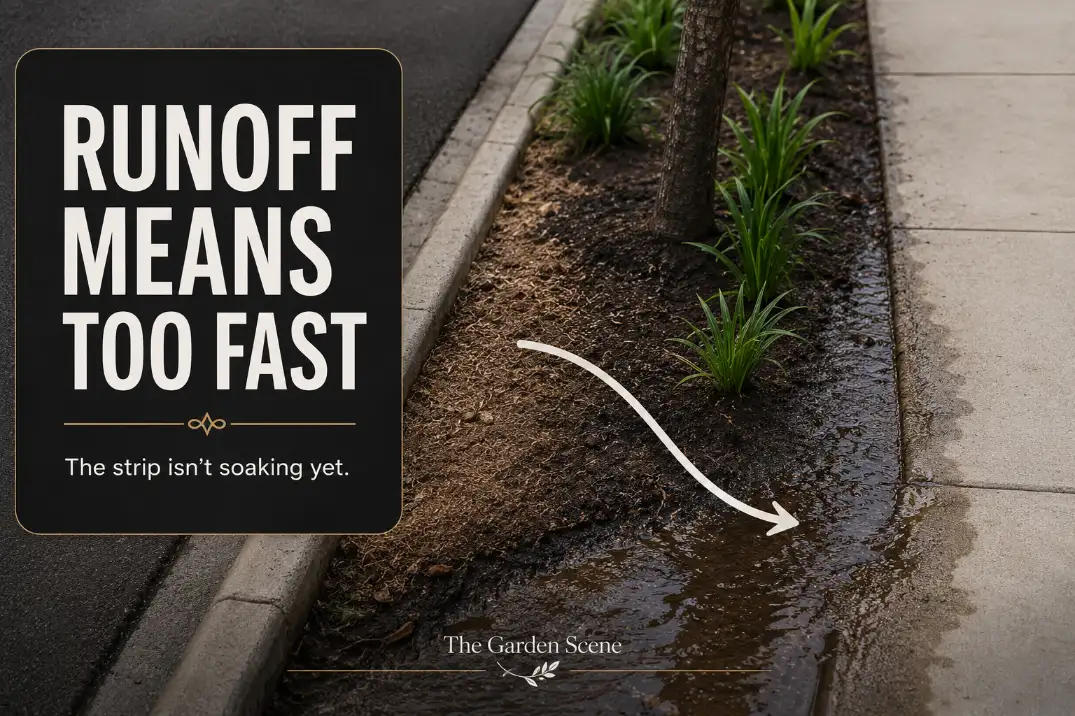
A sidewalk strip usually runs off because water is being applied faster than the soil can absorb it, not because the plants simply need more water.
The first useful checks are timing and depth: does water reach the sidewalk or curb within 3 minutes, does the surface look wet while soil 4 inches down stays dry, and does the curb-side edge wilt again within 24 hours?
Those signals point to shallow watering, compacted surface soil, poor aim, or a strip that is drying from both hot pavement edges.
The fix is slower delivery, shorter cycles, better placement, and a quick moisture check after watering.
A healthy watering pass should darken the top 1–2 inches without crossing onto concrete, then leave useful moisture in the 4–6 inch root zone after the water has had time to soak.
Quick Runoff Test Before You Change Anything
Time the first escape
Start watering the strip at the flow rate you normally use. If water reaches the sidewalk, curb, or gutter in under 3 minutes, the application rate is too fast for that soil. Adding more minutes will mostly increase waste.
If water stays inside the strip for 8–10 minutes without puddling, the delivery rate is closer to useful. That does not prove the roots are watered, but it means the surface is at least accepting water instead of shedding it.
Check depth, not just color
Wait 20–30 minutes after watering, then push a screwdriver, soil probe, or narrow trowel into the strip. If the tool stops hard at 1–2 inches while the surface still looks damp, the problem is infiltration. If the soil is damp 4–6 inches down near the plants, the watering reached the active root zone.
That distinction matters because the surface can lie. Mulch, fine dust, and compacted crust can look wet after a quick hose pass even when the plant roots remain dry.
Why Narrow Strips Dry Unevenly
The strip has two hot edges
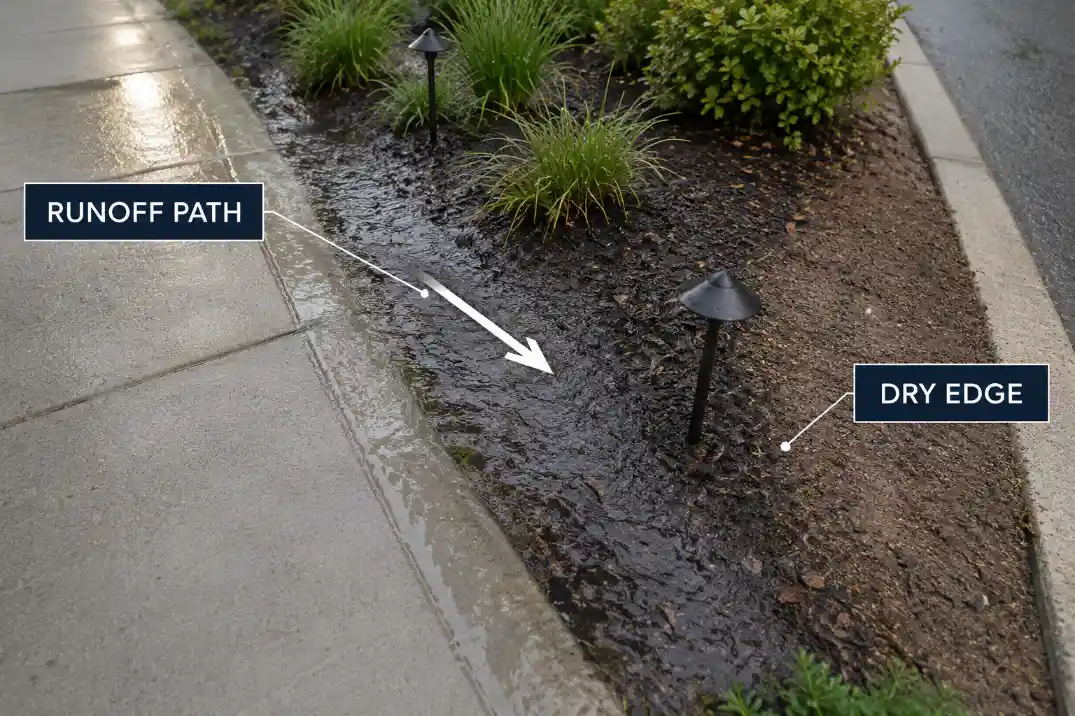
A sidewalk strip is not watered like a normal planting bed. It is exposed to heat from the curb on one side and reflected light from the sidewalk on the other.
In hot dry regions such as Arizona or inland California, the pavement edge can dry the root zone faster than the middle of the strip. In humid regions, the strip may not look as dry, but shallow watering can still leave roots stressed below the surface.
This is why the curb-side edge often fails first. It is not always a plant failure. It is usually a water placement problem combined with heat load. On a 24–36 inch strip, a few inches of spray error can put a large share of the water on concrete instead of soil.
When the same strip also takes foot shortcuts, dog traffic, or trash-day pressure, the watering problem gets worse. Compacted soil accepts water more slowly, and the worn path becomes a small runoff channel.
That is where Sidewalk Strip Maintenance Ideas for Heat and Foot Traffic supports the bigger maintenance pattern: watering only works well after the strip’s stress zone is understood.
The symptom is brown growth; the mechanism is shallow moisture
The visible symptom is often a brown edge, wilting plant, or mulch that dries out by afternoon. The underlying mechanism is usually shallower: water is not reaching the depth where the roots can use it.
A strip that looks wet for 10 minutes but dries hard by evening is not being deeply watered. A strip that stays damp 4 inches down but still browns along the curb may be dealing with heat scorch, road splash, salt, plant mismatch, or reflected pavement heat. Those two cases should not get the same fix.
Overspray Onto the Sidewalk
Adjust the spray before increasing runtime
Sprinklers are the most common waste point in sidewalk strips. A spray head that works across a lawn can be too blunt for a 2-foot curb strip. Before adding runtime, check the basics: tilted head, wrong arc, too much pressure, clogged nozzle, or a spray pattern that throws water beyond the planting bed.
If the sidewalk gets wet before the soil near the curb edge does, the system is not watering evenly. It is missing the target. More runtime only makes the miss more expensive.
For very narrow strips, spray irrigation may be the wrong system altogether. Once the planting area is under roughly 30 inches wide, the margin for error is small enough that drip line, a soaker hose, or careful hand watering often outperforms overhead spray.
Use cycle-and-soak instead of one long blast
A strong hose stream looks efficient, but it often seals the surface, shifts mulch, and pushes water sideways. A softer shower wand, bubbler setting, or low-flow hose pass gives the soil more time to open.
For tight soil, water in short cycles: 3–5 minutes on, 10–20 minutes off, then repeat. The pause lets the first pass soften the surface so the second pass moves deeper instead of sliding across the top.
Pro Tip: If runoff starts during the first cycle, stop immediately and restart after a soak-in pause. The pause is part of the watering method, not a delay.
A cleaner hose setup can also improve accuracy. If the faucet or hose reel forces you to stand too far away, you are more likely to water at a shallow angle and push water across the strip.
A better-positioned hose point, like the kind discussed in Side Yard Hose Reel and Outdoor Faucet Zone Ideas, makes slow, close watering easier to repeat.
Curb-Side Dry Spots
The driest edge needs precision, not flooding
The curb-side edge dries first because it gets reflected heat, road dust, splash, and faster evaporation. The common mistake is to flood that strip after it browns. Flooding rarely fixes the edge. It often sends water toward the gutter while the compacted root zone stays dry.
Instead, water the dry edge with repeated light passes. Hold the flow low, keep the stream soft, and let each pass soak before adding more. If that edge still fails, dig a small test hole 3–4 inches deep.
Dry soil at that depth means the watering is not reaching the active roots. Damp soil below a dry-looking surface means the visible browning may be heat stress, plant choice, or surface exposure.
Daily rescue watering is a warning sign
A sidewalk strip should not need constant emergency watering once plants are established. New plantings may need closer attention for the first few weeks, especially in hot weather, but a mature strip that wilts every afternoon is telling you something more structural.
The plant may be too thirsty for the site. The soil may be too shallow. The strip may have too much exposed pavement heat. In those cases, adding more water only hides the mismatch for a while.
For better long-term plant fit, Best Plants for a Sidewalk Street Strip is more useful than simply increasing runtime.
Drip Lines in Tight Soil
One center line often leaves both edges dry
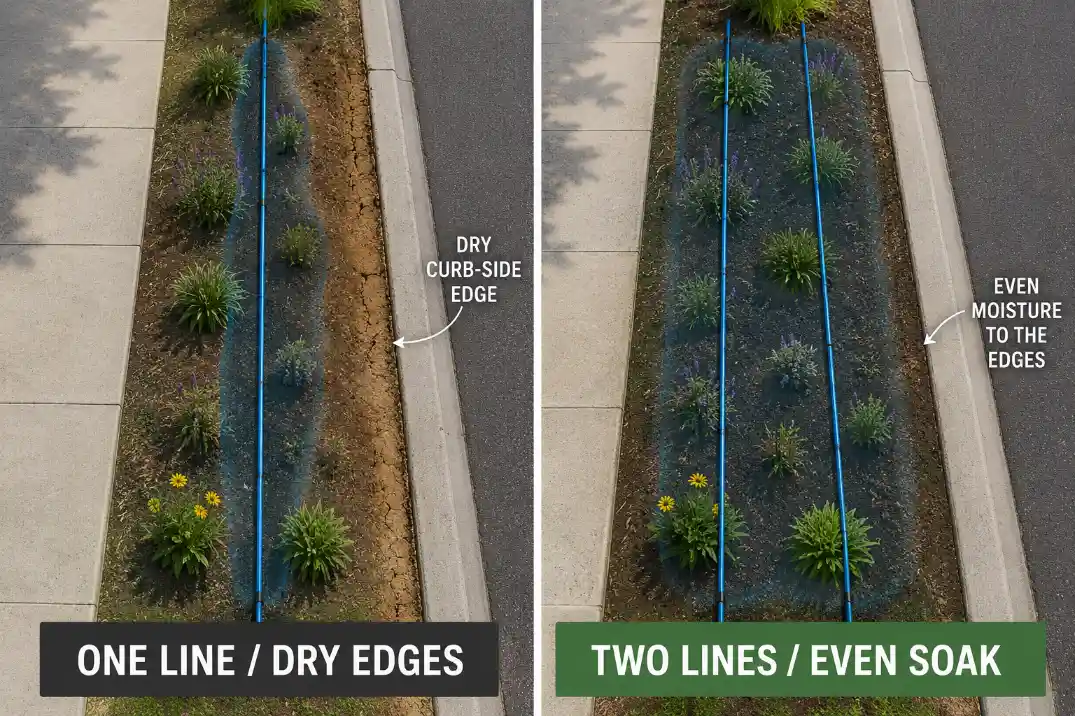
Drip irrigation is often the cleanest way to water a sidewalk strip without runoff, but only when the layout matches the actual width. One drip line down the center of a 30-inch strip may dampen the middle while leaving both edges dry.
Two lengthwise lines spaced about 12–18 inches apart usually perform better where both the curb side and sidewalk side need moisture.
Soil type changes the result. Sandy soil lets water move down faster and sideways less, so edge coverage may need closer line spacing. Clay soil spreads water wider but absorbs it slowly, so cycle length and soak pauses matter more.
The goal is not to make the whole surface look wet. The goal is a connected damp zone below the surface, especially 4 inches down near the curb edge, center, and sidewalk edge.
Use the failure signal to choose the fix
| What you see | What it points to | Best adjustment |
|---|---|---|
| Runoff in under 3 minutes | Flow is faster than soil intake | Lower flow and use short cycles |
| Surface wet, soil dry at 4 inches | Water is staying shallow | Cycle-and-soak before adding runtime |
| Center damp, edges dry | Drip line spacing is too narrow | Add edge pass or second line |
| Water pooling around emitters | Soil is compacted or flow is too high | Shorten cycles and improve surface infiltration |
| Curb edge wilts within 24 hours | Heat load exceeds root-zone moisture | Deepen watering or change planting |
Lightly opening the top 2–3 inches of compacted soil between plants can help water enter, but avoid aggressive cultivation around shallow roots.
A thin compost topdressing can improve surface behavior over time, while a 1–2 inch mulch layer slows evaporation without burying plant crowns.
Water Restrictions and Small Strips
Restrictions make accuracy more important
Many US communities limit irrigation days or watering windows during summer. On watering-restricted weeks, the priority is not getting more water onto the strip on the allowed day.
It is keeping every allowed minute inside the soil instead of losing it to the sidewalk, curb, or gutter.
If watering is allowed twice per week, two careful cycle-and-soak sessions are usually better than quick surface splashes that only cool the mulch.
In dry climates, new plantings may still need temporary hand watering, but established sidewalk strips should be designed to tolerate longer intervals without daily rescue.
A common overestimate is how much a 2-minute hose pass helps. It may darken the surface, but it rarely supports roots through a 95°F afternoon.
A common underestimate is how much mulch depth, plant spacing, and soil intake change demand. Bare exposed soil can dry visibly within hours, while a lightly mulched strip holds usable moisture longer.
If water rules shape the whole front yard, How to Choose Front Yard Plants for Water Restrictions can support the broader planting decision instead of treating the sidewalk strip as an isolated strip of soil.
A small strip can still waste noticeable water
A sidewalk strip is small, so it should not drive a dramatic increase in outdoor water use. If summer irrigation for a small frontage starts pushing costs upward, the likely issue is inefficient delivery, poor plant match, or both.
That problem is easy to miss because the area looks too minor to matter. But spray drifting onto pavement, runoff into the gutter, and daily rescue watering add up.
If the front landscape already feels expensive to keep green, Front Yard Irrigation Costs Climbing is a closer next step than simply adding minutes to a narrow strip.
The cutoff point is simple: if a mature sidewalk strip still needs frequent rescue watering after the first full growing season, stop treating runtime as the main fix. Recheck soil depth, compaction, irrigation placement, and plant choice.
A Strip That Survives Summer
Build the routine around the weakest zone
The best watering routine starts with the part that fails first: the curb edge, the shortcut line, or the sunniest end of the strip. Water that zone slowly, then check whether the rest of the strip is actually dry before treating the whole strip equally.
Equal watering sounds fair, but sidewalk strips are rarely equal environments. The curb edge may need slower attention while the center needs very little. Sandy soil may need shorter but more frequent cycles.
Clay soil may need longer pauses between cycles. Humid Florida conditions may reduce evaporation but make wet foliage less desirable at night. Northern states may need less summer irrigation but more attention to winter salt, spring compaction, and curb splash.
Use a simple pass-fail rule
After watering, the strip should pass three tests:
- Water stays off the sidewalk and curb during normal watering.
- Soil is damp 4–6 inches down after a full watering cycle.
- The hottest edge does not wilt again within 24 hours unless temperatures are extreme.
If it fails the first test, reduce flow before adding runtime. If it fails the second, use cycle-and-soak or improve infiltration. If it fails the third, the strip may need better mulch, tougher plants, or less exposed soil near the pavement edge.
Stop fixing symptoms when the setup is wrong
There is a point where watering stops being the right fix. If the strip is less than about 18 inches wide, packed with thirsty plants, sloped toward pavement, and exposed to full afternoon sun, careful watering can reduce waste but may not create a durable planting.
At that point, the better answer may be a simpler strip: fewer thirsty plants, tougher groundcover, wider mulch breaks, or gravel accents where local rules allow.
A surviving summer strip is not the one that gets the most water. It is the one where water lands slowly, stays in the soil, reaches the root zone, and matches plants that can handle heat reflected from both sides.
For broader official guidance on reducing outdoor water waste, see EPA WaterSense Watering Tips.