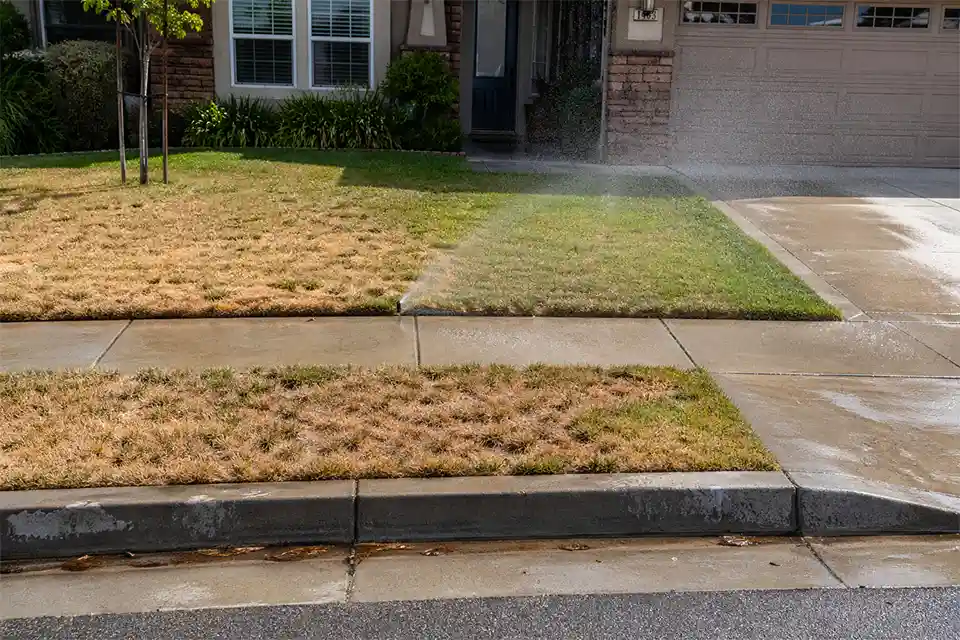
If your front yard irrigation costs keep climbing, the yard usually does not suddenly need dramatically more water. The more common pattern is that water is being lost before the root zone benefits from it.
In practice, the cost increase usually comes in one of two forms: a fast jump caused by a broken head, leak, stuck valve, or pressure problem, or a slow creep caused by uneven coverage, runoff, shallow watering, compacted soil, and plantings that demand more precision than the site can support.
Before changing the controller, do three checks: watch one full zone run, note whether runoff starts in under 5 to 7 minutes, and look for areas that stay wet for 24 to 48 hours while nearby turf still looks stressed by the next day.
A broken sprinkler head alone can waste up to 25,000 gallons over a six-month irrigation season, which is exactly why “more minutes” is often the wrong first move.
A dry-looking front yard can still be overwatered in the wrong places. That is the mistake that drives this issue. A healthy lawn zone may live around a rough 1-inch-per-week baseline including rainfall, but that number stops being useful when the system is misting into the air, throwing water onto pavement, or only wetting the top 1 to 2 inches of soil. In other words, the visible symptom is stress, but the underlying mechanism is usually poor delivery.
What kind of cost increase is it?
A sharp spike and a slow climb should not be diagnosed the same way.
Sudden increase: think mechanical first
If the bill jumped in one or two billing cycles, start with hardware. Broken or missing nozzles, cracked risers, buried heads, tilted heads, or a valve that is not closing fully can raise water use fast.
This is the highest-priority check because it is common, expensive, and often visible once the system is running. One soggy patch that never really dries tells you more than a month of guessing from the porch.
This is also where homeowners often overestimate weather and underestimate failure. A hot week can nudge demand upward. It does not usually explain a sudden jump by itself.
If one section of the front yard suddenly got greener while another declined, the problem is usually distribution or leakage, not a legitimate increase in plant demand.
Slow increase: think drift, not mystery
A gradual increase usually means the front yard and the irrigation logic have drifted apart. Shrubs mature. Tree roots expand. Pavement edges get hotter than expected.
A controller that used to run 10 minutes gets moved to 14, then 18, then 22. None of those changes looks dramatic on its own, but together they create an expensive system that still does not water evenly.
That is especially common after the site changes but the irrigation pattern does not. If grade, hardscape, bed size, or plant mass changed, the old runtime may no longer fit the new yard.
That same broader mismatch also sits behind Front Yard Problems After Regrading or New Hardscaping, where the yard starts behaving differently before the homeowner realizes the irrigation pattern is now part of the problem.
The causes that deserve the most attention
Not every cause belongs in the same tier. These do.
1. Broken heads, bad aim, and hidden leaks
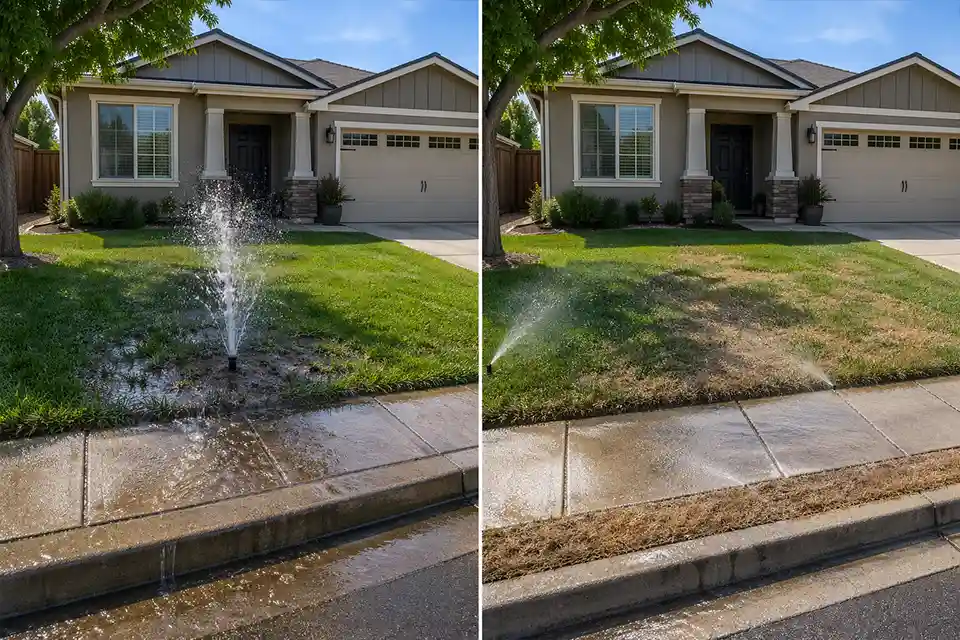
This comes first because it wastes the most water the fastest. If a head no longer rises cleanly, sends water onto the sidewalk, or leaks at its base, the zone can look both too wet and too dry at the same time. That is why longer runtime fails so often: it punishes the failure area and barely helps the weak one.
The common mistake is treating the dry patch as the primary clue. It is not. The more diagnostic clue is the contrast: one zone edge is muddy, another is stressed, and the bill keeps rising.
2. Pressure mismatch
Pressure gets ignored because it is less obvious than a broken head, but it matters more than many homeowners think. When pressure is too high, spray heads mist and drift. When it is too low, coverage weakens and overlap suffers. Common operating ranges are roughly 15 to 25 psi for drip, 25 to 30 psi for spray heads, and 40 to 50 psi for rotors. If the water looks foggy instead of targeted, that is not strong performance. It is usually waste.
This is one of the easiest things to misread. Stronger-looking spray does not mean better watering. In hot or breezy conditions, fine mist can disappear before it helps the root zone at all. People often assume the yard is under-watered when the real problem is that part of the irrigation never reaches the soil effectively.
3. Runoff and shallow infiltration
If water starts running toward pavement in under 5 to 7 minutes, the issue is usually delivery rate versus soil intake, not a lack of water. Most runoff problems come from irrigation running too long or too fast for the soil and slope. That is why a front yard can look soaked on the surface and still perform like it was watered poorly.
This is the point readers usually underestimate: the soil. Even a mild slope can shed water if the top layer is compacted or the nozzle output is too aggressive. A simple probe test helps separate appearance from function. If the top looks wet but the ground is still resistant below 2 to 3 inches the next morning, the watering depth is not matching the apparent surface wetness.
Why the obvious fix keeps failing
The most common fix is to run the zone longer. That is also the fix that most often wastes money.
Longer runtime does not repair bad distribution
If heads are misaligned, partially blocked, or badly spaced, more minutes only exaggerate the wet spots. This is why irrigation bills can rise while the yard still looks inconsistent. The system is applying more water, but not more useful water.
Reseeding or replanting too early wastes time
Dry curb edges and stressed patches often get reseeded before anyone tests the irrigation pattern. That can waste a full season. If the real issue is weak overlap, reflected heat from pavement, shallow soil, or root competition, the replacement planting is being dropped back into the same failure pattern.
That is especially true in front yards with thin soil profiles or aggressive root zones. At that point irrigation is being asked to compensate for a site limitation. The same broader constraint shows up in Front Yard Plants in Shallow Topsoil, where water alone cannot fully solve the planting problem.
Seasonal adjustment is not diagnosis
Yes, hotter weather often justifies a modest runtime increase. But repeated schedule changes are not automatically normal. Once you are manually rescuing the same zone every few weeks, the issue is usually not “summer.” It is uneven coverage, runoff, or a planting layout that no longer fits the site.
Pro Tip: Watch the system at sunrise before changing a single minute on the controller. Most expensive irrigation mistakes are obvious only when the water is actually running.
What actually lowers the cost
The useful fix reduces waste first and fine-tunes demand second.
Test distribution before changing runtime
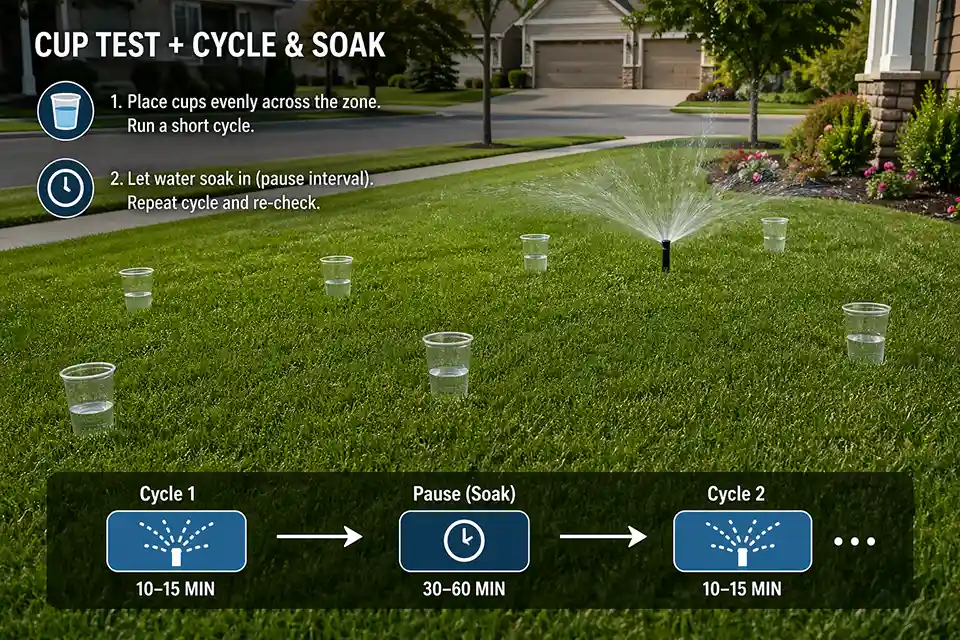
Set 6 to 8 straight-sided cups across a zone and run it for 10 minutes. If the collected water varies by more than about 25%, the zone is uneven enough to justify correction before any schedule edits. That is why catch-can style auditing remains one of the best reality checks in landscape irrigation.
| Check | Healthier condition | Failing condition | What it usually means |
|---|---|---|---|
| Runoff timing | No runoff during cycle | Runoff starts in under 5–7 minutes | Water is arriving faster than soil can absorb it |
| Cup test | Cups fill fairly evenly | More than 25% variation | Poor overlap, pressure issue, or bad spacing |
| Soil probe next morning | Moisture reaches several inches down | Top is damp, deeper layer still hard | Shallow watering or compaction |
| Dry-down pattern | Area begins evening out within 24 hours | One area stays wet for 24–48 hours while another dries fast | Leak, overlap problem, or drainage mismatch |
| Controller changes | Small seasonal edits | Repeated zone edits all season | The system logic no longer matches the site |
Use cycle-and-soak when runoff starts early
If a zone starts shedding water quickly, split one long cycle into shorter runs with soak time in between. A 15-minute cycle often performs better as three 5-minute runs with 30 to 60 minutes between them. Heavier clay usually benefits from the longer end of that pause. This method works because it gives the soil time to absorb water instead of sending it downhill or onto hardscape.
That sounds like a small programming change, but it often marks the line between watering the root zone and watering the sidewalk. If runoff is also collecting near the house, that overlap belongs with Front Yard Water Pooling Near the House Causes.
Match the delivery method to the shape of the planting
This is the quieter cost driver that people miss for too long. Spray irrigation can make sense for broader lawn areas. It is often inefficient in narrow strips, foundation beds, and shrub zones where much of the pattern lands on mulch, concrete, or empty space. If the geometry is wrong for spray, the schedule can be perfect and the cost can still be wrong.
That is where irrigation efficiency stops being just a hardware issue and becomes a design issue. If the front yard only stays presentable under frequent watering, the system may be preserving a bad plant-site match rather than supporting a good one.
That is why lower-demand plant choices matter so much in hot exposures and restricted watering schedules, as discussed in How to Choose Front Yard Plants With Water Restrictions.
When tuning stops making sense
There is a point where more controller tweaking becomes the wrong project.
When the planting is the real cost driver
If the front yard depends on thirsty turf in hot curbside strips, crowded shrubs in narrow beds, or plants that only look acceptable under frequent irrigation, the bill is reflecting the planting design as much as the system. At that point, better watering alone will not fix the economics of the yard.
When the controller has become a rescue tool
If you are reprogramming the same zones all season, that is a sign the runtime is no longer the real issue. Once manual correction becomes routine, the problem is usually deeper: delivery, soil intake, zone design, or plant demand that no longer fits the site.
The useful decision at that point is not “more minutes or fewer.” It is whether the layout still deserves to be watered this precisely.
A front yard irrigation bill that keeps rising is usually not a mystery. It is a sign that water application, soil intake, and plant demand are no longer aligned.
The most productive move is not simply to water less. It is to stop paying for minutes that never improve the yard.
For broader official guidance, see EPA WaterSense.