Last updated: May 2, 2026
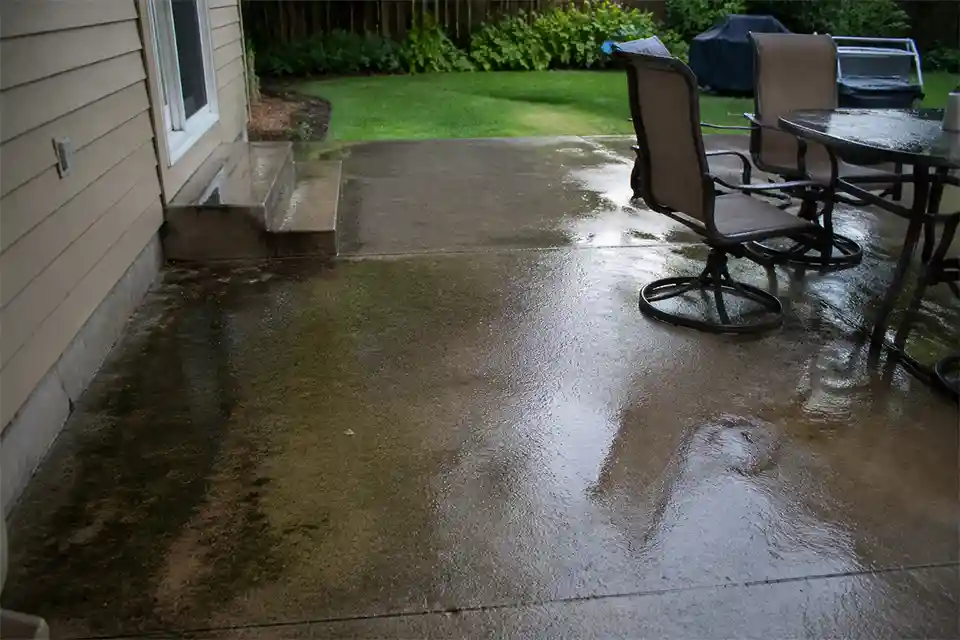
Most slippery patios are misdiagnosed. The usual problem is not that the patio is simply “too smooth.” It is usually one of three patterns: a biofilm that keeps returning because the surface stays damp too long, a film-forming sealer that turns slick when wet, or water movement that keeps re-wetting the same area.
Start with three checks that take less than 10 minutes: hose down a 3-by-3-foot section, time how long visible water remains, compare a shady band with a sunny band, and check whether the slick zone is localized or spread across the whole patio.
If water still beads or sits after 10 to 15 minutes, you are no longer looking at a minor traction annoyance. If the patio stays damp 2 to 4 hours longer than nearby hardscape, the finish may be innocent and the moisture pattern may be the real cause.
That is the key difference from a patio that only feels rough, worn, or slightly uneven underfoot. A slippery patio is usually a moisture-and-surface interaction problem first, not just a texture problem.
First identify which patio you actually have
Smooth concrete
Smooth concrete is the surface most likely to become obviously slick after a topical or glossy sealer goes on. If the patio felt acceptable before sealing and noticeably worse within 6 to 24 months after sealing, the sealer deserves suspicion before you blame shade or climate alone. That is especially true if the surface looks darker, richer, or shinier than it used to.
Stamped concrete
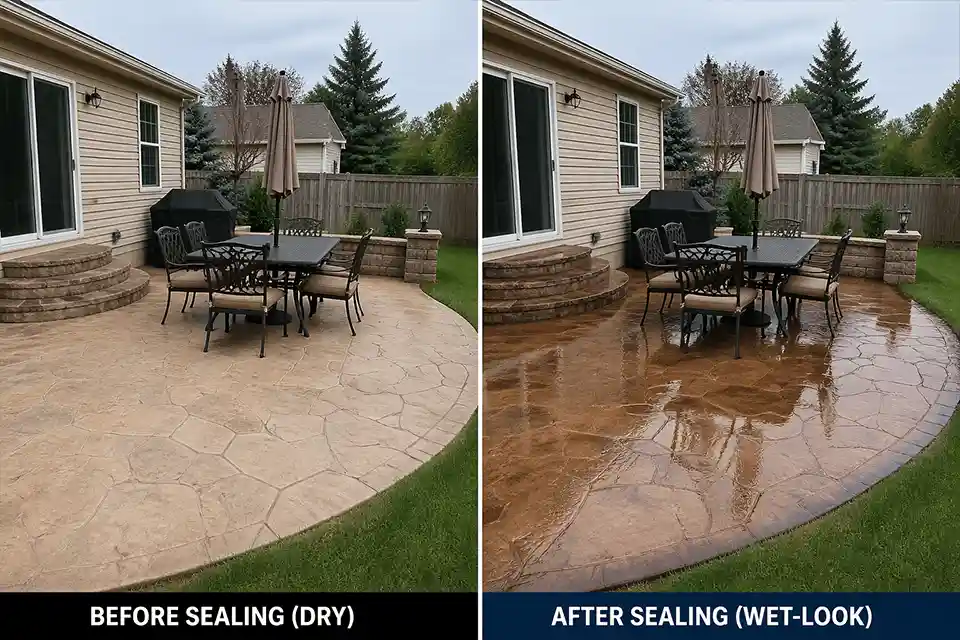
Stamped concrete gets misread all the time because it looks textured enough to be safe. The pattern can create visual traction without delivering real traction once a topical sealer and a thin organic film build up together. On stamped surfaces, “just pressure wash it” is often a temporary win, not a real fix.
Pavers
Pavers are less often made slippery by the paver itself than by what sits on top of it: algae, mildew, repeated overspray, or sealer buildup. If the joints stay dark and damp long after the field of the patio dries, the moisture cycle is doing more damage than the surface type.
Stone or tile
This is where people overestimate cleaners and underestimate finish choice. Dense stone or exterior tile can feel acceptable when dry and become risky the instant a thin wet film appears. If the problem is immediate slipperiness when wet rather than all-day dampness, the surface finish climbs higher on the suspect list.
The 5-minute patio traction check
Run a hose test
Wet a 3-by-3-foot area, then start a timer. On a healthy patio, visible water should begin clearing quickly. If water is still lingering after 10 to 15 minutes on a mild day, that is a useful threshold between “wet but functioning” and “not drying well enough.”
Check slope with a 4-foot level
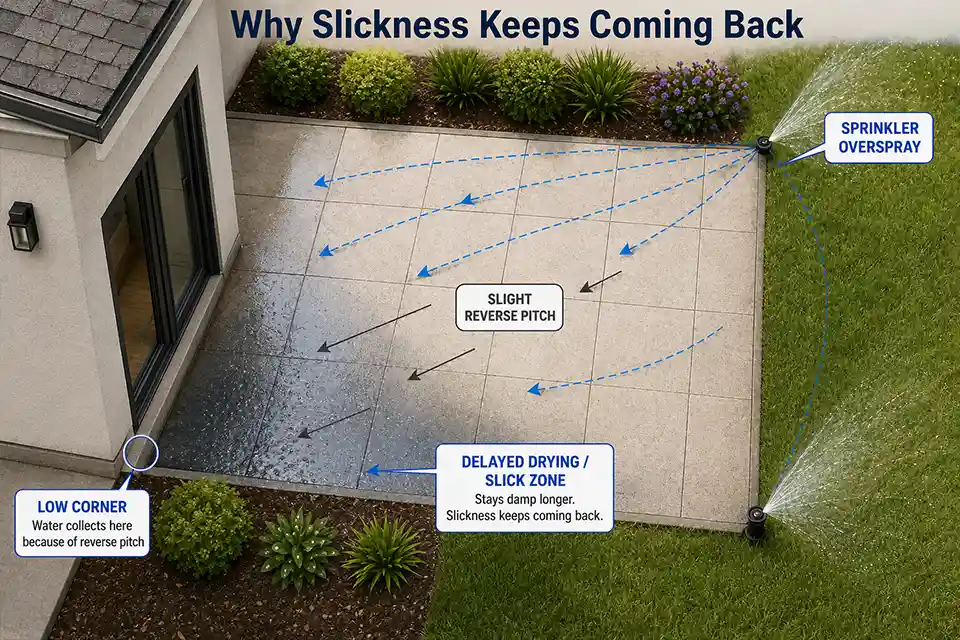
Set a 4-foot level on the patio and measure the drop. For drainage, a practical target is about 1/8 to 1/4 inch per foot away from the house. If you are finding essentially flat areas or reverse pitch, that matters more than almost any coating decision.
Compare shade and sun
If the shady side stays damp 2 to 4 hours longer than the sunny side, moisture persistence is more important than finish appearance. If both areas feel equally slick, the finish or residue layer climbs higher on the suspect list.
Compare rain, irrigation, and rinse water
If the same strip becomes slick after rain, after sprinklers, and after a simple hose rinse, stop shopping anti-slip additives. That pattern usually means the patio is holding water or being re-wet too often.
Pro Tip: A slick band only 12 to 24 inches wide is usually more useful than an evenly slippery patio. Narrow bands often point to overspray, runoff direction, or a low edge.
When the surface feels slick after rain, it also helps to separate cleaning issues from traction issues before choosing among non-slip patio cleaners and treatments.
What people usually misread first
They blame smoothness when the real issue is dwell time
The visible symptom is slipperiness. The mechanism is usually that water stays on the surface long enough to change traction. That is why many patios become risky in partial shade without ever developing dramatic puddles.
They overestimate dew and underestimate irrigation
Morning dew sounds like the obvious culprit and often is not. Repeated irrigation overspray is usually worse. Dew may leave a patio damp for an hour or two. A sprinkler head clipping the patio edge every morning can keep one section wet long enough for algae and mildew to rebuild within weeks.
If you are also seeing broader drainage oddities, the traction problem may be part of a larger water pattern rather than an isolated surface issue. That is where a related problem like Backyard Drainage After a Patio Walkway is more useful than generic cleaning advice.
When sealer is actually the problem
Penetrating sealer is usually not the main traction culprit
If the patio is slippery and you know a penetrating sealer was used, look harder at moisture persistence and organic buildup first. Penetrating products usually do not create the same slick film that topical finishes can.
Film-forming or glossy sealer is often the main culprit on smooth patios
This is the more common bad match. If the patio became noticeably shinier and slipperier after sealing, the finish deserves direct scrutiny. Smooth concrete is where this shows up most clearly.
When grit additive makes sense
Grit helps when the patio drains properly, dries reasonably fast, and only feels risky when the sealed surface gets wet. In other words, the sealer changed traction, but the patio is not trapped in a damp cycle.
When grit additive is mostly a delay tactic
Grit is the wrong first move when water lingers more than 15 minutes, joints stay dark, or the patio turns slick again within 2 to 6 weeks of cleaning. In those cases, the problem is not just lack of texture. It is recurring contamination or recurring wetting. Adding traction into the top layer may help briefly, but it does not change why the slickness keeps coming back.
When stripping or resurfacing makes more sense
If the patio stays damp too long, another coat is usually the wrong move. Stripping a bad topical sealer makes sense only after you rule out drainage and overspray. If the slab is badly pitched, repeated sealer changes are just expensive delay.
A good companion topic here is Patio Drainage Problems Most Homeowners Notice Too Late, because the line between “slippery finish” and “water-handling failure” is often much thinner than homeowners expect.
Symptom-to-fix guide
| What you see | Most likely cause | Fix that usually works | Fix that often wastes time |
|---|---|---|---|
| Dark slick area in shade | Biofilm plus slow drying | Deep cleaning and reducing re-wetting | Adding more sealer |
| Whole patio got slick after sealing | Film-forming sealer mismatch | Strip and reseal correctly or add traction in the right system | Pressure washing alone |
| One narrow patio edge stays slick | Irrigation overspray or runoff path | Adjust sprinkler pattern or redirect water | Full-patio coating changes |
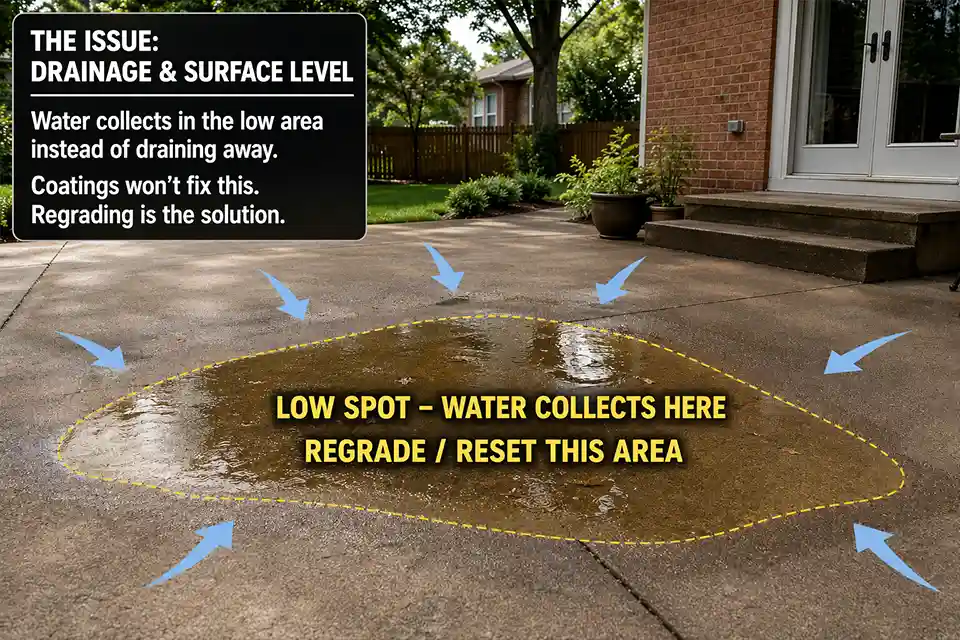
| Water still visible after 15 minutes | Low pitch or drainage issue | Regrade, reset, or rebuild affected section | Anti-slip spray over the top |
| Slippery again within 2 to 6 weeks of cleaning | Cause not removed | Fix moisture source first | Repeating the same wash cycle |
When the standard fix stops making sense
If water remains after 30 minutes, stop thinking in refresh terms
Once water still sits or beads after 30 minutes, especially over multiple spots or more than about 2 to 3 square feet, the patio has crossed out of cleaning-and-coating territory and into correction territory. That may mean regrading, resetting pavers, correcting runoff, or replacing the finish system entirely.
If the patio pitches toward the house, treat it as a drainage problem first
No traction additive is more important than water direction. If the slab sends water toward the house or holds it along the foundation edge, the risk is no longer just slipping. It becomes a broader hardscape and drainage issue. That is why Patio Water Pooling Against the House deserves more urgency than the surface sheen itself.
If the slip zone is on a primary path, move faster
A slick patio in a decorative corner is one thing. A slick path between the back door, grill, steps, or pool gate is a same-week problem. That is also the point where rubber-backed mats or temporary anti-slip tape can make sense as a short-term risk reducer while you fix the actual cause. Those are not elegant solutions, but on a high-traffic path they can buy time without pretending to solve the root problem.
If runoff crosses the patio during storms, stop treating it like a finish issue
When stormwater is physically cutting across the slab, the patio is not failing because the top layer lacks grip. It is being used as a drainage path. In that case, compare the problem to Sloped Yard Runoff Cutting Across Patio instead of assuming a new coating will change the outcome.
How to keep the fix from failing again
Do not reseal a surface that is still trapping moisture
Wait until the patio is truly dry. Sealing damp material can lock in the very condition you are trying to solve.
Recheck after the first heavy rain and after irrigation
A patio that passes the hose test but fails after a thunderstorm is telling you something useful about runoff volume. A patio that passes rain but fails after irrigation is pointing harder at sprinkler control.
Watch the timeline
A fix that fails in under a month was probably the wrong category of fix. A patio that stays safer through the next rain cycle and irrigation cycle is usually on the right track.
The right fix depends less on how slippery the patio feels in the moment and more on why it keeps getting that way. Diagnose the water pattern first, then decide whether you need cleaning, a different sealer system, or actual drainage correction.
For broader official guidance, see the OSHA walking-working surfaces standard.