Last updated: May 2, 2026
If drainage problems started after a patio or walkway was installed, the hardscape usually did not create a brand-new water problem. It changed the route, speed, and concentration of water that was already falling on the site.
That is the first thing to get right. Check three points first: does water still sit on the surface or along the edge after 24 hours, does the wet zone follow the new hardscape line instead of appearing randomly, and can you reproduce the problem with a 10- to 15-minute hose test?
If the answer is yes, the issue is usually not “bad soil” as a broad diagnosis. It is more often one of three failure patterns: the surface is pitched wrong, the hardscape edge became the new low point, or the runoff is now landing in a part of the yard that cannot absorb it fast enough.
That is different from a yard that was always wet. If the lawn stayed soggy long before the project, the patio or walkway may only be exposing a broader drainage weakness. But when the timing lines up tightly with installation, the smarter question is not “why is my backyard wet?” It is “what did this new hardscape change?”
What usually went wrong first
The new surface sped water up
A patio or walkway turns part of the yard into a hard runoff surface. Water that used to soak into soil now moves across pavers or concrete and reaches one edge faster. Even when the installer pitched the surface away from the house, that only solves the first part of the path.
A common target is about 1/4 inch per foot of fall. Across 8 feet, that is enough to move water decisively. But if that runoff is released into compacted turf, a narrow planting strip, or a shaded corner that already dries slowly, the wet problem simply shifts and concentrates.
That is why patio drainage problems most homeowners notice too late often begin with something that looks minor: a dark seam, a damp strip, or a small recurring puddle at the same edge.
The edge transition turned into a shallow basin
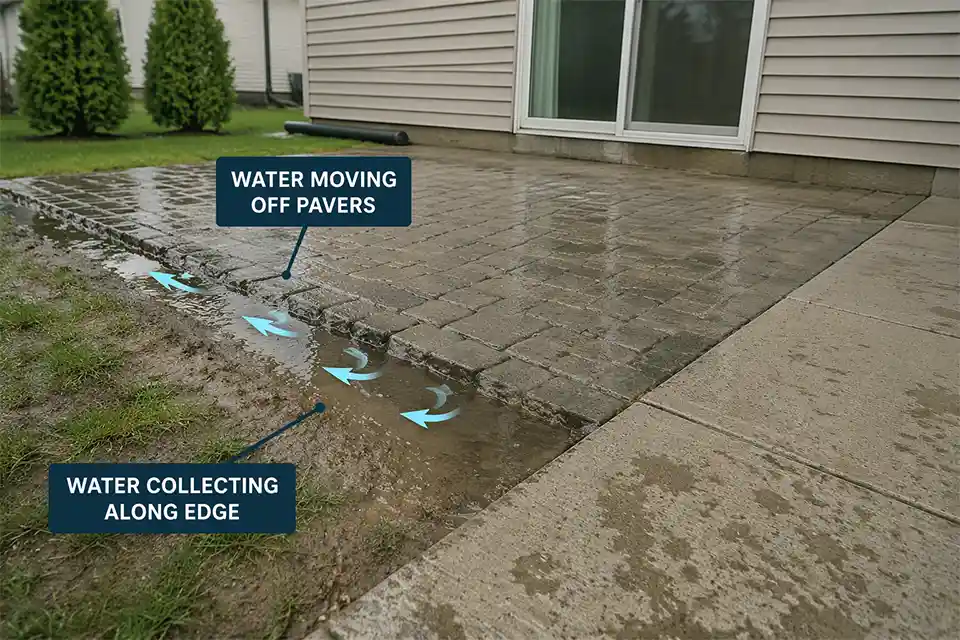
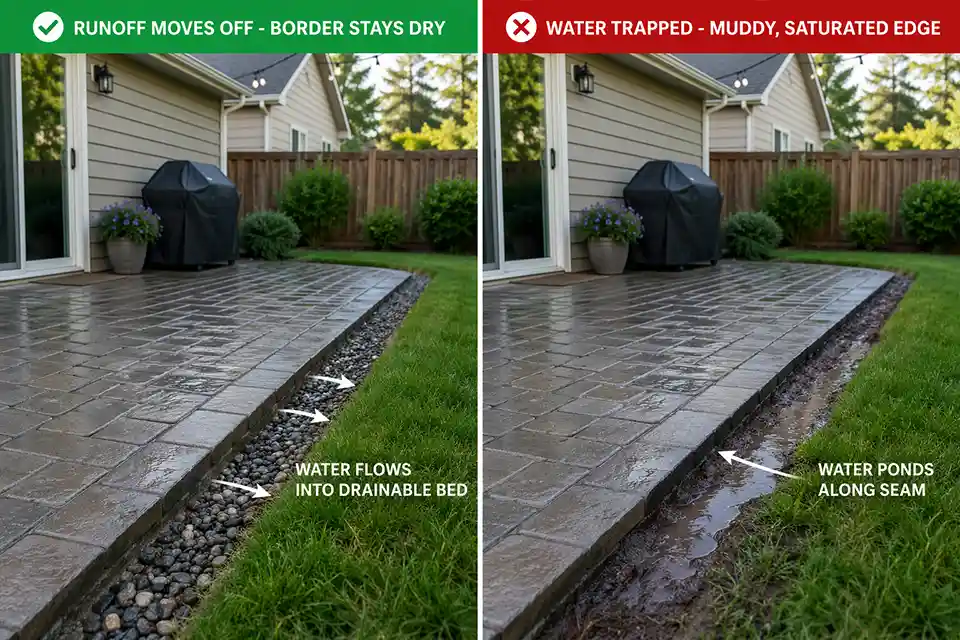
This is the most common failure pattern after a patio install. The paver field may slope correctly, yet the outer course meets the lawn or bed at the wrong height. Water reaches the seam and stalls there. The result is a border that stays soft, a muddy strip 6 to 18 inches wide, algae at the edge, or joint sand that keeps washing out in the same direction.
People often overestimate the phrase “sloped away from the house.” It sounds like a complete answer. In reality, many installs fail at the handoff from hardscape to soil, not on the main pitch itself.
If pavers are staying damp or slick, the next decision may be whether the surface needs drainage correction, cleaning, or one of the right non-slip patio treatment options.
The walkway became a runoff lane
Walkways create a slightly different problem. A long straight walk can channel water toward one low end, especially if it runs beside the house, crosses the natural grade, or ends at a step or gate. In that case the failure may show up 10 to 20 feet away from the section that caused it.
The wettest spot may be the lower landing, the side-yard pinch point, or a corner where the walk empties into already stressed ground.
That is where walkway problems get misread. The puddle appears at the end, so homeowners blame the end. The actual cause is often the hard surface above it.
Quick diagnostic checklist
Before you price drains or assume the whole yard needs reconstruction, check these signals:
- Water remains on the hardscape or at its edge longer than 24 hours after a normal rain.
- The problem began only after the patio or walkway was installed.
- The wet area follows a seam, corner, or lower end instead of showing up across the whole yard.
- Nearby lawn firms up within 8 to 12 hours, but the problem zone stays soft for 24 to 48 hours.
- Joint sand, mulch, or fine soil keeps washing in the same direction.
- A hose test reproduces the same flow path in 10 to 15 minutes.
If four or more are true, the patio or walkway probably changed runoff behavior enough that surface-level patching will not hold.
The three failure patterns that actually matter
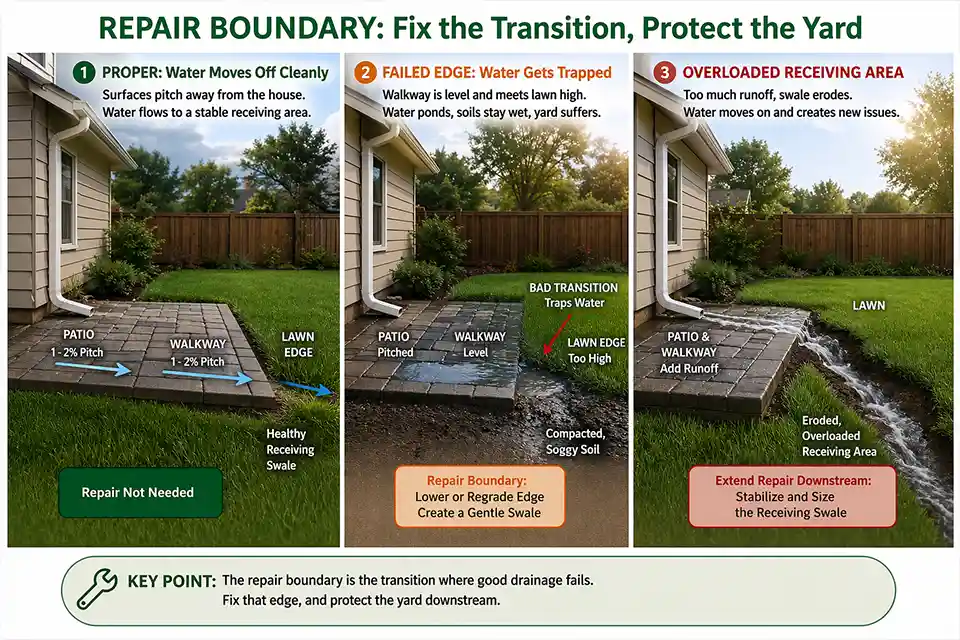
Surface pitch failure
If water sits on the patio or walkway surface itself, the problem is usually in the surface geometry: bad pitch, settlement, or local low spots. A few shallow birdbaths after a heavy storm are one thing. Repeating puddles after ordinary rain are another.
Look for:
- puddles on the pavers themselves
- rocking units underfoot
- settled corners
- reopened joints in the same area
This is where drainage and stability start overlapping. Uneven or sloped ground that makes a patio feel unstable is often part of the same story, not a separate one.
Edge transition failure
If the surface sheds correctly but water stops at the border, the failure is not the main pitch. It is the receiving edge. This is the most common and most fixable diagnosis. It usually shows up as a narrow but persistent problem zone rather than a dramatic flood.
Look for:
- a wet seam instead of a wet patio
- soft soil right next to the outer course
- washed joint sand
- lawn edge decline or mulch migration
This is the condition people underestimate most because it looks cosmetic before it becomes structural.
Receiving zone overload
If the surface and edge both move water, but the lower yard stays saturated, the patio or walkway is now feeding runoff into a part of the site that cannot absorb or carry it. The hardscape is still involved, but it is no longer the whole problem.
Look for:
- water leaving the hardscape cleanly, then stalling downslope
- repeated wetness in a lower corner or side yard
- saturation that lingers 24 to 48 hours
- runoff getting redirected toward fence lines or neighboring grade
That is where backyard drainage problems homeowners ignore until damage spreads becomes the better comparison than a simple patio fix article. The symptom may start at the patio. The bottleneck may now sit below it.
What people usually misread first
They blame soil before they blame geometry
Clay or compacted soil can absolutely make things worse, but if the problem began right after installation, poor soil is usually a secondary factor, not the first diagnosis. Start with the shape of the water path.
They assume every wet edge needs a drain
A drain can work well, but only when it sits at a real collection point and has somewhere useful to send water. A small drain dropped into the wrong spot often becomes a tidy-looking disappointment.
They treat settlement as a cosmetic issue
If pavers move and water lingers in the same area, stop treating the problem as surface-only. Settlement plus repeat wetness often points to base or sub-base trouble, not just a low seam.
Pro Tip: A hose test is most useful when you start where rain actually lands on the hardscape, not where the puddle finally appears.
Which fix fits which problem
| Failure pattern | What you will usually see | What usually works | What usually wastes time |
|---|---|---|---|
| Surface pitch failure | Puddles on the patio or walkway surface, recurring low spots, rocking units | Resetting settled sections, correcting pitch, rebuilding low areas | Adding gravel at the edge |
| Edge transition failure | Muddy seam, washed joint sand, narrow saturated strip | Regrading the receiving edge, resetting outer course, adding a shallow swale if needed | Topdressing soil without changing the water path |
| Receiving zone overload | Water leaves hardscape but saturates lower lawn or side yard for 24–48 hours | Redirecting runoff to a real outlet, reshaping the destination area, broader drainage correction | Small drain insert with no useful discharge path |
| Base or sub-base failure | Settlement plus drainage trouble, separated joints, repeat low corner return | Partial rebuild of the affected section | Repeated patching of the same spot |
When the standard fix stops making sense
Minor correction territory
A smaller repair still makes sense when the surface is mostly stable, the issue is limited to one seam or low edge, and water clears within a day once the path is corrected. This is where lifting and resetting an outer course, lowering an adjacent grade, or creating a shallow swale can genuinely solve the problem.
Partial rebuild territory
The logic changes when you have all three of these at once: standing water after 24 hours, repeat washout at the same location, and visible movement in the hardscape. That combination usually means the problem is not just runoff direction. It often involves base preparation, sub-base compaction, or a grade relationship that was wrong from the start.
Bigger site-drainage territory
If the patio or walkway now pushes water into a fence line, side-yard dead end, or neighboring lot, the repair decision moves beyond the hardscape itself. At that point, you are choosing where runoff is allowed to go. That is a site problem, not just a patio problem. The same logic shows up in sloped backyard drainage that sends water into a neighbor’s yard: moving water away is not enough if it arrives somewhere unstable.
What a strong repair decision looks like
The best repair is usually the least invasive one that matches the first real delay point in the water path.
Start with the delay point
Run water for 10 to 15 minutes and watch where it slows first.
If the first delay is on the hardscape, investigate pitch and settlement.
If the first delay is at the seam, fix the edge transition.
If the first delay is below the seam, solve the destination problem.
Match the fix to the mechanism
Do not ask gravel to do grading work.
Do not ask a drain to solve whole-zone saturation.
Do not ask a topdressed edge to hold if the patio is still sending water to the same low point.
That same mismatch is why pool and hot tub drainage design mistakes so often survive one repair attempt and fail again. The wrong fix can look active while changing very little.
Decide sooner when patching is no longer smart
One of the more expensive mistakes is doing three small repairs in a row on a section that really needs one partial rebuild.
If the same corner keeps settling, the same seam keeps washing out, or the same lower end of a walkway keeps holding water, the pattern matters more than the patch.
For broader official guidance on runoff from patios, walkways, and other hard surfaces, see Penn State Extension.