Last updated: May 2, 2026
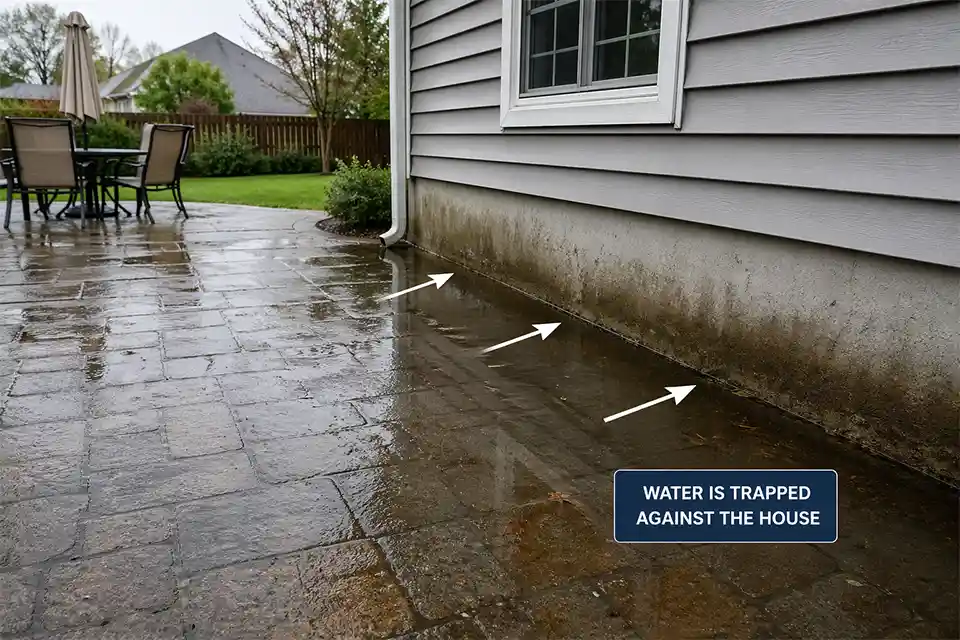
Patio water pooling against the house is usually not a generic drainage problem. In most cases, it comes down to one of three things first: the patio does not slope away from the house enough, a downspout is overloading the same edge, or the surrounding grade changed and now traps runoff where it used to escape.
Start with three checks before you buy anything: measure the slope over the first 4 to 8 feet, see whether water is still there after 6 to 24 hours, and check where the nearest downspout discharges.
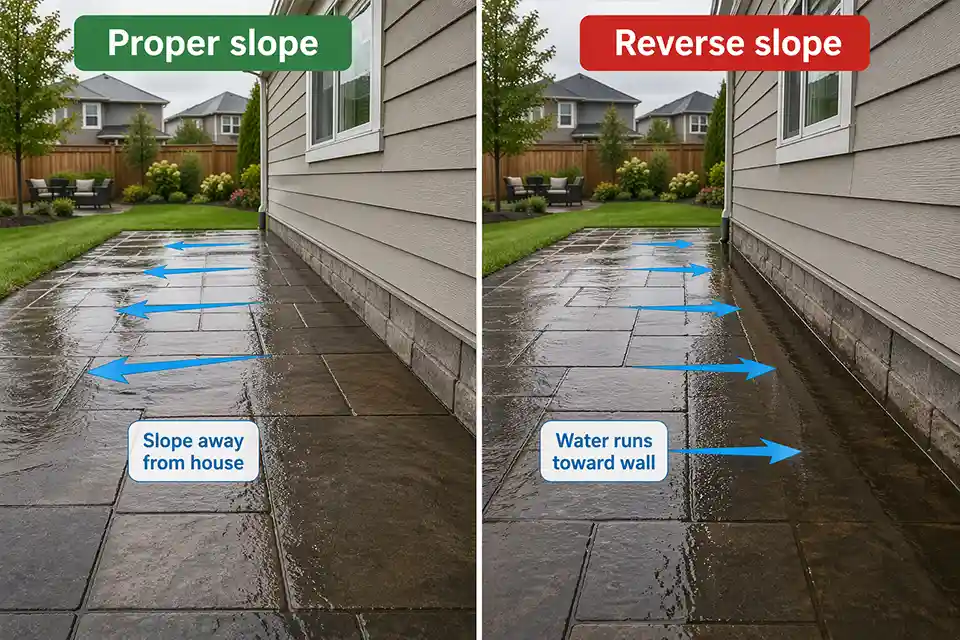
A patio should usually fall away from the house by about 1/8 to 1/4 inch per foot. If it does not, the puddle is only the visible symptom. The real problem is that water is being forced to pause at the one edge of the patio that matters most.
That is what makes this different from a shallow puddle in the middle of a patio. Water that lingers near the house can sit against siding, door thresholds, slab edges, veneer bases, or foundation walls.
If the same strip stays wet for more than 12 hours after a moderate rain, stop treating it like a cosmetic nuisance. At that point, it is a drainage failure with a repair decision attached to it.
The first checks that actually matter
Measure slope before blaming drainage
Homeowners often jump straight to “bad drainage,” but the surface itself usually tells the story first. If the patio does not direct water away from the house, nothing below it will rescue the result for long.
Use a 4-foot level and a tape measure. Over 4 feet, you want roughly 1/2 inch to 1 inch of fall away from the house. Over 8 feet, that becomes about 1 to 2 inches. If the patio only falls 1/4 inch over 4 feet, or if one section near the house sits lower than the outer edge, that is enough to create repeat pooling.
What people often overestimate is a barely visible slope. A patio can look “close enough” and still be functionally too flat. Water does not care whether the surface feels mostly level under furniture. It follows the last low point.
Use drying time as a diagnostic signal
The size of the puddle matters less than how long it stays.
If the water clears within 30 to 60 minutes after rainfall ends, the patio may be marginal but still workable. If it remains after 6 hours, drainage performance is weak. If it is still there after 12 to 24 hours, the problem is no longer small enough to ignore.
A shallow puddle that lingers is often more revealing than a deeper puddle that drains quickly. Long drying time usually points to inward pitch, trapped runoff, or overload from another water source.
Check whether roof runoff is joining the problem
One downspout can turn a tolerable patio flaw into a repeat failure. If the nearest downspout ends within 3 to 5 feet of the patio edge, it may be feeding the exact strip where water is already slow to escape. That matters even more during repeated summer storms or in humid regions where the area stays damp longer between rainfall events.
This is where a lot of people misdiagnose the problem. The patio may have a slope problem, but the downspout is making it look worse and more urgent. That is why Downspouts Flood Backyard Planting Beds is closely related to this issue even when the visible complaint shows up on hardscape instead of soil.
What people usually misread first
The puddle is the symptom; elevation is the mechanism
The visible water is not the repair target. The elevation relationship is.
This is why sealers, fresh caulk at the wall joint, and repeated paver re-sanding often disappoint people. They can reduce water entry for a while, but they do not change where the surface tells water to go. If the patio edge nearest the house is lower by even 1/2 inch across a short run, the surface is still sending water the wrong way.
Patio Drainage Problems Most Homeowners Notice Too Late often show up this way: the visible moisture gets treated, but the actual pitch problem stays in place.
A blocked outlet is real, but it is not the same as reverse pitch
Readers often lump clogged drains and bad slope together, but they are not the same failure.
If the patio already has a channel drain or outlet and water still lingers, then debris, silt, or a blocked discharge line may be part of the issue. But if the surface itself visibly falls toward the house, drain cleaning is not the core fix. It is maintenance work applied to the wrong failure type.
What people commonly underestimate is surface geometry. What they commonly overestimate is the chance that cleaning, sealing, or re-sanding will rescue a patio that is already pitching inward.
Poor drainage can make hard surfaces slippery faster, especially when moisture encourages algae or residue, so it helps to compare the right patio cleaner or anti-slip treatment after the water path is understood.
When the water is touching the wall, not just sitting on the patio
A small birdbath in the middle of a patio is annoying. Water touching the wall line is a different category because it sits at the edge where materials change and failures stack together.
Why this location matters more
At the house edge, water can pause against siding bottoms, door thresholds, slab edges, brick veneer bases, or foundation walls.
In freezing climates, repeated cycles below 32°F can widen joints, pop edges, and accelerate small movement over one to three winters. In warmer humid climates, the problem shows up more as recurring dampness, staining, algae, or persistent moisture at the lower wall area.
The house edge is simply less forgiving than open pavement.
When a channel drain makes sense
A channel drain can be a smart retrofit when the patio mostly drains correctly, but the house-side edge still needs a dedicated collection point. It makes the most sense when:
- the patio generally pitches away, but one narrow strip remains vulnerable
- a doorway or threshold needs extra protection
- runoff has a clear discharge path away from the foundation
When a channel drain is the wrong answer
A channel drain is the wrong answer when the entire patio field still slopes back toward the house. In that case, the drain becomes a bandage on a layout problem.
It may collect some water, but it does not fix the fact that the surface keeps delivering runoff to the wrong place.
Pro Tip: If a proposed drain fix does not include where the captured water will discharge, it is not a full drainage plan.
A 10-minute hose test tells you more than guesswork
How to run it
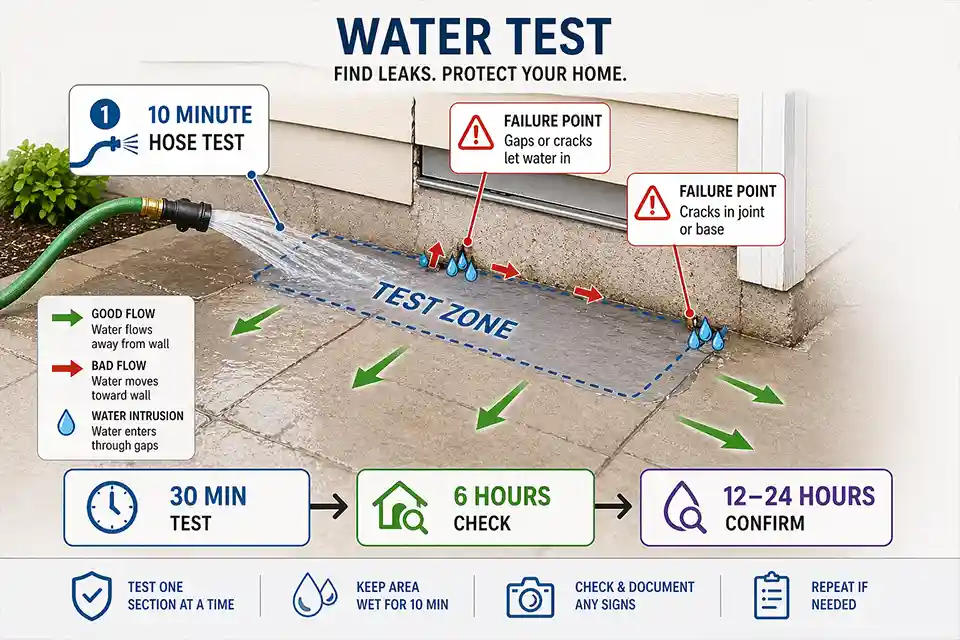
Pick a dry day. Wet the problem area with a hose for 5 to 10 minutes, focusing on the same strip where water usually pools. Watch the first direction of movement, not just the final puddle.
Then repeat the test under two conditions if possible:
- once with no active downspout influence
- once with roof water entering the area normally after the next rain
This helps separate patio geometry from runoff overload.
What counts as a passing result
If the water moves away from the house quickly and clears within 15 to 30 minutes, the patio may be imperfect but still functional. If the water pauses at the house edge, drifts back toward the wall, or remains visible after 6 hours, that points to a real drainage failure.
Mark the deepest standing point. If it is always in the same strip next to the house, that is not random. It is a pattern.
Which fix matches the failure?
| What you’re seeing | Best first fix | Fix that usually wastes time | When reconstruction is smarter |
|---|---|---|---|
| Patio slopes back toward the house along a broad run | Reset or regrade the affected patio section | Sealant alone | When reverse pitch extends across a meaningful share of the patio |
| Water gets much worse only during roof runoff | Extend or redirect the downspout discharge | Surface patching first | If pooling still happens after roof water is moved away |
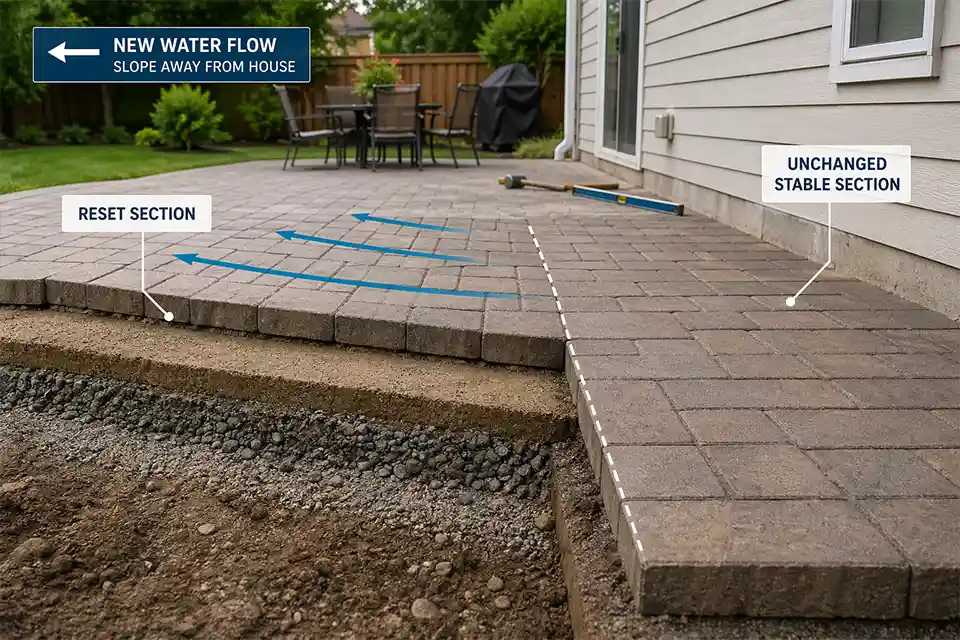
| One paver area settled near the wall | Lift and recompact that section | Re-sanding the joints repeatedly | If the same area keeps settling every season |
| Existing drain is present but water still lingers | Check clogs, outlet slope, and discharge path | Adding a second drain blindly | If the surface still directs water toward the house |
| Patio edge became worse after landscaping or walkway work | Restore drainage path and lower surrounding grade | Treating the patio as a stand-alone problem | If new grading changed the whole runoff pattern |
Most competing advice gets too generous here. Not every fix deserves equal weight. If the patio itself is back-pitched, that remains the first problem even if a downspout or blocked outlet is also involved.
If the patio is new, suspect layout; if it got worse later, suspect settlement
New patio, early problem
If the patio has held water against the house since the first season, poor installation is more likely than maintenance failure. The usual suspects are incorrect pitch, a badly planned drainage path, or a threshold area that was designed too tight to the wall without enough fall.
That is a useful distinction because a new patio that never drained properly is often not asking for maintenance. It is asking for correction.
Older patio, gradual worsening
If the patio used to drain reasonably well and the problem grew over 2 to 10 years, settlement, edging buildup, redirected runoff, or surrounding grade creep is more likely.
That is especially common after nearby landscape or hardscape changes. Backyard Drainage After Patio Walkway often follows this pattern, where a later project quietly changes where water stalls.
Likewise, Front Yard Problems After Regrading Hardscaping reflects the same broader principle: drainage failures often appear after elevation relationships change, not because the surface suddenly forgot how to drain.
The repair logic changes by patio type
Pavers
Pavers are more forgiving to repair because individual sections can be lifted and reset. If one narrow zone near the house has settled, local correction often makes sense. But if more than about 20% to 25% of the patio area shows movement, repeated spot repairs start to lose value.
Poured concrete
Concrete gives you fewer honest options. Grinding or overlay work can help when the defect is shallow and localized, but broad reverse pitch near the house usually pushes the conversation toward resurfacing or replacement.
If the slab is stable but the wall-side edge is consistently low, minor cosmetic fixes tend to delay the larger repair rather than replace it.
Decorative overlays or resurfaced slabs
These can hide the problem visually while preserving the same drainage geometry underneath. If a resurfaced patio still sends water toward the house, the new finish does not change the outcome.
When the standard fix stops working
There is a point where routine fixes stop making sense.
If you have already redirected the downspout, lowered the surrounding soil, cleaned any drains, and sealed obvious joints, but the same strip still holds water after ordinary rain, the issue is no longer maintenance-level. The patio geometry is wrong, or the site is still forcing too much water into the same edge.
That is also where readers often waste the most time. They keep buying small products because the puddle looks small. But the decision should not be based on puddle size.
It should be based on whether the surface keeps sending water to the house after the easy corrections are already done.
When that keeps happening for a full season, especially across several storms, the repair question changes from “What can I patch?” to “How much of this section needs to be reset or rebuilt?”
If water is also pooling in nearby yard areas around the house, Front Yard Water Pooling Near House Causes helps connect the bigger site-drainage pattern to what is happening at the patio edge.
For broader official guidance, see the U.S. EPA’s Soak Up the Rain.