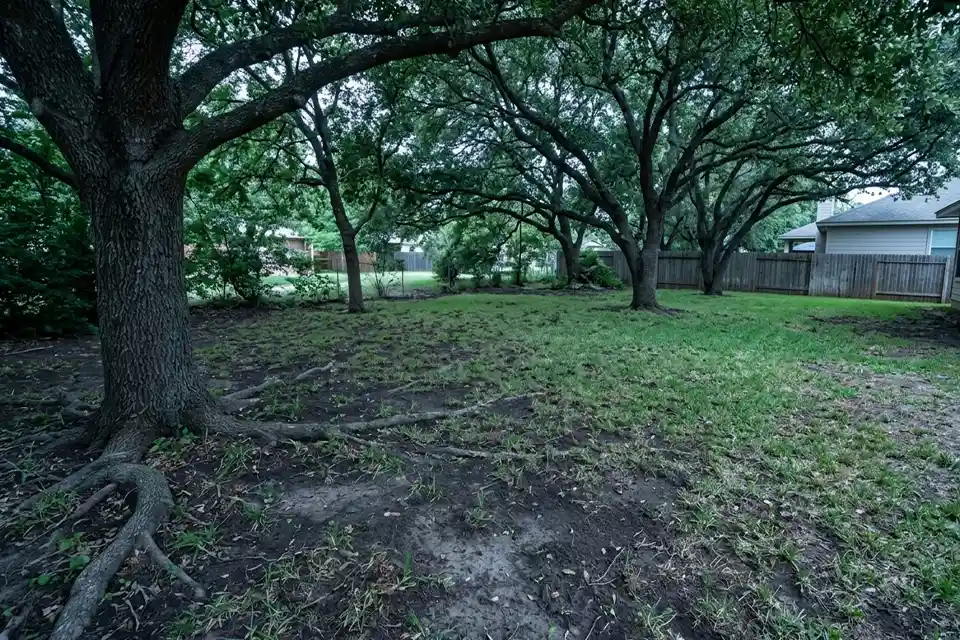
If your backyard still gets a few hours of usable light after the trees fully leaf out, the first category worth browsing is shade-tolerant grass seed mixes.
If it stays dim most of the day, dries slowly, and is packed with shallow roots, the better move is usually to stop forcing turf and shift toward a simple shade-bed conversion. That is the real split. Most people do not have a seed problem. They have a site-fit problem.
Start with three checks. Count direct sun after late-spring leaf-out, not before. If the area gets less than about 3 to 4 hours of direct sun, most lawn grasses will thin instead of spreading.
Check drying time next. If the top 1 inch of soil is still damp 24 hours after rain or irrigation, the site is acting more like a shade bed than a lawn.
Then test the upper root zone. If a trowel hits roots or hard resistance within 2 to 4 inches, new turf is competing in the weakest part of the soil profile.
A patchy lawn in open sun is often a repair problem. A lawn in deep shade, especially under mature trees, is usually a site-limitation problem. That distinction matters more than any bag label ever will.
Quick Shade Split: Repair or Convert?
If the area still gets around 4 to 5 hours of direct sun, has only moderate root competition, and does not stay damp into the next day, turf may still be worth repairing.
If it falls below that line and has already failed through more than one repair cycle, stop treating it like a normal lawn patch.
That is the first useful buying filter. Do not shop from the symptom alone. Shop from the condition. If the lawn still has a realistic chance, seed built for partial shade is the right place to start.
If the site has already crossed into deep-canopy failure, more seed usually becomes a hopeful purchase rather than a smart one.
What People Usually Misread First
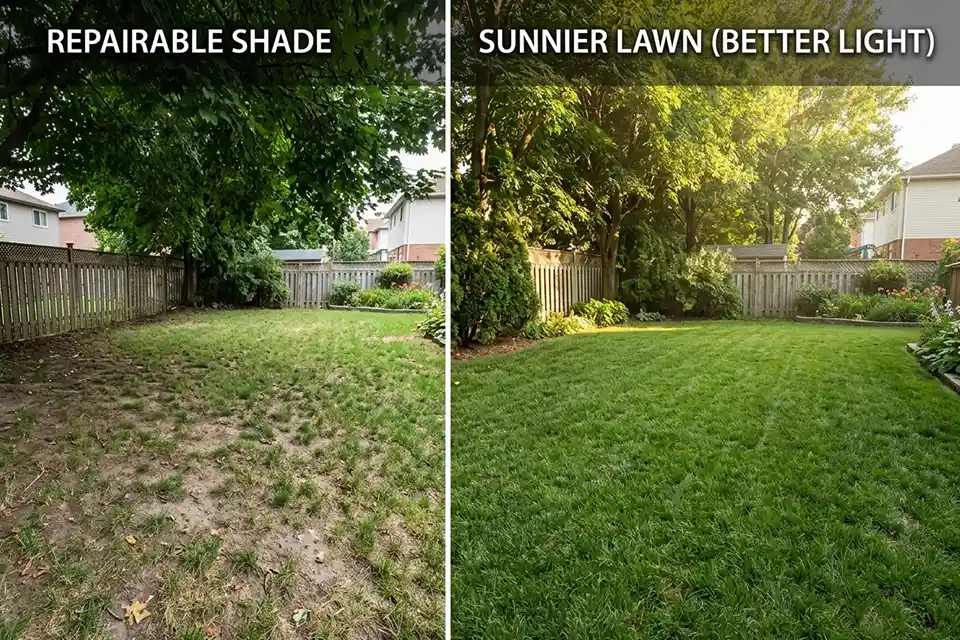
Bright shade is not the same as usable lawn light
Many backyards look brighter than they really are because the space feels open or gets moving dappled light. Turf does not respond to how bright the yard looks at noon.
It responds to total usable light over the day. Four to 6 hours of direct sun or strong filtered light is very different from a yard that feels bright but stays under dense canopy most of the day.
Early spring sun creates false confidence
This gets people every year. A lawn under trees may look workable in early spring before the canopy fully closes, then fail again by early summer once the leaves are fully out. If you judge the site too early, you can mistake a temporary light window for a lawn-friendly condition.
Germination is not establishment
Grass seed may sprout in 7 to 21 days and still fail later. That first flush of green proves very little. Establishment is the harder stage. If the grass keeps fading after 6 to 8 weeks, the real problem is usually not seed quality. It is inadequate light, shallow root competition, or slow drying that keeps the crown weak.
If your yard still clears the repair threshold after those checks, this is the first place to browse. The goal is not to buy a miracle fix. It is to narrow the search to seed mixes that actually match partial shade instead of pretending deep shade behaves like a normal lawn.
| BEST CATEGORY FOR REPAIRABLE SHADE |
|---|
| Shade-Tolerant Grass Seed Mixes |
| Best for backyard areas that still get partial sun and still have a realistic chance of holding turf. |
| This category fits when the lawn is thin but not fully site-incompatible, especially in partial shade rather than dense canopy darkness. |
| Look for mixes labeled for partial shade, region-appropriate grass types, and realistic coverage claims instead of miracle deep-shade promises. |
| 🔴SHOP shade-tolerant grass seed mixes |
| 🔴Alternative 1: sun and shade grass seed mixes |
| 🔴Alternative 2: dense shade grass seed mixes |
Why Grass Never Fills In
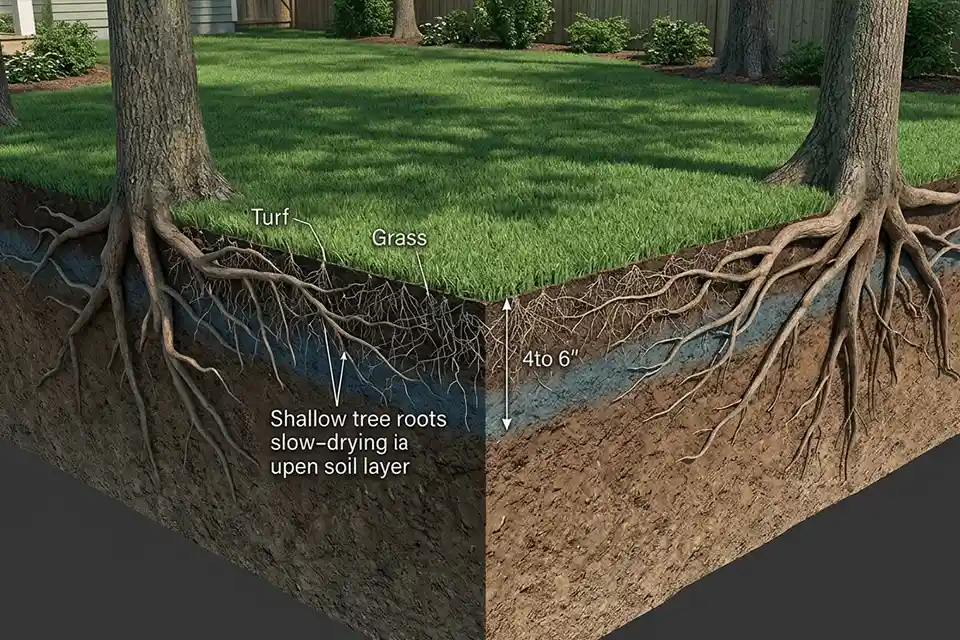
Tree roots usually win the upper-soil battle
In deep shade, especially beneath mature trees, the lawn is often competing with a root system that already controls the upper soil layers. Fine feeder roots commonly occupy the top 4 to 6 inches, which is exactly where young turf needs space, water, and oxygen. Even with irrigation, grass is usually the weaker competitor.
This is also why the problem often gets worse gradually instead of all at once. A lawn may look acceptable for a few years, then thin steadily as the canopy expands and the root zone gets more crowded. The lawn did not suddenly fail on its own. The site shifted first.
Wet shade is often worse than dry shade
People often assume tree areas are always dry. Sometimes they are. But the more frustrating condition is deep shade with slow drying.
If the soil surface stays damp for 24 to 36 hours, rooting slows, moss becomes more competitive, and disease pressure usually increases because both the turf and the soil surface stay wetter longer.
A healthier lawn area normally dries at the surface within several hours to half a day, not into the next day.
Mowing too short quietly keeps the lawn open
Shade lawns need more leaf area, not less. Keeping turf around 3 to 4 inches tall helps it capture more light and tolerate stress. Cutting lower than that often turns a marginal lawn into a failing one.
Pro Tip: Raise mowing height before buying more seed. In shaded lawns, that one adjustment often matters more than another overseeding attempt.
When several of these problems stack together, the yard starts behaving less like open turf and more like a shaded planting zone. That broader pattern overlaps with the logic behind Backyard Landscaping Problems in Shaded Areas, where the site slowly stops acting like a normal lawn space and starts acting like a woodland edge.
Which Grass Still Has a Chance in Shade?
Not all lawn grasses fail equally in shade, but this is where many homeowners expect too much from a “shade-tolerant” mix. Shade tolerance helps at the margin. It does not turn deep shade into a good lawn site.
| Grass type | Shade performance | Traffic tolerance | Where it still makes sense |
|---|---|---|---|
| Fine fescue | Best of the common cool-season options | Low | Partial shade with light foot traffic |
| Tall fescue | Moderate shade tolerance | Moderate | Partial shade with some root competition |
| Kentucky bluegrass | Weak in shade | Moderate | Brighter lawns, not dense canopy areas |
| Bermudagrass | Poor in shade | Good in sun, poor in shade | Sunny warm-season lawns |
| Zoysiagrass | Slightly better than bermuda, still limited | Moderate | Warm climates with filtered light, not deep shade |
For much of the Northeast, Midwest, and Mid-Atlantic, fine fescue or tall fescue is usually the only realistic lawn option in partial shade.
In warm-season regions, St. Augustine is often the most realistic turf choice for shade, but even that does not solve true deep shade under a dense backyard canopy. Grass type matters, but not as much as the light pattern itself.
A second factor people underestimate is traffic. A grass that tolerates shade better may still handle wear worse.
If this is the route from the patio to the gate, the dog’s run line, or the area where kids cut across daily, even a shade-tolerant lawn can fail because the site is both dim and worn down.
When Seed Stops Being the Smart Purchase
If you have overseeded the same area for 2 or 3 seasons and it keeps reopening, the problem is no longer a seeding problem. Repeating the same fix only makes sense when the site is close to workable.
It stops making sense when the yard gets under 3 to 4 hours of direct sun after leaf-out, stays wet too long, or has dense surface roots across most of the zone.
That is the second important decision point. Once the site has crossed into repeat failure, the right next step is no longer better seed. It is a simpler conversion that works with the yard instead of against it.
What to Do Instead of Fighting the Same Patch Forever
Dry shade under trees
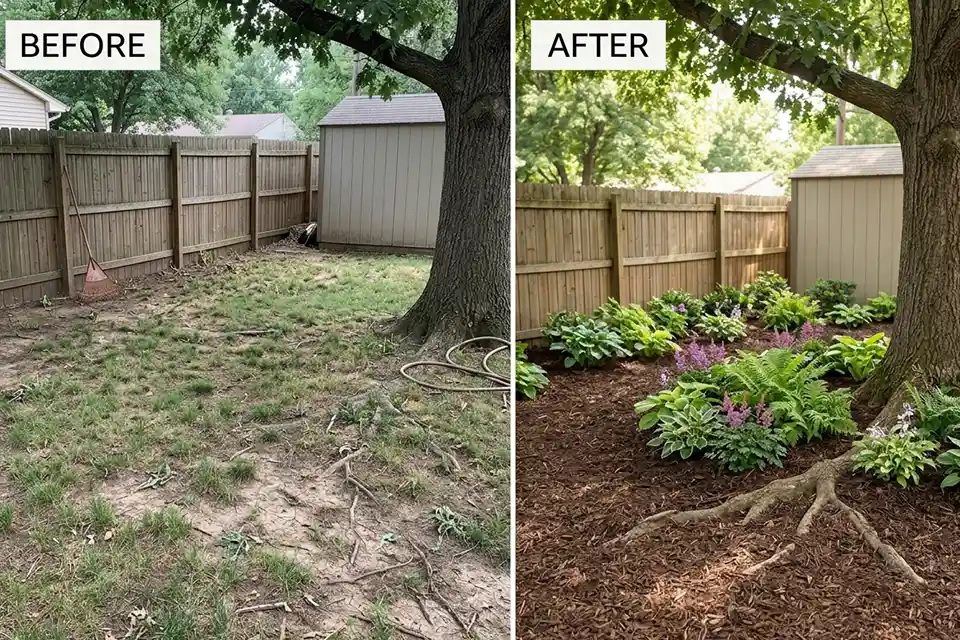
If the area is root-heavy and dries unevenly, a woodland-style bed, mulch zone, or dry-shade planting mix usually makes more sense than another lawn attempt. The best outcome is often a deliberate transition, not a thinner version of the same lawn.
That is also where Backyard Landscaping Without Grass Problems becomes more useful than another lawn-care article. The goal shifts from forcing turf to choosing a surface or planting approach that matches the conditions the yard already has.
Damp shade near dense canopy
If the area stays moist, use plants and materials that tolerate lower light and slower drying. That usually performs better than trying to keep turf alive in a place that behaves more like a shade border than a lawn.
Light foot-traffic corridors
If people still need to move through the area, treat it like circulation space instead of pretending it is lawn. A mulch path, stepping-stone route, or planted edge usually holds up better than weak turf that wears out every season.
If the goal is the simplest stable conversion, this is the section where practical products start making more sense than more lawn inputs.
The main answer is mulch, but the supporting pieces matter too. A defined edge keeps the bed from bleeding back into weak turf, and a standard bagged mulch product is often the most practical way to build a clean first test area.
| BEST PRODUCTS FOR SIMPLE SHADE CONVERSION |
|---|
| Mulch for Shade Beds Under Trees |
| Best for heavily shaded backyard areas where grass keeps failing and the simpler goal is a stable, low-maintenance finish. |
| This category fits when the space is root-exposed, uneven, and better handled as a shade bed than as a weak lawn. |
| Look for mulch with enough particle weight to stay put, good coverage for shaded beds, and a finish that works around visible roots. |
| 🔴 SHOP mulch for shade beds under trees |
| Alternative 1: landscape edging for shade beds |
| Alternative 2: bagged mulch for shade-bed conversion |
Instead of converting the whole lawn at once, test a small 4-by-4-foot section first and see whether that part of the yard performs better as a shade bed, groundcover zone, or path edge. That kind of trial is often more useful than another full-yard reseeding cycle.
This is also where some backyards begin collecting layered maintenance problems.
Once one shaded section stops functioning as lawn, nearby edges, beds, and traffic routes often start shifting with it.
That is part of the longer pattern behind Backyard Landscaping Problems Worse Over Time, where small site mismatches gradually turn into recurring upkeep.
When the Standard Fix Stops Making Sense
The real threshold is not whether you can get blades to sprout. It is whether the area can hold acceptable coverage through a season without constant rescue work.
If it still looks thin after 6 to 8 weeks of active growth, fails again after 2 repair cycles, or stays below the 3-to-4-hour direct-sun line once the canopy is fully leafed out, the routine lawn fix has probably stopped making sense.
If the area still cannot hold coverage after one full growing season of corrected mowing, appropriate seed choice, and controlled watering, it is no longer a lawn-care problem. It is a site-fit problem.
At that point, the smart decision is usually not better seed. It is a better match between the site and the planting strategy.
For broader guidance on why shaded lawns struggle and when repair stops making sense, see the University of Maryland Extension.