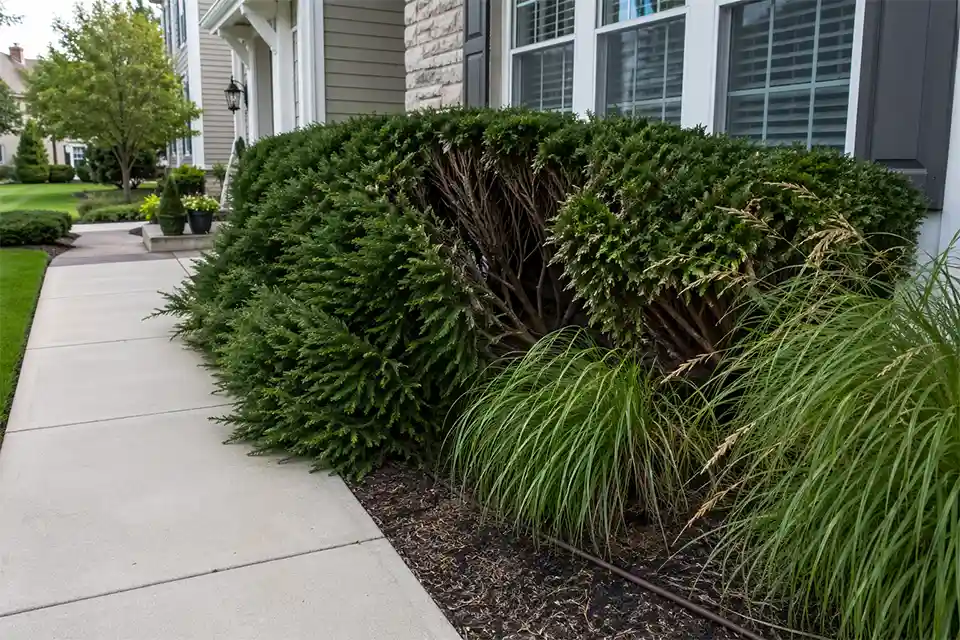
The front yard plants that get expensive fastest are usually not rare plants. They are familiar shrubs and grasses put into beds that are too shallow, too hot, or too close to the house for their mature size.
Start with three checks before you buy anything: compare mature width to bed depth, check whether the plant can still leave a visible gap next to the wall at full size, and ask whether it will still make sense if it needs summer water every week after year two.
If a shrub wants to mature 6 to 8 feet wide in a bed that is only 4 or 5 feet deep, the maintenance cost is already built in.
That is different from a plant that simply looks stressed in one rough stretch of weather. A shrub that wilts during a 95°F heat wave is not automatically the wrong choice.
A shrub that needs shearing every 6 to 8 weeks just to stay off the walk usually is. The expensive front-yard plants are not always expensive to buy. They become expensive because they create a permanent pattern of pruning, irrigation, cleanup, or replacement.
The plant choices that usually get costly first
Fast-growing privacy shrubs in shallow beds
This is the biggest regret category. People want screening fast, so they plant vigorous shrubs close to front windows or along narrow foundation beds. The problem is simple: speed is exactly what raises the long-term bill when space is tight.
Arborvitae, photinia, cherry laurel, and similar fast growers can be useful in the right location, but they are usually a bad bargain in a 4- to 6-foot-deep bed. Once a shrub needs hard reduction 2 or 3 times a year, it stops being a plant choice and starts being a maintenance system.
That is why fast-growing front yard hedges often sound smarter at install than they do by year three.
The wasted fix here is more pruning. Shearing does not solve the mismatch. It usually creates a dense outer shell, a bare interior, and a plant that now depends on constant cutting to stay in bounds.
Large ornamental grasses beside walks
Large grasses are often sold as low maintenance, and sometimes they are. But low maintenance in a broad bed is not the same as low maintenance beside a front walk, mailbox, or driveway edge.
Once the mature clump gets within about 12 inches of a path, it starts borrowing pedestrian space. Add a yearly cutback, blade flop, and leaf litter trapped in the crown, and the labor stops being occasional.
That is why front yard ornamental grass maintenance problems show up so often after the first full growing season.
Thirsty flowering shrubs in reflected heat
This category fools people because it usually looks fine in spring. The trouble starts in midsummer when west-facing walls, driveways, and masonry push heat back into the bed. Hydrangeas, lush mixed shrub borders, and bloom-first front beds can become expensive quickly in those conditions.
The useful threshold is not whether the plant ever wilts. It is whether the bed still needs supplemental water more than once a week in year three. If it does, the site match is weak or the plant is wrong for that exposure.
That is where front yard irrigation costs climbing often becomes the real sequel to a pretty install.
What people usually misread first
Nursery size is not landscape size
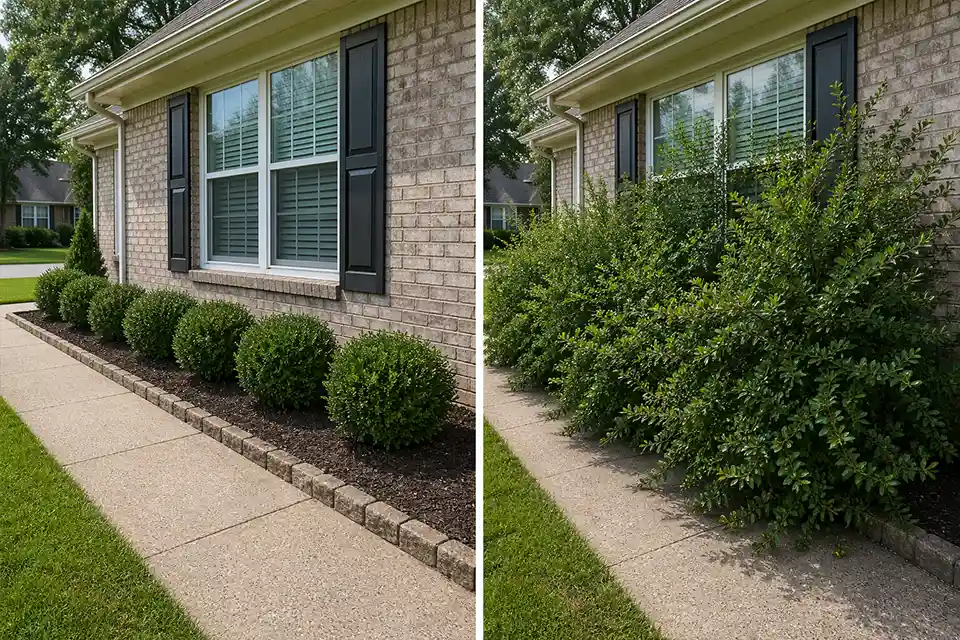
A 3-gallon shrub looks harmless. That visual cue causes more bad front-yard decisions than plant price does. In the front yard, the available space is usually fixed by the house, walkway, and windows, so the bed starts making the decision for you after the first season or two.
More pruning is not a planning strategy
People overestimate pruning and underestimate spacing. If the plant cannot mature while still leaving room from the wall, windows, and walk, the problem is not technique. It is plant fit.
A blunt rule works well here: if mature width is more than about 60 to 70 percent of total bed depth, you are moving into active-management territory. If it is wider than the bed itself, replacement is usually cheaper than control.
Color gets overvalued, structure gets undervalued
A lot of front-yard advice sells seasonal color. What it usually softens is that bloom is brief and maintenance is continuous. Evergreen structure, slower shrubs, and repeated plant groupings usually cost less because they do not force constant editing.
People commonly overestimate how much flowers improve the front yard. They underestimate how much clear walkway edges, visible windows, and orderly structure improve it.
Quick diagnostic checklist
- The bed is under 5 feet deep, but the plant tag shows a mature width above 4 feet.
- The plant will likely need cutting back more than twice each growing season.
- The bed gets 4 or more hours of reflected afternoon heat from pavement or a wall.
- The shrub would eventually crowd the wall or cover part of the lower window line.
- The bed still needs summer watering more than once a week after year two.
- The plant is being asked to provide privacy, flowers, and foundation softness all at once.
If three or more apply, the choice is drifting from attractive to expensive.
What to plant instead if you want lower regret
Use slower structure where speed sounds tempting
Instead of a fast privacy shrub, choose a slower evergreen or naturally compact shrub that can mature inside the footprint. Boxwood, compact inkberry, dwarf yaupon holly, and restrained Japanese holly cultivars may not deliver instant screening, but they usually cost less over time because they are not trying to outgrow the bed.
Use compact texture instead of oversized drama
Instead of a large fountain grass that leans into the walk, use a tighter clumping grass or a low mounded shrub. The front yard rarely needs the most vigorous texture plant. It needs the most disciplined one.
Use flowers as accents, not as the whole system
Instead of building the whole bed around thirsty shrubs or constant seasonal color, use evergreen structure first and add smaller flowering plants as accents. A calmer mix of 3 to 5 repeated plant types is usually cheaper than 10 to 14 varieties chosen for nonstop bloom.
That is also why how to choose plants for front yard landscaping is more useful than another generic plant list when the goal is lower long-term cost.
Pro Tip: Take two measurements to the nursery, not one: bed depth and the height of the lowest window line. Those two numbers eliminate a surprising number of expensive mistakes.
Better-fit substitutions that actually lower regret
| Costly plant pattern | Why people buy it | What the real cost becomes | Better-fit substitute pattern |
|---|---|---|---|
| Fast hedge shrub | Quick privacy | Repeated shearing, blocked windows, crowding | Slower evergreen shrub sized to the bed |
| Large ornamental grass by walk | Instant texture | Flop, cleanup, yearly cutback, path encroachment | Compact clumping grass or low shrub |
| Thirsty flowering shrub in hot exposure | Soft lush look | High irrigation and summer stress | Heat-tolerant structural shrub with lighter seasonal accents |
| Annual-heavy front bed | Maximum color | Replanting and higher water use | Evergreen backbone plus a small accent layer |
| Mixed impulse-buy palette | Variety and fullness | Uneven water needs and constant editing | 3 to 5 repeated species with clear roles |
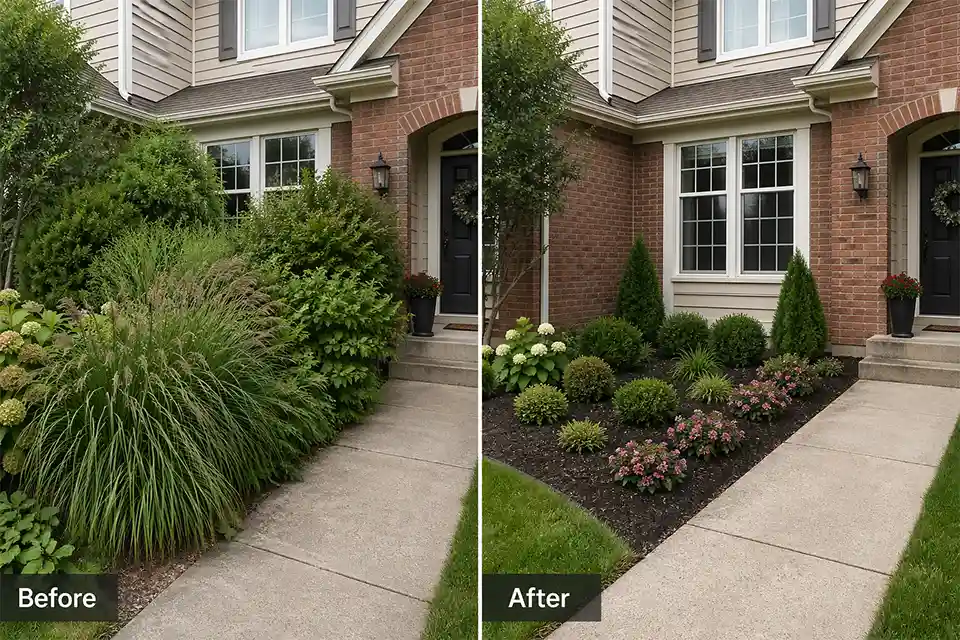
A useful distinction: the cheaper replacement is not always a smaller version of the same idea. Often the better move is a different job entirely.
Replace fast screening with structure. Replace oversized softness with compact rhythm. Replace constant color with a stable backbone that still looks intentional in the off-season.
The site limits that matter more than the plant tag
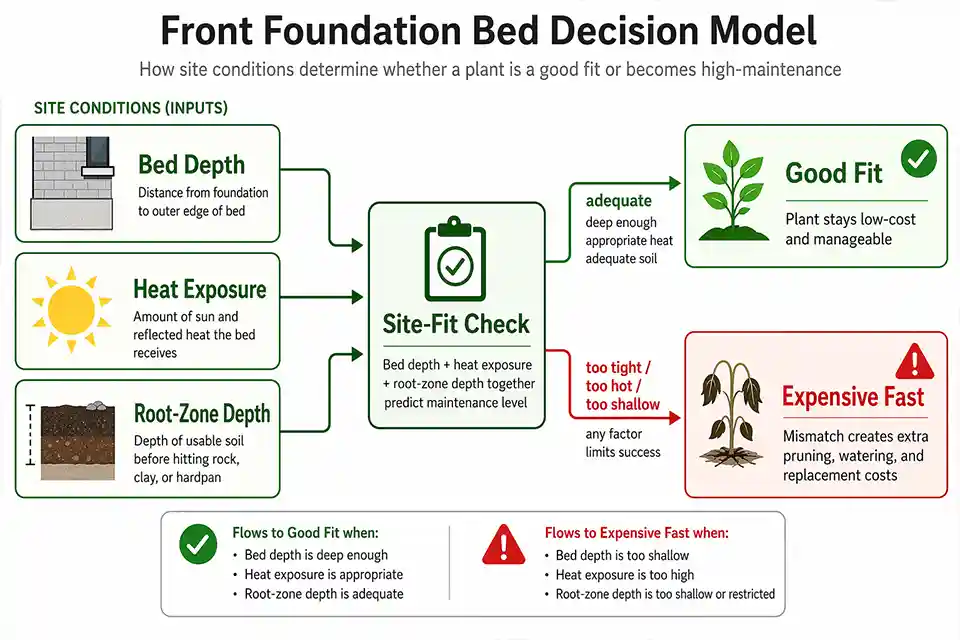
Bed depth and hard edges
A front bed that is 4 feet deep cannot comfortably hold a shrub that wants to spread 6 feet unless you plan to prune it forever. Walkways, porch steps, and siding make front-yard mistakes more expensive because there is less room for plants to misbehave quietly.
Shallow topsoil
This gets underestimated all the time. If a trowel hits compacted fill, rubble, or dense subsoil within 6 to 8 inches, the bed may never support the easy establishment the nursery tag implies. Plants can survive there, but they often become more water-dependent and less stable than expected.
That is where front yard plants in shallow topsoil matters more than another plant list. The site can make an otherwise reasonable plant choice expensive.
Climate pressure
In dry, high-heat areas like inland California or parts of Arizona, reflected heat can turn “tolerant” shrubs into steady water users. In humid parts of Florida and the Southeast, dense overplanting can make vigorous shrubs harder to manage cleanly.
In colder northern states, winter dieback and snow load can make floppy or marginally hardy front plants look rough longer than expected.
When the standard fix stops making sense
Routine pruning stops making sense when the plant’s natural size is more than about one-third larger than the available space, when it needs intervention every month during the growing season, or when one problem bed is forcing a higher irrigation schedule for the whole front yard.
This is the point readers commonly underestimate: the cheap-looking fix is often the expensive one because it preserves the wrong decision.
Replacing two or three oversized plants usually costs less over the next 12 to 24 months than preserving them through constant cutting, cleanup, and extra watering.
One thing that gets missed in real landscapes is that the first plants to become “high maintenance” are not always the fragile ones. Very often, they are the vigorous ones put into small, hot, visible spaces and expected to behave politely.
For broader official guidance on choosing climate-appropriate plants, see the USDA Plant Hardiness Zone Map.