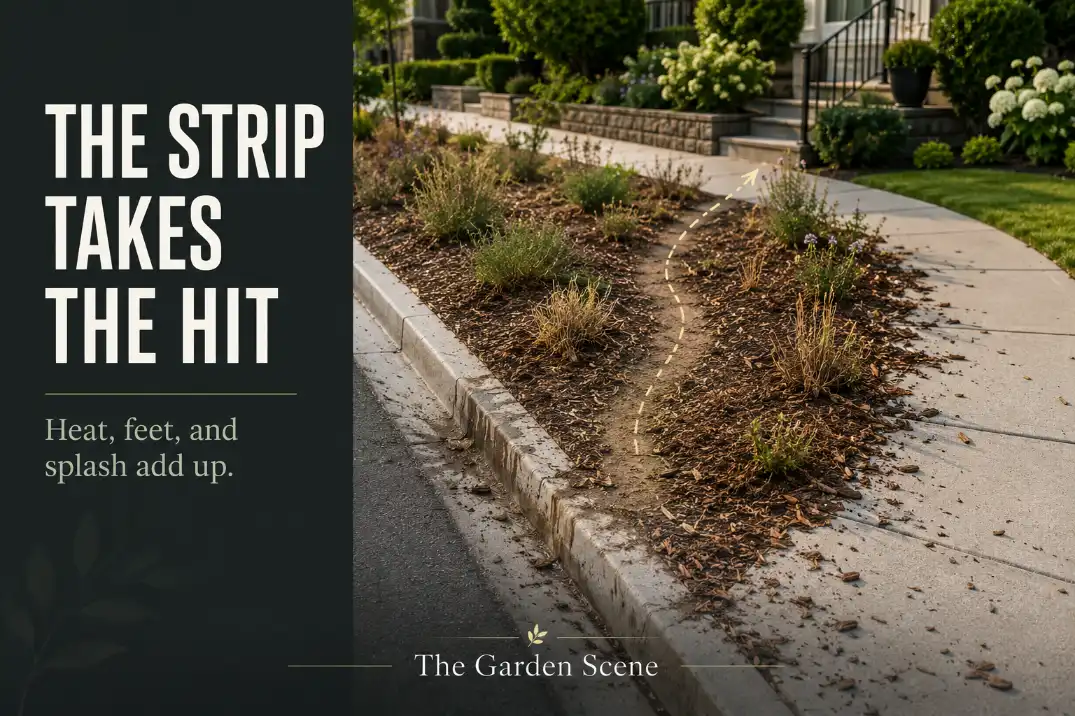
A sidewalk strip usually becomes high-maintenance because it is treated like a narrow garden bed when it actually behaves like a traffic edge. Heat reflects off concrete, people cut across the shortest point, curb splash throws grit into the soil, and loose mulch moves every time water, wind, or a blower hits it.
The first checks are practical: look for a repeated footpath, mulch on the sidewalk within 24–48 hours of rain, and water that fails to soak in after about 30 minutes. That is different from a simple plant problem.
Weak plants matter, but the underlying issue is usually exposure plus movement plus poor containment.
The best low-maintenance idea is rarely one magic plant; it is a durable crossing point, a stable surface, compact planting, and a watering method that does not overspray the walk.
More Than a Planting Strip
A sidewalk strip, parkway, hellstrip, curb strip, or tree lawn sits in one of the roughest parts of the front yard. It is narrow, public-facing, exposed from both sides, and often shaped by city rules, street trees, utilities, mailbox access, parked cars, or snow storage.
The mistake is designing it only for curb appeal. A sidewalk strip has to look intentional from the street, stay out of the walkway, and survive conditions that are hotter and more disturbed than a normal front planting bed.
Check the public edge before spending money
Before adding expensive stonework, dense planting, or permanent edging, check whether the strip sits in a right-of-way or utility access zone.
Many homeowners still maintain the strip, but local rules may limit plant height near intersections, require clear sightlines near driveways, or allow utility work to disturb the area.
That does not mean the strip has to stay bare. It means the smartest maintenance ideas are usually removable, low, and easy to repair: stepping stones, a narrow gravel band, compact plants, and edging that keeps the sidewalk clean without creating a trip point.
For plant choices that fit this exact setting, Best Plants for a Sidewalk Street Strip is the right companion once the maintenance structure is clear.
The strip needs movement control
A good sidewalk strip has four working parts: a surface that does not scatter, an edge that contains material, plants that finish at the right size, and water that reaches roots without washing across concrete. If one is missing, the bed starts exporting mess onto the sidewalk.
People often overestimate plant toughness. A drought-tolerant plant can still fail if its root zone is only 4–6 inches deep, compacted by foot traffic, and baked by reflected heat.
What gets underestimated is cleanup frequency. If mulch, gravel, or soil crosses onto the sidewalk after every rain, the strip is not low-maintenance. It is just making the cleanup visible.
Heat, Foot Traffic, and Curb Splash
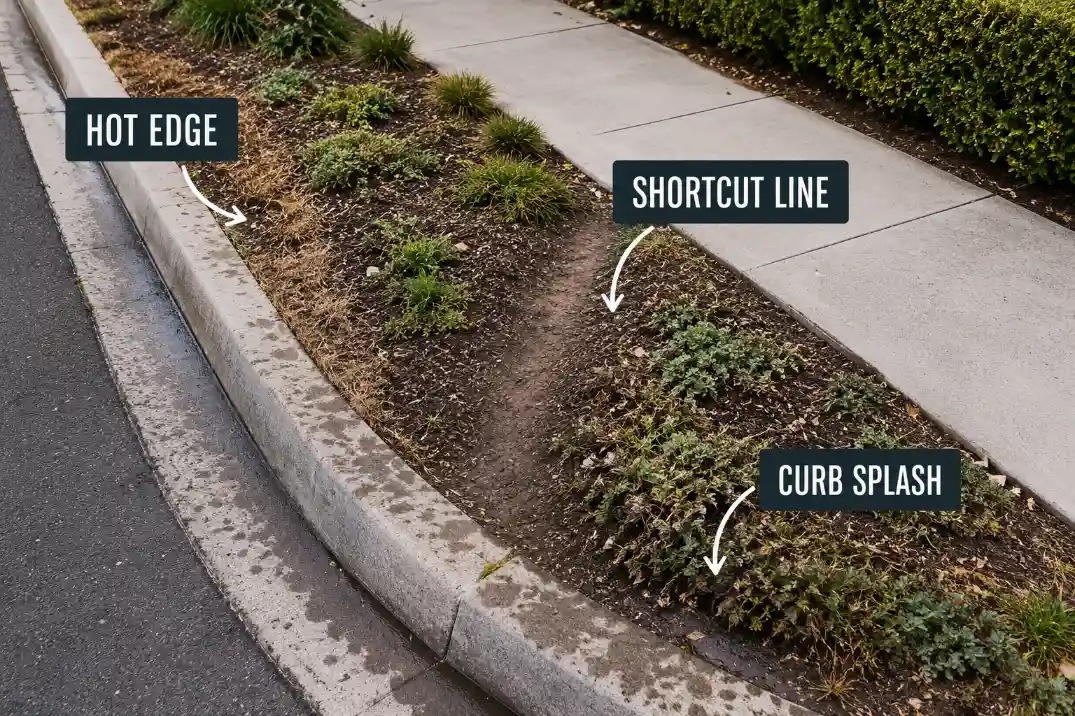
The strongest sidewalk strip maintenance starts by reading the stress pattern. Heat damage, shortcut damage, and curb splash can all make a strip look thin or dirty, but they do not call for the same fix.
Heat shows at the concrete edge first
Reflected heat usually appears as browning, thinning, or crispy foliage along the sidewalk or curb side. In hot climates like Arizona, Texas, inland California, and parts of the Southeast, concrete and asphalt can make this strip much harsher than the rest of the front yard.
A useful threshold: if the first 6–12 inches beside the sidewalk dries out a full day sooner than the center of the strip, watering more often may not be the main answer.
The better move is usually to shade the soil faster with tighter planting, a stable surface, or less exposed bare mulch.
Foot traffic creates a line
Pedestrian wear usually appears as one narrow diagonal or straight shortcut. The rest of the strip may look acceptable while one area stays flattened. That line is a design clue, not just damage.
If people are cutting through the same place, adding delicate plants there wastes time. Use stepping stones, a compact gravel pass-through, or a tougher groundcover zone instead.
For that specific pressure pattern, Front Yard Plants for Sidewalk Shortcut Traffic fits better than another general plant list.
Curb splash is not solved by fertilizer
Curb splash leaves grit, crusting, salt residue in northern states, and debris near the street side. In Midwest and northern winter climates, deicing salt can make the curb edge look weak before spring growth even starts.
The fix is surface control first. If the curb-side 8–10 inches stays dirty, compacted, or crusted, start with mulch choice, soil loosening, and salt-tolerant or easily replaceable plants. Fertilizer does not solve a strip that is being physically hit by runoff and street residue.
Sidewalk Strip Maintenance Ideas That Actually Reduce Work
The best ideas are not decorative add-ons. They remove the reason the strip keeps getting damaged.
Add a curb landing pad
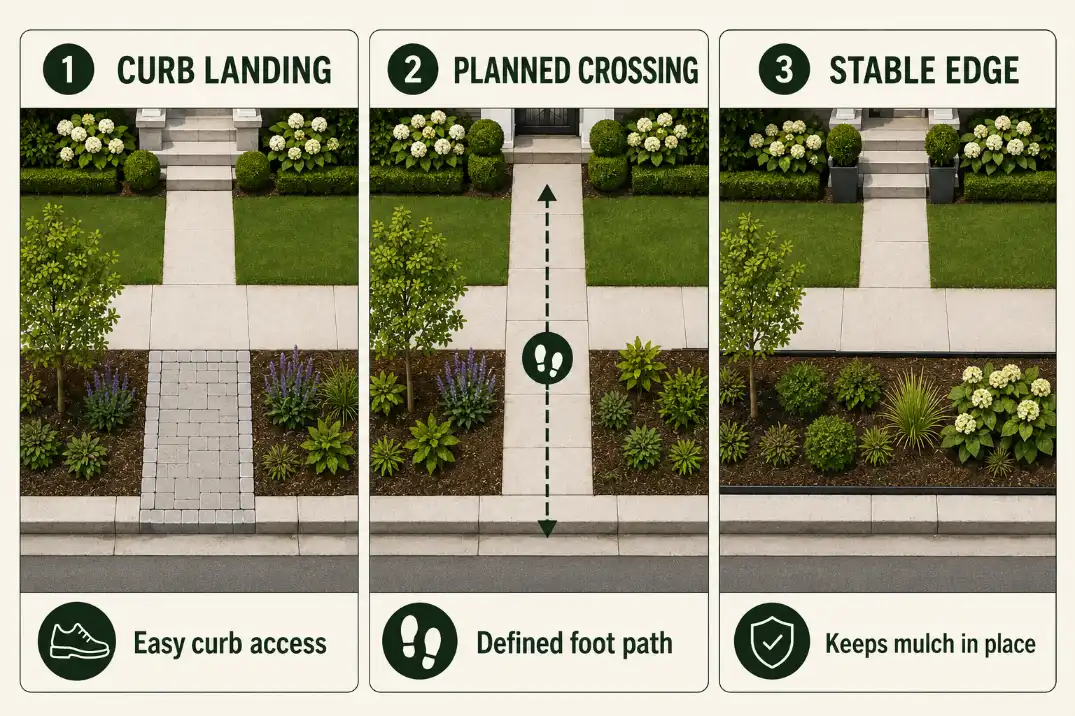
If people step out of parked cars into the strip, build that movement into the design. A 16–24 inch paver, stone, or compact gravel landing near the curb can prevent random trampling and make the strip look intentional.
This matters most where street parking is frequent. Place the landing where car doors naturally open, not where it looks best in a drawing.
Turn the shortcut into a crossing
A repeated footpath will almost always beat soft planting. Instead of fighting it, convert the worn line into a planned crossing with stepping stones or a narrow gravel path.
This is especially useful when the strip sits between a driveway, mailbox, school walking route, or busy sidewalk. Once the crossing is planned, the plants stop taking the blame for a route nobody designed.
Use a mulch-free curb band
The curb edge gets splash, grit, road residue, and sometimes snow pile pressure. Organic mulch often looks good at installation but spreads into the gutter after storms.
A narrow mineral band, larger river rock, or low groundcover edge can work better than bark in that first impact zone. Pea gravel is not always ideal because it can scatter under foot traffic. Larger stone around 1 inch or more is often more stable, though dark rock can increase heat in full sun.
Keep the planting spine compact
A sidewalk strip does not need many plant types. It needs plants that finish at the right size. In a 30–36 inch-wide strip, plants that mature at 18–24 inches wide are easier to keep clean than shrubs that constantly lean into the sidewalk.
The best-looking version is usually not the fullest strip. It is the strip where every exposed edge, crossing point, and plant size has already been controlled.
Mulch That Will Not Stay Put
Loose mulch is one of the fastest ways a sidewalk strip starts looking neglected. The bed is narrow, so there is no buffer. A few inches of drift lands directly on the sidewalk or in the gutter.
Fine mulch moves too easily
Fine bark, shredded light mulch, and fresh wood chips can scatter under rain, wind, leaf blowers, pets, and foot traffic. In a protected garden bed, that movement may not matter. In a 2–4 foot strip, it becomes visible immediately.
A 1–2 inch mulch layer is usually more realistic here than a fluffy 3–4 inch layer. The mulch should cool the soil and suppress weeds without creating loose material that floats or blows into the walkway.
When adding more mulch stops making sense
If you have swept the same mulch back into the strip three times in one month, the problem is no longer mulch depth. It is slope, splash, traffic, blower force, or missing edge control.
At that point, replacing mulch every season is a maintenance loop. Fix the edge, interrupt the runoff path, or switch the highest-impact area to a more stable surface.
For the same failure pattern in broader front beds, Front Yard Mulch Washes Away Every Season explains why loose material keeps escaping instead of staying where it was placed.
Pro Tip: Sweep the strip clean before the next storm and watch what moves first. The drift pattern usually tells you whether the failure is water, wind, or foot pressure.
Watering a Narrow Strip
Watering a sidewalk strip is awkward because the target area is small, exposed, and easy to overspray. The strip needs slow, accurate watering that reaches roots without turning the sidewalk or curb into part of the irrigation zone.
Use the 30-minute absorption check
After watering, look at the strip 30 minutes later. If water is still sitting on the surface or has run onto the sidewalk, the soil may be compacted, the watering rate may be too fast, or the surface may be pitched poorly.
Healthier soil should darken and accept water without sending a visible sheet across the concrete. Failing soil often puddles, crusts, or sheds water toward the curb.
| Condition You See | More Likely Meaning | Better Maintenance Move |
|---|---|---|
| Dry edge within 24 hours | Reflected heat and shallow moisture | Add soil cover and adjust watering depth |
| Water runs off in minutes | Compaction or too-fast watering | Loosen top 4–6 inches and water slower |
| Mulch floats into gutter | Surface flow across loose mulch | Improve edge and use heavier surface material |
| Plants flop onto sidewalk | Wrong mature size or weak trimming plan | Replace with compact plants |
| One bare diagonal line | Pedestrian shortcut | Add stones or a durable crossing |
First-year water is not the permanent plan
New plants often need closer attention for the first 6–8 weeks, and in hot regions they may need support through the first growing season. That does not mean daily surface misting is the right routine.
Water slowly enough that the root zone gets moisture, then let the surface begin to dry. If the top 2 inches are still wet for long periods in humid climates, more water may create disease and weak growth.
In dry inland climates, the same strip may need deeper but less frequent soaking to survive reflected heat.
Sprinklers often waste water here because the strip is too narrow. Dripline, hand watering, or narrow spray patterns usually keep the sidewalk cleaner.
Edges That Keep the Walkway Clean
Edges decide whether the strip looks maintained between cleanups. Without an edge, mulch, soil, gravel, and plants slowly move outward.
A clean edge is a maintenance tool
A good edge does not need to be tall. It needs to hold material in place without creating a trip hazard. Low metal edging, flush stone, or a clean concrete-side border can all work if they keep the walkway line readable.
This is where many homeowners pick the wrong battle. They trim plants more often when the real problem is that the surface has no containment.
Shifting edging becomes its own problem
Plastic edging, loose stone, and shallow metal strips can move under freeze-thaw cycles, mower hits, foot pressure, or expanding roots. If the edge rises, tilts, or creates a lip, it has stopped solving the maintenance problem.
A practical warning sign is movement greater than about 1 inch from the original line. Once that happens, constant re-tucking usually becomes wasted effort.
The edge needs resetting, deeper anchoring, or a different material. If this is already happening, Front Yard Edging Keeps Shifting is more useful than another cleanup routine.
Low-Maintenance Without Looking Bare
A low-maintenance sidewalk strip should not look empty. It should look edited. The cleanest versions use fewer plant types, controlled mature sizes, stable surfaces, and one planned place for people to cross.
Use plants that finish at the right size
A plant that needs trimming every two weeks to stay off the sidewalk is not low-maintenance here. Mature width matters more than nursery size.
If the walkway loses more than 6 inches of usable width during peak growth, the planting is creating a maintenance problem. Replace the plant instead of turning pruning into a permanent chore.
Be careful with spreading groundcovers
Groundcovers can make a strip look full without loose mulch showing everywhere, but spreading plants create another kind of maintenance if they creep into lawn, curb joints, or sidewalk cracks.
This is where “low-maintenance” is often misread. A living carpet is easier only when its spread rate matches the space and the edge can hold it.
For that issue, Front Yard Maintenance Problems When Groundcovers Spread Into Walkways and Lawn is worth checking before choosing aggressive groundcovers.
Keep the strip readable from the street
A narrow strip does not need a complicated plant mix to look finished. Repetition usually works better: one tough low plant, one stable surface, one clear crossing, and one clean edge. That combination looks intentional even when the plants are not in bloom.
Questions People Usually Ask
Is grass easier than planting a sidewalk strip?
Sometimes, but not always. Grass is easy only if it gets enough water, can be mowed safely, and does not turn into a compacted shortcut. In hot, narrow, heavily walked strips, grass may need more irrigation, edging, and repair than a tougher mixed planting.
Should I use artificial turf in a sidewalk strip?
It can look tidy at first, but it is not maintenance-free. Debris, weeds at the edges, heat buildup, pet waste, and matting still need attention. In very hot climates, artificial turf can make the strip feel harsher than living plants or a lighter mineral surface.
What is the simplest upgrade if the strip already looks messy?
Start where the mess is moving. If mulch is crossing the sidewalk, fix the edge or surface. If one diagonal line is bare, add a planned crossing.
If plants keep leaning into the walkway, replace them with compact choices instead of pruning the same problem every few weeks.
A sidewalk strip stays low-maintenance when it is designed for pressure, not just appearance. Handle the repeated stress first: heat at the concrete edge, feet across the shortest path, splash from the curb, and loose material that refuses to stay contained.
After that, plant choice becomes a finishing decision instead of a rescue plan.
For broader official guidance, see the University of Minnesota Extension’s effects of deicing salts on landscapes.