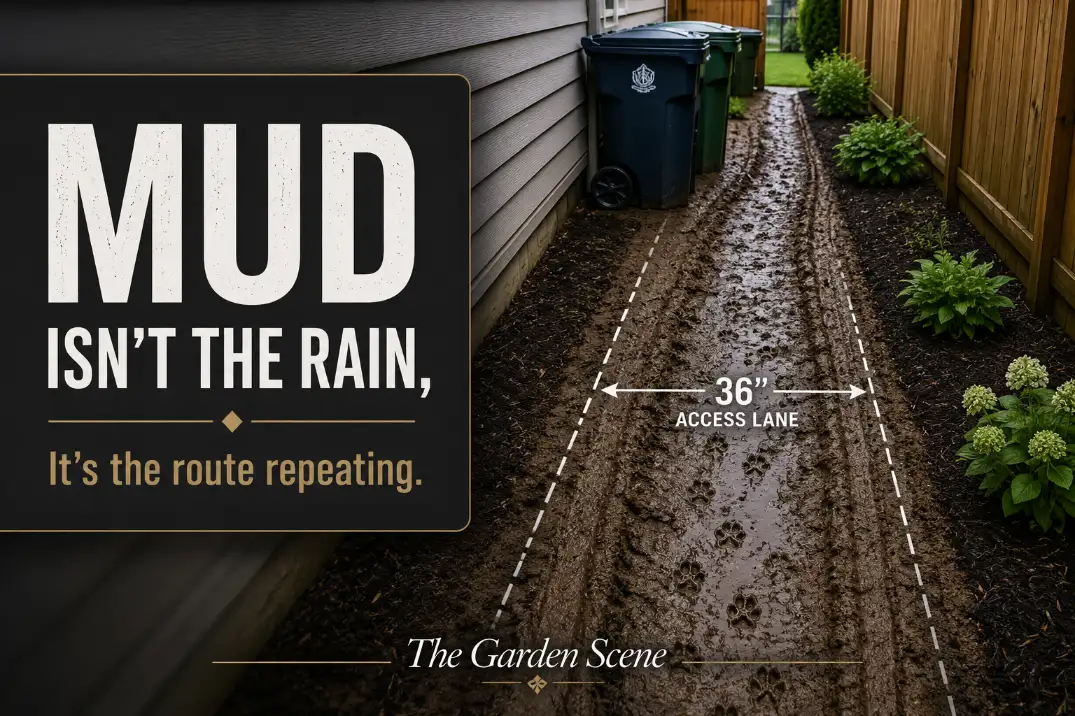
Side yard mud usually starts where traffic, trapped water, and weak surface structure overlap. Dogs run the same line, trash bins cut the same wheel tracks, and daily footsteps compress the top 2–4 inches of soil until water no longer drains through it cleanly.
The first useful checks are simple: does the lane stay soft more than 24–48 hours after rain, do bin wheels leave ruts deeper than 1/2 inch, and does water move away from the house at about 1/4 inch per foot?
That makes this different from a normal puddle or a messy mulch bed. A muddy side yard access route is usually not fixed by “covering” the soil.
The better order is to find where the mud starts, remove or redirect the water source, rebuild the traffic lane, and then choose a surface that can handle dogs, bins, and daily use.
Repeated Traffic Creates Mud
The mud follows the route before it fills the yard
In a side yard, mud usually appears as a strip before the whole area fails. That strip is the clue. If the same 30-inch to 36-inch corridor handles dogs, bins, hose use, and foot traffic, the surface has almost no recovery time.
Grass disappears first, but bare soil is only the symptom. The underlying mechanism is compaction. Repeated pressure closes soil pores, which slows infiltration and keeps water near the surface.
Once the upper few inches become slick and compressed, even a modest rain can leave the route muddy while nearby beds look fine.
The fix that often wastes time is reseeding the same traffic line. Grass may sprout during a quiet week, but if the route is shaded, wet, and used daily, it is being asked to perform like pavement.
A side yard that carries real movement needs to be treated as a working lane, not as a decorative strip of lawn.
What people usually misread first
The most common misread is blaming the last visible event. A muddy footprint appears, so the problem seems like foot traffic. A dog runs through, so the dog gets blamed. A trash bin cuts a rut, so the bin seems like the cause.
Usually, those are symptoms of the same weaker system. The lane is staying wet too long, the soil is already compacted, and the surface is not strong enough for repeated pressure.
If the side yard also serves as the main front-to-back route, the planning logic needs to account for drainage and access together, much like the priorities in Side Yard Ideas for Drainage and Access.
Where the Mud Starts Matters Most
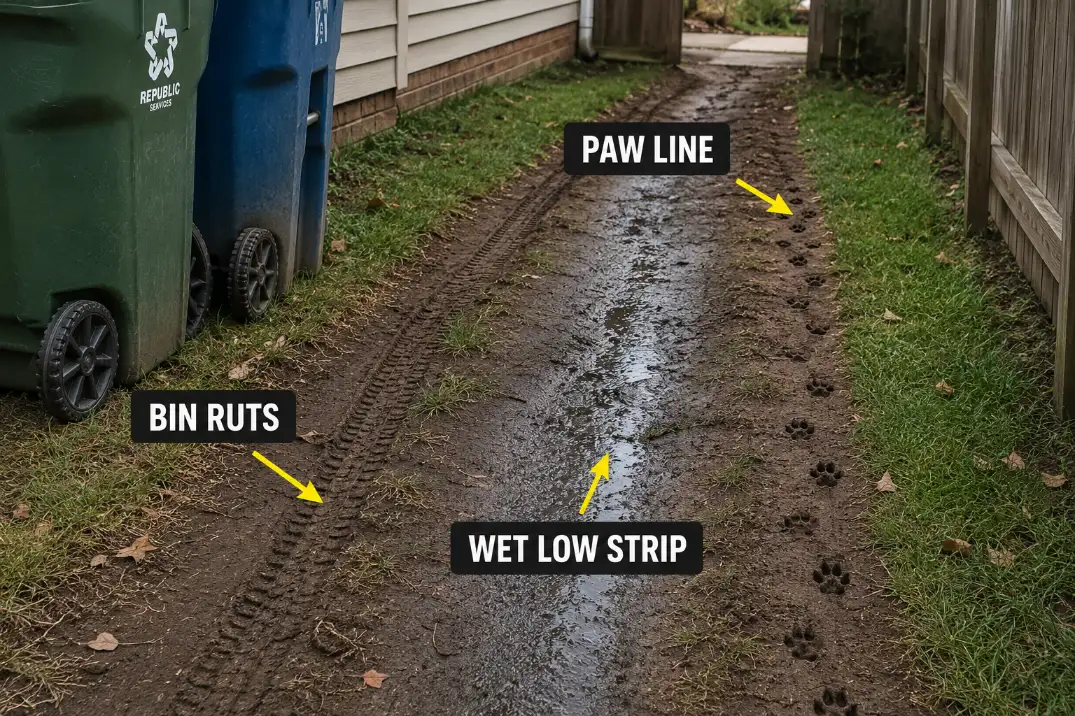
Mud at the gate means turning pressure
Mud at a gate is rarely random. Gates create stopping, turning, dragging, and waiting. Dogs pause there, people pivot there, and bins often twist through the narrowest point.
If the gate area is less than 36 inches clear or forces a tight turn, a surface-only repair will fail first at that bend.
This is one of the clearest points where a routine fix stops making sense. If you add gravel twice in one season and the gate area still turns slick, the problem is not a lack of gravel. It is a narrow wet turn zone with too much concentrated pressure.
Mud along the fence line means patrol traffic
Dogs often create a patrol route along the fence, especially where they can see neighbors, sidewalks, or passing animals. That repeated running line can wear down grass faster than ordinary walking because paws accelerate, brake, and turn in the same spots.
This is where homeowners commonly underestimate dog movement. A dog does not need to dig to create mud. Repeated running over damp soil is enough, especially in shade or in clay-heavy yards that remain soft for 48 hours after rainfall.
Mud beside the bins means wheel load
Trash bins create a different pattern. Their small wheels concentrate weight into narrow tracks, so they can slice through mulch, loose gravel, and wet soil even when the path feels walkable. A route that works for shoes may still fail under a full bin.
For bin routes, a clear 36-inch working lane is usually more realistic than a narrow stepping path. If the bins also live in the side yard, their storage pad should not sit in the lowest wet point.
The placement principles in Where to Put Trash Bins in a Narrow Side Yard matter here because storage location and mud control are often the same decision.
Mud under the hose bib means the water source is local
A muddy patch below the outdoor faucet is not just a path problem. It is a water-source problem. Hose drips, dog rinsing, boot washing, and bin cleaning can keep one small area wet even during dry weather.
That wet spot then spreads into the access lane because people stand there, dogs shake off there, and bins are often rinsed there.
If the hose area drains across the route, the side yard can stay muddy even when the overall yard drainage is acceptable.
Drainage Before Gravel
Gravel over wet soil becomes a mixing layer
Gravel can be a good surface, but not when it is sprinkled over mud. A thin 1-inch layer over soft soil often disappears within months because wet soil pumps upward through the stone under traffic. The gravel is not failing by itself; it is being mixed into an unstable base.
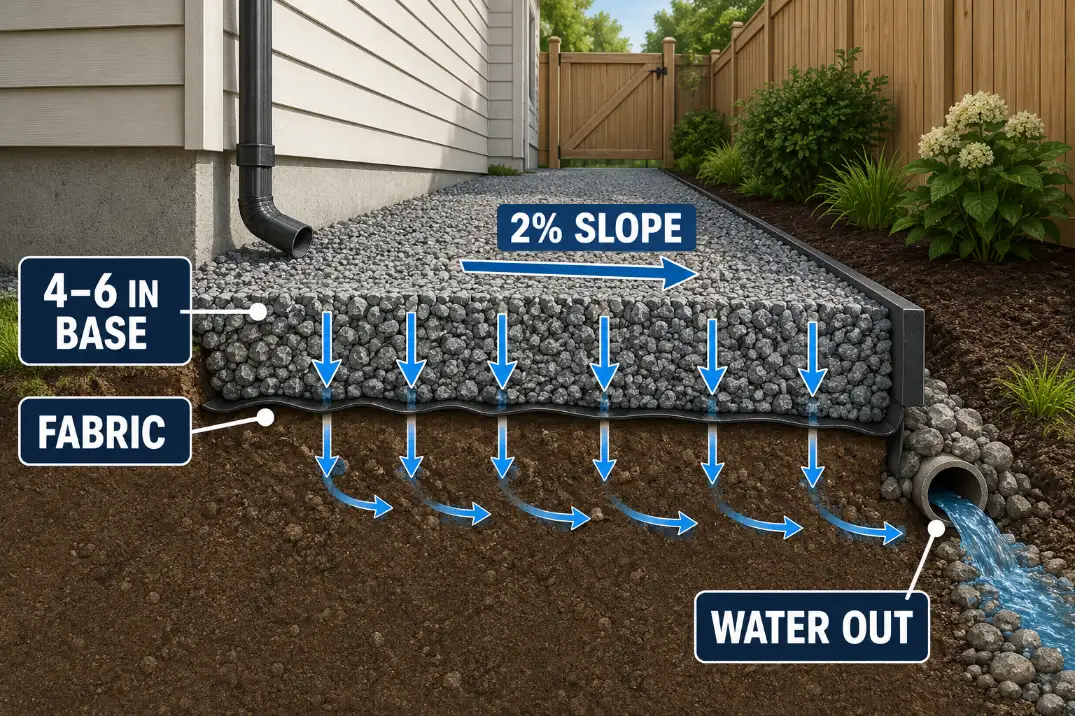
For a daily access lane, a better gravel build usually starts with excavation, separation fabric where soil is soft, and a compacted base around 4–6 inches deep.
The finished surface should shed water, not hold it. A slope of about 2%, or 1/4 inch per foot, is often enough to move water without making the side yard feel awkward to walk through.
Check water entering the lane
Before choosing a surface, check where water is entering the side yard. Downspouts, roof valleys, AC condensate lines, neighbor slope, fence-line runoff, and low gate thresholds can all feed the same muddy route.
This is the condition readers often underestimate. They look at the mud where it sits, not where the water enters. If a downspout dumps into the access strip, no surface will stay clean for long unless that water is extended, redirected, or drained away from the working lane.
In humid climates such as Florida, drying windows may be short enough that the route needs a stronger base and less organic material. In northern states, freeze-thaw makes trapped water worse because wet base material loosens during thaw cycles.
In dry parts of Arizona or inland California, mud may be less frequent, but one concentrated roof runoff line can still damage a narrow side yard after storms.
The surface choice comes after the water path
The right surface depends on the hardest use, not the nicest look. Dogs, bins, and rinse zones do not need the same surface.
A dog route needs paw comfort and drainage. A bin route needs wheel support. A hose area needs a place for water to leave without crossing the main lane.
If the choice is between gravel and pavers, drainage should guide the decision before appearance does. The comparison in Pavers vs. Gravel for Backyard Drainage is useful because both materials can work, but they fail for different reasons when the base and water path are wrong.
| Mud pattern | Better fix direction | Avoid | Why it matters |
|---|---|---|---|
| Dog patrol route along fence | Reinforced gravel, turf grid, or durable dog-run strip | Loose mulch alone | Paws displace soft material quickly |
| Bin wheel route | Compacted gravel base, paver strip, or narrow hard lane | Pea gravel over soil | Wheels cut through loose surfaces |
| Hose or rinse zone | Splash pad plus drainable gravel pocket | Open soil under faucet | Local water keeps the lane wet |
| Gate turn area | Wider reinforced turn pad | Narrow stepping stones | Turning pressure breaks edges first |
| Shaded wet strip | Drainage correction plus firm base | Reseeding only | Grass has too little recovery time |
| Downspout-fed mud | Redirected roof water before resurfacing | Covering with stone | Water source remains active |
Dogs, Bins, and Footsteps Need Different Surfaces
The dog surface has to work for paws
A dog-friendly side yard surface should drain, resist rutting, and stay comfortable enough for repeated paw contact. Very sharp angular stone can be uncomfortable.
Very small loose stone can track into the house or get caught near paws. Dark stone can also get hot in summer sun, especially in hotter US climates.
That does not mean gravel is wrong for dogs. It means the stone size, base, and maintenance pattern matter. If the stone is uncomfortable to stand on barefoot for a few seconds in summer, it may be too harsh for a frequent dog route.
A stable, drainable strip is usually better than soft mulch in a wet dog route, but the surface should not feel like a construction driveway.
If the side yard doubles as a dog run, the broader wear patterns in Dog-Friendly Backyard Design Mistakes That Cause Mud and Wear are worth treating as part of the same system.
The bin route has to carry point loads
Bins do not need a soft surface. They need a firm one. A full bin rolling across wet soil creates pressure in two narrow tracks, which is why wheel ruts often show up even when the rest of the lane looks only damp.
For bins, the best surface is usually the one that stays level and restrained. Compacted gravel with firm edging, a paver strip on a proper base, or a narrow concrete service strip can all work.
Loose pea gravel without a prepared base usually disappoints because wheels plow through it instead of rolling cleanly.
Foot traffic is usually the easiest load
Walking is rarely the hardest use in this scenario. If the route is designed only for footsteps, it may still fail under dogs and bins. That is why a pretty stepping-stone path can look finished but perform badly in a working side yard.
The decision rule is simple: size the repair for the most damaging repeated use. If bins and dogs both use the lane, build for bins first, then make the surface comfortable enough for paws.
Soft Edges Get Messy
The edge often fails before the center
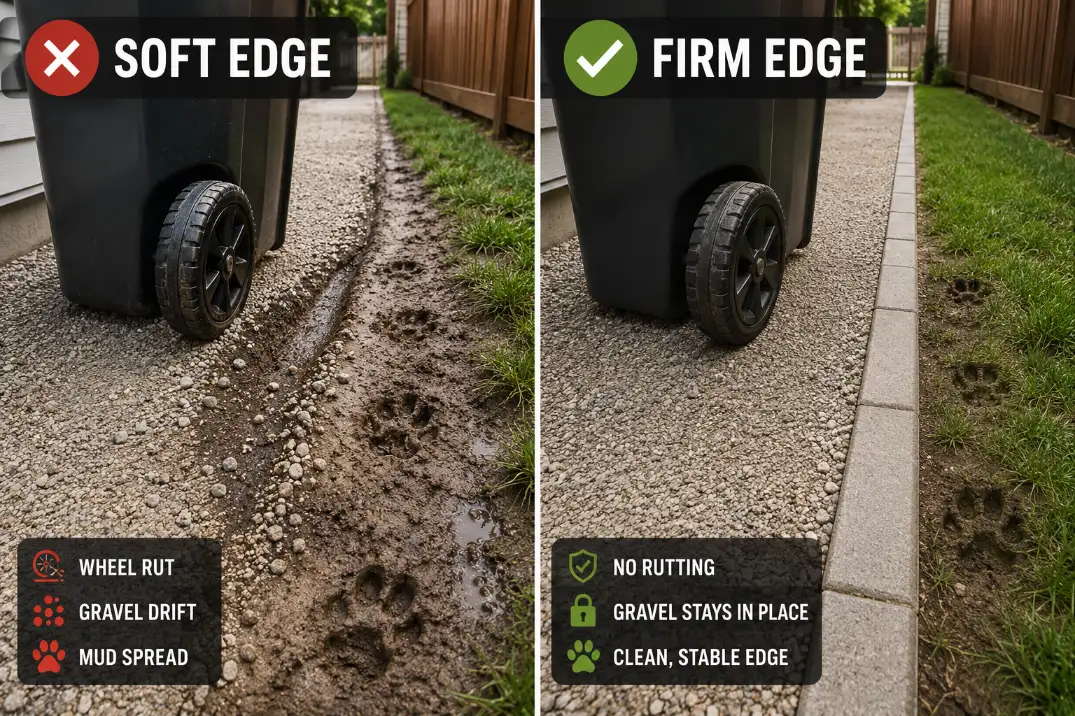
A side yard path can have a solid center and still turn muddy because the edges collapse. Dogs run near borders, bin wheels drift off line, and people step aside when carrying tools or pulling a hose.
Once the edge softens, soil and stone mix, planting gets trampled, and the lane widens into a messy strip.
This is where homeowners commonly overestimate the surface and underestimate edge restraint. Gravel, mulch, and pavers all perform worse when the border is vague. A firm edge does not have to look heavy, but it does need to resist sideways movement.
Soft planting should not touch the work lane
Low planting may look good in a clean design photo, but it often fails beside a dog-and-bin route. Soft soil, loose mulch, and groundcovers become the first place wheels slip and paws dig. If the side yard is only 4–5 feet wide, the edge is not leftover space. It is part of the working system.
A better layout keeps the main lane clear and places planting outside the abuse zone. Where planting must sit close to the lane, use a defined edge and avoid fluffy soil mounded higher than the path.
Pro Tip: If the edge only looks neat when the side yard is dry, it is not a functional edge yet.
Rinse Zones Need Drainage
Convenience can create the wettest spot
Side yards often collect the hose reel, outdoor faucet, dog rinse area, muddy boots, and bin cleaning in one tight location. That is convenient, but it concentrates water in the same place that already receives traffic.
A rinse zone should not drain across the main walking line. If water from the hose bib runs over the access path, the surface stays soft even when rainfall is not the main issue.
A small hard splash pad, drainable gravel pocket, or sloped rinse area can help, but only when it sends water away from the traffic lane.
The hose zone deserves its own planning logic. If the faucet, reel, and access route are all squeezed into the same wet bend, the setup needs to be arranged more carefully than a decorative side-yard corner.
Side Yard Hose Reel and Outdoor Faucet Zone Ideas fits naturally with this problem because water use and mud control are linked.
Keep rinse water out of the turn zone
The most fragile point is often where someone turns with a bin, where a dog stops near a gate, or where a person stands to use the hose.
A 3-by-3 foot wet patch can spread quickly if that area is not edged, drained, or surfaced differently from the rest of the lane.
If mowers, wheelbarrows, or garden carts also use the side yard, test those turns before locking in the rinse area. A lane that looks wide enough while dry may fail once a loaded wheelbarrow or bin has to turn through a damp corner.
That access problem connects closely to the route testing discussed in Side Yard Access for Mowers and Wheelbarrows.
Usable After Rain
The goal is firm, not spotless
A side yard does not need to be perfectly dry after every storm. It needs to remain usable. That means no deep ruts, no standing water in the main lane, no slick clay smear at the gate, and no muddy transfer into the house after ordinary daily use.
A healthier side yard lane feels firm within 24 hours after light rain and within 48 hours after a normal storm. A failing lane still smears under a shoe after two dry days, needs repeated top-ups every few months, or leaves bin tracks deeper than 1/2 inch.
When topping up becomes a warning sign
Adding mulch or gravel once for normal wear is not a problem. Adding it repeatedly without changing drainage, base depth, or edge restraint is different. At that point, you are not refreshing the surface. You are hiding a structural failure.
The better repair sequence is to identify the traffic line, redirect concentrated water, rebuild the base, restrain the edges, then choose a surface that matches the hardest daily use.
For some homes, that means compacted gravel with firm edging. For others, it means a paver strip, a reinforced dog-run lane, a small concrete service pad, or a hybrid path with a separate rinse pocket.
Quick mud-control checklist
- Check whether the lane stays soft more than 48 hours after regular rain.
- Look for bin ruts deeper than 1/2 inch near gates, bends, and storage points.
- Confirm the surface slopes away from the house at about 1/4 inch per foot.
- Redirect downspouts, hose runoff, and rinse water before adding surface material.
- Reinforce gate turns and pause zones before beautifying the edges.
- Use a 36-inch clear working lane where dogs, bins, and daily access overlap.
- Stop reseeding the main traffic line if it cannot recover between uses.
Questions People Usually Ask
Is mulch a good fix for a muddy dog side yard?
Usually not as the main fix. Mulch can reduce splash for a short time, but it holds moisture, breaks down, and mixes with soil under paw and wheel traffic. It works better beside the access lane than under the heaviest route.
Should I use pea gravel for dogs?
Pea gravel can be comfortable underfoot, but it moves easily in narrow working lanes. Under running dogs and bin wheels, it can spread, rut, and track out of place. A stable base and edge restraint matter more than the name of the gravel.
What should I fix first?
Fix water and base strength before appearance. If water keeps entering the lane or the top few inches of soil are compacted, a prettier surface will only hide the mud temporarily.
For broader official guidance on how compaction reduces pore space and slows drainage, see the University of Minnesota Extension.