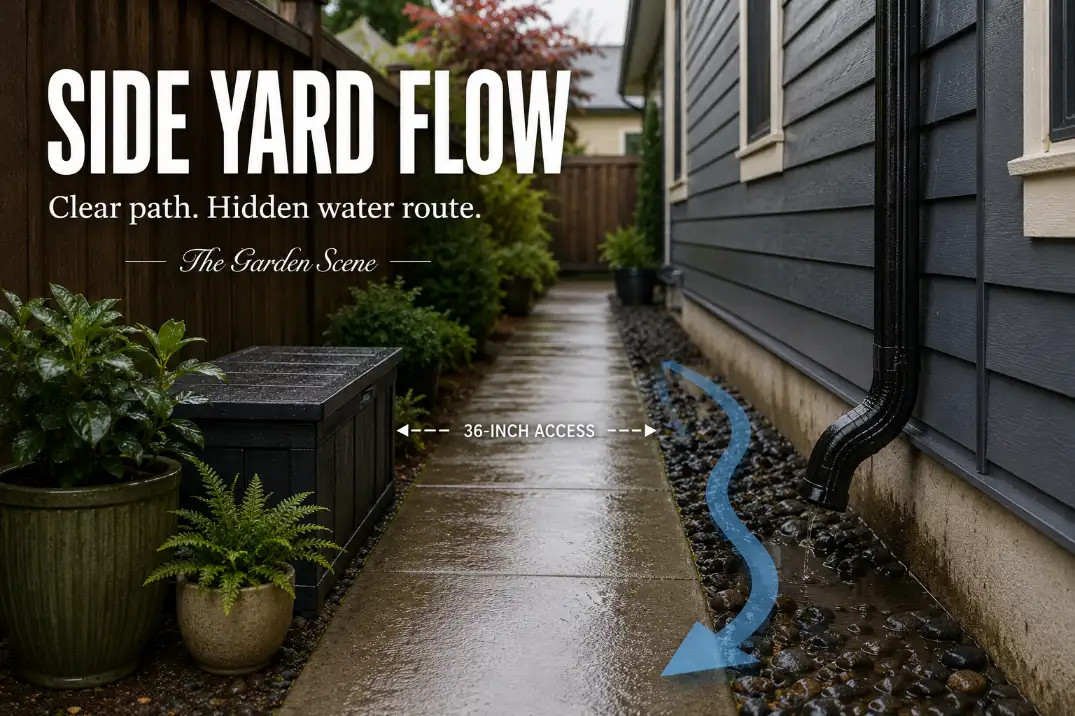
The best side yard ideas keep the space useful without interrupting two things that matter more than decoration: water movement and access. Start with a 30–36 inch clear route, keep runoff moving away from the house at roughly 1/4 inch per foot where possible, and place storage, planting, or paving outside the main drainage path.
If ordinary rain still sits near the foundation after 24 hours, if a trash bin cannot pass through, or if downspout water crosses the walkway, the side yard is not just narrow. It is starting to fail as a service corridor.
That distinction matters. A side yard that looks tight may only need editing. A side yard that blocks drainage or access can trap moisture, hide soft soil, limit utility service, and turn a small upgrade into a maintenance problem within one season.
The goal is not to leave the area empty. The goal is to use it selectively, so every feature earns its space.
The Side Yard Has Two Jobs
Most side yards fail because they are treated as leftover landscaping. In practice, this strip often handles roof runoff, gate movement, hose access, trash-bin circulation, HVAC service, utility meters, and the only practical route into the backyard.
Drainage Comes Before Decoration
Drainage should set the layout before plants, gravel, pavers, or storage are added. If the strip already slopes away from the house and dries within a day, you have more design freedom.
If the soil is clay-heavy, the grade is flat, or the fence and house create a narrow trough, the space has much less tolerance for decorative clutter.
The fix people often overestimate is surface dressing. Fresh gravel, crisp edging, and matching planters can make the side yard look finished while still trapping water underneath. The condition people often underestimate is compaction.
A compacted layer only 2–4 inches deep can keep runoff skating across the surface instead of soaking in, especially where people, bins, or installers have repeatedly compressed the soil.
Access Has to Be Tested, Not Assumed
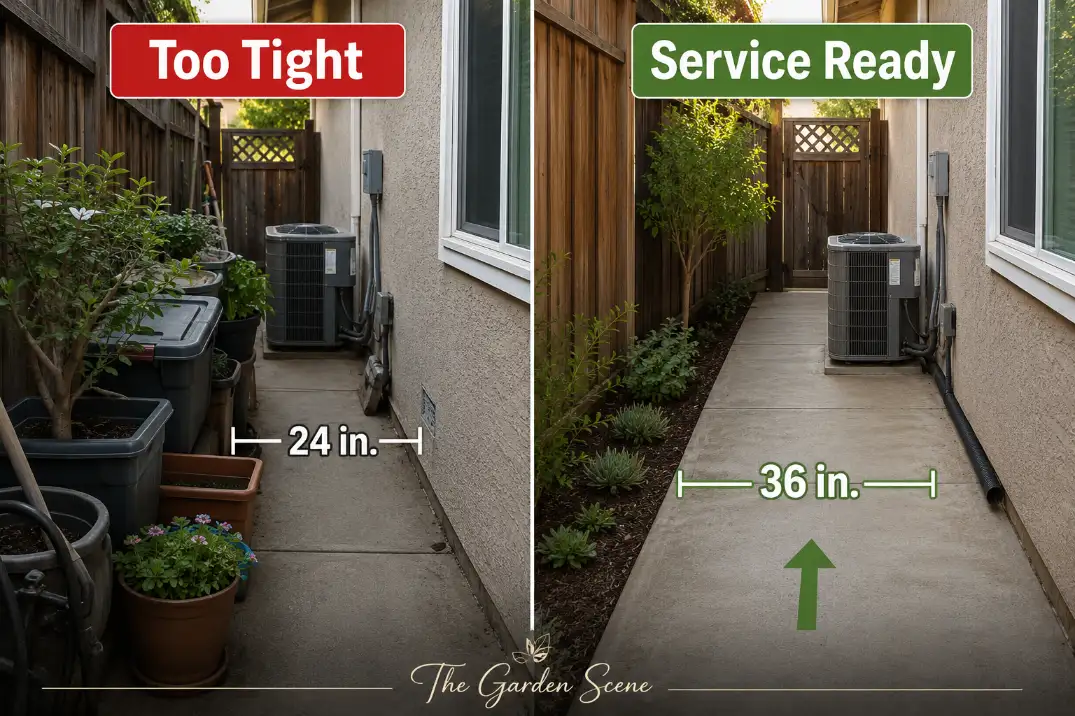
A side yard can feel passable when you walk through it empty-handed. That is not the real test. Pull a trash bin through it. Carry a 24-inch wheelbarrow. Open the gate fully. Reach the hose bib, utility meter, or condenser panel without moving objects first.
For most homes, 30 inches is the practical minimum for a walking route. 36 inches is the better target for a side yard that has to function regularly. If it is the only way to move materials, furniture, or equipment into the backyard, 42 inches is safer.
The same movement logic behind Narrow Side Yard Walkway Flow applies here: the route has to work during real use, not just in a clean photo.
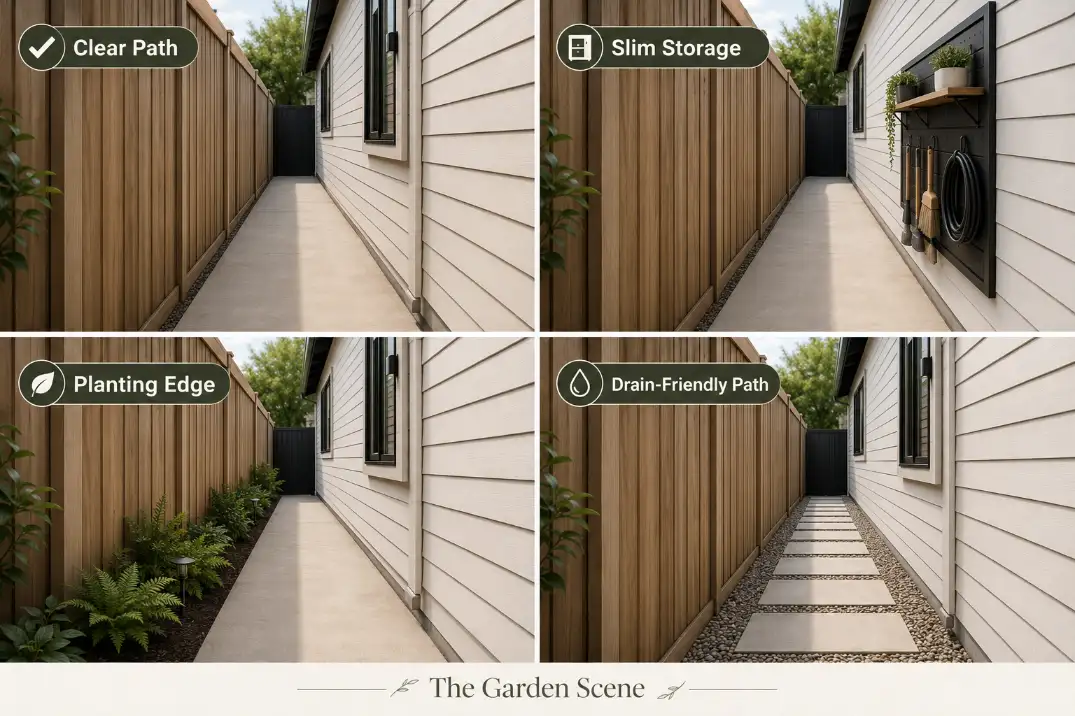
4 Side Yard Ideas That Usually Work
The strongest side yard ideas are usually low-bulk, easy to maintain, and honest about the space. They do not try to turn a service corridor into a full outdoor room.
1) Clear Service Path
This is the safest default idea for side yards under about 5 feet wide. A durable walking strip with nothing projecting into it keeps maintenance simple, protects gate access, and gives runoff a predictable edge to move beside.
It may look less dramatic than a planted walkway, but it performs better in tight spaces. If the side yard has to support trash bins, tools, pets, or backyard access, the clear path is the feature.
2) Slim Wall Storage
Slim storage works when the side yard is also a utility route. A 12–16 inch-deep wall rack or narrow organizer is usually safer than a 24-inch cabinet sitting on wet soil.
The small depth difference matters because it preserves shoulder room and keeps the floor from becoming a damp storage zone.
The best version is raised slightly, easy to remove, and placed outside the main water path.
3) Narrow Planting Edge
A planting edge works when mature plant width can stay under control. In tight side yards, a 12–18 inch planting strip is usually more realistic than deep beds or full shrubs. Choose plants by mature width, not nursery size.
If the design challenge is mainly about arranging the strip without crowding it, Side Yard Layout Ideas for Tight Access is a useful companion because it treats the side yard as a movement problem, not just a planting opportunity.
4) Drain-Friendly Path
A drain-friendly path works when the surface stays usable after rain. Stepping stones, open-joint pavers, and some gravel paths can all work, but only if they do not create a low channel that traps water.
The right question is not “Which surface looks cleanest?” It is “Where does water go after it hits this surface?” If the surface slows access or redirects water toward the house, it is the wrong idea, even if it looks finished.
Quick Diagnostic Checklist
Before adding storage, planting, pavers, or a decorative gate detail, run through this short list:
- Water still sits near the house more than 24 hours after normal rain.
- The narrowest point of access is under 30 inches.
- Downspout water crosses the walking route.
- Gravel, mulch, or soil keeps drifting toward the foundation or fence.
- You cannot pull a trash bin through without turning it sideways.
- Plants brush siding, utilities, or HVAC equipment.
- The ground stays soft for 48 hours or more after moderate rain.
One item is not always serious. Three or more usually means the side yard is being used in a way the site cannot support.
What People Usually Misread First
Puddles Are a Symptom, Not the Cause
A puddle tells you where water stopped. It does not tell you why. The underlying cause may be flat grade, compacted soil, a buried edging strip, a downspout dumping into the corridor, or a path that sits like a shallow dam.
That distinction matters because the obvious fix—adding more gravel—often wastes time. Gravel can make the surface look drier while water still sits below it or gets pushed sideways into worse areas.
If you are choosing between surfaces, the base and outlet matter more than the top layer. That is why Pavers vs Gravel for Backyard Drainage is more useful than treating gravel as a universal fix.
The Fence Side Is Not Automatically the Drainage Side
Many homeowners assume water should be pushed toward the fence because the house side feels more urgent. Sometimes that works. Sometimes it sends runoff into a shared fence line, a neighbor’s low spot, or a strip with nowhere legal or stable for water to go.
This is where a routine fix stops making sense. If water cannot leave the side yard safely, edging, mulch, or another decorative border just rearranges the symptoms.
When water movement is the bigger issue, the order should follow the logic in Fix Drainage or Layout First: solve the water path before refining the layout around it.
What Not to Add to a Narrow Wet Side Yard
Some popular side yard ideas look good in inspiration photos but perform badly when the strip is narrow, shaded, or slow to dry.
Deep Raised Beds
Raised beds can work in wider side yards, but they often overwhelm narrow ones. A bed that projects 24 inches or more into the route can erase the access corridor, trap moisture along the house, and make it harder to move bins or equipment.
Floor Cabinets on Soil
Floor cabinets are one of the fastest ways to make a side yard feel organized and function worse. They block inspection, slow drying, and become awkward to clean around. If storage is necessary, wall-mounted or raised storage is usually the better choice.
Artificial Turf Over Soft Clay
Artificial turf can make a side yard look cleaner, but it does not fix trapped water. If soil stays soft for 48 hours after rain, turf may hide the problem rather than solve it. The base still needs drainage.
Dense Privacy Shrubs Around Utilities
Privacy shrubs are often too aggressive for utility side yards. If plants block meters, hose bibs, HVAC panels, or cleanouts, they create a maintenance problem. In tight side yards, screening should be narrow, removable, or placed where service access remains obvious.
Which Fix Fits Which Side Yard?
Not every side yard needs the same solution. The best fix depends on whether the main failure is slope, runoff volume, compaction, or blocked access.
| Condition | Better Fix | Avoid | Useful Threshold |
|---|---|---|---|
| Light puddling that clears within a day | Minor regrading and a simple permeable path | More mulch piled near the house | Water clears within 24 hours |
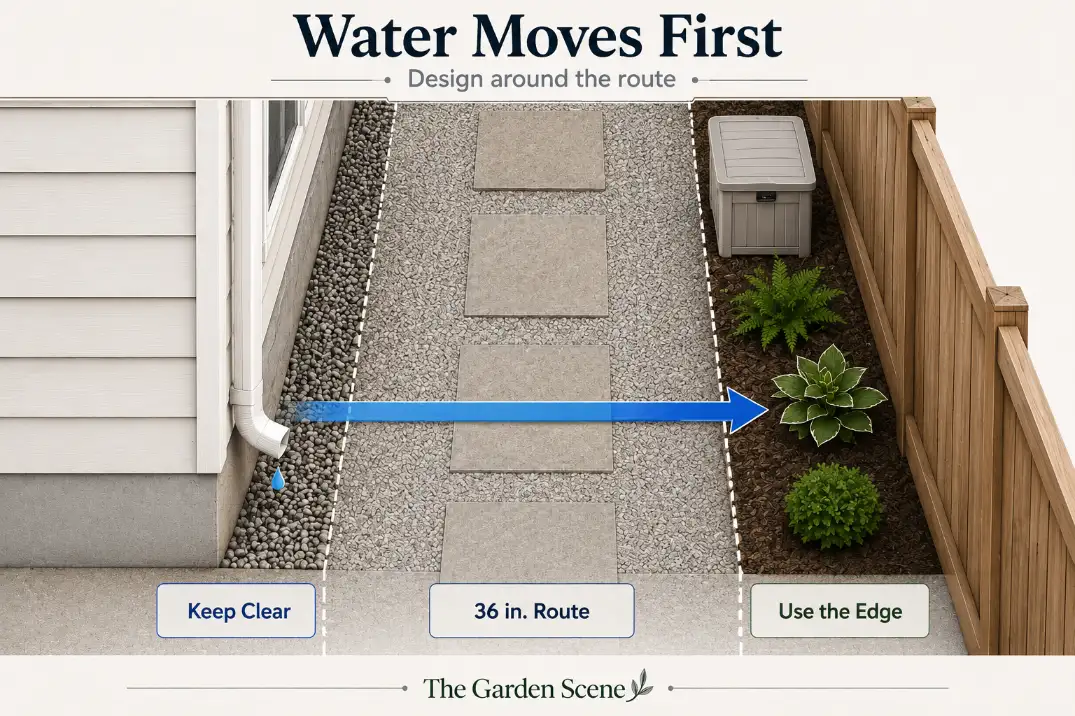
| Downspout water crossing the route | Downspout extension or solid pipe to a safe outlet | Letting runoff spill across the walkway | Move discharge 6–10 feet away where appropriate |
| Clay soil staying soft after rain | Drainage strategy plus reduced compaction | Decorative gravel over saturated soil | Soft after 48 hours signals a bigger issue |
| Access squeezed by objects or plants | Remove floor storage and buy by mature width | Constant pruning or shifting objects | Clear route stays 30–36 inches |
| Gate area becoming the pinch point | Widen or rehang gate if feasible | Decorative gate details that reduce opening | Useful opening closer to 36 inches |
| Shallow planting strip beside path | Use narrow plants or a restrained border | Full shrubs or deep raised beds | Planting edge around 12–18 inches |
How to Build a Side Yard That Still Works
Keep the Foundation Edge Inspectable
The first 6–12 inches beside the house should stay easy to inspect. It does not have to be barren, but it should not be buried under piled mulch, oversized pots, or spreading foliage. Moisture against siding, stucco, or veneer is often underestimated because the surface looks neat from above.
Use the Middle for Movement or Shared Flow
The most useful zone is usually the clear route. Depending on the width, that route may sit in the center or slightly offset, but it should remain visually obvious and physically open.
If the path disappears under décor, storage, or plant spill, the design has become more ambitious than the space can support.
Use the Fence Side Carefully
The fence side is usually where side-yard extras belong: a shallow rack, a tight planting strip, or a narrow gravel margin. But even this “safe side” is not blank space.
If the fence line is lower, damp, or already collecting water, it may need to remain open for drainage instead of storage.
For side yards where roof runoff is part of the issue, Downspouts Flood Backyard Planting Beds is relevant because the bed or corridor often gets blamed when the real problem is the amount and direction of roof water.
When the Standard Fix Stops Working
When a French Drain Is Actually Worth Considering
A French drain should not be the automatic answer to every wet side yard. It makes more sense when several conditions line up: the grade is limited, the soil stays soft for 48 hours or longer, runoff volume is high, and simpler surface corrections have not solved the problem.
It can also help when roof water and narrow-site geometry create a side-yard trough effect.
What gets overestimated is the drain itself. What gets underestimated is the outlet. A French drain without a valid discharge strategy is not much of a solution. If the water has nowhere appropriate to go, the system can disappoint quickly.
When Storage Stops Being a Smart Use
Storage stops making sense when it interrupts inspection, service, or circulation. That threshold arrives sooner than many homeowners expect.
If a shallow rack still blocks a hose bib, if a cabinet forces you below 30 inches of clearance, or if you need to move items before an HVAC technician can work, the side yard has crossed from efficient to self-defeating.
When Planting Becomes More Work Than Value
Plants are a good side-yard use only when they stay within their lane. If you are shearing the same shrubs back every few weeks, or if mature width keeps spilling into the route, the plant choice is wrong even if the species itself is attractive.
For that reason, Best Plants and Materials for Narrow Side Yards is most useful after you know the width the site can tolerate.
Questions People Usually Ask
Can a side yard be both decorative and functional?
Yes, but only if the functional geometry comes first. In most side yards, a clear route, restrained planting, and one controlled drainage strategy age better than a busier design that starts attractive and becomes awkward.
Is artificial turf a smart side-yard solution?
Sometimes, but it is often oversold. Turf can make a side yard look cleaner, but if the underlying grade and drainage are wrong, it may simply hide wet conditions. It is a finish, not a fix.
What is the simplest upgrade that usually pays off?
Clear the route, correct downspout discharge, and establish one stable path surface. That usually improves both access and drainage more than adding multiple decorative features at once.
A good side yard rarely feels overdesigned. It feels calm, passable, and easy to maintain after rain—not just on install day. For broader official guidance on managing runoff around the home, see the U.S. EPA Soak Up the Rain program.