
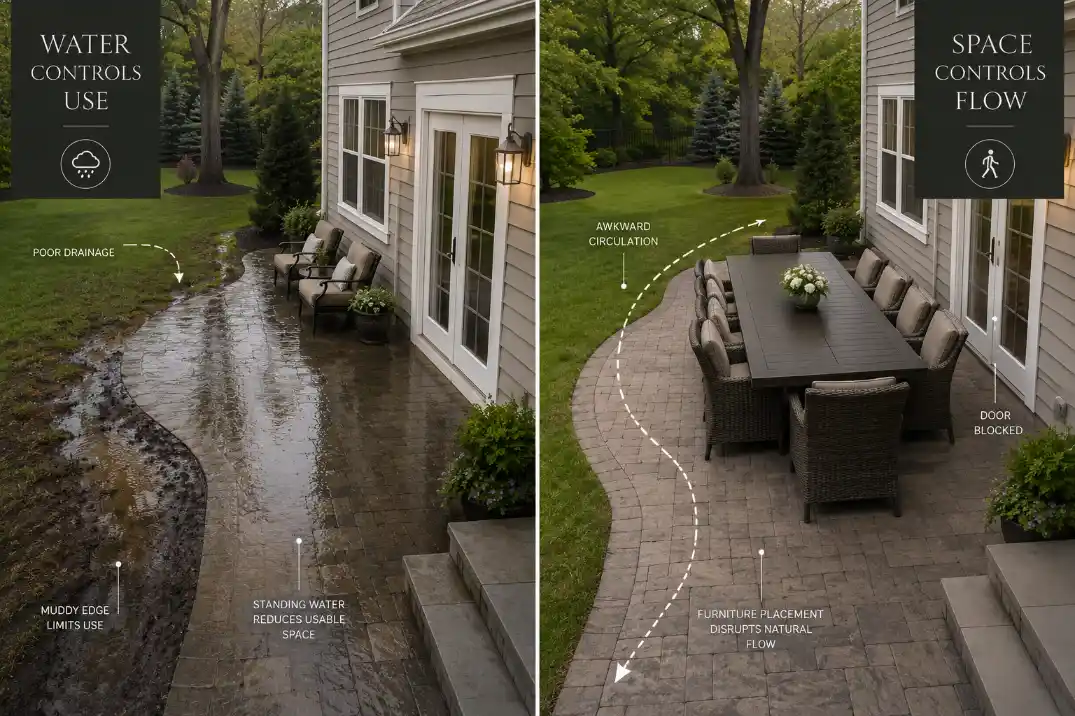
Drainage should usually be fixed before layout when water is changing where people can walk, sit, cook, or safely build. A poor furniture arrangement can make a backyard annoying, but standing water, soft soil, or runoff crossing the main path will keep defeating almost any layout placed over it.
Start with three checks: where water comes from, where it goes, and whether the dry usable area is large enough for the activity you want.
A useful threshold is time. Water that sits on a patio, walkway, or compacted lawn for more than 24–48 hours after normal rain is not just a cosmetic problem. Soil that stays soft enough to leave ½-inch-deep footprints is also telling you the base is unreliable.
That differs from a pure layout problem, where the patio stays dry and stable but chairs block doors, the grill crowds the dining area, or the main route is too narrow.
The Order That Usually Saves the Most Money
The safest sequence is drainage first, stable surface second, layout third. That does not mean every wet yard needs a drain. It means the water problem has to be understood before you finalize hardscape edges, furniture zones, walkways, or planting beds.
First, protect the house and main routes
Water near the foundation, steps, door thresholds, basement windows, or patio edge outranks almost every layout concern. If runoff is moving toward the house, the issue is no longer about comfort. It is about where stormwater is being directed.
Main walking routes matter almost as much. If the path from the back door to the grill, gate, shed, or seating area turns muddy after rain, the layout will never feel right. People will step through beds, drag mud onto the patio, or stop using part of the yard entirely.
If the whole outdoor area feels difficult to use and you are unsure whether drainage, access, furniture, or surface choice is the main problem, What to Fix First When Your Backyard Is Hard to Use is a helpful next read because it separates comfort problems from base-function problems.
Then measure the dry usable area
Do not measure the full patio or lawn and assume all of it works. Measure the portion that stays dry, firm, and reachable. A 12-by-16-foot patio that loses a wet 3-foot strip along one side does not behave like a 12-by-16 patio. It behaves like a smaller patio with a drainage constraint.
This is where people often misread the problem. The furniture may look too large, but the real issue may be that water has reduced the usable footprint. Rearranging chairs can help only after the usable surface is stable.
Finish with layout, not the other way around
Once the water path is known and the surface performs, layout decisions become much clearer. Main walkways usually need about 30–36 inches of clear width for comfortable daily use. Less than 24 inches starts to feel like squeezing past furniture, especially around dining chairs, grills, and door swings.
That is a layout problem only if the ground already works. If the route is narrow because half the patio is wet, drainage is still the first constraint.
What People Usually Misread First
The visible annoyance is not always the cause. Puddles, muddy corners, rocking pavers, crowded chairs, and awkward paths are symptoms. The mechanism may be grade, patio pitch, downspout discharge, compacted soil, surface material, or simply too many activities competing for one small area.
Temporary puddling is not always urgent
A low planting bed that holds water for a few hours after a heavy storm may not deserve a major drainage project. In clay-heavy Midwest yards or humid parts of Florida and the Southeast, water can linger longer than it would in dry western climates. The key is persistence, location, and consequence.
Water that disappears within 12–24 hours in a planting bed is usually less urgent than water sitting for 36–48 hours on a patio, walkway, or traffic route. Water against the house is more serious than water in a far back corner. Water moving across the main use zone matters more than water hidden behind shrubs.
A cramped patio is not always a patio-size problem
Homeowners often overestimate what a small patio can hold. A dining set may physically fit, but chairs still need pull-back space. A grill may fit along the edge, but not if it blocks the route from the door. A storage box may seem harmless until it steals the last usable corner.
If the surface is dry and stable, layout may be the first fix. If the patio only feels cramped after rain because people avoid wet areas, drainage is still driving the problem. For dry patios where furniture placement is the real issue, Patio Layout Problems That Make Spaces Hard to Use goes deeper into spacing, circulation, and zone conflicts.
Check Patio Pitch Before Blaming the Layout
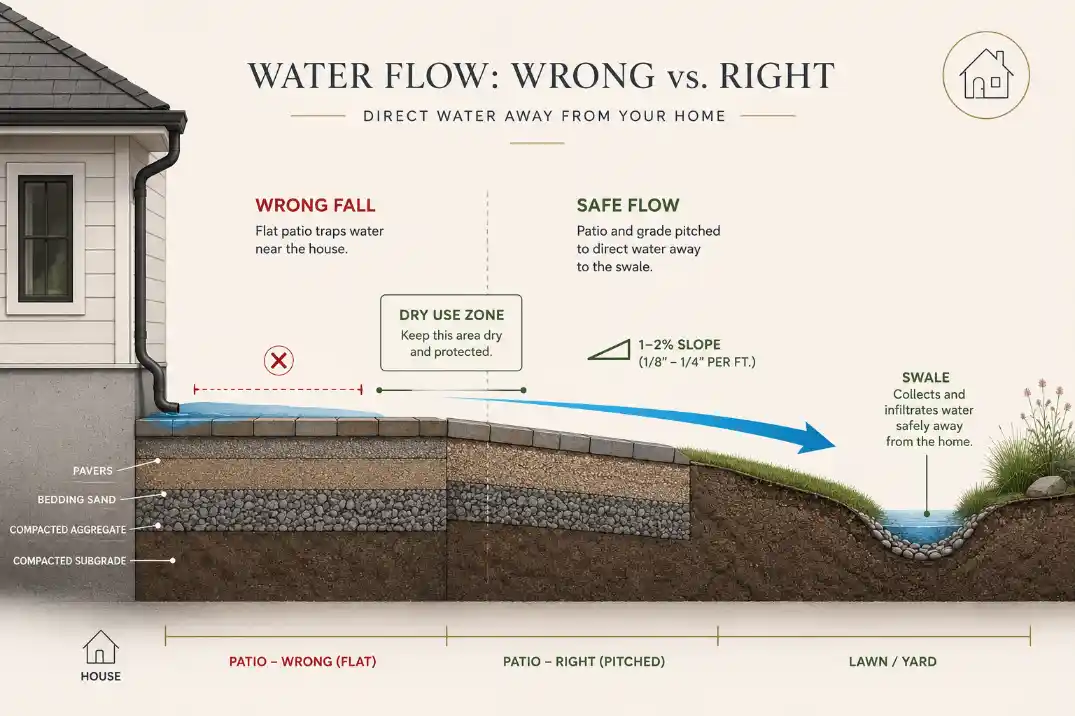
Patio slope is one of the most useful ways to separate a drainage defect from a layout inconvenience. A patio should generally move water away from the house and toward a safe discharge area. Many residential patios are planned around roughly 1/8 to 1/4 inch of fall per foot, depending on surface type, exposure, and local conditions.
A small pitch error can create a big layout problem
On a 10-foot patio, that rough pitch range can mean about 1¼ to 2½ inches of total fall. If the surface is nearly flat, dips toward the house, or traps water at the center, the furniture plan is secondary. Chairs, rugs, planters, and grill carts cannot solve a surface that sends water to the wrong place.
This is especially important in northern states with freeze-thaw winters. Water that sits in joints, low spots, or patio edges can freeze, expand, and worsen movement over a season or two. What looks like a minor puddle in fall can become a rocking paver or uneven edge by spring.
If water is collecting near the wall or patio edge, Why Water Pools Against the House on a Patio is more relevant than a layout tweak because the higher-risk issue is water direction, not furniture placement.
Surface stability matters as much as surface dryness
A patio can drain visibly yet still fail underneath. Watch for rocking pavers, sunken corners, washed-out joints, gravel migration, or soil that pumps water when stepped on. Those signs point to a base or edge problem, not just bad spacing.
In wet backyards, the best fix may not be “add a drain” by default. Sometimes the smarter move is changing the surface system, base preparation, or edge detail so the yard can handle repeated moisture. That is why Best Patio Materials for Wet Backyards matters when the drainage issue and surface choice are tied together.
Drainage Is Not Fixed Until Water Has Somewhere Better to Go
A drainage plan is not complete just because water leaves the patio. It has to go somewhere that does not create a new problem. Sending runoff into a neighbor’s yard, against a fence line, across a walkway, or back toward the house is not a fix. It is relocation.
Find the source before choosing the solution
The most common sources are not mysterious. Downspouts discharge too close to the patio. Soil slopes toward the house. A walkway blocks natural sheet flow. A compacted dog run or kids’ path sheds water into a low spot. A new patio interrupts where water used to spread out.
Simple corrections may include extending a downspout 6–10 feet away from the house, opening a trapped patio edge, creating a shallow swale, adding a catch basin, or routing water toward a rain garden. More involved cases may need a French drain, channel drain, permeable edge, or rebuilt base.
Pro Tip: Do not install a drain until you know the outlet. A drain without a safe discharge point often becomes an expensive way to move water from one bad location to another.
New projects need drainage decisions before layout decisions
If you are building a new patio, walkway, or major backyard redesign, drainage and grade come before the final layout. Hardscape locks in water movement. Once the patio edge, base elevation, and walkway route are built, changing the water path becomes harder and more expensive.
Existing yards are different. There, the first move is diagnosis. If the patio is dry but awkward, layout can lead. If the patio pools, settles, or redirects runoff, drainage needs attention before the next design layer.
When a patio or walkway made the yard wetter instead of better, Backyard Drainage Problems After Adding a Patio or Walkway explains why the new surface may have blocked or redirected the old flow pattern.
When Layout Should Come First
Layout should come first when the ground already performs. The patio dries evenly, the walking routes stay firm, the surface does not rock or sink, and water is not deciding which parts of the yard can be used.
The surface works, but the space fights itself
A dry patio can still feel bad. The grill may sit too close to dining chairs. The table may block the back door. Lounge furniture may interrupt the route to the lawn. A play area may be placed where adults naturally walk. These are layout problems, and drainage work will not fix them.
The better first move is to simplify the job of the space. Decide whether the patio is mainly for dining, lounging, grilling, or circulation. Then remove or resize anything that competes with that primary use.
The yard is overloaded, not wet
Small yards often fail because every feature is treated as essential. Dining, grilling, lounging, pets, kids, planters, storage, and fire features cannot all claim the same 100–150 square feet without tradeoffs.
This is where homeowners commonly underestimate clearance. A table that looks fine when chairs are tucked in may become too large once people sit down. A grill that fits along a wall may still need working room and heat clearance. A bench, smaller table, or flexible cart can sometimes improve daily use more than expanding the patio.
If your main issue is choosing what belongs in the limited dry area, Patio Furniture Layout Fixes That Make a Big Difference is the more direct fix path.
Fixes That Feel Productive but Usually Come Too Early
Some fixes look practical because they change the surface quickly. The problem is that they do not always change the mechanism.
Covering wet soil is not the same as fixing drainage
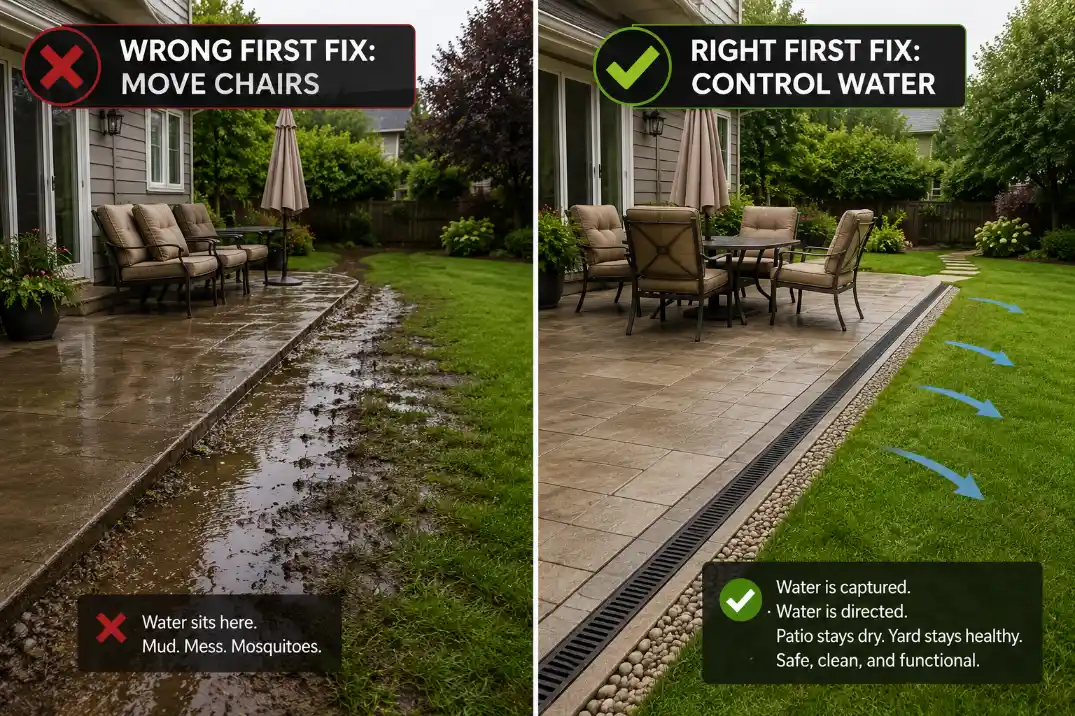
A thin layer of gravel over saturated soil often sinks, migrates, or mixes into mud. Mulch can float or wash into low spots. Outdoor rugs may hide staining or algae for a while, but they can also trap moisture on a patio that already dries slowly.
The point where a routine fix stops making sense is repetition. If the same low area needs new gravel, mulch, sand, or leveling every season, the material is not the root problem. Water movement, soil compaction, or base preparation needs to be addressed.
For yards where gravel seems like the obvious answer, Pavers vs. Gravel for Backyard Drainage helps clarify when gravel improves drainage and when it simply spreads or sinks.
Buying new furniture before measuring the dry area can backfire
Smaller furniture may help a true layout problem, but it will not fix a patio that loses usable space after every storm. Measure the dry, stable footprint first. Then buy furniture for that footprint, not for the total patio dimensions.
This matters most with fixed features: built-in benches, outdoor kitchens, fire pits, and large dining sets. Once those are installed, they reduce your ability to correct drainage, adjust grade, or reroute circulation.
Drainage First vs. Layout First: Decision Guide
| What you see | First priority | Why it matters | What not to do first |
|---|---|---|---|
| Water sits on patio for 24–48+ hours | Drainage | The surface is not reliably usable | Buy new furniture |
| Dry patio but chairs block doors | Layout | Circulation, not water, is the constraint | Install drains |
| Water collects near foundation or steps | Drainage | Higher-risk location than comfort zones | Hide it with planters |
| Muddy route from door to grill | Drainage | Main traffic path fails after rain | Add stepping stones only |
| Stable patio but too many uses | Layout | The space is overloaded | Regrade the yard |
| One distant bed puddles briefly | Usually planting/layout | Temporary water may be tolerable | Major drainage work |
Questions People Usually Ask
Can I redesign the layout before fixing drainage?
Yes, but keep it as a sketch. You can plan zones, decide what matters most, and remove obvious clutter. Do not install fixed features, buy final furniture, or build new hardscape until you know how water moves and how much dry usable area you truly have.
Should a French drain go in before a patio?
If runoff threatens the patio base, foundation, or main walking route, drainage should be planned before the patio is built. But a French drain is not automatically the right answer. Sometimes pitch, downspout routing, a swale, or a better patio edge solves the actual problem with less disruption.
Is a soggy lawn always a drainage problem?
No. A soggy lawn can come from compaction, shade, clay soil, irrigation overspray, heavy foot traffic, or a low spot. The important distinction is whether the wet area affects structures, paths, patios, or daily use. A wet back corner may be a planting decision. A wet path to the door is a functional failure.
The Bottom Line
Fix drainage first when water controls the usable area, threatens the house, softens the base, or crosses the main route. Fix layout first when the surface is dry and stable but the space is crowded, blocked, or poorly arranged.
The sharper way to decide is to separate the symptom from the mechanism. Awkward furniture is a symptom you can rearrange. Water moving through the seating area is a mechanism that will keep defeating the plan.
Once drainage is understood, the layout usually gets simpler, smaller, and more honest about what the yard can actually support.
For broader official guidance on residential grading and drainage, see the Penn State Extension lawn establishment guide.