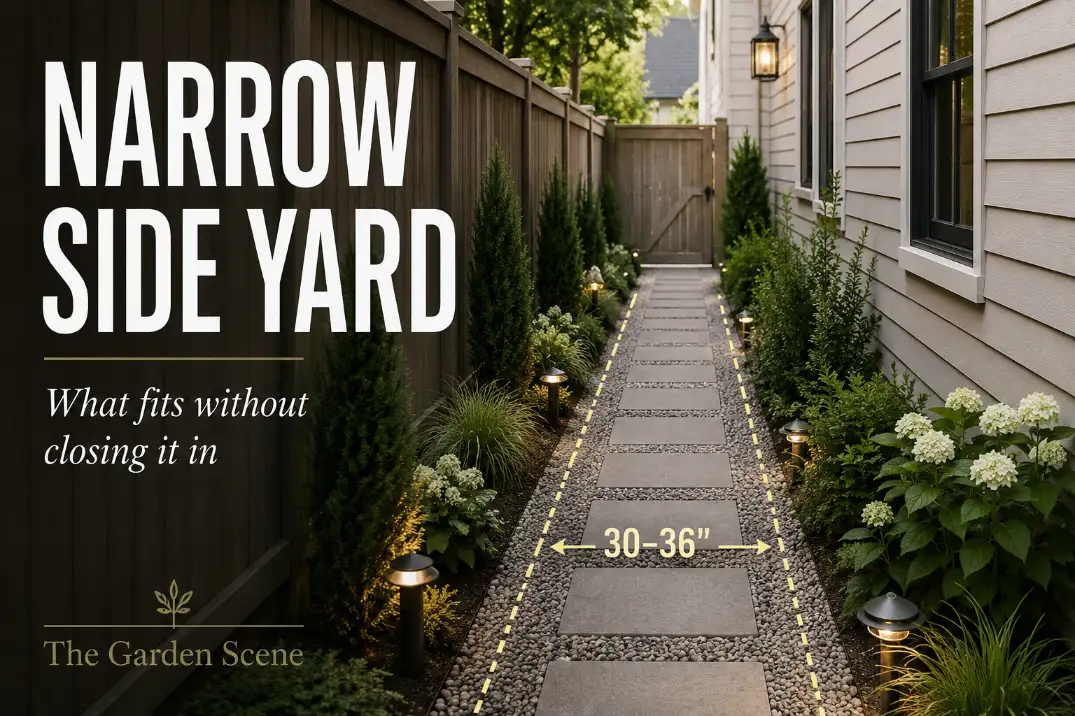
The best plants and materials for narrow side yards are the ones that keep the space usable after the plants mature, not just the ones that look good on installation day.
Start with three checks: keep at least 30–36 inches of clear passage, confirm whether water disappears within 24 hours after rain, and choose plants by mature width rather than nursery size.
A narrow side yard usually fails when the path gets squeezed, the surface turns muddy or unstable, or plants create a maintenance chore every few weeks.
This differs from a small garden bed problem because the side yard is also a service route: trash bins, hoses, gates, meters, and backyard access still have to work. If water lingers for more than a day, fix drainage and surface choice before blaming the plant list.
First, Classify the Width
3–5 feet: treat it as a corridor
A 3–5 foot side yard should be designed as an access corridor first. Keep planting low, vertical, or one-sided. This is not the place for wide shrubs, loose pots on both sides, or a dense cottage-garden mix.
If the clear walking route drops below 30 inches, the space will feel tight even if the planting looks attractive in photos. In this width range, the best design usually comes from restraint: one path surface, one main plant texture, and one clean edge.
5–7 feet: add one narrow planting zone
A 5–7 foot side yard can usually handle a path plus a narrow planting bed. This is the range where upright shrubs, compact grasses, sedges, and controlled groundcovers start making more sense.
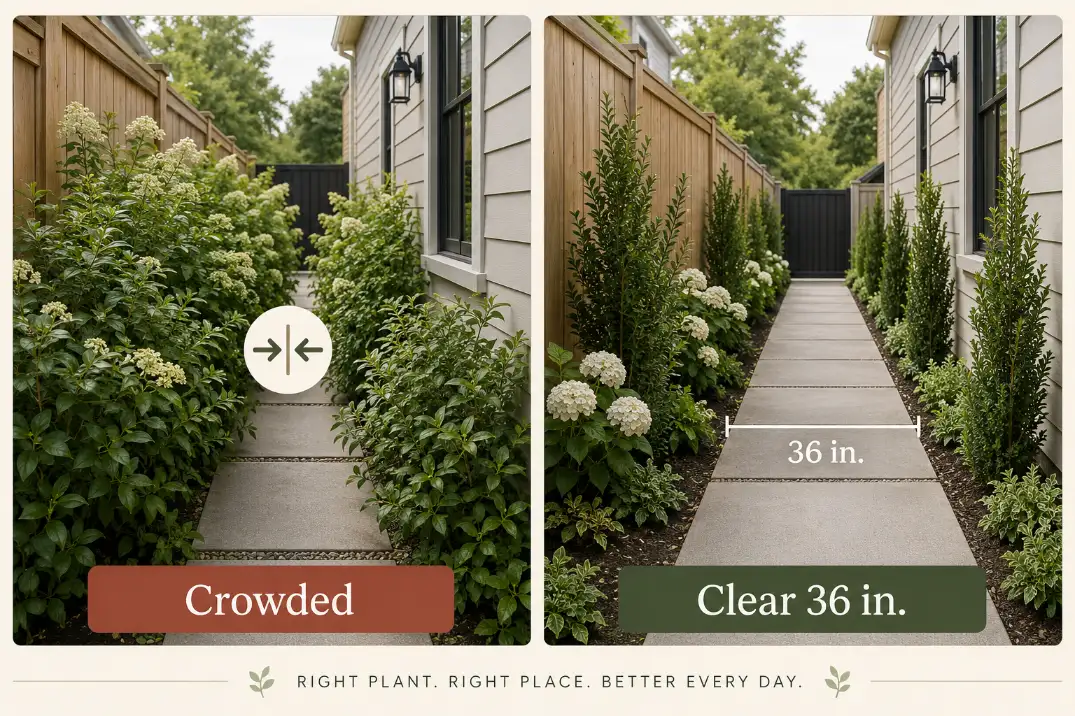
The mistake is treating this size like a full garden room. A 3-foot shrub beside a 30-inch path leaves very little tolerance for seasonal growth, leaning stems, or someone carrying tools.
8 feet or more: it can behave like a small garden room
Once the side yard reaches about 8 feet wide, it can support more layered planting, larger pavers, or a small focal moment. Even then, the access route should be protected first. A wider side yard can still fail if plants, pots, and surfaces compete for the same walking space.
Best Plant and Material Pairings for Narrow Side Yards
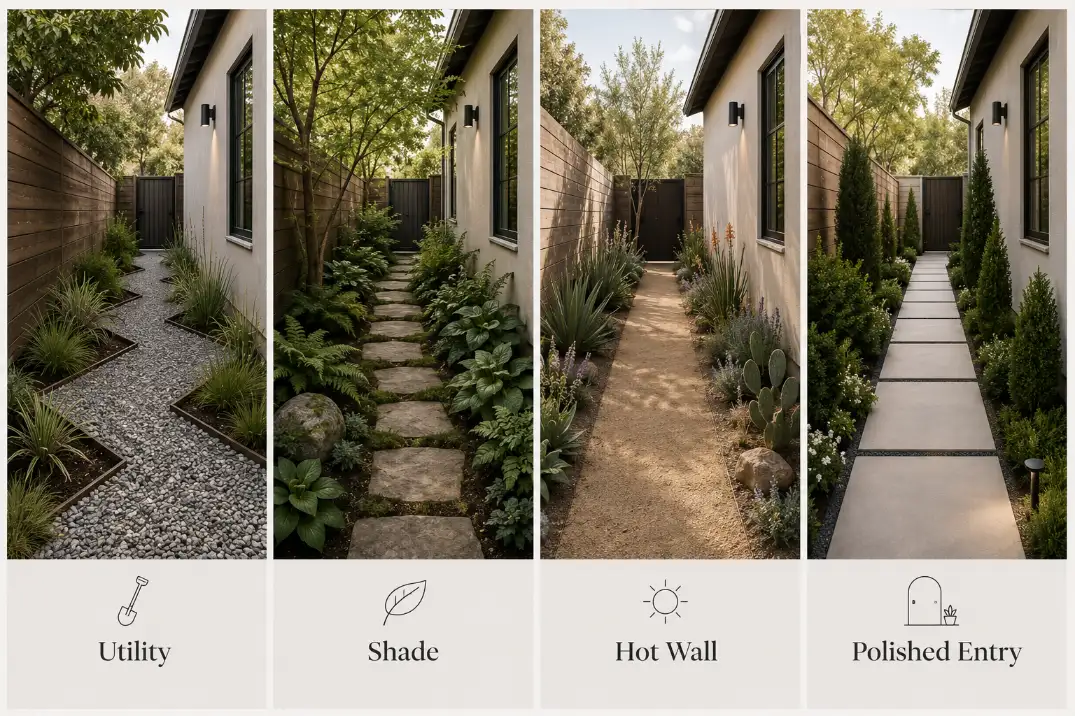
For a utility side yard
The strongest utility combination is angular gravel, steel or concrete edging, and low plants used in pockets rather than a continuous border. Carex, liriope, dwarf mondo grass, compact sedges, and small evergreen accents work because they stay low and do not grab shoulder space.
This is the best setup for trash-bin routes, hose access, and side yards where function matters more than a lush garden look. It also tolerates irregular widths better than a rigid paver pattern.
For a shaded side yard
Use stepping stones or narrow pavers with controlled mulch beds and shade-tolerant plants. Ferns, heuchera, carex, hellebores, hostas, and compact hydrangeas can work, but only if the space has enough airflow.
In humid regions, especially the Southeast and Florida, dense shade planting can keep leaves wet for 8–12 hours after rain. That is where “shade tolerant” gets misread. The plant may tolerate shade, but the whole side yard may still stay too damp.
For a hot wall side yard
In hot, bright side yards, decomposed granite, pale angular gravel, or permeable pavers usually pair better with drought-tolerant plants than dark stone or thirsty annual beds. Lavender, rosemary, dwarf ornamental grasses, sedum, santolina, compact juniper, and regionally adapted natives are better starting points.
This matters in Arizona, Texas, inland California, and other hot climates where wall and fence surfaces reflect heat. The plant is not just sitting in sun; it may be growing in a heat pocket.
For a polished side entrance
Where the side yard is visible from windows, a driveway, or a guest route, use larger pavers, repeated upright shrubs, and one restrained groundcover. The key is repetition. Too many plant types make a narrow corridor look busier and smaller.
A polished side yard still needs the same access discipline covered in Narrow Side Yard Walkway Flow: if the route feels pinched, the design is not working, no matter how attractive the plants are.
Plants That Behave Well in Tight Side Yards
Use the following as plant behavior categories, not a universal shopping list. Before buying, match the plant to your USDA zone, local water rules, deer pressure, winter lows, soil moisture, and sun exposure.
Plants that stay vertical
Upright growth is more valuable than fast growth in a narrow side yard. Columnar evergreens, narrow hollies, dwarf yaupon holly, upright boxwood alternatives, compact viburnums, and slim arborvitae types can work when their mature width stays inside the available bed.
The practical spacing rule is simple: allow at least half the mature spread between the plant center and the path edge, then add about 6 inches of maintenance breathing room where possible. A shrub that matures at 30 inches wide should not be planted 8 inches from the walkway.
Plants that stay low
Low plants are often safer than shrubs because they soften the side yard without narrowing it at shoulder height. Liriope, carex, dwarf mondo grass, creeping thyme, sedum, ajuga, and regionally appropriate native groundcovers can work well.
The condition people overestimate is “low maintenance.” A groundcover only stays low maintenance if it has a hard boundary. Without edging, it creeps into gravel, paver joints, lawn, or the neighbor’s fence line.
Plants that soften walls without closing the path
A narrow side yard often needs softness along a wall or fence, but not bulk. The best plants here have fine texture, predictable size, and a shape that does not flop after rain. Dwarf grasses, sedges, compact perennials, and small evergreen anchors are usually better than wide flowering shrubs.
This is the same pattern behind Backyard Plants Crowding Paths and Seating: the plant may be healthy, but its natural shape works against circulation.
Pro Tip: In a side yard under 5 feet wide, repeat one main plant texture instead of mixing many forms. Repetition makes the space feel calmer and wider.
Materials That Make Narrow Side Yards Easier to Use
Angular gravel works when it is edged
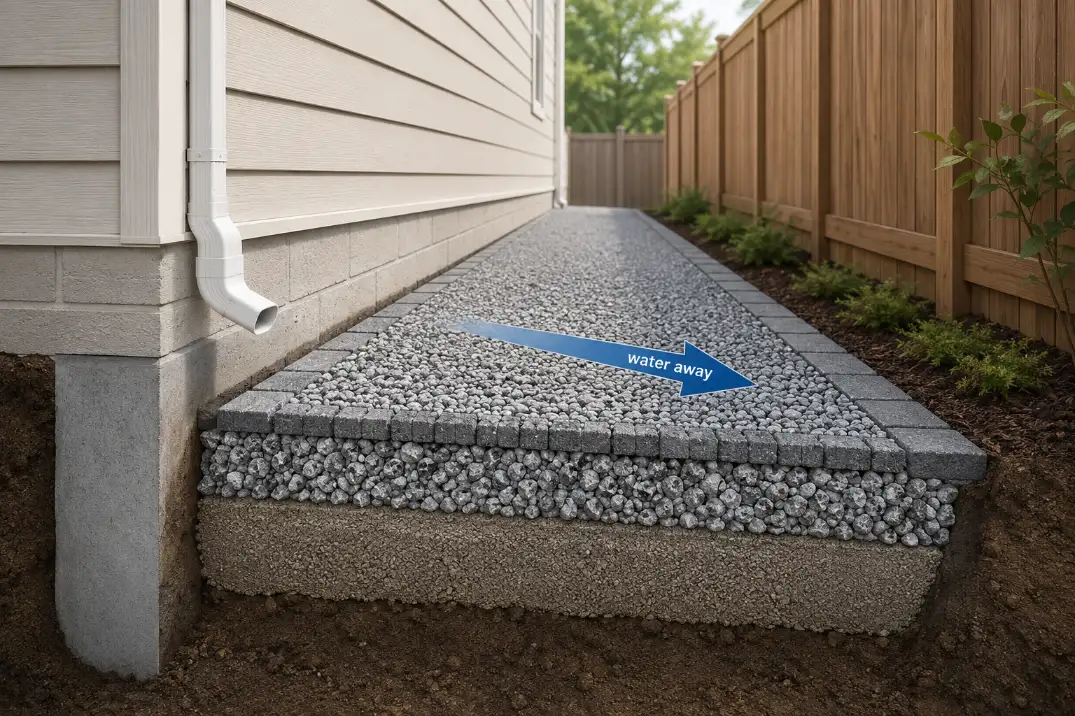
Gravel is one of the best side-yard materials because it drains, fits uneven widths, and looks intentional when contained. But loose gravel without edging is not a finished surface. It spreads, traps leaves, and becomes uneven.
For walking areas, use a compacted base and keep the decorative gravel layer around 1–2 inches. Angular gravel locks together better than rounded pea gravel, especially where bins, wheelbarrows, or kids’ bikes move through.
Decomposed granite works best in dry informal side yards
Decomposed granite is a strong option for dry climates and casual side-yard paths. It can feel more stable than loose gravel and visually softer than concrete. It is especially useful in California, the Southwest, and low-rainfall areas where a natural-looking path is preferred.
DG is less convincing where runoff crosses the side yard, where slopes are noticeable, or where freeze-thaw movement is severe. If water regularly cuts across the path, DG may wash, rut, or need repeated topping up.
Pavers need base depth, not just better stones
Pavers give a narrow side yard a cleaner, more finished look, but they are less forgiving than gravel. A shallow base will show up quickly because the eye follows the long corridor.
For pedestrian pavers, a 4–6 inch compacted base is usually a practical minimum, with more care needed in northern freeze-thaw regions or wet clay soil. If pavers are sinking, adding sand on top is usually a cosmetic fix. The underlying mechanism is base movement, not a surface problem.
Mulch belongs beside the path, not as the path
Mulch is useful in planting beds, but it is weak as the main walking surface in a side yard used every day. Bark mulch breaks down, shifts after storms, sticks to shoes, and can wash toward drains or patios.
In beds, 2–3 inches of mulch is usually enough. More mulch does not automatically protect plants better. In shaded side yards, deep mulch can hold too much moisture against stems, siding, and fence bases.
For more on the surface tradeoff, Pavers vs Gravel for Backyard Drainage is relevant because narrow side yards often magnify the same drainage and stability issues.
Match the Choice to the Side Yard Condition
| Side Yard Type | Best Plant Move | Best Surface Move | Avoid |
|---|---|---|---|
| Daily utility route | Low sedges, liriope, compact evergreen pockets | Angular gravel with firm edging | Loose pea gravel |
| Damp shade | Ferns, carex, hellebores, shade perennials | Stepping stones or pavers over stable base | Mulch-only paths |
| Hot wall exposure | Drought-tolerant perennials, dwarf grasses, compact evergreens | DG, pale gravel, or permeable pavers | Dark heat-holding stone |
| Visible side entrance | Upright shrubs and restrained groundcover | Large pavers or clean gravel-paver mix | Too many plant varieties |
| Utility meter or gate zone | Low plants set back from access points | Gravel or pavers with clear service space | Thorny shrubs and vines |
| Shallow compacted soil | Smaller shallow-rooted plants | Raised or amended planting strip | Large shrubs forced into 4–6 inches of soil |
What People Usually Choose Wrong
Fast-growing privacy plants
Fast growth sounds efficient, but in a narrow side yard it often creates the first problem. A hedge that needs clipping every 3–4 weeks during the growing season is not a low-maintenance solution. It is a maintenance subscription.
If privacy is the real goal, use narrow upright plants, a trellis in selected zones, or layered pockets rather than a continuous hedge that turns the corridor into a tunnel.
Aggressive vines
Vines look space-saving because they grow vertically, but they still need structure, pruning, and access. A vigorous vine can lean into the walkway, trap moisture against siding, or make fence maintenance harder.
Use vines only when the support is permanent and the species is controlled. Do not use them as a shortcut in a damp or already crowded side yard.
Wide shrubs in sub-5-foot corridors
Hydrangeas, large grasses, spreading roses, and broad evergreen shrubs may look beautiful in photos, but they often fail in a side yard under 5 feet wide. The problem is not plant health. The problem is geometry.
A 3-foot-wide shrub beside a 30-inch path leaves almost no tolerance for leaning stems, seasonal growth, or a person carrying tools.
Heavy containers along both sides
Containers can help where soil is poor, but lining both sides with pots usually narrows the path and complicates watering. In summer, small containers may need water every 1–2 days in hot climates. That is not a low-effort solution.
A few larger containers in wider pockets are usually better than a decorative row of small pots.
When Drainage Changes the Whole Decision
Water near the house is not just a plant problem
Side yards sit close to foundations, siding, vents, and utility penetrations. If the surface directs water toward the house, the planting plan is secondary. A slight 1–2 percent slope away from the foundation is often more important than the plant palette.
If water pools after ordinary rain, plants that “like moisture” will not necessarily fix it. They may survive, but the path can still stay soft, slippery, or unpleasant.
Wet soil makes plants look like the issue
Yellowing leaves, weak roots, and patchy growth can look like a bad plant choice. In many side yards, the real mechanism is poor drainage or compacted soil. If the soil is still soft 48 hours after moderate rain, the material and grading deserve attention before replacing plants.
That is why a narrow side yard with drainage trouble should be handled more like a surface-and-water problem than a shopping list. The same sequencing logic appears in Fix Drainage or Layout First: solve the constraint that controls everything else before buying prettier pieces.
Narrow Side Yard Checklist Before Buying
- Keep 30–36 inches clear for regular walking access.
- Check whether water disappears within 24 hours after rain.
- Choose plants by mature width, not pot size.
- Keep thorny or floppy plants away from gates, meters, and trash-bin routes.
- Use edging wherever gravel, DG, mulch, or groundcover meets a path.
- Treat hard soil at 4–6 inches deep as a real planting constraint.
- Avoid fast-growing privacy hedges if pruning access is already tight.
Best Overall Choices
For most narrow side yards, the safest all-around combination is angular gravel or permeable pavers, a defined edge, compact low planting, and one or two upright accents. This keeps the space useful without making it feel bare.
For shaded side yards, stepping stones with controlled planting usually outperform lawn strips and mulch-only paths. For hot side yards, decomposed granite or pale gravel with drought-tolerant plants is often better than dark pavers and thirsty planting beds.
For visible side entrances, larger pavers and repeated upright shrubs create the most polished look with the least visual clutter.
The choices that deserve the most caution are not unusual plants or expensive materials. They are ordinary decisions used in the wrong place: fast hedges, loose pea gravel, wide shrubs, mulch paths, and too many pots. In a narrow side yard, small errors become daily friction.
If the side yard already feels cramped, Side Yard Mistakes That Make Tight Spaces Feel Cramped can help separate a plant problem from a layout problem before the next round of buying.
Questions People Usually Ask
What is the best low-maintenance plant for a narrow side yard?
The best low-maintenance plant is one that reaches mature size without entering the path. Compact sedges, liriope, dwarf mondo grass, upright evergreens, dwarf ornamental grasses, and regionally adapted groundcovers are usually safer than fast-growing shrubs.
Is gravel or pavers better for a narrow side yard?
Gravel is better for irregular, drainage-sensitive, or utility-heavy side yards. Pavers are better where the side yard is highly visible or needs a cleaner walking surface. Gravel needs edging; pavers need a proper compacted base.
Is decomposed granite good for side yards?
Decomposed granite is good in dry, informal side yards where runoff is controlled. It is less ideal on slopes, in heavy-rain areas, or where water regularly crosses the path.
What should I avoid in a narrow side yard?
Avoid bamboo, aggressive vines, thorny shrubs near gates, wide shrubs in tight corridors, loose pea gravel on daily paths, mulch-only walkways in wet shade, and fast-growing hedges that need constant clipping.
For broader university guidance on mulch depth and soil protection, see University of Minnesota Extension.