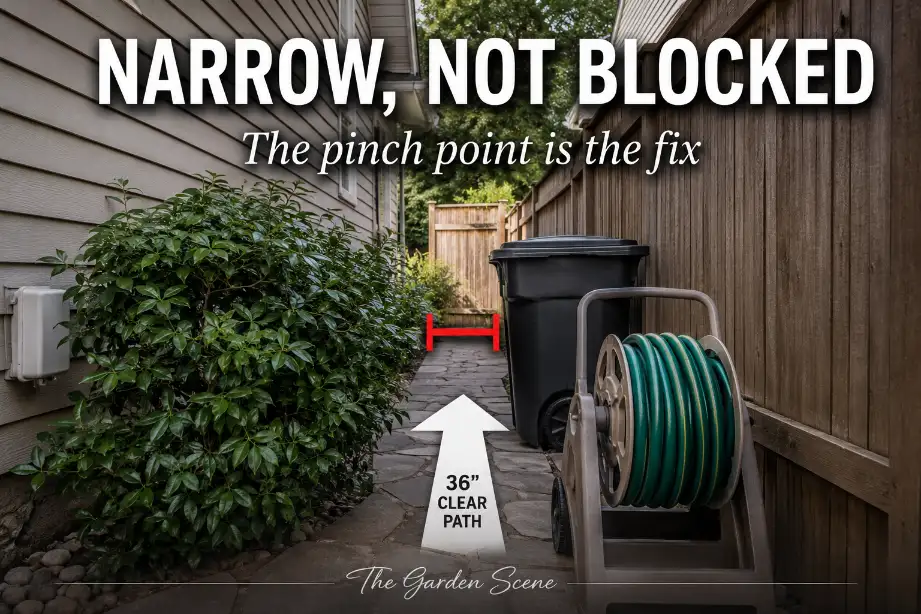
A narrow side yard is usually hard to walk through for one of three reasons: the clear path is too thin, the surface feels unstable, or objects project into the route at hip, shoulder, or gate height. Start with the useful numbers.
If the usable walking line drops below about 30 inches for more than a few steps, most adults will slow down, turn slightly, or brush against the fence and wall. A 36-inch clear path is a better everyday target, while 42 inches feels noticeably easier if you move trash cans, bikes, tools, or garden supplies through the space.
This is different from a side yard that simply looks narrow. A visually tight side yard can still work if the surface is firm, the edges are controlled, and nothing catches your arms.
A wider side yard can feel worse if gravel shifts, plants flop after rain, or storage items sit exactly where your stride needs to land.
Know Which Kind of Side Yard You Have
Before choosing pavers, gravel, plants, or lighting, decide what the side yard actually needs to do. A narrow side yard fails when it is treated as decoration first and circulation second.
The service corridor
This is the side yard used for trash cans, hose access, meters, AC equipment, garden tools, and occasional maintenance. It needs a durable walking strip, open equipment access, and fewer objects along the middle of the run. Pretty stepping stones often disappoint here because bins and carts need a continuous surface.
The garden strip
This side yard is mostly for light access, planting, and visual softness between the house and fence. It can use stepping stones, low planting, or gravel more successfully, but only if mature plant width stays behind the path edge.
If plants need trimming every 3 to 6 weeks just to keep the walkway open, the design is already asking for too much maintenance.
The pass-through route
This side yard connects the front, driveway, or gate to the backyard. It has to feel readable from end to end. A clean line matters more than a collection of small features.
If the space is already tight, alternating planters, random stepping stones, and small decor pieces usually make movement feel more interrupted.
A useful starting point is to treat the route the way you would treat a small outdoor hallway. The article on side yard layout ideas for tight access is a strong companion because tight side yards need layout logic before styling.
Start With the Walking Line, Not the Decoration
Most narrow side-yard fixes fail because they begin with plants, pavers, or storage before defining the walking line. In a tight space, the path is the room. Everything else has to serve it.
Measure the real clearance
Do not measure fence-to-wall width and assume that is your walking width. Measure the narrowest usable space after accounting for siding, downspouts, hose reels, AC equipment, plant spread, gate swing, edging, and surface drop-offs.
A 48-inch side yard can behave like a 28-inch path once a shrub extends 10 inches, a hose reel projects 6 inches, and loose edging makes one side feel unsafe to step on. That is the symptom: the yard feels tight. The underlying mechanism is lost usable clearance.
Use a tape measure in three places: near the gate, at the tightest middle point, and where the side yard opens into the backyard. If one pinch point is under 30 inches, fix that before redesigning the whole run.
Keep the route visually continuous
A side yard becomes easier to walk through when your eye can read one clean path from end to end. That does not always mean pouring a new walkway. It can mean using the same surface strip, the same edging line, or a repeated stepping rhythm.
Random stepping stones, alternating planters, and small decorative features can make the path look designed but feel interrupted. If the route is already tight, visual breaks often make people slow down instead of move naturally.
If the side yard is currently treated as leftover space, the better mental model is closer to a service corridor than a miniature garden room. The article on side yards becoming wasted outdoor space is useful here because the main problem is often not lack of ideas; it is lack of a clear job for the space.
What Usually Makes a Narrow Side Yard Hard to Use
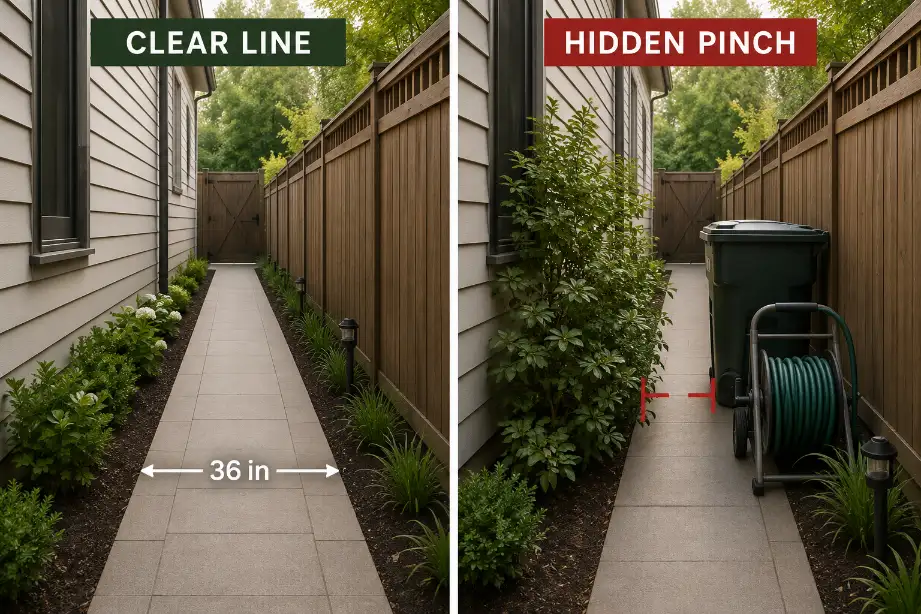
The most common problem is not the total lot width. It is the combination of small intrusions that stack up until the walking line disappears.
Plants that behave wider than they looked
Small shrubs, ornamental grasses, vines, and soft perennials often look harmless in a nursery pot. After two growing seasons, a plant labeled 24 inches wide can easily occupy 30 inches or more if it leans toward light or flops after rain.
In a side yard, that matters more than in an open bed. A plant that steals 6 inches from a 7-foot-wide backyard border is not a big deal. A plant that steals 6 inches from a 34-inch walking path changes how the whole route feels.
This is why trimming alone often disappoints. If the plant naturally wants to arch into the path every few weeks during the growing season, pruning becomes maintenance debt, not a fix.
Use upright, narrow plants only where they can stay inside their mature width without constant correction.
Where plants are already crowding movement, backyard plants crowding paths and seating explains the same failure pattern in a broader layout context.
Loose surfaces that make people walk carefully
A narrow path needs a surface that feels predictable. Loose pea gravel, uneven stepping stones, soft mulch, and badly settled pavers make people shorten their stride. That is why a 40-inch gravel strip can feel less walkable than a 32-inch firm concrete or compacted paver path.
For everyday access, aim for a surface that stays firm after rain and does not shift under heel pressure. If gravel is the best budget choice, use angular crushed stone rather than rounded pea gravel, and keep the compacted layer stable with edging.
A 2- to 3-inch loose top layer is usually too deep for a narrow passage; it makes wheels, bins, and loaded garden carts harder to move.
Objects placed at the wrong height
People often clear the ground but forget shoulder space. Hose reels, meters, spigots, latch hardware, wall-mounted shelves, hanging baskets, and AC lines can all make a side yard feel tighter even when the floor is open.
The most irritating obstacles sit between 30 and 60 inches high because they catch hips, elbows, bags, and trash can handles. A low groundcover at the edge may look messy, but it rarely stops movement the way a wall-mounted reel does.
Pro Tip: Walk the route while carrying the widest object you regularly move through it. A trash can, folding chair, or garden tote will reveal pinch points faster than looking at the path empty.
Fix Water Before You Upgrade the Surface
Drainage is the part homeowners often underestimate. A narrow side yard may look like a surface problem when it is really a water path problem. Roof runoff, downspouts, AC condensate, neighbor grade, compacted clay soil, and a slight side-yard slope can all push water across the exact place where people need to walk.
The warning sign is repeated mess
If mud, silt, algae, or washed gravel returns within 24 to 48 hours after rain, resurfacing alone will probably fail. New pavers over poor drainage may look clean for a few weeks, then settle, stain, or collect slime in the same low spots.
The decision rule is simple: if water crosses the walking line, fix water movement before upgrading the path. This can mean extending a downspout, regrading a shallow swale, adding a drain where appropriate, or choosing a surface that can drain without spreading.
In wet regions or shaded side yards, a slick smooth paver can become more annoying than a modest crushed-stone path with firm edging.
If you suspect the problem is bigger than the walkway itself, fixing drainage or layout first is the better priority check before spending on finish materials.
The Practical Fix Sequence
Do the fixes in this order. It prevents you from spending money on a new surface while the real problem remains overhead, along the edge, or at the gate.
1. Remove the worst intrusions first
Start with the one or two things that reduce clearance the most. This may be a leaning shrub, a hose reel, a storage bin, a gate latch, or a planter that seemed useful but sits exactly where a foot needs to land.
Do not begin by buying narrow planters or decorative edging. Those may improve the look, but they rarely solve the first-use problem. The side yard becomes easier when the body can move through it without turning, brushing, or pausing.
A good threshold: if you cannot walk through with both arms relaxed at your sides, the path is still functioning as a squeeze point.
2. Create a firm center strip
Once the route is clear, stabilize the walking line. For most homes, the best side-yard surface is a continuous strip of concrete, large-format pavers, compacted decomposed granite, or tightly set pavers over a proper base.
A practical path width range is 32 to 42 inches. Use 32 inches only where space is genuinely limited and the path is straight. Use 36 inches as the better everyday target. Use 42 inches or more if bins, bikes, wheelbarrows, or equipment regularly pass through.
The base matters more than the surface style. A paver path over a weak base will shift after freeze-thaw cycles in northern states or after repeated heavy rain in Midwest yards. A compacted 4- to 6-inch base is usually more important than choosing a more expensive paver.
3. Control the edges
Edges decide whether the side yard stays walkable after the first season. Without firm edging, gravel spreads, mulch migrates, soil washes onto the path, and plants creep inward.
This is especially important where downspouts, side-yard slopes, or roof runoff cross the route. If water leaves silt on the path after every storm, the problem is not just a messy surface.
It is a drainage pattern cutting across the walking line. In that case, backyard drainage after adding a patio or walkway is a better next read than another decorative walkway idea.
Side Yard Ideas That Actually Improve Walking Flow
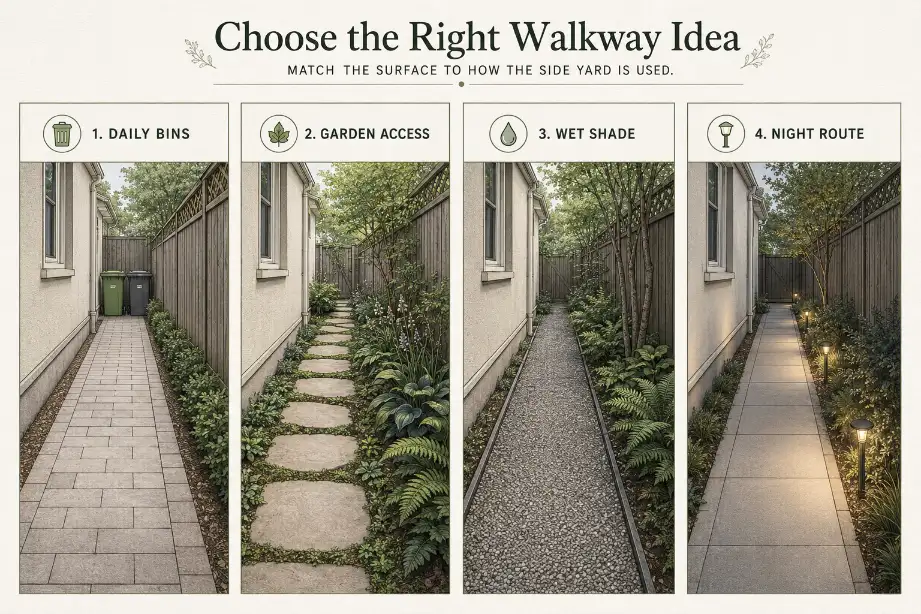
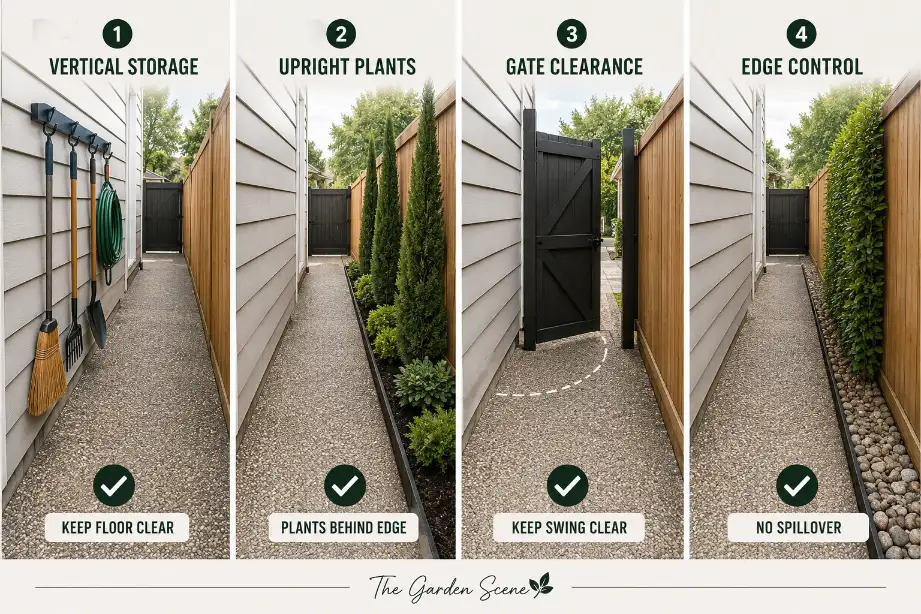
A narrow side yard does not need a long list of features. It needs one idea that protects the walking line. The best options are the ones that make the route easier to read, easier to step on, or easier to keep clear after rain and seasonal growth.
For a service side yard, the strongest idea is usually a continuous hard strip with storage pushed to one end. For a garden-style side yard, use planting as a narrow edge, not as a soft wall that leans into the path.
For a wet or shady side yard, crushed stone with firm edging often beats mulch because it drains faster and does not smear into the walking surface.
For a side yard used at night, low-glare lighting every 6 to 8 feet matters more than bright decorative fixtures.
The ideas below are worth considering because each one solves a different walking-flow problem. Avoid combining too many of them in the same narrow run.
In a side yard under 4 feet wide, one clear move almost always works better than four small decorative gestures.
Side Yard Walkability Guide
| Side Yard Use | Best Surface or Layout Move | Avoid |
|---|---|---|
| Weekly trash can route | Continuous pavers or concrete strip | Loose pea gravel or irregular stepping stones |
| Occasional garden access | Stepping stones with compacted gravel | Deep mulch that shifts onto the path |
| Wet or shady side yard | Crushed stone with firm edging | Slick smooth pavers without drainage |
| Sloped side yard | Leveled landing zones or stable pavers | Loose gravel running down grade |
| Bikes, tools, or carts | Firm continuous 36–42 inch route | Narrow decorative gaps between features |
| Plant-focused side yard | Upright planting behind a hard edge | Floppy shrubs that need monthly trimming |
Lighting, Gates, and Small Details That Change the Feel
A narrow side yard does not need dramatic lighting. It needs enough light to show edges, steps, slopes, and latch points. Low-glare path lights placed every 6 to 8 feet often work better than one bright wall light that throws harsh shadows.
If the path has steps, a slope, or uneven transitions, lighting becomes a safety feature rather than decoration. The guidance in path lighting for steps, slopes, and walkways fits side yards well because narrow routes leave less room for recovery if someone missteps.
Gates deserve the same attention. A gate that opens into the walking line can turn a decent side yard into an awkward stop-and-turn sequence. If possible, set the latch where it can be reached without stepping into planting, and avoid placing bins or storage immediately inside the swing zone.
When the Standard Fix Stops Making Sense
A basic cleanup and path refresh works when the side yard is mostly clear, dry, and structurally simple. It stops making sense when the passage is forced to handle too many jobs at once.
Too much storage for the width
If the side yard is under 4 feet wide, avoid treating it as both a walkway and a storage zone. Wall hooks, slim cabinets, hose reels, and bins can work only if they do not reduce the usable path below the comfort threshold.
A common mistake is moving clutter from the patio into the side yard without changing the storage logic. The backyard looks better, but the service route becomes annoying. If storage is unavoidable, keep it near one end rather than scattering it along the run.
Drainage or equipment blocks the route
AC units, utility meters, downspouts, cleanouts, and service panels are not decorative obstacles. They need access. Do not hide them behind planters or build a path that makes maintenance harder.
As a rule, leave at least 30 inches of working access around equipment where possible, and more if your local code, manufacturer, or service technician requires it. If a unit already consumes most of the side yard, the realistic fix may be a cleaner surface and better edge control, not a full garden-style walkway.
The path has a tight turn
Straight narrow paths are easier than narrow paths with turns. If the route turns around a corner, gate, utility box, or storage item, add clearance at the turn before improving the straight sections. A 36-inch straight path can feel acceptable; a 36-inch turn around an obstruction often feels clumsy.
This is one reason some narrow side-yard layouts perform better when the planting is concentrated in one clean strip instead of alternating from side to side. The more the eye and body can move in one direction, the less narrow the space feels.
Questions People Usually Ask
Is a 3-foot-wide side yard path enough?
Yes, 36 inches is a useful target for a clear walking route, especially if the path is straight and the surface is firm. It starts to feel tight when plants, storage, wall fixtures, or edging reduce that width below about 30 inches.
Is gravel bad for a narrow side yard?
Gravel is not automatically bad, but rounded pea gravel and deep loose layers are poor choices for daily movement. Angular crushed stone over a compacted base with firm edging is usually easier to walk on and easier to keep contained.
Can I store trash cans in a narrow side yard?
Yes, but only if the cans do not sit in the walking line or block the gate swing. In side yards under 4 feet wide, storing cans at one end usually works better than lining them along the route.
Should drainage be fixed before adding pavers?
Yes, if water crosses the path or mud returns within 24 to 48 hours after rain. Pavers can improve footing, but they will not solve runoff that keeps pushing water, silt, or debris across the walkway.
A narrow side yard becomes easier to walk through when it is treated as a movement route first and a landscape space second.
The best upgrades are not always the most visible ones: firm footing, clean edges, controlled plant width, fewer shoulder-height obstacles, and a path that reads clearly from the gate to the backyard. Once those are right, small design choices actually have room to work.
For broader official clearance guidance, see the U.S. Access Board guide to accessible routes.