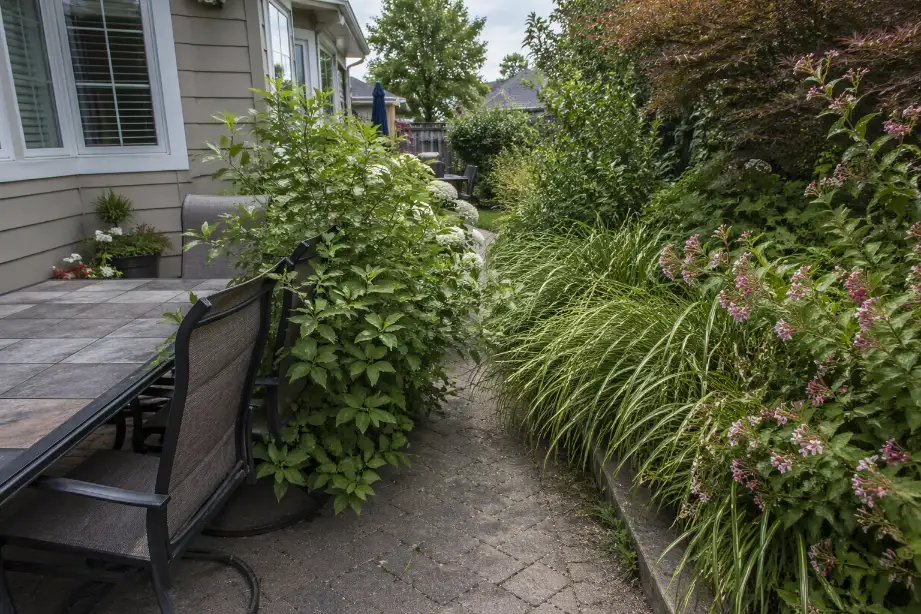
When backyard plants start crowding paths and seating, the problem is usually not vigorous growth by itself. It is usually a spacing mistake that only becomes obvious once the planting reaches real size.
The first checks should be practical, not aesthetic: how much clear walking width is left, how much space chairs need to move, and how far plant mass is crossing into those zones.
Extension guidance is consistent on the underlying principle: measure the plantable space, choose plants for their mature size, and make sure the landscape still functions as it grows.
That distinction matters because people often diagnose this as a pruning problem. It usually is not. A planting can look lush and layered without failing.
It becomes a real problem when a path drops below about 36 inches of clear width, when chairs cannot move back naturally, or when you are pruning every 4 to 8 weeks during active growth just to keep the area usable.
At that point, the symptom is overgrowth, but the mechanism is a bad relationship between mature plant spread and hard-use space.
The issue is lost function, not just too much greenery
A backyard does not feel cramped simply because it has a lot of planting. It feels cramped when plant mass starts taking space that circulation and seating need every day.
Path width is the first honest test
Design guidance for residential landscapes repeatedly treats path width as a functional decision, not a decorative one. Main routes need to be wide enough for how they are actually used, and overgrown plants along the edge reduce that function fast.
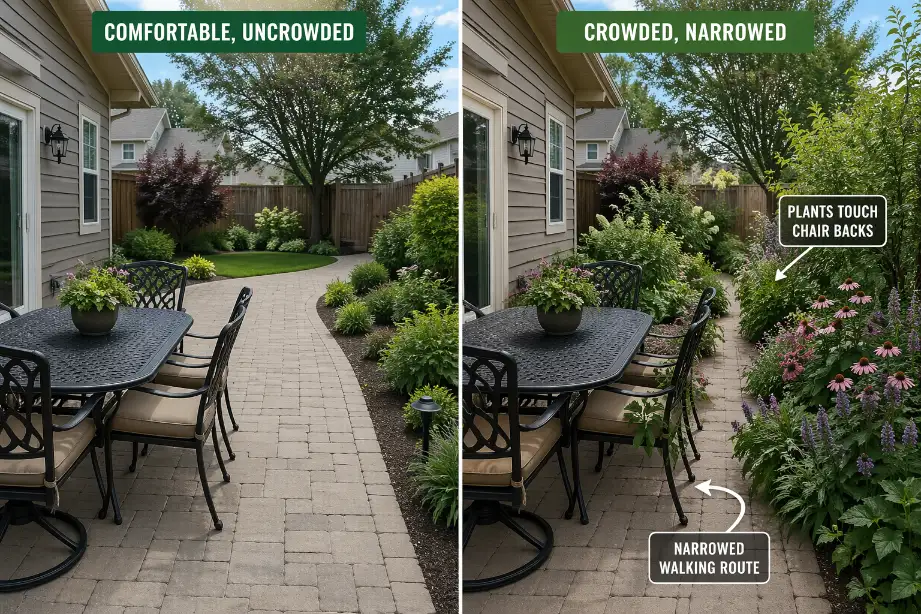
For a typical backyard path, 36 inches is a practical minimum once the route is in regular use. Around 42 to 48 inches is more comfortable where people carry trays, pass through with tools, or move between the house, grill, gate, and patio. Once foliage is regularly intruding 6 to 12 inches into that width, the path often still looks acceptable in photos but already works poorly in daily life.
Seating usually fails before people realize it
Seating problems get misread because homeowners measure furniture footprint, not furniture movement. The chair may technically fit, but if it cannot pull back without catching branches or wet foliage, the space is already compromised. That is why this problem often overlaps with Overplanted Backyard? Why It Feels Smaller. The yard may not be small in total square footage; it just lost the space people actually use.
What people usually misread first
The visible symptom is foliage in the way. The underlying cause is usually one of three design errors.
Mature size was ignored at planting time
This is the most common one. The bed was spaced for install-day appearance, not year-three or year-five plant spread. University guidance is very clear that plant choice and spacing should reflect mature size and the purpose of the space, not just what looks balanced the day it is planted.
The bed edge is too close to the use zone
Sometimes the plants are not unusually aggressive at all. The bed line itself is too close to the path or patio, so even normal growth has nowhere to go except into circulation space.
The wrong plant habit was used at the edge
This is where many articles stay too vague. The issue is not always “a plant that gets too big.” Often it is a plant with the wrong habit for the location: arching, fountaining, suckering, lateral-spreading, or soft and floppy after rain. A medium-size plant can still be a bad edge plant if its natural shape keeps stealing clearance.
That is also why Shrubs Taking Over the Patio? What Went Wrong is so closely related. Patio-edge problems are often less about neglect than about mature form meeting fixed hardscape.
Quick diagnostic checklist
- Your main path falls below 36 inches of clear width during part of the growing season
- Plants lean or spill more than 6 inches over the hardscape edge for weeks at a time
- Chairs cannot pull back naturally because there is less than about 24 to 30 inches behind them
- The same edge plants need cutting back every 4 to 8 weeks just to preserve access
- The space looks fine in winter or early spring but feels cramped by midsummer
- The outer bed edge contains the fastest-growing or widest-arching plants
Why the obvious fix often wastes time
The most common waste of effort is treating a layout conflict like a maintenance problem.
Repeated shearing usually makes the edge thicker
When people try to hold an unsuitable plant in place by repeated clipping, they often get a denser outer shell and a more awkward shape. That is why crude size suppression is usually less effective than selective thinning or structural pruning. The plant may look smaller for a short time, but the edge often becomes bulkier and harder to manage.
“Just keep trimming it” stops making sense quickly
Once a plant repeatedly blocks a path or crowds chairs, the question is no longer whether you can reduce it again. The better question is whether the yard should depend on constant intervention to remain usable.
That is the point many competing pages dodge. They describe pruning, but they do not decide when pruning has become a weak answer.
A useful parallel is Patio Furniture Layout Fixes That Make a Big Difference. What feels like a furniture problem is sometimes actually a planting-clearance problem eating away at the same operating space.
What to fix first, in the right order
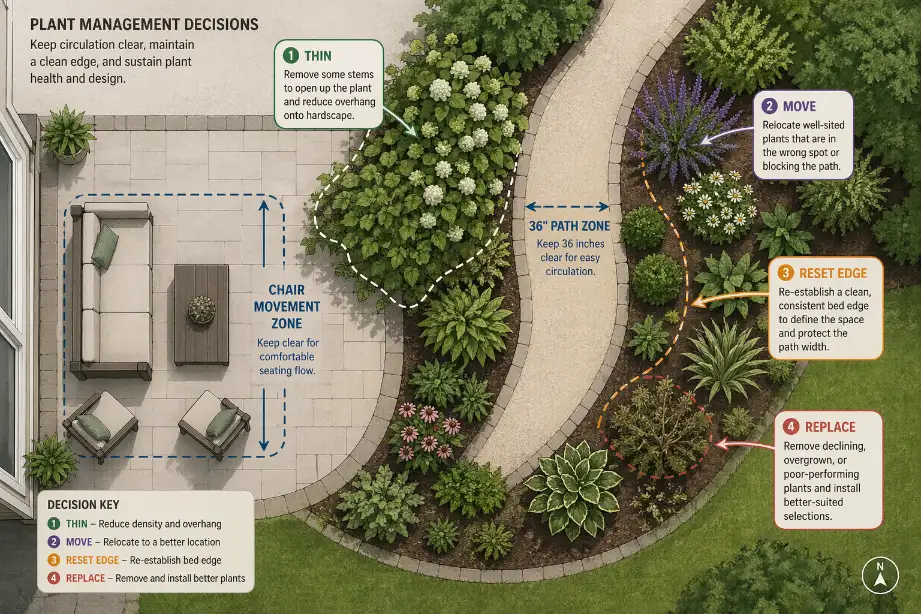
1. Protect circulation before plant shape
Restore the route first. If the path matters daily, protect that width before trying to preserve a perfect plant silhouette. Circulation is the primary job.
2. Thin selectively before you shear
If the plant is otherwise suitable, remove the stems that are actually crossing into the use zone instead of clipping the entire surface. Selective thinning usually preserves the plant’s natural form better and avoids creating a denser outer shell.
3. Relocate the repeat offender
If the same plant keeps reclaiming the path or patio after proper thinning, relocation is often smarter than permanent correction. A plant that repeatedly returns to conflict is telling you it is not in the right place.
Pro Tip: If restoring clearance requires turning the plant into an unnatural ball, slab, or box, pruning has already stopped being a good long-term solution.
4. Move the bed edge if the bed is undersized
Sometimes one or two plants are not the main problem. The planting strip is. Shifting the bed edge back even 8 to 18 inches can change how the entire patio or path functions.
5. Replace by habit, not just by height
This is one of the best ways to outrank softer SERP content. The real replacement question is not “what stays smaller?” It is “what holds its shape without invading human space?”
Near paths and seating, plants described as upright, narrow, clumping, mounding, or slow-spreading tend to be safer long-term bets. Plants described as arching, fountain-shaped, suckering, trailing, vigorous, or floppy after bloom deserve much more caution at the edge.
The comparison that actually helps
| Condition | Usually manageable | Usually a sign of the wrong fit | Why |
|---|---|---|---|
| Seasonal spill of 3 to 5 inches | Yes | Not usually | Minor edge correction |
| Regular spill of 6 to 12 inches | Sometimes | Often | Functional clearance is being lost |
| Path stays above 36 inches clear | Yes | Rarely | The route still works |
| Path drops below 36 inches clear | Briefly at best | Often | This is now a use problem |
| Chair movement still feels natural | Yes | No | Seating still functions |
| Chairs catch foliage or stay damp from contact | Rarely | Often | Comfort and usability are compromised |
| Same plant needs control every 4 to 8 weeks | Poor long-term fit | Yes | Maintenance is masking a layout mistake |
What changes under different backyard conditions
Small patios and connectors
Small patios fail faster because there is less buffer between the bed edge and the usable room. A plant that behaves acceptably beside lawn can become a constant problem beside a compact patio or a narrow connector path.
Wet, fertile climates
In wetter regions, plants often put on stronger seasonal growth and lean farther after storms. A layout that looks disciplined in May can feel crowded by midsummer simply because softness and seasonal expansion were underestimated.
High-irrigation yards
Overwatering can intensify the exact growth pattern that starts eating hardscape edges. That is one reason Why Backyard Water Bills Spike Every Summer connects more than it may seem at first glance. Too much irrigation can make a borderline plant choice fail faster.
Weak backyard flow from the start
Some spaces already had poor movement logic before the plants matured. In those yards, the planting is exposing the weakness rather than creating it from scratch. Backyard Layout Problems That Make Spaces Hard to Use fits here because circulation flaws become much less forgiving once plant mass increases.
When pruning stops making sense
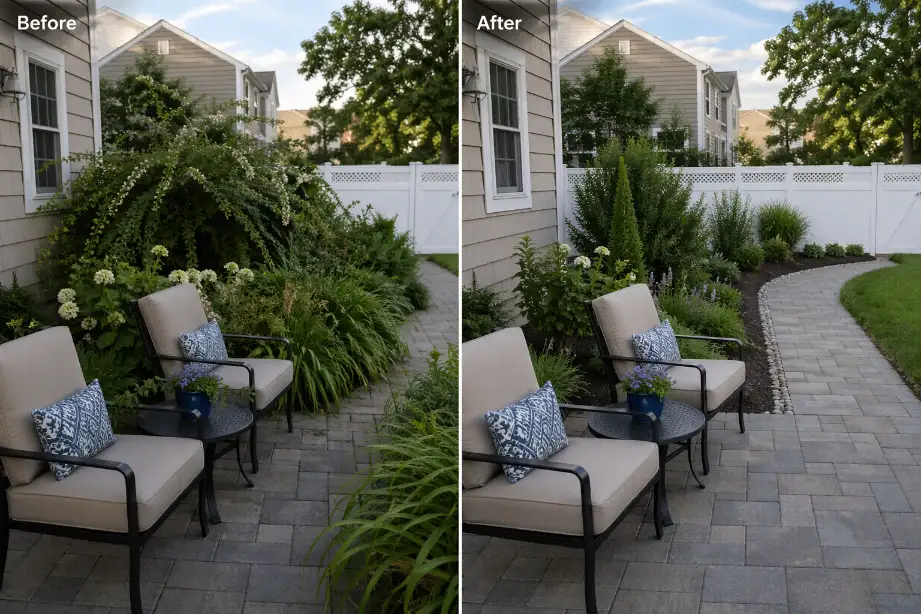
There is a point where “just maintain it better” becomes the wrong advice. If a plant repeatedly blocks a route, brushes people as they pass, crowds chair movement, traps moisture against seating, or needs monthly correction to preserve basic function, it has stopped being a good plant for that location.
The commonly underestimated factor is mature habit.
The commonly overestimated factor is how much maintenance can compensate for bad siting.
That is the sharper conclusion this topic needs. A backyard should not require daily negotiation between plant mass and human movement. Once that negotiation becomes constant, the best fix is usually not more pruning. It is a better boundary between planting space and living space.
For broader official guidance on plant spacing and functional landscape design, see University of Minnesota Extension.