Last updated: July 6, 2026
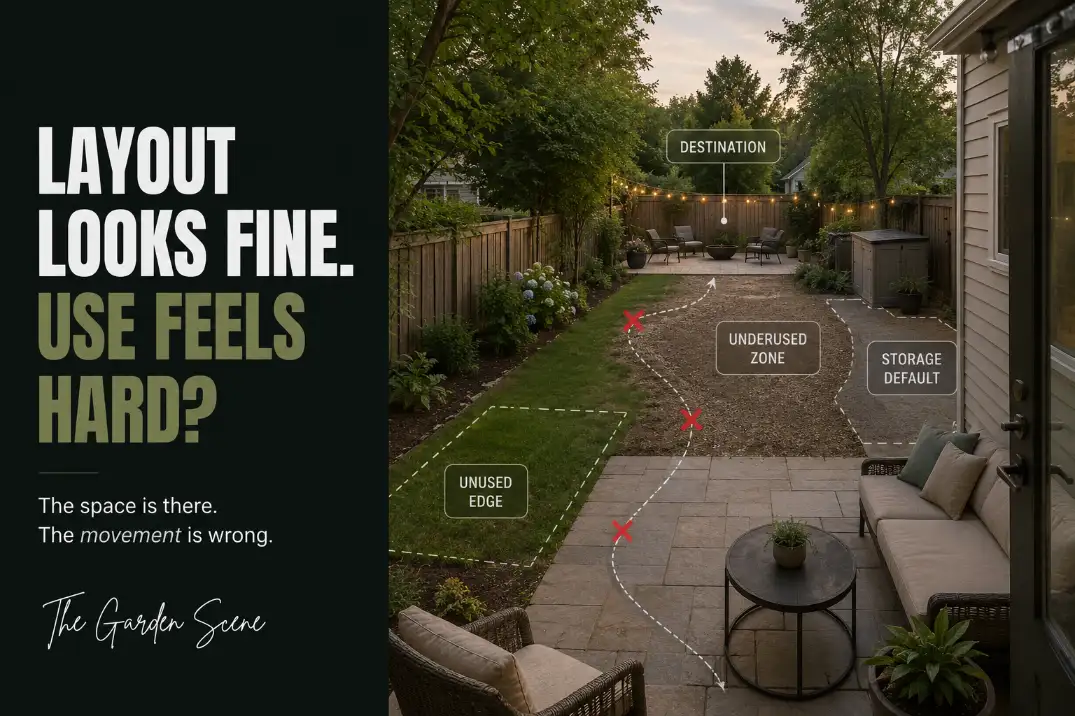
A backyard usually becomes hard to use before it looks obviously wrong. The patio may be installed, the lawn may be open, the chairs may fit, and the far end may even have a purpose. The failure shows up only when someone opens the back door, carries food outside, pulls a chair back, reaches a gate, stores a bike, or tries to use the far end on a normal weeknight.
That is the real diagnosis: the yard is not only a collection of spaces. It is a sequence of movements. When that sequence breaks, the backyard starts feeling smaller, slower, more exposed, or more annoying than its square footage suggests.
This is not a backyard makeover plan or a “what to fix first” priority list. It is a field diagnosis. Before adding more features, changing furniture, or building a new path, check where daily use actually breaks: the route, the seating clearance, the middle zone, the sightline, the storage edge, or the connection to the far end.
The Space Is Not the Problem If the Route Is Doing Too Much
Start with the route, not the features. In many hard-to-use backyards, one narrow line from the back door is quietly expected to handle everything: walking outside, carrying food, reaching the grill, getting to storage, letting kids or pets pass, moving cushions, accessing the side gate, and crossing to the far end.
A route can look open when the yard is empty and still fail during use. The real test is not whether one person can walk through once. The test is whether the route still works when a chair is pulled back, someone else is seated, a gate needs to open, and a person is carrying something with both hands.
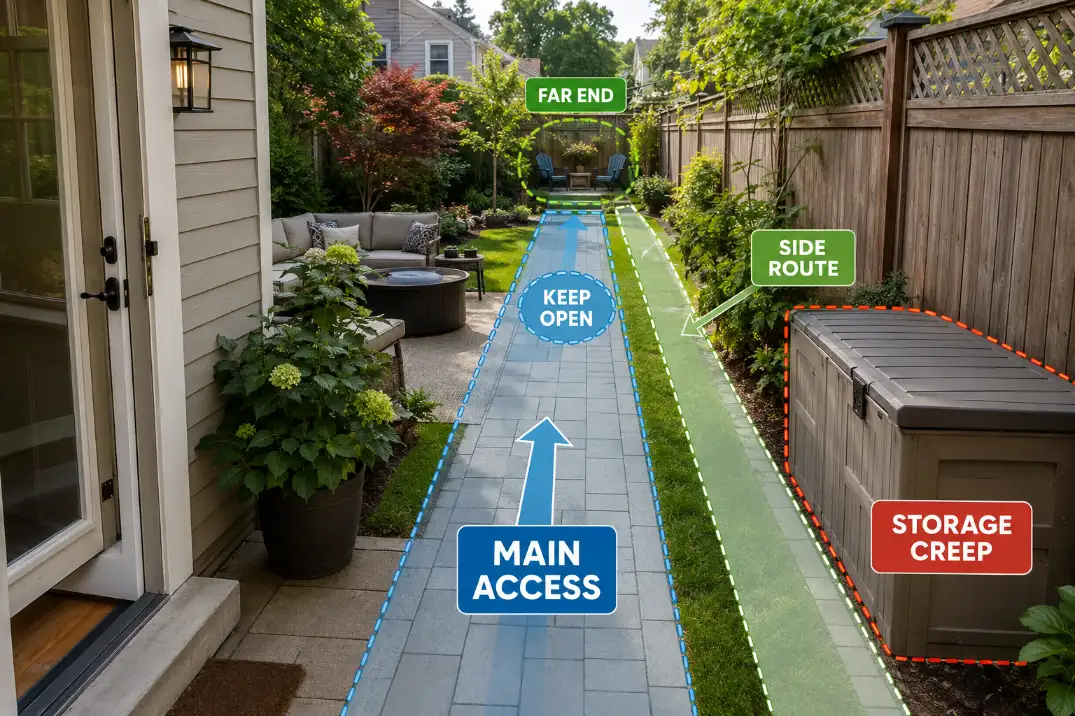
The warning sign is body adjustment. People turn sideways. They step onto grass to avoid a chair. They pause at the door because someone else is coming through. They avoid carrying larger items outside because the path feels irritating.
That is the difference between a visible path and a usable route. A visible path is where the paving, lawn, or stepping stones appear to lead. A usable route still works after furniture moves, doors open, storage shifts, and normal activity begins.
If your backyard only works when everything is tucked in and nobody is using it, the route is doing too much. For yards where the driveway, side gate, or service path affects the rear yard, a tight backyard access path from the driveway can make the entire space feel harder to use even when the patio itself is not the main failure.
| Daily-use symptom | Likely layout cause | First field check |
|---|---|---|
| People squeeze past chairs | Main route crosses active seating space | Pull out each chair and walk the route again |
| Far end rarely gets used | Yard is arranged as a pass-through, not a sequence | Walk to the far end while carrying something |
| Middle lawn feels empty but unused | No pause point, edge, shade, or purpose | Watch whether anyone stops there naturally |
| Side gate access feels irritating | Storage or furniture has taken over the edge route | Open the gate fully and check the swing area |
| Patio works only when furniture is tucked in | Static footprint is being mistaken for real-use clearance | Test the layout with seats occupied or pulled back |
| Yard feels long and exposed | Straight sightline makes the space read like a corridor | Stand at the back door and track the view to the far fence |
Zones Fail When They Are Stacked in a Straight Line
A backyard does not have real zones just because it has separate areas. If the back door, patio, lawn strip, middle space, and far-end feature all sit in one straight sequence, the yard may behave more like a corridor than an outdoor room.
The daily symptom is predictable: people stay near the house, cross the middle only when necessary, and rarely settle at the far end. The yard may technically include a lawn, garden, sitting area, or fire pit, but those elements do not create use if the sequence never invites people to stop.
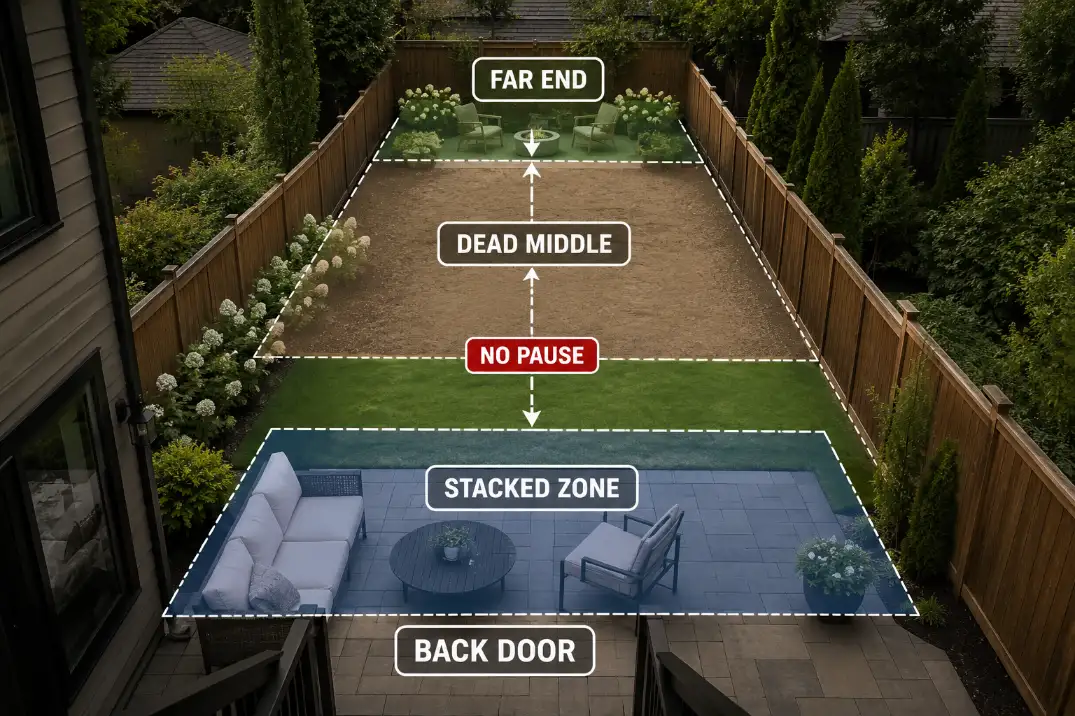
The problem is not the long shape itself. The problem is that every part of the yard tells the body to keep moving. There is no slight turn, edge, visual stop, shade pocket, or landing point that says, “This is a place to pause.”
A working backyard sequence usually has small interruptions. A seating edge turns slightly. A planting bed breaks the line. A middle area gains a clear job. A path bends enough to slow movement. Those moves do not need to become a full redesign, but they clarify the diagnosis: the yard is not failing because it lacks features. It is failing because the features are not connected by behavior.
If your yard has several named areas but still feels like one long strip, compare the pattern with backyard zoning mistakes that weaken outdoor flow. The distinction matters: this page diagnoses why use breaks down; a zoning page helps after you know the sequence is the problem.
Furniture Can Fit and Still Block the Yard
The common mistake is judging furniture while it is parked, not while it is being used. Chairs pushed under a table can make a patio look organized. A centered table can look balanced. A clear strip beside the seating can look like enough room.
Then someone sits down.
A chair pulls back into the walking line. A seated person blocks the route to the lawn. A side table sits exactly where someone needs to step around the grill. A storage bench near the patio edge leaves no recovery space. The furniture fits as objects, but it fails as active layout.
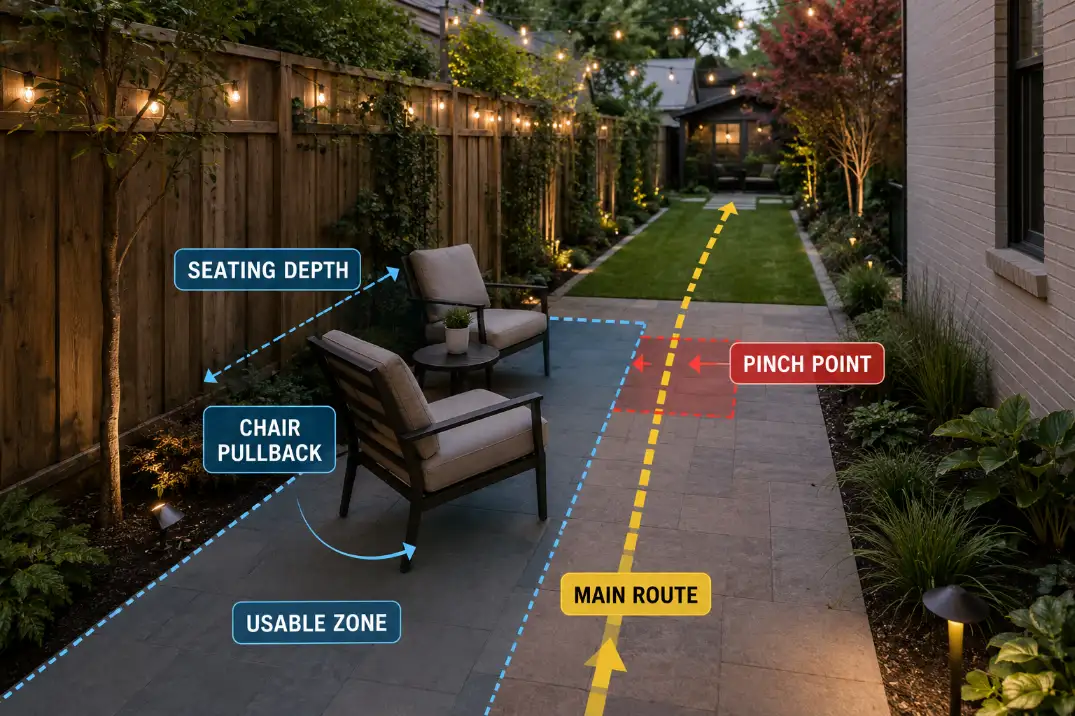
The first check is chair pullback. Pull every seat into the position it reaches when someone sits down, stands up, or leaves the table. Then walk behind it, beside it, and from the door to the yard. If the route disappears only when the chair is active, the problem is not simply furniture size. It is a layout that assumes furniture stays still.
Table reach matters too. A table that forces people to lean, step around corners, or block the route every time they serve food can make a backyard feel more crowded than it is. The same applies to grills, prep carts, planters, and storage boxes near seating. Each item may be reasonable alone, but together they can steal the movement space that makes the yard work.
Layout note:
If the pinch point happens only around the door, table, or seating edge, diagnose the patio before blaming the whole backyard. A focused patio clearance problem can feel like a full-yard problem because everyone has to pass through it first.
If the conflict is concentrated around the door, table, or seating edge, compare it with patio layout problems that make spaces hard to use before assuming the entire backyard layout is broken.
The Middle of the Yard Becomes Dead Space When Nothing Asks You to Stop
Open space fails when it has no job. A clear middle lawn may look useful from the back door, but if people only cross it, mow it, or look past it, that space is not functioning as part of daily outdoor living.
This often happens when the patio stays tight to the house and the far end contains the only destination. The middle becomes leftover distance between two more obvious places. It may be open, but it is not active.
The diagnostic clue is avoidance. If people naturally stay near the back door or skip directly to the far end, the middle is not operating as a zone. It may lack shade, a defined edge, a view, a small sitting reason, a play purpose, or even a comfortable place to stand without feeling exposed.
That does not mean every middle space needs furniture. In some yards, the strongest middle zone is intentionally open. But intentional open space still has a job: play, view relief, flexible gathering, drainage, movement, or visual breathing room. Dead space has no job. It is just the area left after everything else was placed.
The useful question is not “What can I put there?” It is “What should this area do during a normal week?” If the answer is unclear, the yard may be larger on paper than it is in use.
Straight Sightlines Can Make the Yard Feel Narrower Than It Is
A backyard can feel cramped even when nothing is physically blocking it. The cause is often visual: one long, uninterrupted sightline from the back door to the far fence.
When fence lines, lawn edges, paths, and furniture all point in the same direction, the eye shoots straight to the end. The sides feel closer. The middle feels exposed. The far end feels farther away than it really is.
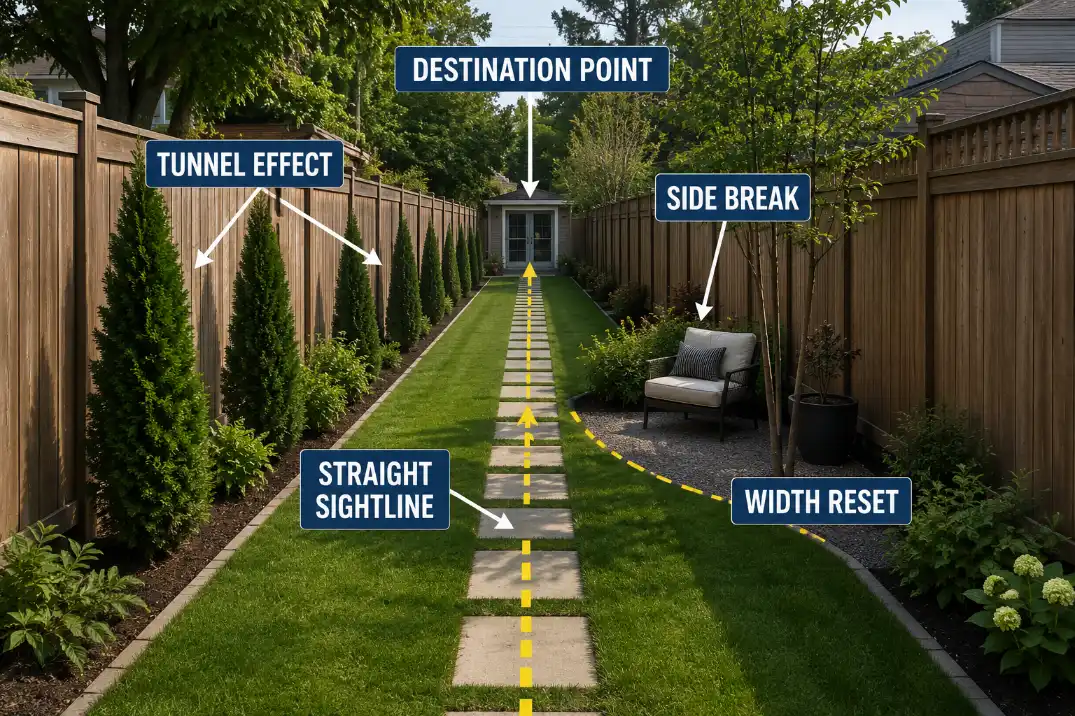
The homeowner symptom is usually not “my sightline is wrong.” It sounds more like: the yard feels exposed, unfinished, narrow, awkward, or not relaxing. People stay near the house because the rest of the yard reads as a corridor instead of a place to settle.
The first check is simple. Stand at the back door and look straight out. If every strong line sends your eye to the same far point, the yard may need a visual interruption. That interruption could be a planting edge, a slight furniture offset, a small destination point, or a surface change.
This is not decoration for its own sake. It is a way to stop the yard from reading as one long tube.
Keep this diagnosis separate from privacy. A sightline break can make a backyard feel better even when no neighbor can see in. Privacy solves outside exposure. Sightline control solves how the space feels from inside the yard.
Storage Creep Turns Edges Into Obstacles
Storage creep is a layout problem that disguises itself as tidiness. A hose sits beside the patio. A deck box shifts closer to the route. Bikes lean near the gate. Extra planters line the path. Cushions, tools, toys, bins, firewood, and folding chairs slowly occupy the edges that once made movement feel easy.
The yard may not look cluttered. That is why this failure is easy to miss. The issue is that stored objects take over the edge space needed for walking, turning, gate access, and recovery.
Side paths are especially vulnerable. A route that works when empty can fail when handlebars, bins, hose reels, or leaning tools narrow the usable line. Gate areas are just as sensitive. If an object sits where the gate swings, where a person turns, or where someone carries a bin through, storage has become part of the layout failure.
When bikes are involved, the useful question is not only whether they are neatly parked. It is whether the storage position protects the route. A bike can fit against a wall and still damage daily movement if its pullout space, handlebar swing, or kickstand angle falls into the walking line. That is why outdoor bike storage near entry paths should be judged by movement clearance, not just by parked footprint.
Field note:
Remove movable objects from the working edges for one day. If the yard suddenly feels easier to cross, sit in, or maintain, the original layout may not be the main failure. The edges have been occupied.
Test the Backyard While It Is Being Used, Not While It Is Empty
The best layout test is not a drawing of the yard at rest. It is a short walk-through with the yard in its active state.
Do this before changing furniture, adding a path, building a feature, or deciding the yard needs a major improvement. The goal is to find the primary friction point, not to create a long project list.
A Simple Daily-Use Walk-Through
- Start at the back door and walk the route you use most often.
- Pull chairs out as if people are sitting, standing, and leaving the table.
- Carry something real, such as a tray, cushion, trash bag, small bin, or garden tool.
- Open the gate, storage lid, grill zone, or side access point that gets used during the week.
- Walk to the far end and back without correcting the route as you go.
- Note where you pause, squeeze, turn sideways, step off the route, or avoid the area entirely.
Backyard Layout Friction Checklist
- Does the yard only feel open when furniture is tucked in?
- Does one route handle walking, seating, storage, and service access?
- Does anyone naturally stop in the middle of the yard?
- Does the far end get used during normal weeks, not just special occasions?
- Do stored objects narrow the route even when they look organized?
- Does the yard feel like a corridor from the back door?
- Can someone carry something through the main route without adjusting around obstacles?
One clear friction point is more useful than a long improvement list. If the route is the problem, the next decision is about access and clearance. If seating causes the pinch, the next decision is furniture depth or patio arrangement. If the middle is ignored, the next decision is purpose. If the far end is disconnected, the next decision is sequence.
Only after that diagnosis does it make sense to compare broader small backyard fix priorities or decide which improvement deserves attention first. Otherwise, the yard can collect more features without becoming easier to use.
Once You Know the Friction Point, the Next Fix Gets Easier
The strongest next move is not adding the most visible feature. It is correcting the point where daily use breaks down.
A route-based issue may need clearer access. A seating issue may need real-use clearance. A dead middle may need a reason to pause, or it may need to stay open with a clearer purpose. A sightline issue may need a visual break. A storage issue may need protected working edges instead of more containers.
That diagnosis keeps the yard from collecting fixes that do not change behavior. A backyard that works in daily life is not always the one with the most elements. It is the one where movement, sitting, access, storage, and destinations stop fighting each other.
For a broader design reference on functional outdoor rooms, see Penn State Extension’s guide to creating outdoor rooms.