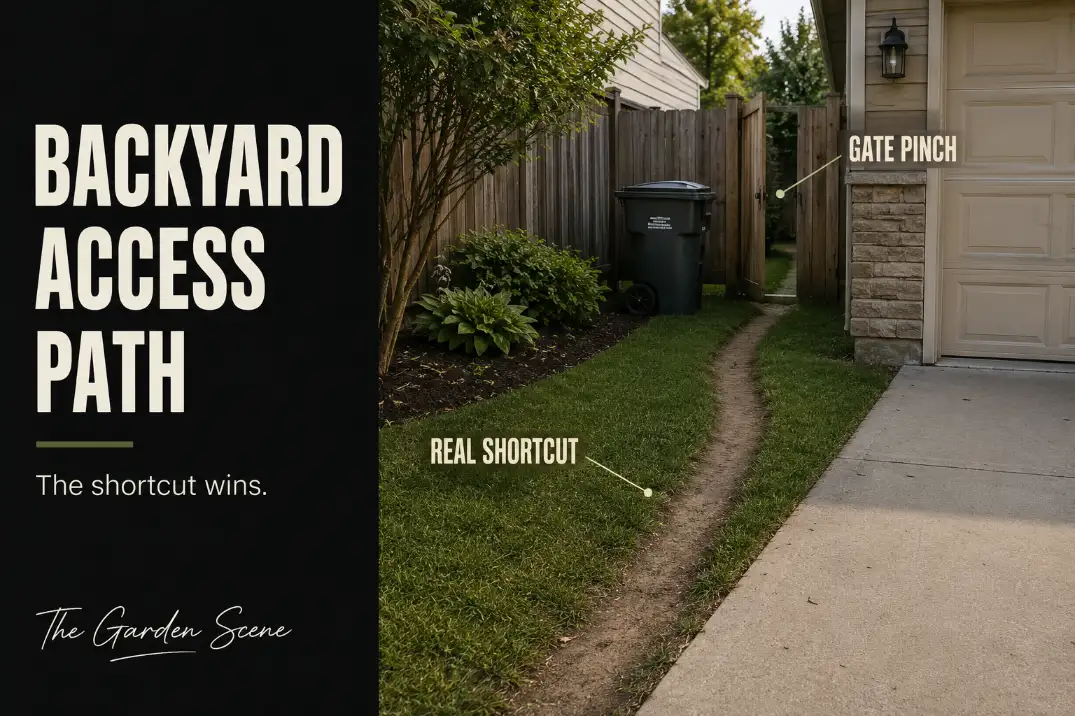
A backyard access path from the driveway should follow the line people already use, not the decorative path that looks best on a plan.
The strongest version is usually a direct, firm 36–48 inch access line that connects the driveway edge to the backyard gate without forcing trash carts, mowers, or wheelbarrows through grass and planting.
The first checks are practical: where the lawn is already worn, whether a cart can turn at the gate, and whether the surface stays usable 24 hours after rain.
This differs from a normal garden walkway because the path is not only for strolling. It has to handle weekly movement, wet shoes, tools, bins, and the awkward first few feet beside parked cars.
The Shortcut People Take
The real path is usually already visible
The best access path usually follows the line people already cut across the yard. If feet move straight from the driveway to the gate, patio, shed, or trash area, that pattern will not disappear because a prettier path curves somewhere else.
A worn grass strip near the driveway is not just a cosmetic problem. It is a movement signal. People take that line because it is shorter, easier, or better aligned with the way they carry things from the car to the backyard.
A decorative path that adds 6–10 extra feet may look softer, but it often gets ignored when someone is pulling a bin, carrying patio cushions, or moving through after dark. The yard is already telling you where the access line wants to be.
The first 6 feet decide the layout
The driveway handoff is where many backyard access paths fail. That first 6 feet can include a parked car door, a step-out zone, a trash cart pull, a gate turn, a fence post, and the start of a planting bed. If those pieces overlap, the path may look open but still feel awkward.
A clear walking line should stay near 36 inches wide. Where trash carts, mowers, wheelbarrows, coolers, or yard bags move often, closer to 42–48 inches works better.
If the path begins beside a parked car, solve the driveway edge first; otherwise the access line becomes another pinch point.
The clearance logic in Driveway Landscaping With Car Door Clearance matters here because people need room to open the door, step out, turn, and move toward the backyard without stepping into plants.
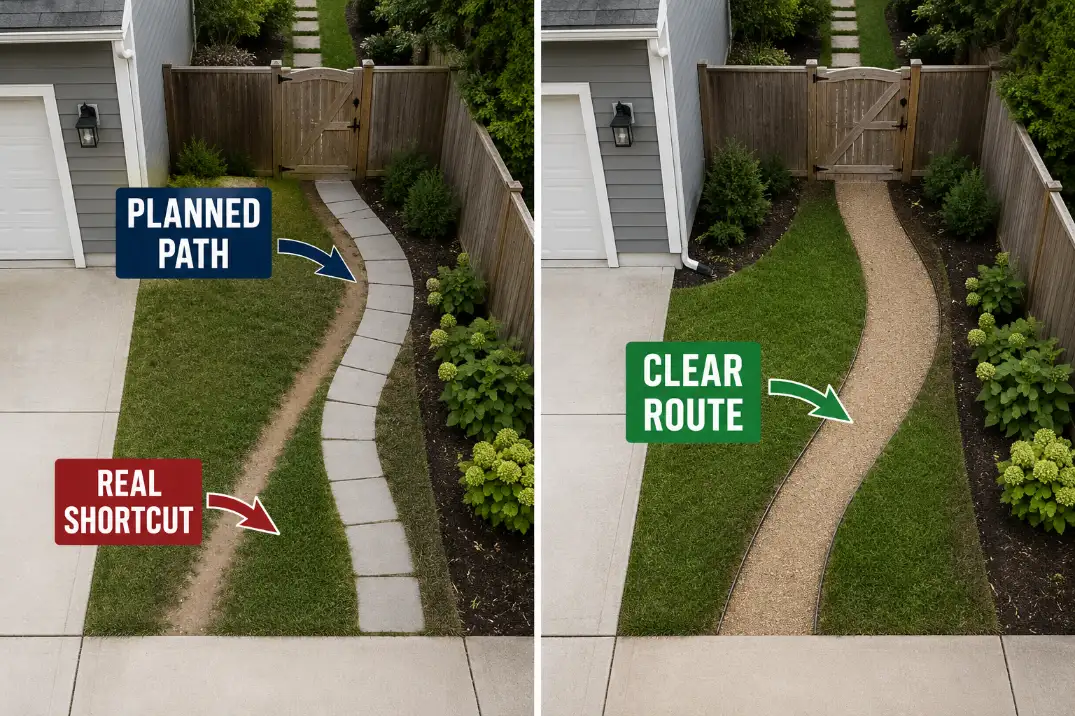
Gate Placement Matters
A gate should meet the access line, not the fence design
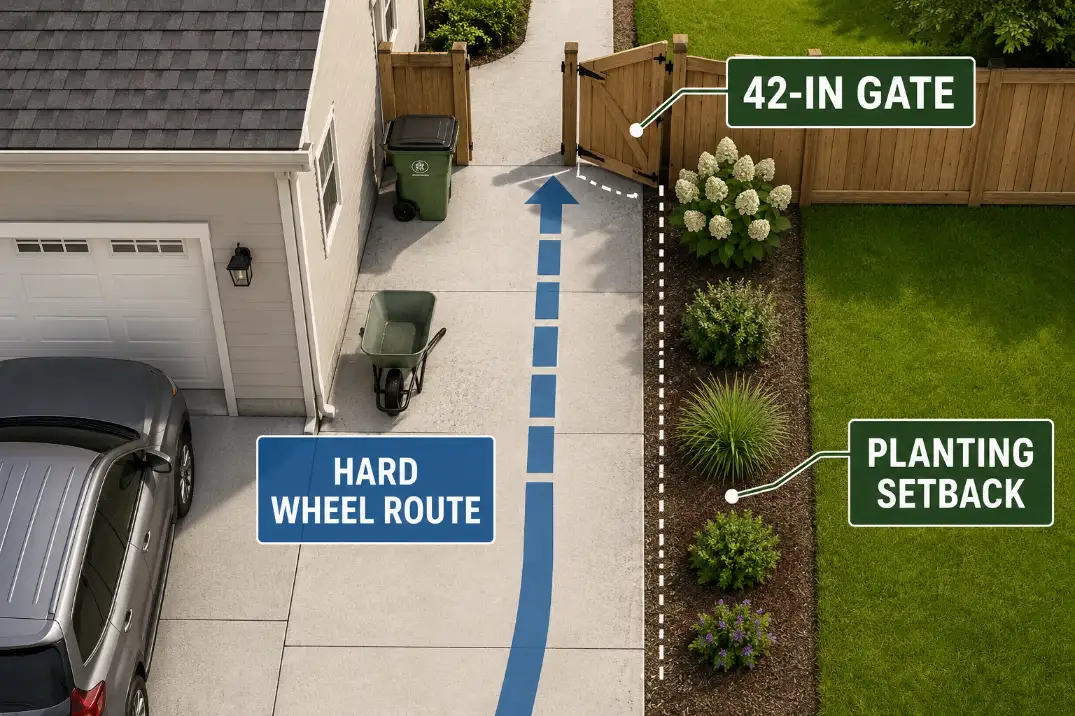
A gate is in the right place only if it meets the access line without forcing a sideways turn. Centering the gate on the fence panel may look tidy from the street, but it can be wrong if the driveway approach lands 2 feet to one side.
A 36-inch gate can work for occasional foot traffic. For trash carts, garden carts, or mowers, 42 inches or more is usually more forgiving.
The extra space matters at the latch side, where hands, handles, wheels, shoulders, and small steering corrections all compete in the same spot.
The landing matters as much as the opening
The gate opening is only part of the system. A small flat landing near the gate often matters more than a longer walkway. Where bins or tools turn through the gate, a firm 3-by-4-foot or 4-by-4-foot pad can prevent the edge from breaking down into muddy grass.
Gate swing direction also deserves attention. If the gate opens into the access line, the user has to pull the gate, back up, reposition the cart, and move again.
That tiny sequence is why people prop gates open, drag bins through planting beds, or abandon the intended path.
The same problem shows up in tight side yards where gate swing, storage, and walking clearance all fight for the same few feet. If the gate itself is part of the problem, Side Yard Gate Swing Clearance gives that moving clearance its own planning logic.
Pro Tip: Test the gate line with the actual item that uses it most. A gate that feels fine with empty hands may feel wrong with a full trash cart.
Trash and Tool Movement
Walking clearance is not working clearance
Walking width is not enough if the path carries weekly wheels. Most outdoor trash carts are roughly 24–30 inches wide at the body, but the usable path has to include wheels, handles, arm movement, and small steering corrections.
That is why a 30-inch gap may look open and still feel irritating every pickup day. A person can squeeze through. A loaded bin cannot politely shrink itself.
Weekly movement also creates a different standard than occasional movement. If a shrub brushes a person once a month, it may be tolerable.
If the same shrub catches a trash cart every week, the service strip is already failing. When trimming is needed every 2–3 weeks just to preserve access, the planting or path width is wrong.
The loaded test is the honest test
The best test is not walking the path empty. Pull the full trash cart, push the mower, or roll the wheelbarrow through the proposed line. Watch where the wheels drift, where the handle hits, and where you naturally step off the hard surface.
This is also where trash storage and access should be planned together. If bins live near the side yard, Trash Bins in Narrow Side Yard can help separate storage from movement instead of letting the bin zone slowly block the path.
Tools create the same pressure. A mower, spreader, or wheelbarrow needs a stable corridor under load, especially after rain.
If the path must move equipment from the driveway to the backyard, it should behave more like a small service lane than a decorative stepping-stone walk.
Surface That Handles Wheels
Choose the surface by load, not style
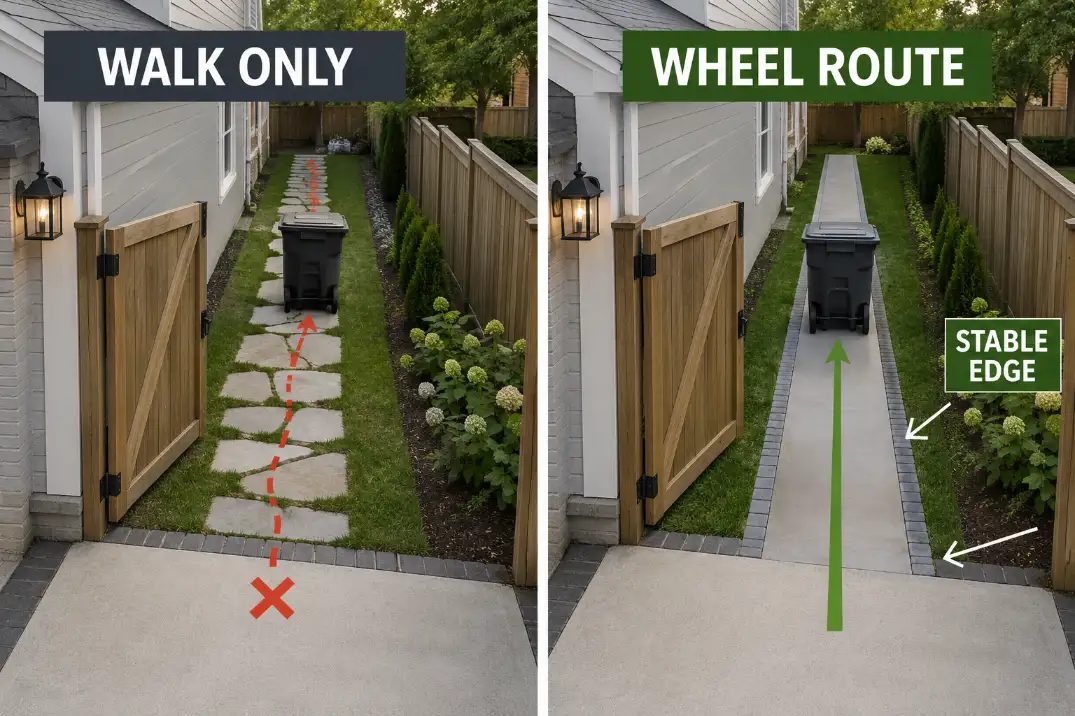
The surface fails when wheels catch, sink, or drag loose material back onto the driveway. For occasional foot traffic, stepping stones may be enough.
For bins, mowers, and wheelbarrows, the path needs a continuous surface, firm base, and clean edge.
Loose mulch is usually the fix that wastes time here. It looks finished at first, but wheels sink into it, shoes track it, and the edge gets kicked into the driveway after repeated use. Decorative gravel can have the same problem if it is not compacted and edged.
| Surface choice | Best use | Watch point | Practical threshold |
|---|---|---|---|
| Concrete strip | Frequent bins, carts, and mowers | Can look too driveway-like if oversized | 36–48 inches wide with slight drainage pitch |
| Pavers on compacted base | Visible access line with a cleaner garden look | Poor base causes rocking and edge movement | 4–6 inches of compacted base for regular wheel use |
| Compacted gravel or fines | Secondary access with lighter wheel traffic | Loose edges migrate onto lawn or driveway | Needs firm edging and a compacted surface layer |
| Stepping stones | Occasional dry foot traffic | Poor for bins and rolling loads | Better for walking only, not weekly cart movement |
| Hard transition strip | Driveway-to-path handoff | Raised lip catches wheels | Keep the transition flush or nearly flush |
For a deeper material-level decision, Backyard Surface Choice and Usability is useful before choosing a path surface by appearance alone.
The transition is where wheels catch
The driveway-to-path transition should be smooth. Even a small raised lip can catch a trash cart wheel, especially when the cart is full or being pulled at an angle. A path that is technically wide enough can still fail if the first wheel bump makes people step off into grass.
The edge matters too. If gravel, mulch, or soil migrates onto the driveway after a few weeks of use, the path is not holding its shape. A stable access line needs a surface, base, and edge working together.
Drainage decides whether the path keeps working
A path that holds water for more than 24 hours after normal rain is already warning you that the slope, base, or soil is wrong. Wet joints, soft gravel, and muddy edges quickly turn a useful shortcut into a maintenance strip.
In freezing northern states, trapped water also becomes a freeze-thaw issue that can lift pavers or make a narrow path uneven by late winter. In humid regions, shaded side access can stay slick longer after storms, especially when airflow is poor.
A slight pitch away from the house, garage, or fence line is usually more important than a decorative finish. For many small access paths, about 1/8 to 1/4 inch per foot is enough to move water without making carts feel like they are tipping.
Planting Beside the Route
Plant for mature size, not installation day
Planting should frame the path after mature growth, not only on the day it is installed. A new bed may look clean with plants tucked close to the edge, but the usable width changes once shrubs spread, grasses flop, and wet foliage leans into the access line.
A low plant that spreads 18 inches can steal 6–8 inches from the movement zone if it is placed too close. For narrow driveway-to-backyard paths, a 12–18 inch planting setback from the hard edge is often the difference between “tight but usable” and “always brushing against something.”
Do not use pruning as the main fix
The common overestimate is pruning discipline. Homeowners often assume they will keep shrubs clipped neatly along the path, but access lines are used when people are busy, carrying things, or moving through after dark.
A plant that only works when freshly trimmed is not really working.
The underestimated issue is seasonal pressure. Ornamental grasses can flop after storms. Mulch can kick onto the hard surface. Wet foliage can brush legs and bins. Thorny or stiff plants can make a technically open path feel hostile.
The better move is to use compact plants, upright forms, or low edging that protects the movement line without borrowing from it.
The same pattern appears when backyard planting crowds seating or walking routes; Backyard Plants Crowding Paths and Seating explains why harmless-looking plants can slowly make an outdoor space feel smaller.
Pro Tip: Keep thorny, floppy, or wet-contact plants away from the driveway-to-backyard path. This access line is used while carrying things, not while carefully stepping through a garden bed.
Access That Stays Open
Build the path in the right order
The strongest order is access line first, gate second, surface third, planting last. If the planting bed or fence symmetry comes first, the path often gets squeezed around decisions that should have been secondary.
Start by marking the actual shortcut from the driveway. Test it with the largest rolling item that uses the path. Set the gate where that line naturally lands. Choose a surface that handles the load. Then place planting outside the movement envelope.
That order may feel less decorative at first, but it produces a path people keep using.
Know when the standard fix stops working
Stepping stones are fine for light foot traffic. They stop making sense when the route carries weekly trash bins, a mower, a loaded wheelbarrow, or muddy shoes after rain.
A narrow gravel strip can work as a secondary access line. It stops making sense when gravel keeps spreading onto the driveway, sinking into soft soil, or catching wheels at the transition.
The symptom is usually worn grass, muddy edges, clipped plants, or loose material on the driveway. The underlying mechanism is different: the yard is missing a stable movement corridor between the driveway, gate, storage, and backyard.
Use the right fix for the real pressure
| If the path mainly carries | Usually enough | Better upgrade | Fix that often disappoints |
|---|---|---|---|
| Occasional foot traffic | Stepping stones or compacted gravel | Narrow hard path if soil stays wet | Mulch over worn grass |
| Weekly trash bins | Continuous hard surface | 42–48 inch wheel-friendly route | Narrow decorative gravel |
| Mowers and wheelbarrows | Firm path with gate landing | Wider hard strip with flush transition | Loose stones without edging |
| Wet-weather access | Drained, stable surface | Slight pitch and compacted base | Flat pavers over soft soil |
| Tight side-yard access | Direct path and clear gate swing | Gate relocation or larger landing | Pruning plants every few weeks |
A backyard access path from the driveway should feel almost boring when it is done right: direct, firm, open, and easy to use on the busiest day of the week. If the shortcut, gate, surface, and planting all respect the same movement line, the path stays useful instead of becoming one more edge to maintain.
Because this kind of path often doubles as a practical movement corridor, the firm, stable, and clear-surface principles in the U.S. Access Board guidance are useful beyond formal accessibility planning.