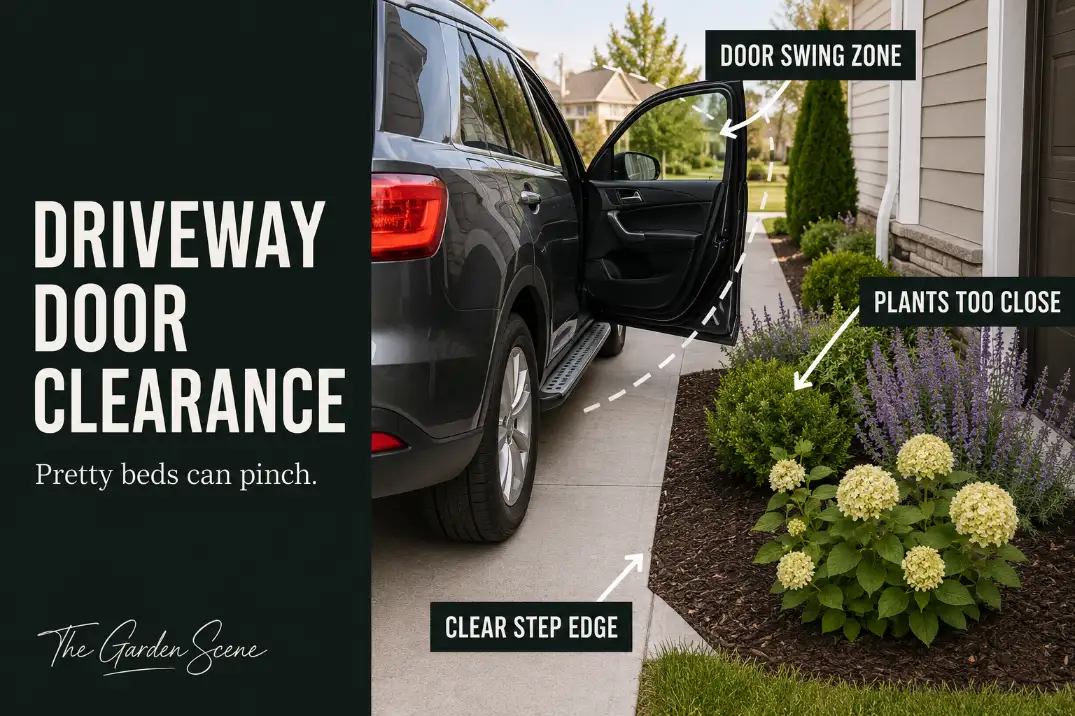
Driveway landscaping works best when the first 30 to 36 inches beside the parked car stay clear, low, and easy to step onto before taller planting begins.
That space is where doors open, feet land, grocery bags swing, and visitors move toward the house.
The first checks are simple: open the widest door, watch where your foot lands, and see whether mulch or gravel moves onto the concrete within a week of normal use.
This is not the same as a narrow driveway problem. The tires may fit perfectly while the doors, walkway, and planting edge still fight each other every day.
Good driveway landscaping starts by separating decoration from movement.
Cars Need Breathing Room
Tire space is not door space
A driveway can look wide enough because the vehicle fits between the edges. That does not mean the landscape is usable. Tires need a clean parking lane.
People need enough room to open a door, step out, turn, and walk toward the house without brushing plants or landing in loose material.
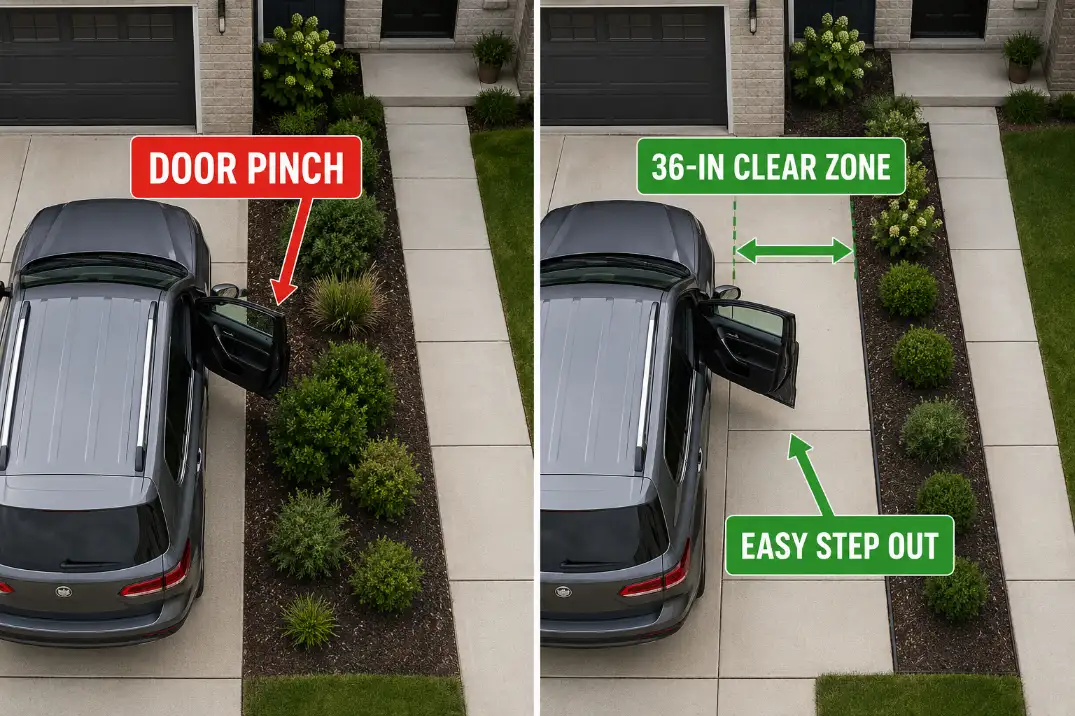
For daily parking, treat 30 inches beside the car as the minimum working zone. A 36-inch clear edge feels much better, especially beside the driver’s door.
A 24-inch pinch may work for an occasional passenger side, but it becomes frustrating where kids, bags, work gear, or visitors exit.
If the driveway also guides people toward the front door, the car edge and entry route should be planned together. A layout like Front Yard Design for Driveway and Front Door Access is often more useful than treating the driveway bed as a decorative strip by itself.
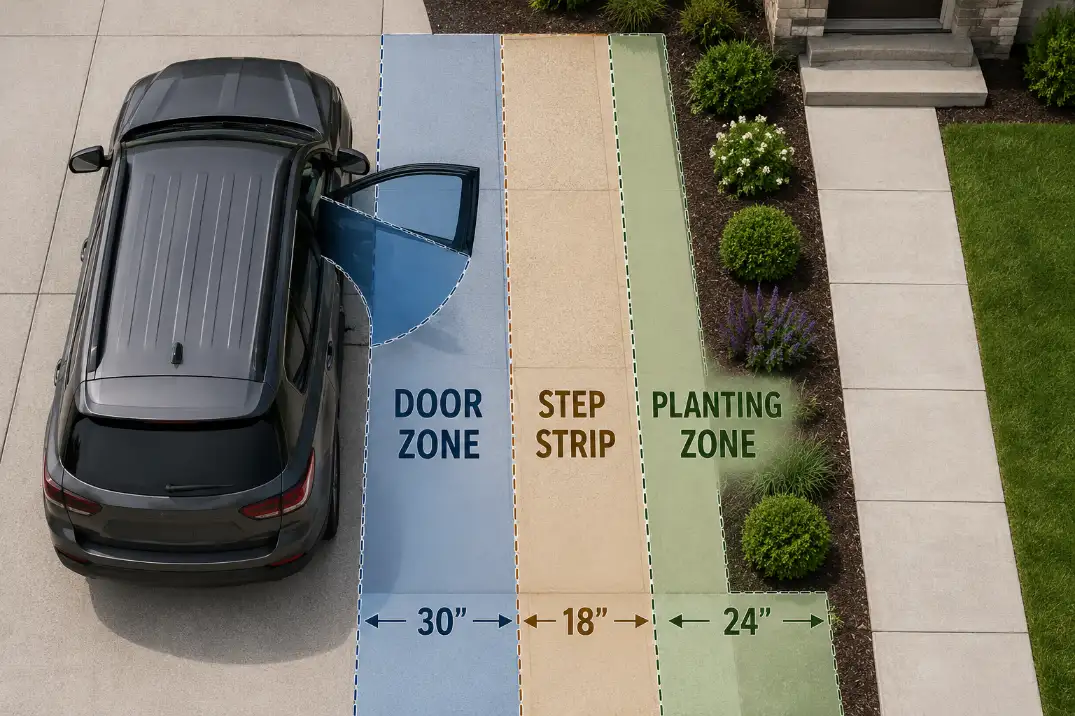
Use three zones, not one planting strip
The cleanest driveway edge has three jobs.
The first zone is the door swing area, closest to the parked car. It should stay free of tall edging, woody stems, loose rock, and raised planting.
The second zone is the step-out strip. This is where a flush paver band, compacted hard edge, very low groundcover, or controlled mulch edge can work if it stays firm and predictable.
The third zone is the real planting zone. Taller shrubs, ornamental grasses, privacy planting, and stronger design moves belong here, beyond the door arc.
This zoning rule is more useful than asking whether a plant “looks good” beside the driveway. A plant can look right from the curb and still be wrong if it grows into the space the car and people use every day.
The Door Swing Zone
Measure the opened door, not the parked car
The real test is not how the driveway looks when the doors are closed. Park normally, open the widest door, and measure from the outer door edge to the nearest plant, edging, wall, loose gravel, or raised bed.
This takes less than 5 minutes and reveals the problem quickly. If the door stops short, your foot lands in mulch, or you have to twist your shoulder to get out, the landscape is inside the usable parking edge. That is a layout issue, not a seasonal cleanup issue.
Pro Tip: Test the driveway with the car parked slightly off-center. Real parking is rarely perfect, and a design that only works when the vehicle is exactly centered is too fragile.
Different vehicles use the edge differently
SUVs, minivans, pickup trucks, and compact cars do not create the same clearance problem. A sedan may only need side-door space.
An SUV may also need rear hatch room. A pickup may need access beside the bed. A minivan may reduce swing conflict with sliding doors, but it still needs a safe step-out strip.
The highest-pressure spots are usually the driver’s door, the passenger side used by kids or guests, and any route between the vehicle and the front entry.
If a car seat, cooler, stroller, trash bin, or grocery load comes through that area every week, do not design it as a delicate planting edge.
Plants Too Close to Parking
Mature width matters more than nursery size
The plant that looks perfect in a 1-gallon or 3-gallon pot may be the wrong plant beside a driveway. Many compact shrubs still add 12 to 24 inches of width after a few growing seasons. That extra growth often lands exactly where the door needs to open.
This is where homeowners often overestimate pruning. Cutting a plant back once or twice a year is normal. Trimming the same driveway edge every 4 to 6 weeks during the growing season means the plant is fighting the layout. At that point, pruning is not maintenance; it is compensation for poor placement.
Low groundcovers, compact sedges, low mounding perennials, and flush hard edges are usually safer near the step-out strip. Woody shrubs, stiff ornamental grasses, thorny plants, and spreading plants belong farther back where they can mature without touching doors.
For hot driveway edges, toughness matters too. Concrete can hold heat long after the afternoon sun fades, and soil beside pavement often dries faster than the rest of the bed.
If the planting strip also touches the front walk, Best Plants for Front Walkway Hot Concrete can help narrow the plant choices.
Soft-looking plants can still scratch
A plant does not need thorns to damage the experience. Dry stems, dusty leaves, seed heads, and stiff grass blades can brush the same car door twice a day. Over a few weeks, that repeated contact can leave marks or make people avoid opening the door fully.
This is the difference between a cosmetic symptom and the real mechanism. The visible symptom is a bent plant, messy mulch, or a scratched door edge.
The mechanism is that the plant occupies a movement zone. Replacing it with a prettier plant of the same size does not solve the problem.
The better rule is blunt but useful: if a plant can touch an open door, it is too close for an active parking edge.
Gravel and Mulch Kickout
Loose material moves because people use the edge
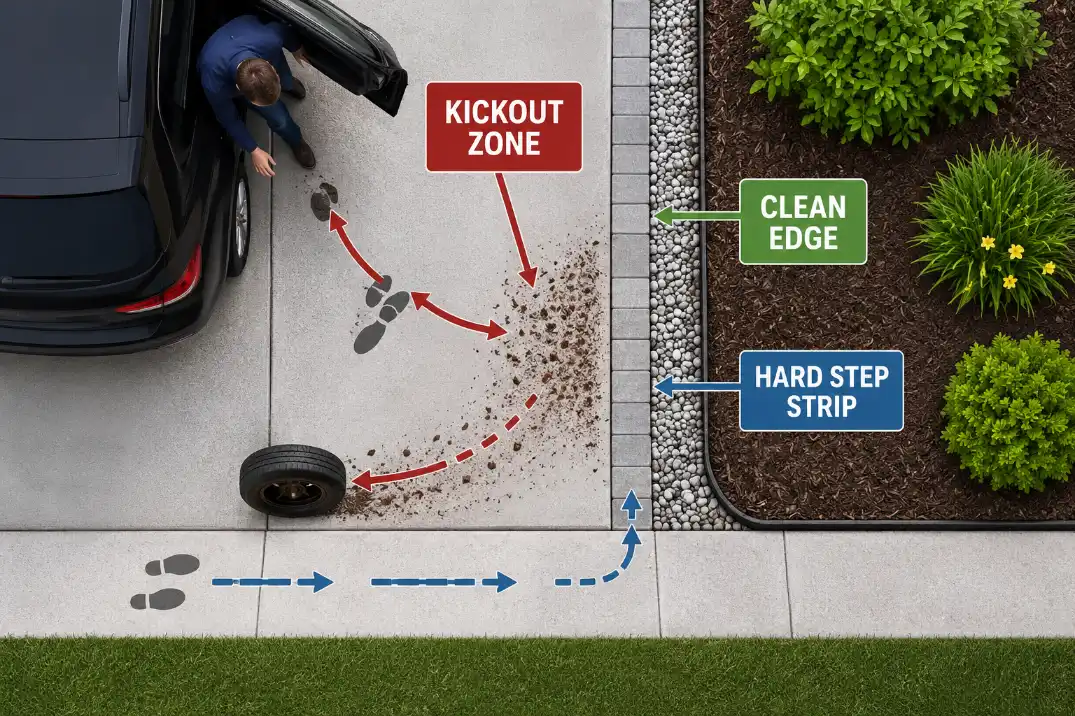
When gravel or mulch keeps showing up on the driveway, the material is not always the first thing to blame. The edge may be absorbing too much daily movement.
Loose material beside a car door is hit by shoes, tires, rain splash, leaf blowers, and the small sideways shuffle people make while getting out of a vehicle.
If gravel spreads 6 inches or more onto the driveway after one week of normal use, the edge is failing. Sweeping it back is only a reset.
This is the same movement pattern that makes rock migrate in other front yard edges, but a driveway adds tire pressure and door-side foot traffic.
The issue connects closely with Front Yard Gravel or Rock Spreading Into the Lawn, except the driveway version usually fails faster because the edge gets used every day.
More mulch is often the wrong fix
Refreshing mulch can make the bed look cleaner for a few days. It does not fix a bed that is too high, too loose, or too close to the step-out strip.
Mulch beside a driveway usually works best around 2 to 3 inches deep. A thicker mound may look freshly finished, but it can roll onto the concrete, bury edging, or make the parking edge feel soft underfoot.
Gravel has the opposite problem: small rounded gravel scatters easily, while larger angular gravel stays put better but feels harsh if someone steps into it while exiting the car.
If people regularly step out into the material, the better fix is a hard landing strip, a flush border, or a wider paved edge. Loose material should frame the driveway, not serve as the daily landing pad.
Walkway Beside the Driveway
A walkway cannot borrow space from an opening door
A walkway beside the driveway looks efficient until it has to share space with opening doors, mulch, plants, and parked cars. The walkway needs its own clear width.
The door swing zone needs its own clearance. When both depend on the same 2-foot strip, the layout becomes awkward.
A 36-inch walkway is comfortable for daily use. A 30-inch walkway can still work in a tight front yard if the edges stay clean.
A 24-inch walkway is better treated as a short pinch point, not the main arrival route. If the walkway runs beside parking for several feet, it should still feel usable while a car door is open.
If guests naturally follow the driveway toward the front door, the problem may be part of the broader entry sequence.
In that case, Front Yard Landscape Ideas for Walkway and Front Door is more helpful than thinking only about the planting strip.
Planting beds should not become stepping zones
A driveway bed often reveals the truth after a few weeks of use. Flattened mulch, broken edging, crushed plants, and bare patches all point to the same thing: people are using the bed because the hard surface ends too soon.
That is not a plant failure. It is a route failure. Replanting the same edge usually disappoints because the movement pattern stays the same. The fix is a clearer walking route, a harder step-out strip, or moving the planting zone farther away from the door arc.
A good driveway walkway does not make people choose between stepping into plants and squeezing past a door.
Clean Edges Without Scratches
Choose edges that forgive daily movement
The best driveway edge is not always the sharpest-looking edge. Steel, stone, brick, and concrete can all work, but the profile matters.
Anything tall, jagged, or raised above the surface can catch shoes, scrape doors, or make the parking edge feel tighter than it is.
Flush paver borders, low concrete bands, and stable edging set outside the door zone usually age better. They give the driveway a finished line without becoming another obstacle.
If the edge keeps lifting, leaning, or separating after rain, freeze-thaw cycles, or repeated contact, the issue is often base support rather than the visible edging material.
That failure pattern is similar to what happens when Front Yard Edging Keeps Shifting under pressure from soil, water, and daily use.
When trimming and cleanup stop making sense
The routine fix is usually simple: trim the plants, sweep the gravel, refresh the mulch, and straighten the edge. That makes sense when the bed is basically in the right place.
It stops making sense when the same damage returns within 30 to 60 days. Fast repeat failure means the edge is being used as part of the driveway, not just sitting beside it. Once that happens, the better answer is usually to rebuild the edge around movement.
| Driveway edge signal | What it usually means | Better decision |
|---|---|---|
| Door touches plants when fully open | Planting is inside the door swing zone | Move plants back or replace them with lower growth |
| Mulch lands on concrete after rain | Bed is too high, loose, or unrestrained | Lower the mulch profile and add a clean edge |
| Gravel spreads 6 inches or more onto driveway | Loose material is too close to tire or foot traffic | Add a hard setback or step-out strip |
| Guests walk through the planting bed | The walking route is undersized or unclear | Widen or redirect the walkway |
| Edge damage returns within 30–60 days | Daily movement is breaking the layout | Rebuild the edge around real use, not curb appeal alone |
The strongest driveway landscaping usually leaves the active edge quieter than the rest of the front yard. Put the more decorative planting where doors do not open, tires do not turn, and people do not step out every day. Keep the parking edge low, clean, and forgiving first. The curb appeal will look better because the space works better.
For broader official guidance on clear walking-route width, see the U.S. Access Board accessible routes guide.