Last updated: July 7, 2026
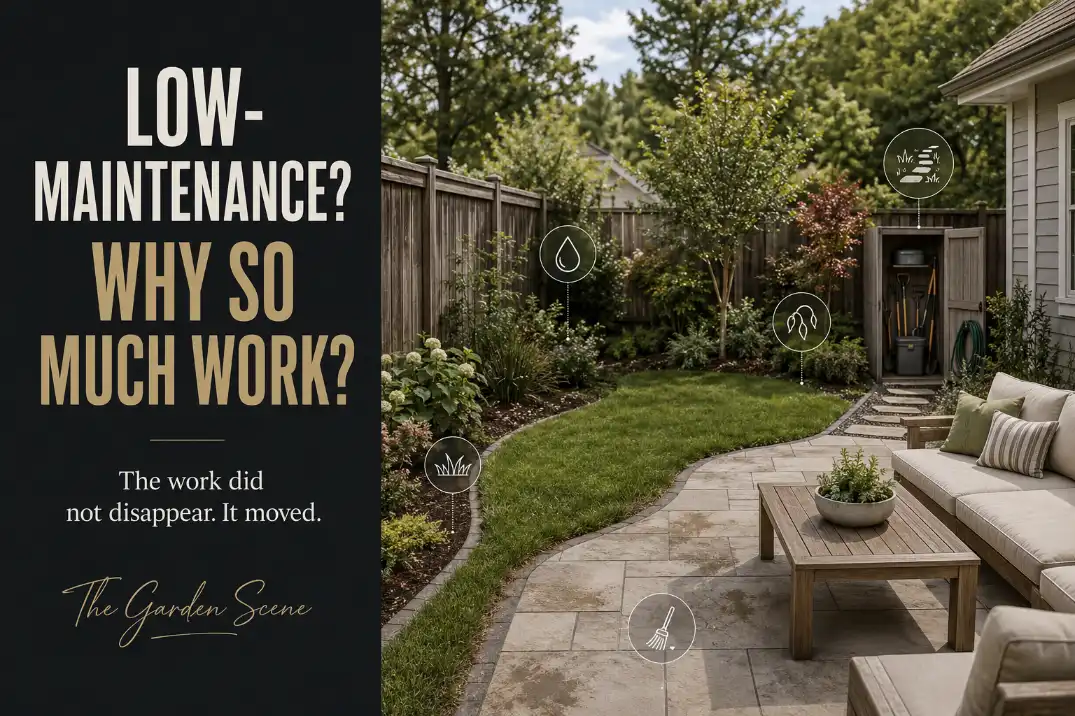
A low-maintenance backyard usually fails for one reason: the design removes the obvious chore but leaves the pressure behind.
The lawn gets smaller, but the new gravel spreads into the grass. The planting gets simpler, but the shrubs crowd the patio. The patio replaces a messy patch of turf, but now it stains, puddles, grows weeds in the seams, or collects leaves behind furniture. The yard looks cleaner on installation day, yet after rain, heat, storage, foot traffic, pets, grilling, and weekend use, it starts asking for work in places the design did not plan for.
That is the difference between a backyard that looks low-maintenance and one that stays low-maintenance. The first removes visible tasks. The second gives water, growth, edges, surfaces, access, and storage a place to behave.
This article is not about choosing fewer plants or more hardscape by default. It is about finding where the work moved.
Low-Maintenance Often Means the Work Moves Somewhere Else
The first test is simple: did the design reduce a recurring failure point, or did it just move the job to a less obvious place?
A backyard does not become easier to care for just because it has less lawn, fewer beds, more gravel, more paving, or a cleaner plan. Those changes can help, but only when they match how the yard actually gets used. People drag chairs, rinse things on the patio, leave cushions out, let dogs run the same route, store toys near the door, grill near the seating area, and walk through wet spots after rain. Shade shifts. Leaves collect behind furniture. Water follows the lowest path, not the neatest design idea.
That is why “low-maintenance” is not the same as “no maintenance.” The useful question is not whether a feature removes one task. It is whether that feature creates a smaller, easier, more predictable task somewhere else.
| Low-maintenance choice | Hidden upkeep it can create | Early sign to watch |
|---|---|---|
| More patio or paver area | Stains, puddles, weeds in seams, heat, runoff | Dark spots, standing water, debris lines |
| Gravel instead of grass | Spreading, sinking, weeds, difficult leaf cleanup | Gravel showing up in lawn or beds |
| Fewer planting beds | Exposed soil, weeds, heat stress, erosion | Bare patches and dry soil crust |
| Fast-growing “easy” shrubs | Repeated trimming near seating, gates, fences, and paths | Branches touching use areas too soon |
| Hidden storage | Clutter piles, damp cushions, blocked access | Items left out after every use |
| Tight clean design | No room to reach drains, hoses, outlets, or edges | Small tasks require moving furniture first |
Maintenance note: Removing a visible chore is only a win if the replacement does not create a hidden service problem. A cleaner-looking backyard can still be harder to live with if the hose, drain, edge, storage, or cleanup route disappears behind the design.
Hardscape Can Reduce Mowing but Increase Cleaning and Repair
Hardscape is not a maintenance escape hatch. It is a maintenance trade.
Replacing grass with patio, pavers, gravel, concrete, or artificial-surface zones can reduce mowing. But those surfaces show what turf often hides: dust, pollen, leaves, grease, runoff marks, pet traffic, and shade-related surface growth.
Patio seams catch grit. Chair legs trap leaves. Grill areas collect stains. Fence-side paving gathers windblown debris. Paver joints settle and invite weeds. Gravel looks relaxed until leaves, soil, and grass runners start mixing into it.
The early signs are small but telling: a dark stain that does not rinse clean, a green film in a shaded corner, a strip of weeds along the patio edge, or water that sits longer after rain than it should. Once those signs repeat, the backyard has not become lower-maintenance. It has changed from mowing work to surface, seam, edge, and drainage work.
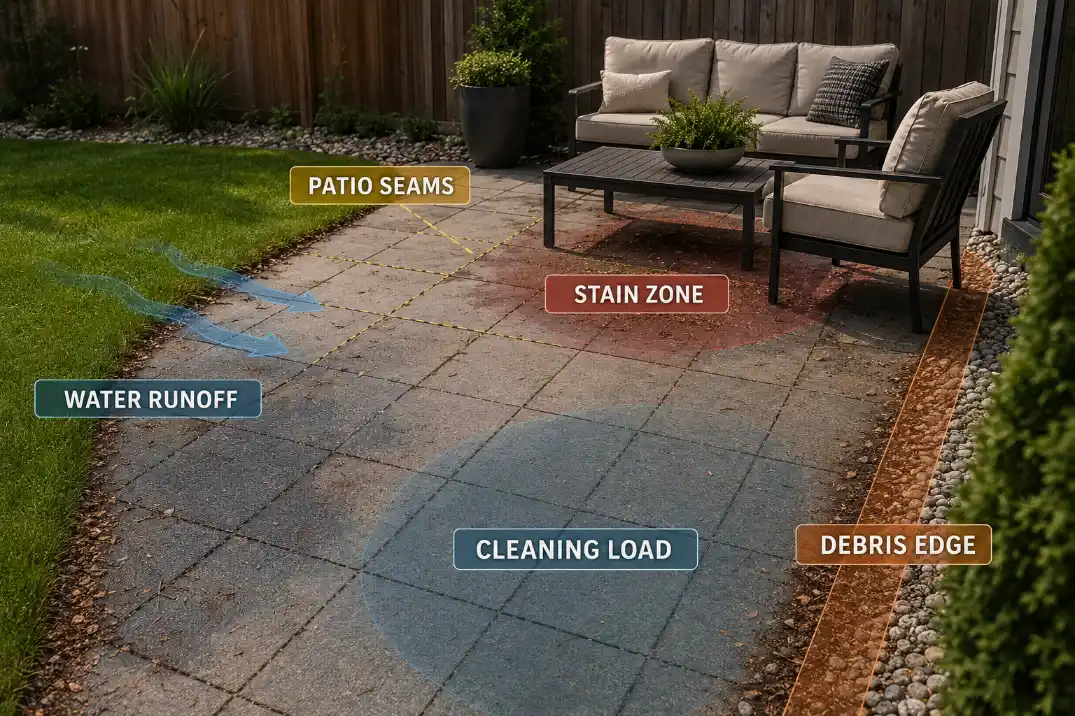
The prevention move is to plan hardscape as a service surface, not just a use surface. Before expanding it, watch where water moves after rain. Keep seams and edges reachable. Avoid narrow strips that cannot be swept, trimmed, or rinsed without moving half the yard.
If the patio already has repeated staining, pooling, or slippery shaded growth, the issue may be the surface condition, not your cleaning habits. A deeper surface-specific guide like why some patio surfaces become hard to clean and maintain can help when the surface itself is the maintenance source.
What not to overdo: do not keep adding hard surface only because grass is annoying. If the new surface sends water toward beds, fences, low corners, or the house, it may reduce mowing while increasing repair pressure.
Simplified Planting Fails When It Ignores Backyard Stress
A simple planting plan stays easy only when the plants fit the backyard pressure around them.
A sparse bed with three shrubs and fresh mulch may look clean in the beginning. After summer heat, reflected warmth from fences and walls, patio glare, dog traffic, irrigation gaps, and mature growth, that same bed can become a cycle of weeds, crispy leaves, bare soil, and emergency trimming.
Backyard planting fails differently than front yard planting. The pressure is not just curb appeal. It is seating clearance, grill heat, fence reflection, patio runoff, shade from the house, privacy pressure, and repeated movement through the same few routes.
The early signs are easy to miss. A plant leans away from a hot wall. Mulch dries out faster near the patio. A shrub grows into the chair pullback area before it has reached full size. Bare soil appears between “simple” plant groupings. One corner stays wet while another bakes.
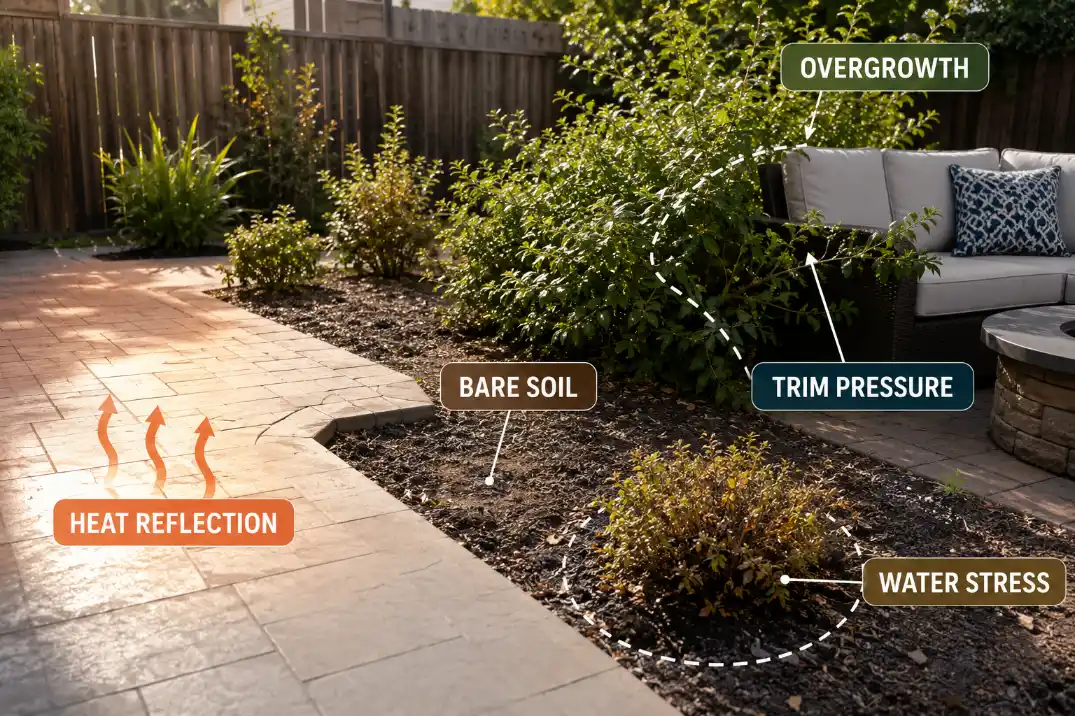
The prevention move is not to add more plants randomly. It is to match each plant to the maintenance pressure around it. Near seating, mature spread matters more than small nursery size. Near fences and walls, heat tolerance matters. Near runoff paths, root health and soil stability matter. Near gates and walkways, clearance matters.
If plants are already crowding seating, paths, or patio edges, the fix is not constant trimming forever. The better move is to decide whether the plant is in the wrong place, growing toward the wrong zone, or being asked to solve a privacy or coverage problem it cannot solve neatly. For that specific failure pattern, backyard plants crowding paths and seating is a better next read than a generic plant list.
What not to overdo: do not make the planting so sparse that soil stays exposed. Bare soil invites weeds, dries faster, splashes onto hard surfaces, and can wash during storms.
Edges Create More Work Than the Center of the Yard
When a backyard keeps feeling messy, inspect the edges before blaming the main surface.
The center of a patio or lawn is often the easiest part to maintain. The repeating work usually appears where two things meet: patio and grass, gravel and lawn, mulch and pavers, fence and planting bed, deck step and landing, storage corner and walkway.
Those borders catch weeds, leaves, mulch creep, grass runners, water, and clutter. A patio-lawn seam needs trimming. A fence line collects leaves. A narrow strip behind the grill becomes grimy. The corner behind the storage bench catches dead leaves and damp items. Gravel starts migrating into the lawn one footstep at a time.
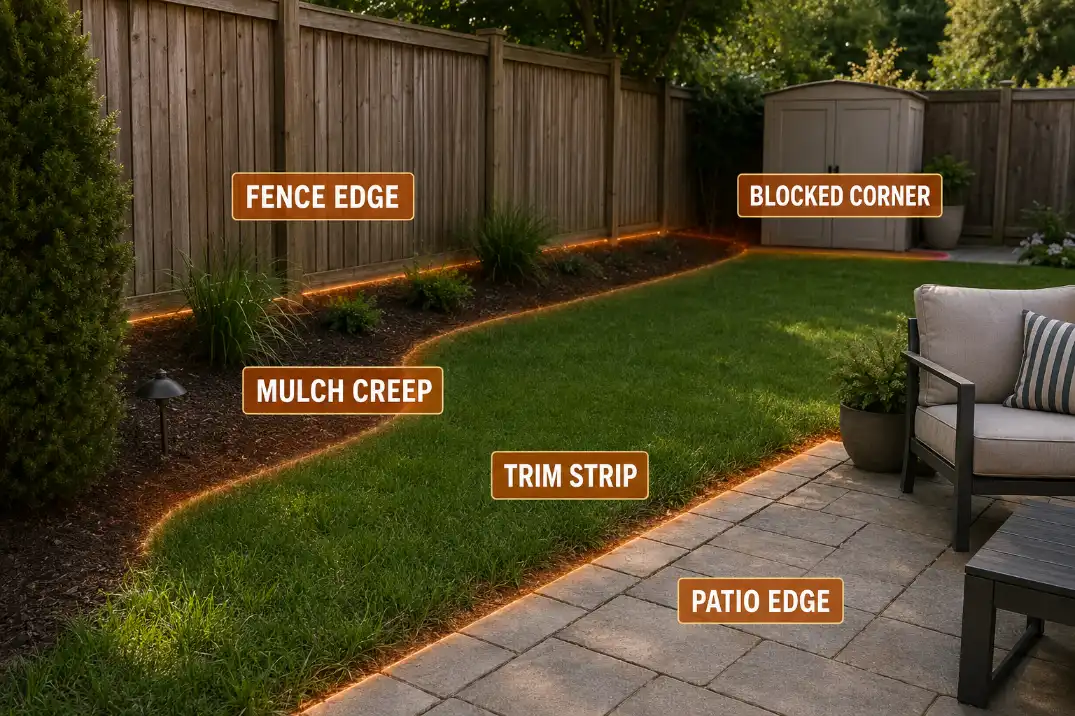
The early sign is a task you keep postponing because it is awkward. You know the fence edge needs trimming, but the chairs are in the way. You know the mulch is spilling onto the patio, but the border is too weak to hold it. You know leaves collect behind the storage box, but moving it feels like a chore of its own.
The prevention move is to design edges as working boundaries. Leave enough room to reach them. Avoid thin leftover strips that cannot be mowed, trimmed, swept, or planted well. Keep furniture and storage out of the exact corners where debris naturally settles. Use visible transitions so you can tell where lawn, bed, gravel, and patio are supposed to stop.
What not to overdo: do not solve every edge with more edging material. If water, foot traffic, or mower movement keeps pushing material out of place, the edge is responding to pressure. The pressure needs to be fixed, not just covered.
Poor Access Turns Small Tasks Into Avoided Tasks
A backyard becomes high-maintenance when ordinary care requires rearranging the space first.
The hose is behind a chair. The outlet is blocked by a planter. The drain cover is under a storage bench. The gate route is narrowed by bins. The grill cover has nowhere to go while cooking. The cushion box is too far from the seating area, so cushions stay out. The side path is too tight for a wheelbarrow, so soil, mulch, and tools get staged on the patio instead.
That is access maintenance. It is not glamorous, but it decides whether small tasks stay small.
A low-maintenance layout often fails when it hides service points for the sake of a cleaner look. At first, the yard feels tidy. Later, the hidden hose, blocked drain, covered outlet, or tight storage route makes normal care annoying enough to delay.
Field note: A service point does not need to be visually dominant, but it does need to be reachable. If a simple task requires clearing furniture first, the design is creating maintenance friction.
The prevention move is to leave service paths visible in the plan. Before calling the yard finished, walk the route to the hose, gate, trash area, storage, drain, outlet, grill, and main seating zone. If the same object blocks more than one task, move the object before it becomes part of the routine.
This is where backyard layout and maintenance overlap. A space that looks open in photos can still fail during daily use if the walking route, storage route, and cleaning route fight each other. When access is the real problem, backyard layout problems that make spaces hard to use is a more useful next step than adding another maintenance task.
What not to overdo: do not create empty space everywhere. The goal is not a bare backyard. The goal is to keep maintenance routes clear enough that normal care does not feel like resetting the whole yard.
Water Problems Make Easy-Care Areas High-Care Fast
Water turns small design weaknesses into repeat work faster than almost anything else in a backyard.
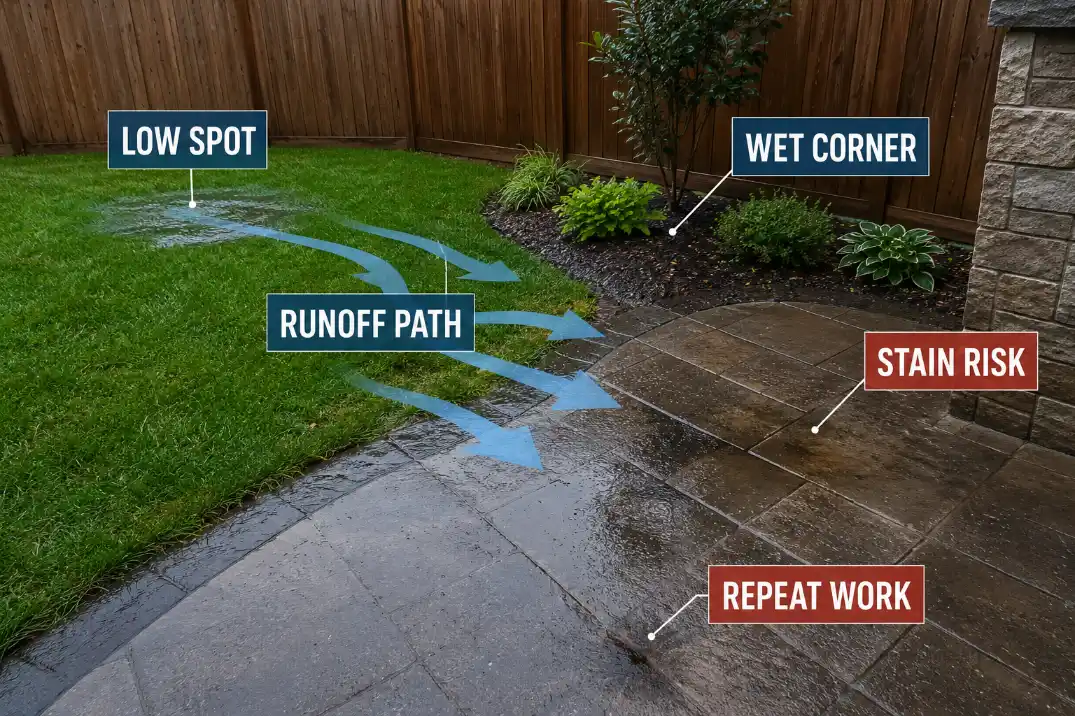
A low spot near the patio becomes a muddy corner. Runoff from a new hard surface pushes mulch out of a bed. Irrigation overspray stains a fence or keeps a shaded patio edge damp. Compacted soil around a seating route refuses to absorb water. Gravel that looked tidy starts moving downhill. A simple planting bed becomes a soggy strip where plants decline and weeds thrive.
The early signs show up after rain or watering: puddles, soil splash, mulch trails, green film on shaded surfaces, wet fence bases, sour-smelling soil, mosquito-prone corners, or one plant that always looks stressed while nearby plants look fine.
A neutral extension source is helpful here because this is not just a design preference. The University of Minnesota Extension explains that overwatering can harm trees and shrubs in clay or compacted soils because water fills pore spaces normally occupied by oxygen. University of Minnesota Extension
For a backyard, the practical lesson is straightforward: do not judge the design only when it is dry and freshly cleaned. Watch it after heavy rain, after irrigation runs, and during peak summer heat. If water keeps creating the same mess, the area is not low-maintenance yet.
The prevention move is to solve the water pattern before adding more surface, gravel, mulch, or plants. If water is crossing the patio, pooling near the house, washing mulch, or keeping one corner wet, adding “easy-care” materials may only give the water more places to cause work.
For a deeper look at those warning signs, backyard drainage problems homeowners ignore fits better than trying to solve drainage inside a general maintenance plan.
What not to overdo: do not assume every wet spot needs a major drainage system. Start by identifying where the water comes from, where it slows down, and what it damages. If water is moving toward the house, undermining surfaces, creating persistent slippery areas, or returning after every storm, that is when repair or professional drainage advice may be needed.
Storage and Outdoor Living Add Maintenance Unless They Have a Home
A backyard with no reset plan will feel high-maintenance even if the landscaping is simple.
Cushions, toys, garden tools, hoses, pet items, pool gear, grill tools, folding chairs, firewood, sports equipment, and covers all create work if they do not have a realistic home. The yard may have fewer plants and less grass, but if every weekend ends with loose items on the patio, the space still demands a cleanup routine.
The early sign is repetition. Cushions stay on chairs because the storage box is too far away. Toys pile near the back door because the storage spot is around the side yard. Tools lean against the fence because the shed path is blocked. Covers trap moisture because there is nowhere to dry them.
The prevention move is to store items near the use zone without blocking the service zone. Cushions should be easy to put away before rain. Tools should not live in the same corner that needs sweeping. Hoses should not cross the main route. Storage should not sit directly where water collects or leaves pile up.
If clutter is already making the backyard feel smaller or harder to reset, a targeted guide like storage mistakes that make small backyards harder to use can help separate a storage problem from a landscape problem.
What not to overdo: do not add storage everywhere. Too many boxes, benches, bins, and cabinets can create more blocked edges, damp corners, and cleaning obstacles. Storage only reduces maintenance when it is close enough to use and placed where it does not create another job.
The Backyard Pressure Check Before You Call It Low-Maintenance
Before you decide a backyard is truly low-maintenance, look for the pressure source behind the work. The mess you see is often only the visible result.
| What keeps happening? | Likely hidden pressure | Prevention move |
|---|---|---|
| Patio keeps staining or growing green film | Shade, overspray, poor drying, or low slope | Fix water exposure and drying conditions before adding more surface |
| Gravel or mulch keeps spreading | Runoff, foot traffic, weak edge, or slope | Strengthen the transition and redirect movement pressure |
| Plants need constant trimming | Wrong mature size or wrong placement near use zones | Replace, relocate, or reset spacing instead of trimming forever |
| Edges always look messy | Narrow strips, blocked access, or unclear boundaries | Make edges reachable and visually defined |
| Yard feels cluttered after every use | Storage too far away or placed in the wrong zone | Move storage closer without blocking cleaning routes |
Use this final check before adding more “easy” materials:
- After rain, can you see where water goes without guessing?
- Can you reach the hose, outlet, drain, gate, trash route, and storage without moving furniture?
- Do patio, lawn, gravel, and bed edges have clear stopping points?
- Will plants still fit after mature growth, not just on planting day?
- Can the main surface be cleaned without clearing the entire patio first?
- Do daily-use items have a nearby home that will actually be used?
- Is the first recurring mess caused by water, access, edges, growth, surface wear, or storage?
If one answer keeps pointing to the same pressure source, fix that first. Otherwise, the backyard may keep gaining new “low-maintenance” features while the same maintenance loop stays in place.
A Truly Low-Maintenance Backyard Is Designed for Service, Not Just Simplicity
The best low-maintenance backyard is not the one with the fewest features. It is the one where water has a route, plants have room, edges can be reached, surfaces can dry, storage has a home, and service points remain usable.
That is why the first fix should not always be the most visible mess. A dirty patio may be a drainage problem. A weedy gravel strip may be an edge problem. A cluttered seating area may be a storage-route problem. A plant that needs constant trimming may be a placement problem.
Find the loop that repeats. Start there.
Once the hidden pressure is corrected, the backyard usually needs fewer reminders, fewer emergency cleanups, and fewer weekend resets. Low-maintenance does not mean nothing will ever need care. It means the design stops creating the same unnecessary work over and over again.