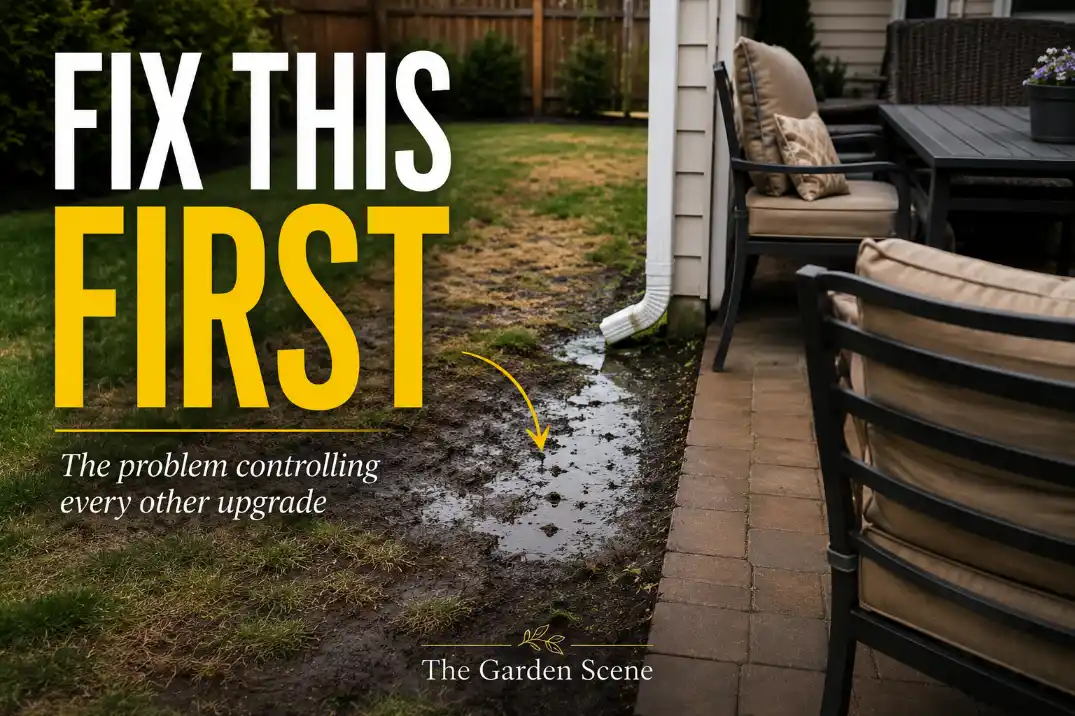
In a small backyard with multiple problems, prioritize drainage and grading first if water stays longer than 24–48 hours, moves toward the house, softens the ground under a patio, or leaves the main route muddy after normal rain.
If water is not the issue, fix access and layout next: keep the main walking route about 36 inches wide and create one dependable seating or dining zone before spending money on plants, furniture, privacy screens, or decorative surfaces.
That order matters because many visible problems are symptoms. Patchy grass may really be compaction or runoff. A “too small” patio may really be oversized furniture.
A privacy problem may feel urgent, but if the only path from the back door is muddy or blocked by chairs, the yard still will not work. The first fix should protect later spending, not just make the yard look better for a weekend.
The Backyard Priority Triage
When everything looks wrong, sort the yard by consequence, not annoyance. The question is not “what bothers me most today?” It is “what will make every other fix fail if I ignore it?”
Fix Immediately
Water near the house, erosion, unstable paving, unsafe slopes, and blocked access belong at the top. These problems can damage structures, create trip hazards, or make later upgrades fail.
A patio that holds water against the foundation is more important than a tired planting bed. A muddy route from the back door to the gate matters more than a color mismatch between mulch and pavers.
If runoff crosses the patio during a 20–30 minute rain, do not treat that as a surface problem. Treat it as a water-movement problem.
If you are choosing between drainage and layout, the decision should start with whether water is actively limiting use or threatening the house. The deeper comparison in Fix Drainage or Layout First is useful when both problems seem equally urgent.
Fix Next
Cramped seating, a failing lawn, awkward traffic patterns, and poor surface choices are next. These problems usually affect daily use more than appearance.
A small backyard improves faster when one zone works well than when every corner gets a little attention. One dry route, one stable seating area, and one clear circulation path will change the yard more than adding another planter or replacing furniture with a similar-sized set.
Fix Later
Privacy finishing, decorative planting, mulch color, garden decor, and furniture style can usually wait. They matter, but they rarely protect the rest of the yard.
There are exceptions. If the only usable seating area is directly exposed to a neighbor’s deck or second-story window, privacy may shape the layout early. Even then, solve the location and sightline first. Do not start by buying the tallest possible screen.
Measurements That Change the Priority
Small yards are easy to misread because the problems overlap. A few measurements can quickly separate a cosmetic issue from a decision-changing one.
| Measurement or signal | What it usually means | What to prioritize |
|---|---|---|
| Water remains more than 24–48 hours | Drainage, compaction, or shade is slowing drying | Fix water movement before surfaces or planting |
| Main route is under 36 inches wide | Furniture, beds, or layout are blocking use | Clear access before adding features |
| Patio slopes toward the house | Water can collect near the foundation | Correct drainage before resurfacing |
| Downspout ends beside patio or foundation | Roof runoff is feeding the problem | Redirect roof water before redesigning |
| Same grass area fails twice | Wear, shade, soil, or water is the real cause | Stop reseeding until the stress is fixed |
| Paving has settled about 1 inch or more | Base or drainage may be failing | Investigate stability before cosmetic repair |
The important point is comparison. A lawn patch that looks thin but dries normally and sits outside the main traffic path is less urgent than a narrow, muddy route used every day. A slightly exposed seating area used twice a month is less urgent than a patio edge that stays slippery for two days after rain.
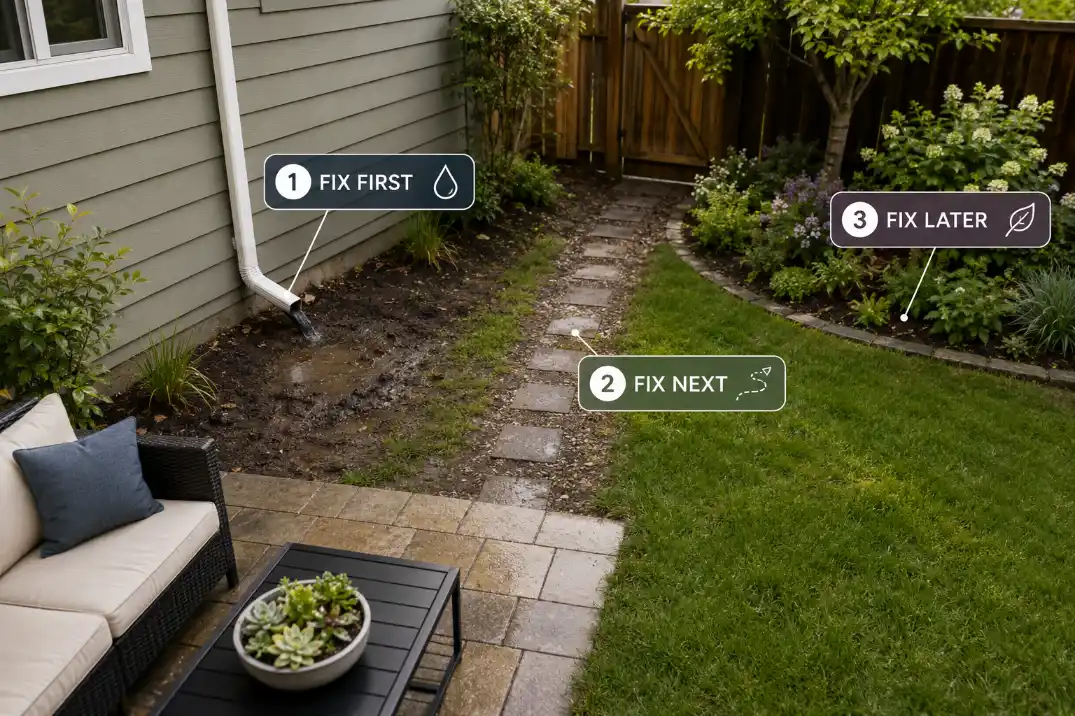
Water Comes First Only When It Controls the Yard
Drainage deserves top priority when it affects structures, safety, or the usable part of the yard. But not every damp spot deserves a full drainage project.
When drainage really is first
Water is the first priority if it moves toward the house, pools against a patio or foundation, washes mulch or soil downhill, keeps a route muddy, or leaves a paved surface slick long after rain. In those cases, new furniture, new plants, or fresh gravel will not solve the underlying failure.
A practical benchmark: soil next to the house should generally move water away from the foundation, and patios should shed water away from the structure rather than hold it. If a puddle forms in the same place after ordinary rainfall, especially near the house, treat it as a design constraint before choosing materials.
Downspouts are often the simplest clue. If a downspout ends right beside a patio, planting bed, or foundation wall, roof water may be creating a backyard problem that looks like bad soil or poor grass. Extending that water several feet away from the house can sometimes change the whole yard’s behavior.
For yards where water collects at the patio edge or against the house, Patio Water Pooling Against the House gives a more focused look at why surface fixes often disappoint.
Do not choose a drain before choosing the outlet
This is where many backyard fixes go wrong. A drain is not a solution by itself. It is only useful if the water has somewhere safe and legal to go.
French drains, catch basins, dry creek beds, and channel drains can all fail when they collect water but do not discharge it properly. Sending runoff toward a neighbor, sidewalk, driveway, or low corner can simply move the problem. In some neighborhoods, it can create a dispute or violate local drainage rules.
Before installing any drainage product, identify the outlet. Can water move to a street-approved discharge point, rain garden, swale, dry well, or lower landscape area that can actually absorb it? If the answer is unclear, pause before digging.
When drainage is not the first priority
Drainage can wait if the yard dries within about 24 hours after normal rain, water moves away from the house, and the wettest area is not part of the main route or seating zone.
In that case, layout may be the real first fix. A dry yard can still be hard to use if the grill blocks the door, the chairs pinch the path, or the only route cuts through a planting bed. In small spaces, usability often fails before materials do.
Access Beats Appearance
After water is under control, the next priority is movement. A backyard that cannot be entered, crossed, or used comfortably will not feel fixed no matter how polished it looks.
The 36-inch route rule
A main route should usually stay close to 36 inches wide. That does not mean every gap needs to be that wide, but the everyday path from the door to the seating area, gate, grill, storage, or trash area should not require turning sideways or moving chairs.
This is where people often overestimate patio size. A 10-by-12-foot patio sounds useful, but a dining set can consume most of it once chairs pull out. Dining chairs often need about 30–36 inches behind them. If that clearance overlaps the walking path, the patio will feel crowded even if the furniture technically fits.
A common mistake is expanding the patio before editing the layout. Sometimes the better fix is removing one chair, switching to a bench, changing the table shape, or moving the grill. The article Backyard Hard to Use: What to Fix First is especially relevant when the yard feels frustrating but not obviously broken.
Build one complete zone first
A small backyard should not be designed as a collection of mini features. It should first have one complete zone that works without adjustment.
That might be a small dining area, a lounge corner, a grill-and-prep zone, or a quiet sitting spot. The key is that the zone has a stable surface, enough clearance, and a logical route to it. Once that exists, other improvements become easier to judge.
If no single zone works yet, decorative upgrades are premature.
Stop Repeating Fixes That Already Failed
A routine fix stops making sense when it does not change the condition that caused the problem. This is where small backyard budgets disappear quietly.
Reseeding a traffic path
If grass fails in the same strip after seeding once or twice, the grass is not the main problem. The route is.
Foot traffic, pets, wheels, shade, and compacted soil can keep new grass from establishing. The top 2–4 inches of soil near gates, play areas, and patio edges often become dense enough that roots struggle, especially when the area is also wet. Seed may look good for 3–6 weeks, then thin again.
At that point, install a better route or change the use pattern. A stepping path, compacted gravel path with firm edging, or properly based pavers may solve more than another bag of seed.
Adding plants where space is already tight
Plants rarely fix a circulation problem. They often make it worse after the first full growing season.
A shrub that grows 18–24 inches wider than expected can pinch a walkway, crowd a seating area, or block hose access. This is not a plant failure. It is a spacing failure. If beds are already pushing into the usable part of the yard, editing plants should happen before adding more. The same failure pattern shows up often in yards where backyard plants crowd paths and seating, especially after the first full growing season.
Pro Tip: Before planting near a path or patio, mark the mature width with a hose or painter’s tape. If the outline steals chair space or walking room, the plant is too large for that spot.
Buying new furniture before measuring
New furniture can make a small backyard worse faster than almost anything else. Deep seating, oversized fire tables, and full dining sets often look reasonable online but dominate compact patios.
Before buying, measure the surface and subtract clearance. If the remaining usable area is small, choose fewer pieces, slimmer profiles, folding pieces, benches, or a smaller table shape. Style should come after scale.
What Can Usually Wait
A strong priority plan is as much about delay as action. Some backyard flaws are real, but they do not need to be first.
Minor lawn flaws outside the main use area
If a patchy area is not muddy, not spreading, and not part of the main walking route, it can wait. Fix the route and seating zone first. Then decide whether the lawn is worth repairing or whether a different surface makes more sense.
Decorative mulch and bed cleanup
Fresh mulch can make a yard look better quickly, but it should not hide evidence. If mulch is washing away, piling at the edge of a patio, or thinning downhill, observe the pattern before refreshing it. The washout is more useful than the color.
Privacy gaps away from the seating area
Not every exposed view deserves a screen. Focus privacy where people actually sit, dine, cook, or relax. Screening the whole fence line can make a small yard feel narrower and add unnecessary maintenance.
Furniture style
If the furniture is the wrong size, changing the style will not help much. A cleaner-looking oversized set is still oversized. Fix scale before aesthetics.
How Conditions Change the Order
The sequence stays similar across the US, but the signals change by climate and site condition.
Wet and humid regions
In humid regions, especially parts of Florida, the Gulf Coast, and the Southeast, drying time matters. A surface that stays damp for days can become slick, mosquito-prone, and hard on furniture. Drainage, airflow, and low-slip surfaces often matter more than dense planting.
Dry, hot climates
In Arizona, Nevada, inland California, and other hot dry areas, water may not be the dominant problem. Heat, glare, and exposed surfaces may make the yard unusable. In those yards, shade placement can move higher in the sequence, especially if afternoon temperatures make the patio uncomfortable for several hours a day.
Freeze-thaw regions
In northern states, unstable bases often reveal themselves after winter. Pavers that looked acceptable in fall may rock, lift, or separate by spring if water sits beneath them and freezes. If a paved area has shifted about 1 inch or more, investigate the base and drainage before resetting surface pieces.
When to Bring in Help
Call a qualified contractor, drainage specialist, landscape architect, or engineer if water moves toward the foundation, runoff from an uphill property cuts through your yard, soil erodes near a fence or structure, a retaining wall leans, or paving has settled enough to create a trip hazard.
Also pause before any fix that sends water toward a neighbor’s property. The first priority in that situation is not buying a drain or adding gravel. It is creating a legal, safe water path that will not create a larger problem.
The Bottom Line
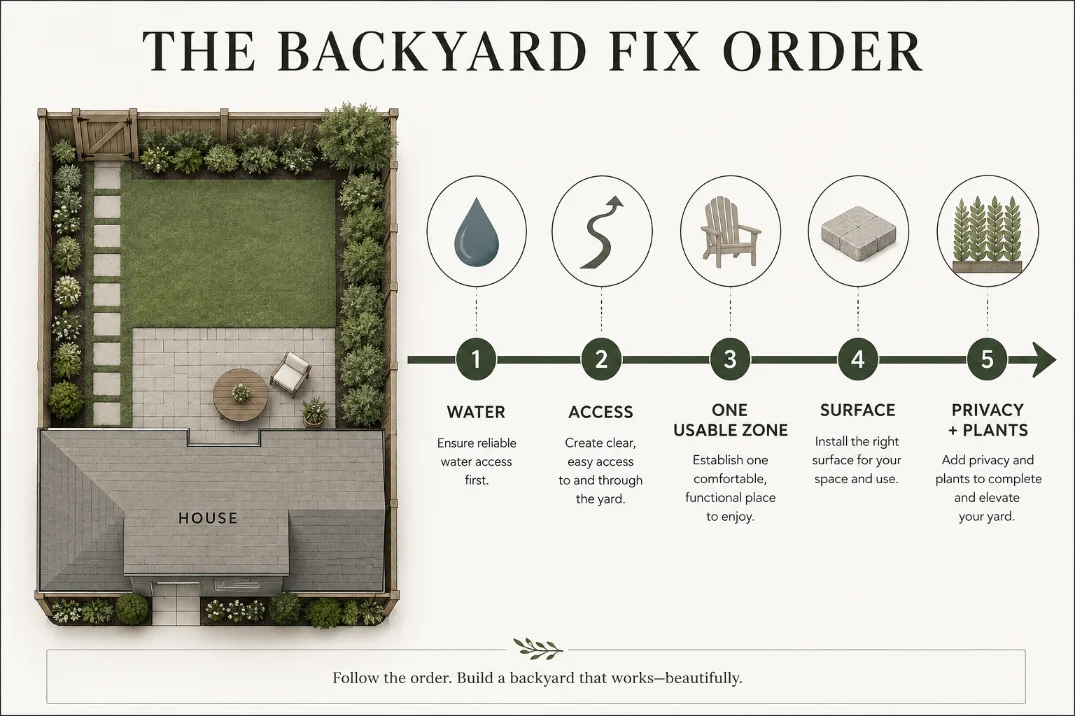
In a small backyard with multiple problems, fix the issue that controls the others. Start with water if it threatens the house, softens the ground, or keeps the yard unusable. If water is not the main issue, fix access and layout. Then create one dependable use zone. After that, choose surfaces, plants, privacy, and decorative upgrades.
The most expensive mistake is improving the visible parts before fixing the conditions that make the yard muddy, cramped, unstable, or hard to use. A small backyard does not need every problem solved at once. It needs the first problem solved in the right order.
For broader official guidance on reducing residential runoff, see the EPA guide to redirecting downspouts.