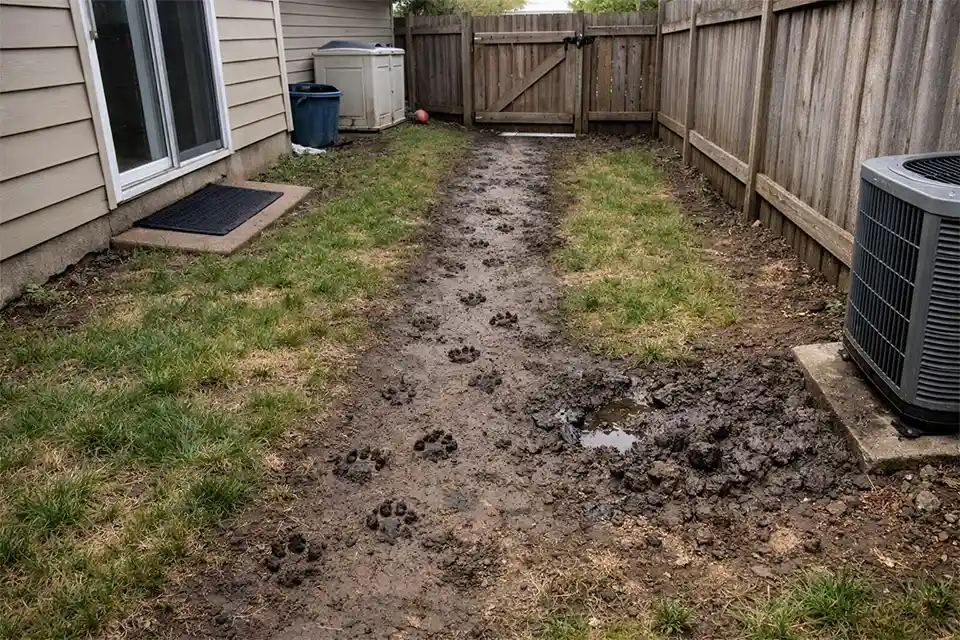
Most muddy dog yards are not failing because the grass is weak. They fail because the layout keeps sending the dog through the same narrow route while the surface stays wet too long to recover.
Check three things first: whether the worn strip is concentrated in a path under about 3 to 4 feet wide, whether water is still sitting there 30 minutes after rain or irrigation, and whether the top 2 to 4 inches of soil feel hard when you probe them.
That combination usually points to traffic concentration plus compaction, not just “bad lawn.”
A healthier yard firms back up within about 6 to 12 hours after a normal watering cycle. A failing one often stays soft for 24 to 48 hours, then gets torn apart by the next sprint, pivot, or launch off the patio.
That is also different from urine burn. Urine damage tends to create spots or rings. Traffic wear creates lanes, corners, and muddy turns.
If the same strip has failed twice in one growing season, stop treating it like a seed-only problem. At that point, the fix is usually route design, water control, or a surface change.
The first mistake is letting the dog design the yard
Dogs establish movement patterns faster than most homeowners notice. The shortest line from the back door to the gate, from patio to fence, or from shade to patrol line becomes the real circulation route whether you planned one or not.
Door-to-gate wear matters more than general thinning
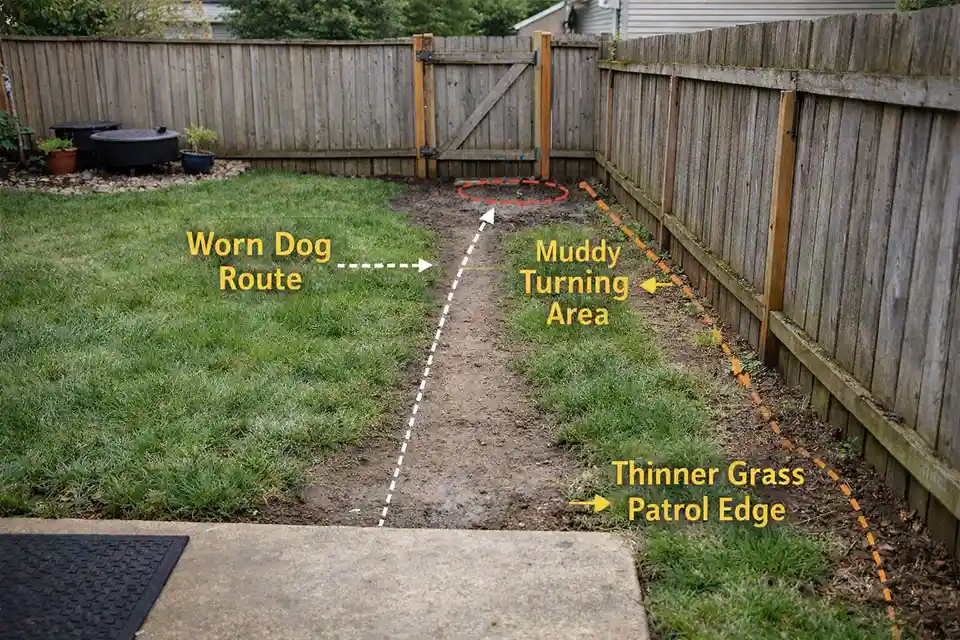
If the worst damage is in the first 6 to 10 feet outside the door and again at the gate, that usually means acceleration and turning force are driving the failure. General lawn decline looks broad and patchy. Dog wear looks directional and repeatable.
Fence patrol routes get missed all the time
A narrow strip along the fence often takes more abuse than the center of the yard, especially if the dog can see neighbors, sidewalks, or other pets. That edge is not randomly wearing out. It is being used as a track.
That is why Backyard Landscaping Problems With Pets is more useful in many cases than broad lawn-repair advice.
What people usually misread first
Mud near the house is not always a drainage defect
The surface can fail near the door even in a reasonably drained yard because that is where force is concentrated. Dogs launch, skid, and pivot there. If the middle of the lawn still dries and recovers, the dominant problem is route pressure, not necessarily bad grading.
Widening mud after storms usually is a water problem
If the muddy zone keeps spreading outward after rain, or stays tacky more than a day after a modest storm, that is no longer just traffic wear. That is water staying in the surface layer too long. Clay-heavy soils make this worse because repeated traffic seals the top layer and slows infiltration.
A practical threshold helps: if you cannot push a screwdriver more than about 2 or 3 inches into damp soil without forcing it, compaction is strong enough that seed, fertilizer, and extra watering will usually waste time.
If runoff is feeding the problem from a patio edge, downspout, or slight low spot, Backyard Drainage Problems Most Homeowners Ignore is the more relevant companion topic.
Why the obvious fixes keep failing
More seed rarely survives the same route
Cool-season seed may need 10 to 21 days to germinate, then several more weeks before it can handle repeated use. That can work in a rested northern yard in early fall. It usually does not work in an active dog lane unless traffic changes first.
More irrigation can make the surface weaker
This is one of the most common bad trade-offs. Thin grass makes people water more often. The lawn may look greener for a week while the top inch stays softer, slicker, and easier to tear apart. In humid places like Florida, that is especially counterproductive because slow drying is already part of the problem.
Loose mulch solves the look of mud more than the cause
Mulch in an active dog corridor gets kicked aside, traps moisture, and blends into the soil. Once it breaks down, the area can become softer rather than firmer. More importantly, “dog-friendly” has to mean safe as well as durable. Avoid cocoa mulch around dogs, be cautious with very hot rubbery surfaces, and do not assume any decorative ground cover belongs in a high-use run zone.
Pro Tip: If the worn strip is still soft the next morning, do not add seed or mulch yet. First reduce watering frequency and identify where the water is coming from.
Dog-friendly also means choosing a safer surface
The strongest missed layer in many muddy-yard fixes is material choice. The real question is not what hides mud. It is what controls mud without creating a new problem like heat, odor, stone scatter, or sore paws.
Surface choice changes by climate
In wetter parts of the Pacific Northwest or the Midwest, stable drainage and base construction matter more because surfaces stay under moisture pressure longer.
In hot inland climates like Arizona, heat buildup matters more, especially with artificial turf, dark pavers, and unshaded decomposed surfaces. In freeze-thaw regions, a shallow decorative layer that looks fine in October can rut and shift by late winter.
Grass type still matters, but later than people think
If you are keeping lawn in part of the yard, regional turf choice should follow climate. Warm-season grasses usually make more sense in the South, while cool-season lawns are more realistic in northern states. But even the right turf will fail in a route that stays wet and takes constant turning traffic.
| Surface | Where it works best | Main drawback | Best use case |
|---|---|---|---|
| Natural turf | Moderate traffic, decent sun, faster drying soil | Repeated route failure | Open play area, not the main dog lane |
| Compacted fines or decomposed granite | Predictable paths, moderate drainage control | Can track dust in dry climates | Door-to-gate route or patrol lane |
| Pea gravel | Potty zones, drainage-friendly spots | Scatter and paw preference vary | Separate relief area, not fast turns |
| Pavers | Tight, durable traffic points | Hard surface and heat in full sun | Gate approach, patio exit, turning pads |
| Artificial turf | Small yards where mud control is the top priority | Heat, odor, and base prep matter | Compact yards with disciplined maintenance |
That trade-off is part of why Backyard Landscaping Without Grass Problems is worth reading before removing lawn too aggressively.
The layout change that fixes more than people expect
Separate the running path from the potty zone
Many yards fail because one small area is being asked to do everything. Dogs run there, wait there, turn there, and relieve themselves there. That stacks moisture, odor, and wear in one zone. A designated relief area can reduce repeated damage to the main circulation route, especially in compact suburban backyards.
Build one durable route on purpose
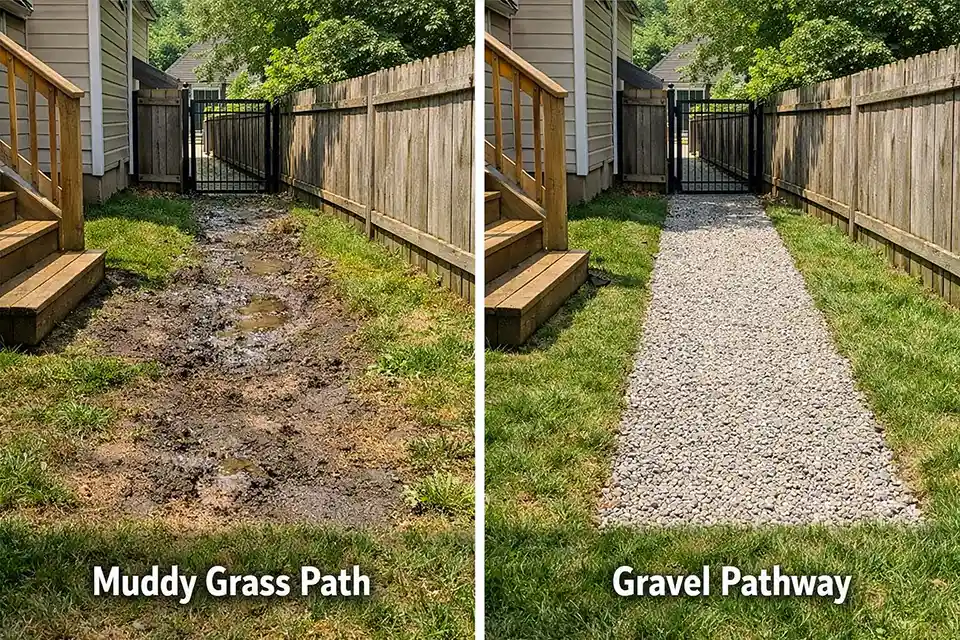
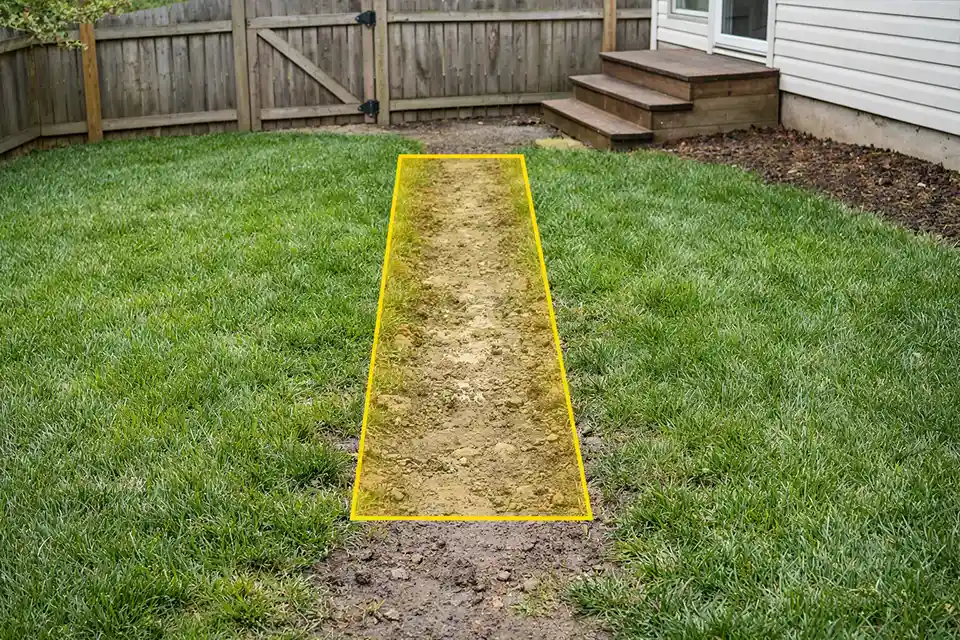
Most yards do better with one deliberate 36- to 48-inch-wide path than with constant patching across the whole lawn. The route should connect the back door, gate, and favorite patrol line using a surface built for repetition. Turning zones near steps and gates matter even more than straight stretches because they take the highest force.
Keep the rest of the yard for recovery
Do not try to make every square foot equally durable. That usually increases cost without solving the pressure points. Lawn should be reserved for areas that can recover, not forced to behave like hardscape.
This is also where Backyard Zoning Mistakes That Ruin Outdoor Flow becomes relevant. Dog use is not separate from backyard flow. It is part of it.
When to stop trying to save grass
Turf can still work when recovery is realistic
If the worn strip is narrow, the soil drains reasonably well, and the area dries within half a day after irrigation, grass recovery may still make sense. That is more realistic in sunnier yards with moderate dog activity and a chance to rest the area for 2 to 4 weeks.
Turf stops making sense under repeat structural stress
If the same lane fails twice in one season, stays soft longer than 24 hours, or sits in heavy shade for much of the day, routine lawn repair stops being a smart use of time.
In small backyards, where the same route gets used dozens of times a day, a durable path usually outperforms another round of seed.
One thing people often miss is that a lawn can look almost recovered right before it fails again. Thin green cover is not the same as roots strong enough for high-speed traffic.
Quick diagnostic checklist
- The worst wear follows a repeated line between door, gate, shade, or fence
- Water remains on the surface for more than 30 minutes after irrigation or rain
- The area stays soft for 24 hours or more instead of firming within 6 to 12 hours
- The top 2 to 4 inches are hard to probe when damp
- The muddy zone grows wider after storms rather than staying as one lane
- Reseeding has failed more than once in the same strip within one growing season
The practical decision most readers actually need
If the area dries fast enough, sees only moderate traffic, and can be rested for a few weeks, keep the lawn and fix the route pressure.
If the area stays wet, sits in shade, or keeps failing in the same corridor, stop forcing turf and build a path or dedicated dog surface there instead.
For broader official guidance, see the University of Florida IFAS petscaping guidance.