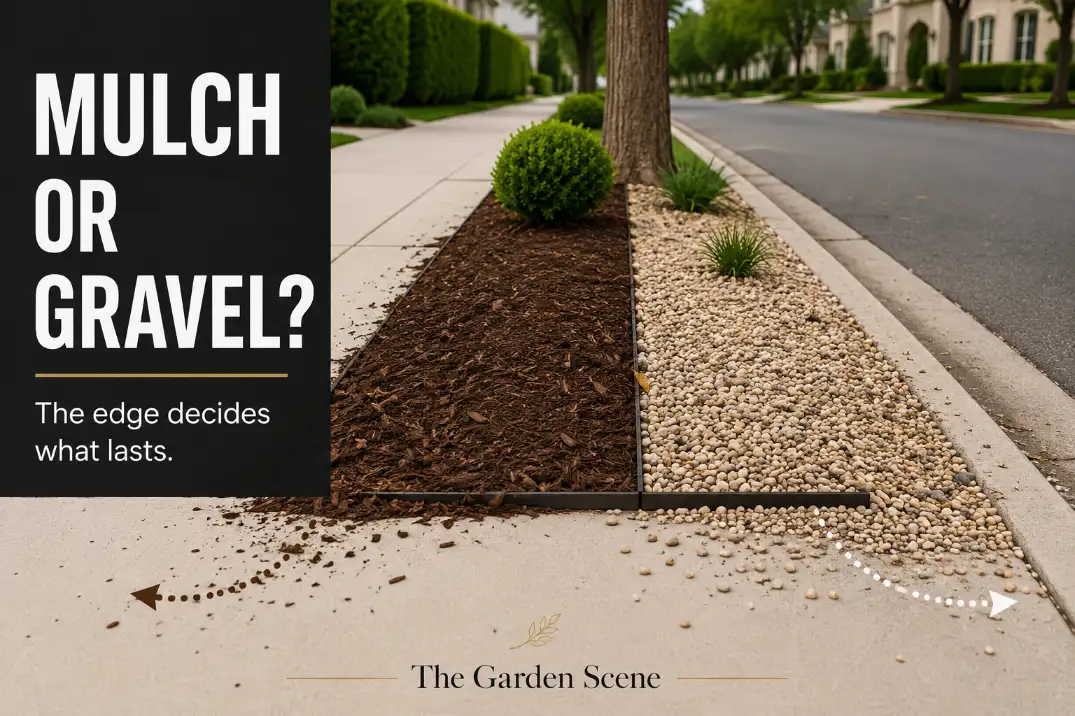
Mulch vs gravel for sidewalk strips is not just a style choice. Whether the space is called a curb strip, parking strip, tree lawn, or hellstrip, the material has to survive heat from concrete, foot traffic, rain splash, leaf debris, curb cleanup, and the occasional shortcut from the sidewalk to a parked car.
The first decision is not “Which looks better?” It is “Which one will stay contained here?”
If the loose surface sits less than 1/2 inch below the sidewalk or curb edge, both mulch and gravel are likely to spill. If the same worn path comes back within 2 to 3 weeks after you refill it, the strip is being used as a route, not a planting bed.
And if the area gets 6 or more hours of reflected afternoon sun, gravel may look cleaner while making the root zone hotter.
The practical answer is simple: mulch usually performs better in planted sidewalk strips; gravel performs better in controlled, edged, low-traffic strips.
The Clean Look Problem
The clean look fails first at the edge
Gravel usually wins the day-one appearance test. It gives a sidewalk strip a crisp, modern surface, especially beside concrete. The problem is that every escaped stone looks out of place.
A few pieces in the sidewalk joint, curb gutter, or lawn edge can make the whole strip look messy.
Mulch is more forgiving. A few bark pieces on the soil surface, around plant stems, or under ornamental grasses do not look as visually wrong.
But mulch fades, compresses, and breaks down. A fresh 2- to 3-inch layer can settle noticeably after one season, especially in humid regions or irrigated strips.
The mistake is judging the material by the first week. Sidewalk strips age at the edges first. Leaf blowers, street runoff, dog walkers, parked-car doors, mail carriers, and seasonal cleanup all test the border before they test the middle.
Gravel needs containment more than color
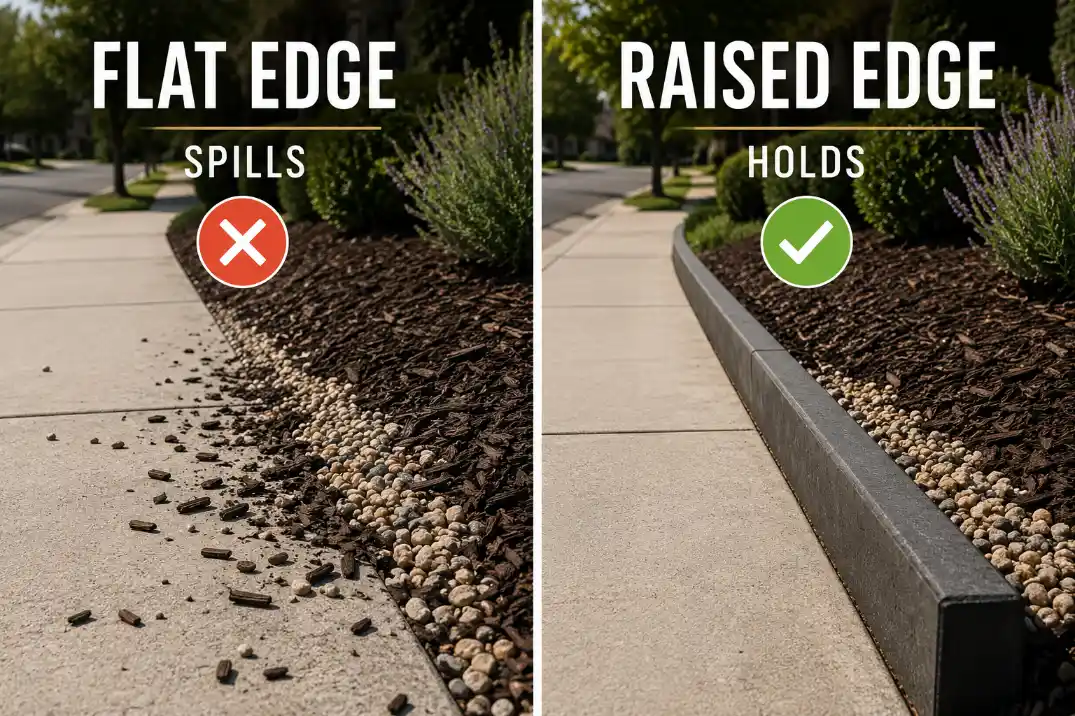
Changing from tan gravel to gray gravel does not solve scattering. Neither does using a more expensive decorative stone if the strip is flat with the sidewalk. Gravel needs a physical stop.
A raised metal, brick, concrete, or stone edge that holds the gravel surface about 1 inch below the top of the border is usually more important than the gravel type. Without that height difference, the sidewalk becomes the overflow zone.
Mulch can tolerate a softer edge, but even mulch should not be piled flush with concrete. When mulch sits level with the sidewalk, rain and foot traffic push it outward.
If you are already seeing mulch or gravel trails across the pavement, the issue is closer to an edge-control problem than a material problem.
For a deeper look at that specific failure pattern, Sidewalk Strip Mulch and Gravel Control is the better companion guide.
Heat Around Concrete
Gravel can make the strip hotter
Sidewalk strips already run warmer than ordinary planting beds because they sit between hard surfaces. Concrete reflects heat, curbs radiate heat, and narrow soil dries faster than deeper garden beds.
Gravel can intensify that condition because stone absorbs and holds heat near the soil surface.
This matters most in south-facing strips, inland California neighborhoods, Arizona yards, and other hot-climate front yards where summer pavement temperatures climb quickly.
The visible symptom is often wilting, crispy leaf edges, or plants that look fine in spring but decline hard by July.
The symptom is plant stress. The mechanism is heat and moisture pressure around a shallow root zone.
If the strip gets 6 to 8 hours of direct sun and contains young plants, gravel should not be treated as the automatic low-maintenance choice. It may reduce surface refreshing, but it can make the planting itself less forgiving.
Mulch protects the root zone better
Mulch is usually better when plants still need help from the soil surface. A 2-inch mulch layer can reduce evaporation, soften rain impact, and keep the top few inches of soil from drying as quickly.
That is especially useful near hot sidewalks, where small plants often struggle before they are fully rooted.
This is why mulch pairs better with many living sidewalk-strip plantings. If the main goal is healthy plants rather than a rock-garden look, material choice and plant choice should work together.
Drought-tolerant plants may handle gravel well, but softer perennials, shallow-rooted groundcovers, and young shrubs usually benefit more from mulch.
For plant selection in this exact setting, Best Plants for a Sidewalk Street Strip fits the decision better than surface style alone.
Pro Tip: In hot strips, use mulch around plant root zones even if you use gravel as a narrow decorative band near the curb.
Fire-prone areas change the answer
In fire-prone parts of the West, local defensible-space guidance may affect front-yard material choices. A street-side sidewalk strip is not the same risk category as mulch directly against siding, fences, or dry vegetation, but the climate context can still change the decision.
This is where gravel may be the smarter surface in some zones, especially with drought-tolerant plants and a clean edge.
The point is not that gravel is always safer or mulch is always risky. The point is that in dry, fire-conscious regions, the decision is not purely about curb appeal.
Weeds Between Loose Material
Fabric under gravel solves less than people expect
Landscape fabric is one of the most overestimated fixes in gravel strips. It can help keep gravel from sinking into the soil, and it can reduce weeds coming from below if the base was prepared well. But it does not stop weed seeds from landing on top.
Dust, decomposed leaves, grass clippings, and soil particles collect between stones. Once that layer becomes deep enough, weeds germinate above the fabric.
That is why a gravel strip can look clean for the first few months, then start showing weeds after a rainy 2- to 3-week stretch.
The fabric did not necessarily fail. The growing layer moved upward.
Mulch suppresses weeds only when it stays thick enough
Mulch blocks light well when it is fresh and deep enough. But when mulch thins below about 1 inch, weed pressure rises quickly. Bare soil begins to show through, small seeds get light, and the strip starts looking patchy.
A working mulch depth of about 2 inches is usually enough for a sidewalk strip. Piling on 4 inches just to avoid refreshing later can create different problems, especially around plant crowns.
Too much mulch can hold moisture against stems and make watering less predictable.
The better weed-control question is not “Which material stops weeds forever?” Neither does. The better question is: which surface will be easiest to keep clean every 2 to 4 weeks during the active growing season?
| Site condition | Mulch usually performs better when… | Gravel usually performs better when… |
|---|---|---|
| Planted strip | Plants need cooler, steadier soil | Plants are drought-tolerant and heat-adapted |
| Clean edge | The edge is slightly irregular | The edge is raised and firmly anchored |
| Weed pressure | The mulch stays near 2 inches deep | Debris is removed before it becomes soil-like |
| Curbside parking | People occasionally step into the strip | A stepping pad carries the foot traffic |
| Tree litter | Leaves can blend into a natural bed | Leaves are easy to blow or rake off |
| Winter cleanup | Shoveling is light or infrequent | Stones are kept away from shovel and plow paths |
| Fire-prone climate | The strip is planted and away from structures | Local conditions favor non-organic surface material |
Foot Traffic and Scattering
If the strip has become a route, stop treating it like a bed
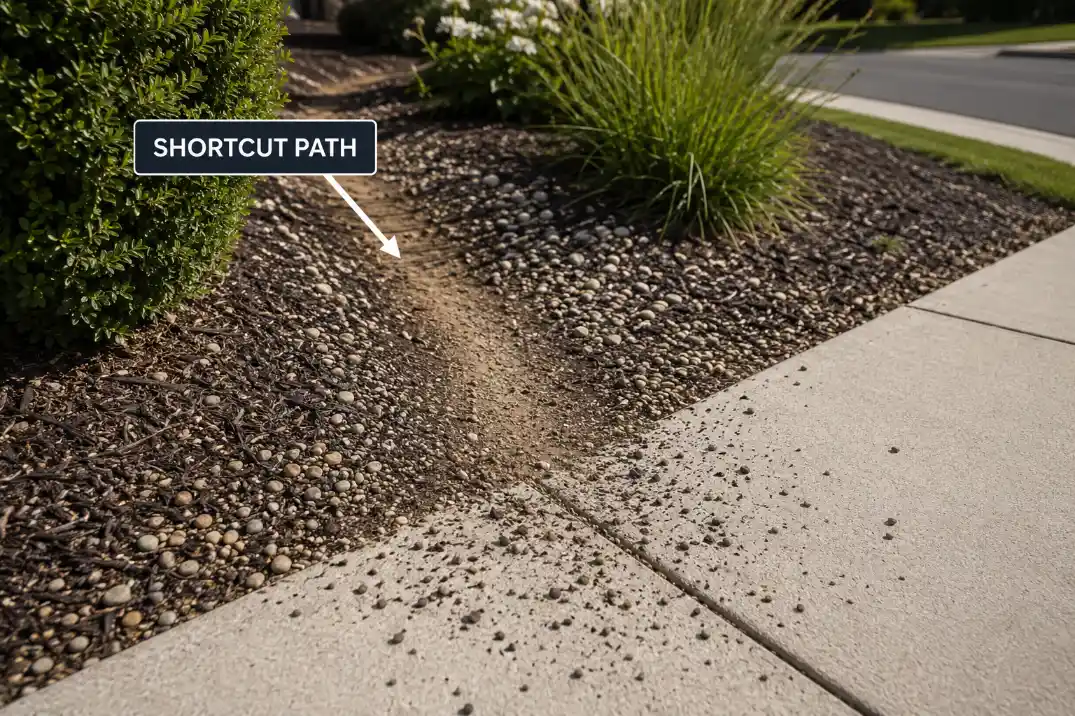
Foot traffic changes the decision more than most people expect. If people cut across the strip, mulch and gravel both lose. Mulch gets ground into the soil. Gravel gets kicked onto the sidewalk.
The material is not failing because it is cheap; it is failing because it is being asked to act like a path.
A worn line wider than 8 to 12 inches is a strong signal. So is a repeated bare patch near a mailbox, driveway, parked-car zone, or sidewalk corner. If that worn path returns within 2 to 3 weeks after a refresh, adding more loose material is wasted effort.
The better fix is a deliberate crossing point: a stepping stone, small paver pad, compacted gravel cell, or short hard-surface insert. Once foot pressure has a place to go, mulch or gravel can stay where it belongs.
Rounded gravel moves faster than angular gravel
If gravel still makes sense, shape matters. Rounded pea gravel rolls easily and is more likely to scatter across concrete. Angular crushed stone, often around 3/8 inch to 1/2 inch, locks together better and usually stays cleaner in narrow strips.
That said, angular gravel is not a perfect answer near curbside parking. If people step out of cars into the strip, the surface can feel sharp, unstable, or messy.
In that situation, a stable stepping area is more useful than switching gravel colors or adding another inch of rock.
If the strip is also exposed to heat, daily shortcut traffic, and repeated curb cleanup, the maintenance pattern is worth diagnosing as a whole. Sidewalk Strip Maintenance for Heat and Traffic connects those pressures more directly.
Watering and Soil Moisture
Mulch is better when the strip still needs soil support
Mulch is usually the better choice when the sidewalk strip includes plants that need steadier moisture. It slows drying, reduces surface crusting, and helps rainfall or irrigation soak in more gently.
Do not judge moisture from the surface alone. Check the soil 2 inches down. If the mulch surface looks dry but the soil below is still lightly moist, the system is working.
If the soil is powder-dry 2 inches down within 24 hours of watering, the problem is bigger than surface material. The strip may have compacted soil, reflected heat stress, shallow topsoil, root competition, or poor watering rhythm.
This is where people often overestimate gravel as “low water.” Gravel may reduce some surface evaporation, but it does not create moisture or fix compacted soil.
Gravel needs the right plant-and-water plan
Gravel can work well when the planting is sparse, drought-tolerant, and designed for heat. It is much less reliable when used to dress up struggling plants in poor soil.
If a gravel strip needs frequent hand watering just to keep plants alive, the surface is not actually low maintenance. The real repair may be loosening the planting zone, improving the soil before the surface goes down, choosing tougher plants, or adjusting irrigation so water enters the soil instead of running across the concrete.
For runoff-prone strips, watering technique can matter more than the surface material. How to Water a Sidewalk Strip Without Runoff is especially relevant when water leaves the strip before it soaks in.
Which One Ages Better
Gravel ages better visually when conditions are controlled
Gravel has the better long-term finished look when the site is controlled: strong edging, low debris, minimal foot traffic, and heat-tolerant planting. In that setting, gravel can hold its surface character for years with occasional blowing, raking, and small top-ups.
It also avoids the faded, compressed look that bark mulch can develop after 6 to 12 months. That makes gravel appealing in modern, low-planting sidewalk strips where the surface itself is part of the design.
But gravel ages badly when organic debris builds between stones. Once dust, leaves, and soil settle into the voids, the gravel surface becomes harder to clean.
You cannot refresh it as easily as mulch. At some point, the top layer may need to be lifted, screened, or replaced.
Mulch ages better biologically, but needs renewal
Mulch does not stay visually fresh as long, but it supports the planting system better in many curb strips. It breaks down gradually, softens soil conditions, and makes the bed more forgiving during heat and dry spells.
That benefit depends on maintenance. A thin, tired mulch layer is not doing much. A thick mound is not better either. For most sidewalk strips, refreshing back to about 2 inches is more useful than piling material higher every season.
The point where routine refreshing stops making sense is easy to spot: if mulch washes out, scatters, or exposes the same bare areas after every storm or every few weeks of use, the strip needs an edge, a crossing point, or a different layout.
Winter cleanup changes gravel’s maintenance cost
In northern states, winter can shift the mulch-versus-gravel decision. Snow shovels, plows, ice melt, and freeze-thaw movement can pull loose gravel onto the sidewalk or into the curb line.
If the sidewalk is shoveled by someone who will not carefully avoid the strip, gravel can become a spring cleanup problem.
Mulch is not immune to winter movement, but it is less risky around mowers and snow cleanup equipment. Loose rock near turf can also create problems when stones migrate into grass.
If gravel is spreading beyond the strip, Why Front Yard Gravel Spreads Into Lawn may be more important than choosing a different decorative stone.
The Best Choice for Most Sidewalk Strips
Choose mulch for living soil
Mulch is usually the safer first choice when the sidewalk strip has living plants, young roots, hot concrete, shallow soil, or visible moisture stress.
It is not maintenance-free, but its maintenance is predictable: keep it near 2 inches deep, pull it back from plant crowns, and refresh thin areas before weeds take over.
Mulch also hides small amounts of leaf litter better, which matters in older neighborhoods with street trees. If the strip is meant to look planted and healthy, mulch usually supports that goal better than gravel.
Choose gravel for a contained surface
Gravel is the better choice when the strip is designed to look crisp, sparse, and controlled. It works best with a raised edge, low debris, tough plants, and little foot traffic.
It is especially useful when the goal is a clean curbside band rather than a moisture-protective planting surface.
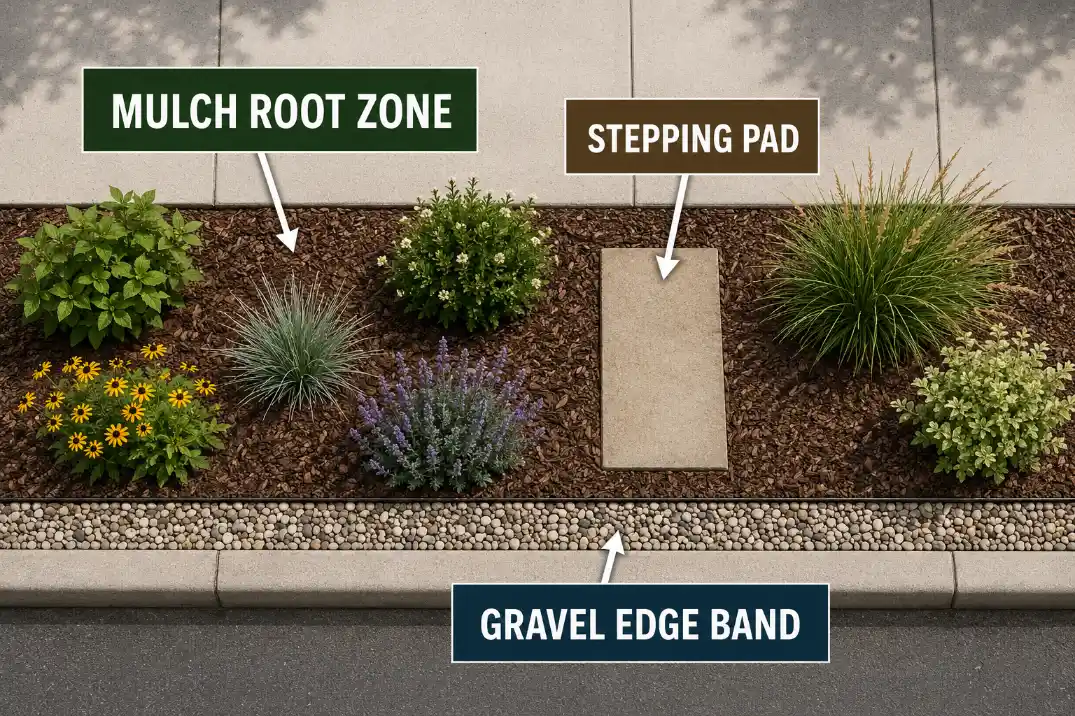
The strongest solution is sometimes a split approach: mulch around plant roots, gravel in a contained edge band, and stepping pads where people actually walk. That works because each material gets the job it can handle.
Fix edge and traffic before choosing the surface
If the sidewalk strip is narrow, hot, stepped on, poorly edged, and exposed to runoff, neither mulch nor gravel will solve the issue alone. First fix the edge. Then fix the walking route.
After that, choose mulch for living soil, gravel for a contained surface, or a mix when each material has a clear job.
That is the real verdict: the cleaner sidewalk strip is not the one with the trendier material. It is the one where the surface matches the pressure placed on it.
Questions People Usually Ask
Can you mix mulch and gravel in a sidewalk strip?
Yes, and it is often the best solution. Use mulch where plants need root-zone protection, and use gravel only where you want a cleaner edge or decorative curbside band. Keep the materials separated with edging so gravel does not migrate into the mulch.
Should landscape fabric go under gravel in a sidewalk strip?
It can help keep gravel from sinking into the soil, but it should not be treated as a complete weed solution. Weeds can still grow in dust, leaves, and debris that collect above the fabric.
Fabric is most useful under gravel when the base is clean, the edge is contained, and the surface will be maintained.
Is pea gravel good for sidewalk strips?
Pea gravel looks soft and decorative, but it rolls easily. It is usually not the best choice near sidewalks, curbside parking, or shortcut paths. Angular gravel holds better, but even angular gravel needs edging and a stable walking route.
For broader technical guidance on organic and inorganic mulches, see Virginia Tech Extension.