Last updated: July 1, 2026
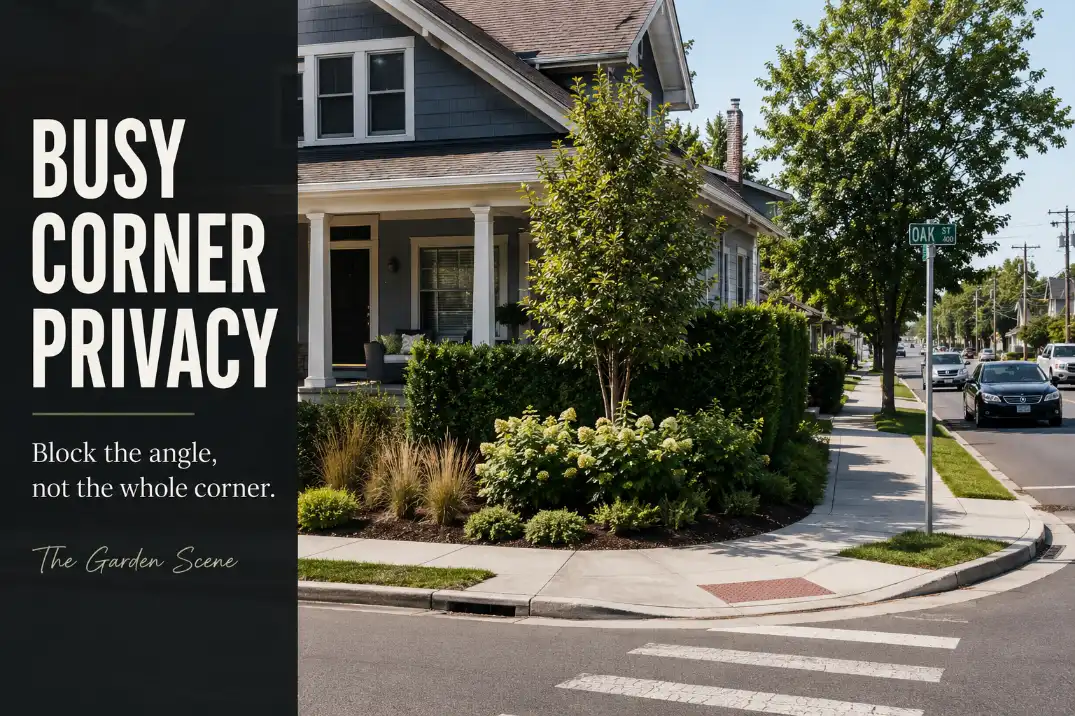
Creating privacy on a busy street corner is not the same as screening a normal front yard. A regular front yard usually has one main exposure: the street in front of the house. A corner lot has at least three: the main street view, the side street view, and the diagonal view that cuts across the corner toward the porch, window, or sitting area.
That diagonal view is usually the one homeowners underestimate. It is also the one that makes the yard feel most exposed, because people are not only looking from the front. They are passing through the corner, turning, waiting, walking dogs, or slowing near the curb. A privacy screen that simply follows the property line can miss the angle that actually reaches the house.
The stronger approach is to map the views before choosing plants, fence panels, screens, or walls. A busy corner needs privacy that interrupts personal sightlines while keeping the curb corner, entry walk, house number, and driveway approach readable. The goal is not to hide the entire front yard. The goal is to block the view where it becomes personal.
Start With the Corner, Not the Privacy Screen
The first decision is not what to plant or what material to use. The first decision is which street angle actually makes the space feel exposed.
Stand where the privacy problem happens: inside the front window, on the porch chair, near the front walk, or beside the driveway. Then look outward and separate the views instead of treating the whole corner as one exposed edge.
The straight front view
This is the view from the main street directly toward the front face of the house. It usually affects front windows, porch seating, and the lawn edge closest to traffic.
A straight front view can often be softened with layered planting, a low wall, a partial screen, or a staggered planting bed. It does not always need a tall barrier across the whole frontage.
The side street view
This view comes from the street running along the side of the lot. It may hit the porch from the side, expose a side-facing window, or make the driveway feel too open.
Side street privacy often works best with a targeted interruption placed where the view enters the usable part of the yard. Screening the entire side edge can feel heavy and may reduce the open approach to the home.
The diagonal corner view
This is the view that cuts across the corner from passing pedestrians, stopped cars, turning traffic, or people approaching from the sidewalk bend.
On a busy corner, this is often the controlling view. A privacy layer can look substantial from the front but still fail if the diagonal line can see past it into the porch or window.
Separate the Main Street View From the Side Street View
The common mistake is treating both street edges the same. A corner lot rarely needs equal privacy on both sides. One edge may need a stronger buffer, while the other may only need a short interruption near the porch, window, or driveway.
The main street view usually needs broader softening because traffic is more constant. The side street view often needs more precise placement because the view may only become uncomfortable at one angle.

Use the street edge that creates the most constant exposure for broader layering. Use the street edge that creates one awkward angle for a more targeted screen.
| Exposure source | What it usually hits | Better privacy placement |
|---|---|---|
| Main street view | Front windows, porch face, lawn edge | Stronger layered buffer along the main street edge |
| Side street view | Porch side, driveway edge, side-facing window | Targeted screen where the view enters usable space |
| Diagonal corner view | Porch seating, front walk, deeper yard | Staggered privacy break pulled back from the curb corner |
| Entry approach view | Front door, house number, walkway | Keep open enough to read the entrance clearly |
| Immediate curb corner | Turning view, sidewalk corner, street visibility | Low, open, or transparent treatment |
If the main street is the constant problem, privacy should feel layered and continuous without turning into a wall. If the side street is the problem, the screen often belongs closer to the use area than to the curb.
For a yard where the sidewalk sits close to the window, the same mapping logic applies, but the personal view is usually much shorter.
That situation needs a tighter window-level strategy, like the one explained in front yard privacy when the sidewalk runs only a few feet from your windows.
Interrupt the Diagonal Sightline Across the Corner
The diagonal view is the reason many corner-lot privacy fixes feel weaker than expected. A screen may cover the front edge and still leave a clear angled view across the corner into the porch, window, or sitting area.
The stronger move is to interrupt the diagonal line where it starts to reach private space, not where the property line begins. That often means pulling the privacy element slightly inward, staggering it, or placing it behind the open curb area.
The overlooked part is that diagonal privacy does not always need to be tall. It needs to be placed where the viewer’s line crosses the yard. A mid-height screen or layered planting can work better than a taller element sitting in the wrong place.
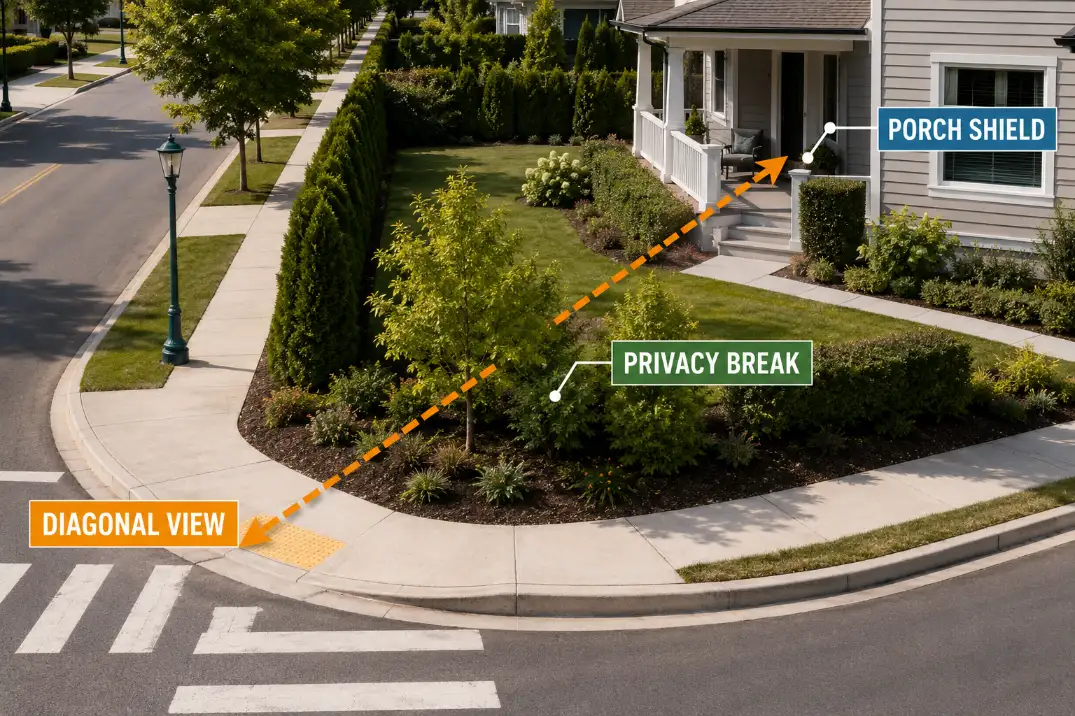
A diagonal privacy break can be created with a layered shrub group, a short fence panel, a narrow trellis, a raised planter, or a combination of lower and mid-height elements. The exact material matters less than the alignment.
Test the line from the sidewalk corner, the opposite curb, and the side street approach. If the porch or window is still visible through the gap, the privacy layer is not controlling the real view yet.
Keep the Curb Triangle Visibly Open
A busy corner needs privacy, but it also needs readable movement. Closing the curb corner first is usually the wrong fix because it can make the property feel boxed in and may create visibility problems for drivers, pedestrians, cyclists, and the homeowner entering or leaving the driveway.
The curb corner should usually stay low, open, or visually transparent. The stronger privacy move belongs behind that open zone, where it can protect the porch or window without making the intersection edge feel blocked.
This is the main trade-off on a corner lot: the corner itself often needs openness, while the personal space behind it needs interruption.
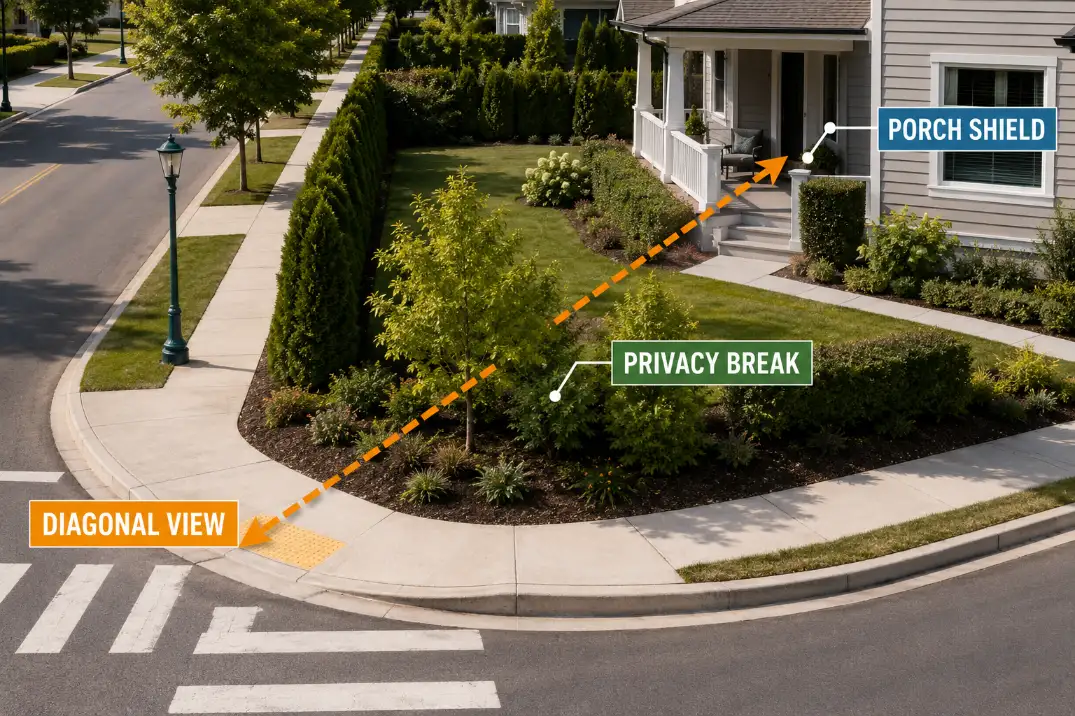
Do not use the curb triangle as the main privacy wall. Use it as the clear zone that lets the yard stay readable.
A low groundcover bed, short ornamental planting, open lawn corner, or transparent edge can keep the corner from feeling closed. Behind that, the privacy layer can rise where the view starts to become personal.
Local rules can vary, especially near intersections and driveways. This article is not a code guide, so treat the curb corner as a design constraint first and confirm local visibility rules before building anything permanent.
Protect the Porch and Windows Without Hiding the Entry
The entry must remain easy to understand from the street. A front yard that hides the door, blocks the house number, or makes the walkway feel uncertain may gain privacy but lose welcome.
The better decision is to separate privacy for sitting areas and windows from visibility for arrival. Porch chairs, low windows, and exposed seating need interruption. The front door, main walk, house number, and safe approach path need readability.
A corner-lot privacy plan fails when it treats the whole front face of the house as something to hide. The front yard should still explain how to enter.
Practical note: if guests pause at the sidewalk because they cannot tell where to walk, the privacy layer is doing too much. If pedestrians can look directly into the porch chair or front room, it is doing too little.
For a more general version of this balance, see how to make front yard privacy still look welcoming.
Use Layered Height Instead of One Heavy Barrier
A single tall barrier across a busy corner often looks like the simplest fix, but it can make the yard feel defensive and may still miss the diagonal view. Layered height is usually more useful because each layer can handle a different part of the sightline.
The corner layer stays low. The diagonal layer rises where the view crosses private space. The background layer can be taller near the porch, side window, or seating zone.
Keep the corner layer low
The immediate corner should not carry the whole privacy job. Keep this area visually open enough to read the sidewalk, curb, and entry approach.
Low planting, open spacing, or transparent structure works better here than a dense wall.
Use mid-height screening for the diagonal view
The diagonal layer is the workhorse. It should sit where the angled view reaches the porch, window, or sitting area.
This layer may be a shrub group, trellis, planter, screen panel, or mixed planting. Its job is not to close the yard. Its job is to break the personal line of sight.
Place taller screening behind the open zone
Taller screening belongs where it protects the most personal area without blocking the corner. That may be closer to a porch side, beside a window, or behind the first low layer.
The further back the tall element sits, the less it feels like a street wall.
A layered approach also works well when you want privacy without relying on a full fence. The same principle is explained in front yard privacy layering without a fence.
Route Each Privacy Move to the Right Edge
Once the main views are separated, each privacy move should have a job. Do not add screens just because an edge feels exposed. Add them because a specific view reaches a specific use area.
Use this routing logic:
- Main street edge: soften constant exposure.
- Side street edge: interrupt the side approach where it reaches the porch, driveway, or side window.
- Diagonal corner: pull privacy back and stagger it across the angled view.
- Entry zone: keep the front door, house number, and walkway readable.
- Curb corner: keep it open, low, or transparent.
The common mistake is spending the privacy budget on the longest edge. The more useful move is to spend it on the edge that controls how exposed the porch, window, or entry actually feels.
Driveway exposure needs the same kind of separation. If the driveway is open to the street, avoid letting a corner privacy screen create a blind, cramped, or confusing arrival zone. A more focused driveway approach is covered in front yard privacy when the driveway is open to the street.
Test the Layout From the Street Before You Build It
A corner-lot privacy plan should be tested from the places where people actually see the yard. The drawing may look balanced from above, but the real privacy result depends on eye level, walking route, car position, and the angle of approach.
Before planting or building, mark the proposed privacy locations with temporary stakes, trash cans, cardboard panels, folding screens, or garden chairs. Then check the view from several points:
- straight across the main street
- along the side street
- from the sidewalk corner
- from the opposite curb
- while approaching the front walk
- from inside the porch or front window
The useful test is not whether the yard looks screened from one angle. The useful test is whether the personal view disappears while the entry and curb corner still make sense.
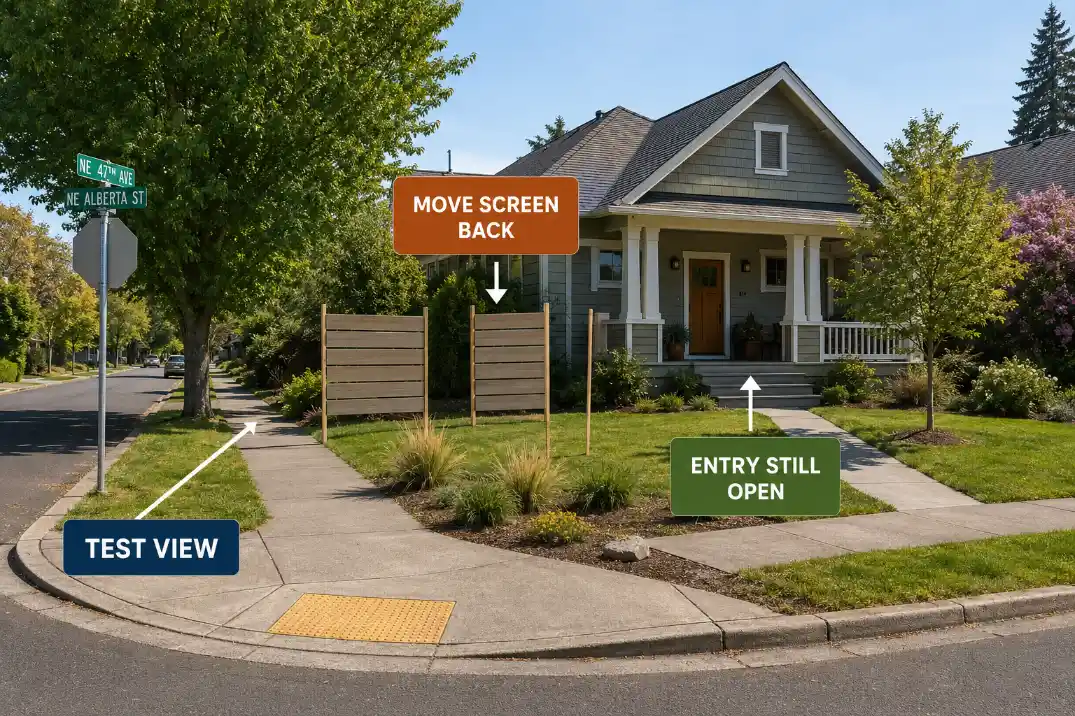
This test often shows that a small shift matters more than a bigger screen. Moving a privacy layer a few feet back from the corner can protect the porch better, keep the curb clearer, and make the whole front yard feel less defensive.
For smaller lots, the same test should be tighter and more selective. A compact yard cannot absorb heavy screening as easily, so the privacy layer must do more with less space. See small front yard privacy landscaping for a smaller-scale version of that problem.
The best busy-corner privacy layout does not try to erase the street. It reads the street. It separates the main view, side view, diagonal view, curb openness, and entry readability, then gives each one the right level of interruption.
That is what makes the yard feel more private without making it feel closed. The corner stays visible. The entry stays welcoming. The porch and windows stop feeling exposed. The privacy works because it is placed on the actual sightline, not simply spread across the property edge.
For local visibility rules, start with your city or county code; for one example of how municipalities define a corner vision clearance area, see La Puente, California’s vision clearance triangle ordinance.