Last updated: June 19, 2026
Privacy planters work best when the privacy problem is narrow, close to a paved surface, or not worth solving with a permanent hedge or fence. They are especially useful where digging is limited, HOA rules are strict, or a patio needs seasonal screening without rebuilding the whole yard.
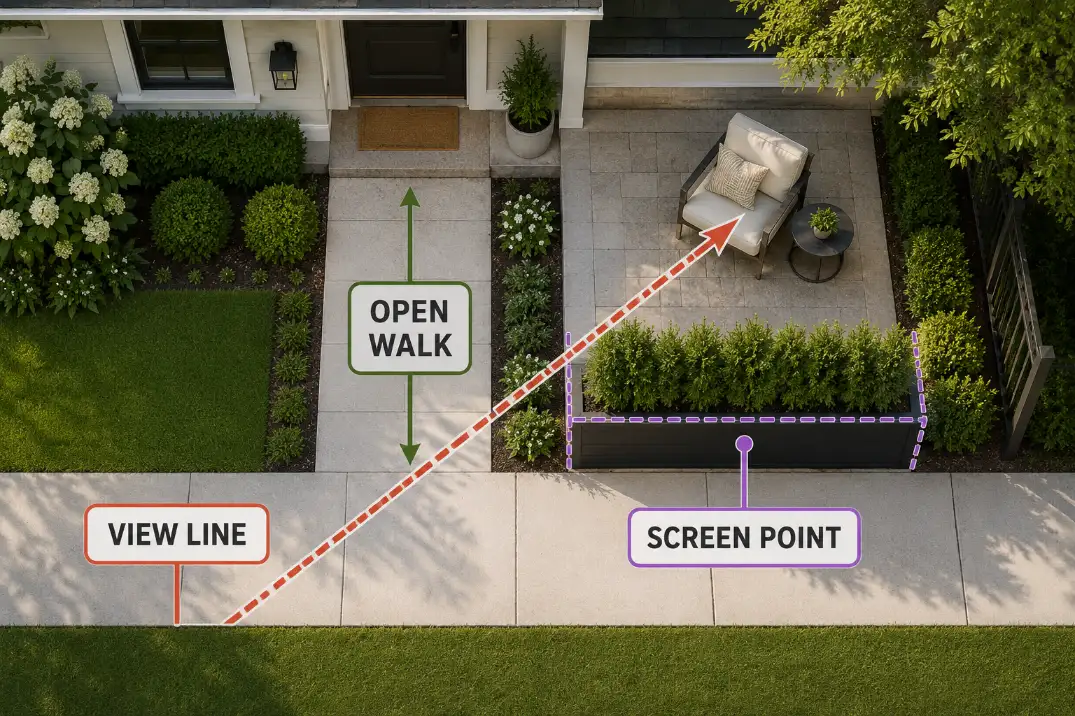
Start with the view, not the pot. Stand where the unwanted view begins and look toward the chair, window, grill, or door you want to protect.
If the exposed opening is only about 3 to 8 feet wide, planters can often solve it cleanly. Once that opening stretches past 8 to 10 feet, a few containers usually stop feeling intentional and start looking like scattered barriers.
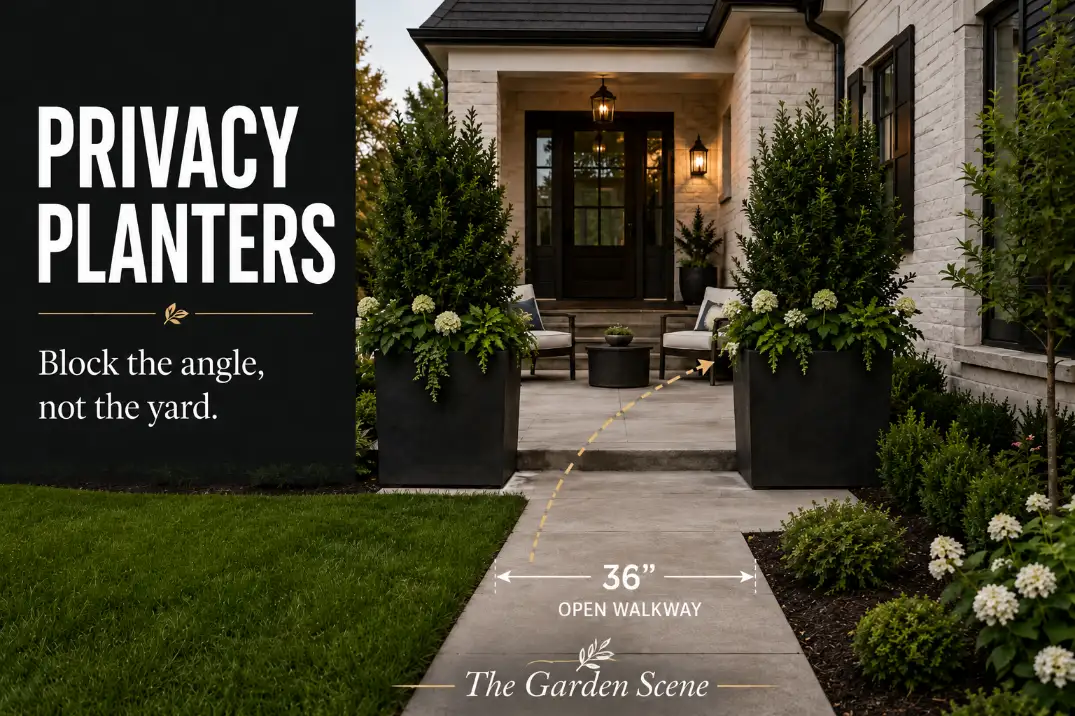
Also check access early: a front walk, patio door, or side-yard route should usually keep about 36 inches of clear passage after the plant fills in.
When Planters Work Best
Use planters for the missing screen point
The strongest privacy planter layout usually solves one missing screen point, not the whole yard. That may be the corner of a patio, the side of a front walk, the line between a sidewalk and a front window, or the small opening where a driveway view cuts into the yard.
This is where planters differ from permanent privacy landscaping. A hedge works as a broad boundary. A planter works as a movable screen.
In a larger yard, Landscaping for Privacy can shape the full privacy system, while containers should stay focused on the tight angle that needs fast coverage.
Do not confuse height with privacy
A tall planter does not automatically create a private space. Privacy comes from the dense foliage between the viewer and the target, not from the tallest stem in the container.
For seated patio privacy, the useful screen often begins around 42 to 48 inches above the surface.
For standing views from a sidewalk, driveway, or neighbor path, a combined planter-and-plant height of about 60 to 72 inches is usually more useful.
A 30-inch planter with airy grasses may look dramatic and still allow the viewing gap to stay open.
Front Yard Privacy Planters
Keep the entry open, not exposed
Front yard privacy planters need restraint because they are part of the home’s public face. Too many large containers can make a small front yard feel blocked off, especially near steps, mailboxes, and front walks.
The better move is usually a small group of two or three planters near the exposed view rather than a full row across the house.
If the main issue is a front window close to the sidewalk, place the planter where the sidewalk-to-window view actually passes. Do not automatically center the pot under the window.
When the whole frontage needs more softness, Front Yard Landscaping for Privacy can carry the broader planting plan while the container handles the tight visual gap.
Avoid the front-walk pinch
A planter that narrows the route below about 30 inches will feel awkward even if it creates privacy. Guests turn sideways, delivery drivers step around it, and the yard starts to feel less usable. A 36-inch clear route is a safer working minimum for most front walks.
Pro Tip: Measure the route with the mature plant width, not the empty planter width.
Patio Privacy Planters
Screen the sitting angle first
Patio privacy is usually a seated-view problem. That means the planter does not always need to be extremely tall. A dense 48- to 60-inch screen placed close to the exposed chair can work better than a 7-foot plant placed against the far fence.
Many patio layouts fail because every privacy planter gets pushed to the patio edge or fence line because it looks tidy. If the neighbor’s view comes in diagonally, the planter needs to catch that diagonal line.
For seating areas where furniture, shade, and enclosure all affect privacy, Patio Privacy Ideas for Secluded Seating gives the planter a stronger layout context.
Plan for hotter container conditions
Patios are harder on containers than nearby planting beds. Concrete, pavers, and stone can make container conditions feel noticeably hotter than nearby soil, sometimes by 10°F or more on sunny afternoons.
In hot weather, a small container may dry in less than 24 hours. In humid or shaded areas, the same planter may stay wet for several days, which can create root stress instead of drought stress.
For real screening, shallow decorative pots are usually the wrong place to spend money. Many shrubs and upright grasses perform better with at least 16 to 24 inches of soil depth. Larger evergreen screens often need more root volume than a slim decorative planter can provide.
Best Privacy Planter Formats
Match the planter shape to the job
The best privacy planter is not always the tallest one. Shape, stability, soil volume, and placement matter more than the label on the pot. A long trough can protect a patio edge better than a tall square pot.
A tall square planter can block a tight window angle better than a row of small containers. A planter with a trellis can help where foliage alone is too thin.
| Planter format | Best use | Watch out for | Strongest privacy role |
|---|---|---|---|
| Rectangular trough | Patio edges, side yards, low boundary gaps | Too little soil depth | Creates a stable horizontal screen |
| Tall square planter | Front walk, porch corner, narrow sightline | Top-heavy plant choice | Adds height in one exact spot |
| Planter + trellis | Patio seating, rental spaces, thin plant coverage | Weak wind support | Gives instant vertical structure |
| Rolling planter | Protected patios, seasonal repositioning | Wind and uneven paving | Flexible short-term screening |
| Paired large pots | Entry corners, small patios | Forced symmetry | Frames privacy without a full row |
| Narrow side-yard trough | Tight passages and service zones | Crowded access | Screens while keeping movement open |
Use planter-and-trellis setups carefully
A planter-backed trellis can be useful when the privacy need is immediate or the plants are still filling in. It is especially helpful for patios, townhomes, rentals, and paved areas where in-ground planting is not practical.
But a trellis also changes the wind load. A lightweight planter with a tall trellis can tip or twist in storms, especially on open driveway edges or exposed corner patios. If the site is windy, choose a broader base, heavier container, protected placement, or a lower screen.
Driveway Privacy Planters
Solve the edge, not the whole driveway
Driveway privacy planters work best where one view opens into the yard, not where the entire driveway needs to disappear. A long row of containers can become expensive, thirsty, and awkward to maintain. In northern states, it can also interfere with snow storage and plow clearance.
Near a driveway, the useful spot is usually the place where the view opens toward the yard or patio, not the longest edge of the pavement.
If the main goal is vertical coverage along hardscape, Tall Planters for Driveway Privacy can help refine the height, weight, and spacing before the containers become obstacles.
Leave room for daily movement
A planter that works in a photo can fail in daily use. Around parked cars, allow for the door swing plus at least 24 to 30 inches of comfortable movement space. Near the garage, avoid placing heavy containers where people step out with groceries, bins, strollers, or tools.
Buying heavier planters is not the real fix if the location is wrong. Weight helps only when the container belongs there. If the planter blocks a daily path, sturdiness simply makes the mistake harder to move.
Side Yard Privacy Planters
Use narrow depth without starving the roots
Side yards often need narrow planters, but narrow should not mean rootless. A container that is 10 inches deep and 36 inches tall may look like a privacy screen but may not hold enough soil for dense growth. It can also become unstable once the plant catches wind.
A better side-yard planter is often long and stable rather than tall and skinny. Rectangular planters can support upright grasses, compact evergreens, or contained clumping plants while keeping the route open.
For very tight passages, Narrow Planters for Privacy Screens in Side Yards is useful because the real challenge is balancing privacy with service access, not just finding the narrowest pot.
Keep service access visible
Side yards often hold gates, hose bibs, meters, trash bins, AC units, and utility access. Privacy planters should not hide the things people need to reach quickly. If the container must be dragged aside every time the gate opens or the hose is used, the layout is not finished.
Tall Planters for Screening
Do not build a top-heavy screen
Tall planters are useful when the screen needs instant elevation, but they are also easier to misuse. A narrow lightweight pot with a tall evergreen or trellis can become top-heavy. This matters most on open patios, driveway corners, coastal yards, and windy side passages.
A safer tall screen has three things working together: a broad enough base, enough soil volume, and a plant that stays dense without becoming a sail. If the container is tall but the plant is thin at eye level, the screen looks impressive without solving the privacy problem.
Know when containers stop making sense
Planters stop making sense when the privacy need is long, permanent, wind-exposed, and low-maintenance. If you need hedge-level coverage across 20 or 30 feet, in-ground planting usually performs better. Containers dry faster, freeze harder, and restrict root growth sooner.
A routine fix reaches its limit when you keep increasing pot size but still need a hedge-length screen. At that point, the problem is not planter selection. It is the wrong privacy system.
Best Planter Plantings
Choose structure before flowers
Flowers can make privacy planters attractive, but they rarely carry the screen. The backbone should come from foliage structure: compact evergreens, upright grasses, broadleaf shrubs, columnar plants, or a trellis-supported climber.
Good choices depend on climate, exposure, and container size. Japanese holly, compact arborvitae, boxwood, podocarpus, camellia, gardenia, switchgrass, and fountain grass can all work in the right region and container, but none of them are universal.
The planter and plant should be chosen as one system; Plant and Planter Combinations for Front Yard Privacy is especially useful when the screen needs to look intentional from the street.
In hot Arizona conditions, heat and reflected paving matter. In Florida humidity, airflow and drainage matter. In freezing northern winters, container root hardiness matters more than the plant’s in-ground zone rating.
Do not overestimate fast growth
Fast growth is often overrated in privacy containers. A plant that grows quickly may also need more water, more pruning, and more root space than the planter can provide. Controlled density is usually better than speed.
A healthier privacy container has steady foliage density, even moisture, and enough root space to recover between waterings. A failing one often shows crispy edges, leaning stems, exposed lower gaps, or soil pulling away from the planter wall.
If water runs straight through in under 10 seconds, the root ball may be too dry or the mix may have shrunk away from the sides.
Pro Tip: Use seasonal flowers as accents around the privacy plant, not as the privacy plant itself.
Planter Placement Mistakes
Mistake 1: lining the boundary by default
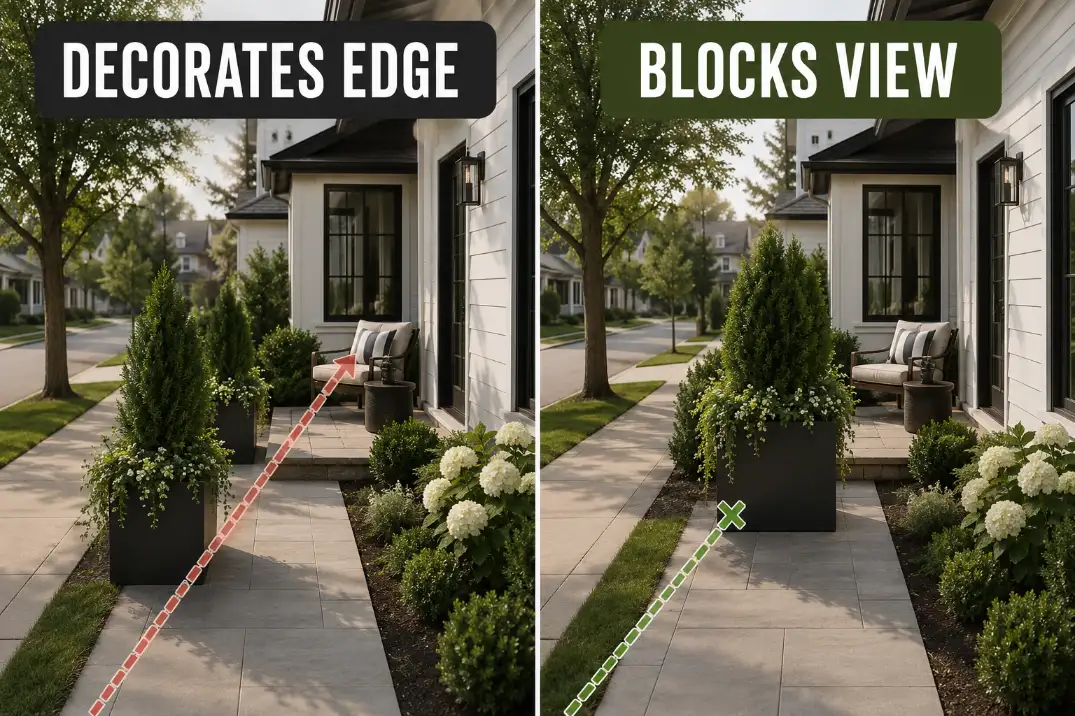
The boundary is not always the screen point. If the view crosses diagonally, comes from an upstairs window, or opens near a driveway, a boundary row may leave the important angle untouched.
This is the main reason privacy planters disappoint. They look arranged, but they do not interrupt the view.
Mistake 2: forcing symmetry
Matching planters look orderly, but privacy is not always symmetrical. One planter placed at the exposed corner can do more than two planters placed evenly beside a door. The eye likes pairs; sightlines do not care about pairs.
Mistake 3: choosing the pot before the mature plant
A plant that matures to 4 feet wide can overwhelm a 3-foot path. A narrow plant in a wide exposure can look finished but fail to screen. Choose the mature plant width, then choose the planter location.
Keep Access Routes Open
Measure the route after the plant fills in
Privacy should not make the yard harder to use. Keep about 36 inches clear for primary walking routes. Around patios, leave 24 to 30 inches behind chairs so people can pull them back without hitting the planter. Around gates, allow the full swing plus standing room at the latch.
This is where many planter layouts fail quietly. They solve the view but make the everyday route annoying.
Watch watering access
A privacy planter that is hard to water will decline first. This is especially true under roof overhangs, where rainfall may not reach the soil.
In summer, large containers may need water every 1 to 3 days depending on heat, wind, plant type, and soil volume. In cooler seasons, the same planter may need much less.
The signal is not the calendar. Check whether the top 1 to 2 inches of mix are dry while the root zone below still holds some moisture.
Simple Planter Privacy Layouts
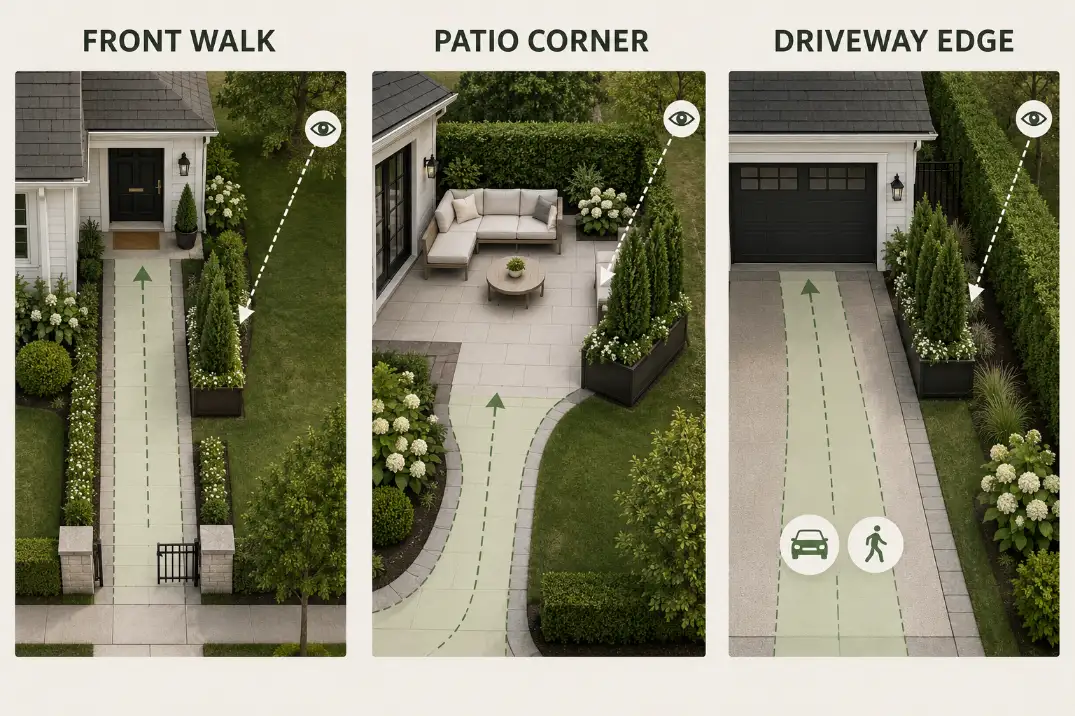
Front window layout
Use one larger planter near the viewing gap between the sidewalk and the window, then support it with lower planting nearby. This works better than placing equal pots across the entire front of the house. The goal is to soften the view, not make the window look barricaded.
Patio corner layout
Place the main planter at the exposed corner of the seating area. Add a second lower planter only if it helps shape the edge. On a small patio, two carefully placed containers usually beat five scattered ones.
Driveway-side layout
Use a tall, stable planter near the point where the driveway view opens toward the yard or patio. Keep it outside the car-door swing and away from the tightest turning point. If the view is broad and constant, planters may need to support a larger driveway privacy layout rather than carry the whole job.
Side-yard layout
Use one long rectangular planter along the exposed side, leaving the walking route clean. Avoid tall, narrow pots that wobble or force people sideways. The side yard needs a working passage first and privacy second.
When Privacy Planters Are the Wrong Fix
The exposed view is too long
If the privacy gap runs across a full property line, a few planters will usually look temporary. In-ground shrubs, a fence, a mixed border, or a built screen may be more practical.
The site is too windy
Lightweight containers, tall trellises, and narrow evergreens can struggle in exposed wind. This is especially true near driveway corners, open patios, and coastal sites. In those spots, stability is not optional.
The planter blocks the way people actually move
If the planter interferes with the front walk, patio chair movement, gate swing, driveway door clearance, hose access, or trash-bin route, the privacy gain is probably not worth the daily friction.
The plant needs more root space than the container can give
Some plants can survive in containers but never become dense enough to screen well. If the plant repeatedly dries out, drops lower leaves, leans, or fails to fill in after a growing season, the planter may be too small for the job.
Quick Placement Checklist
- Stand at the viewer’s position before choosing the planter location.
- Keep primary walking routes close to 36 inches clear.
- Use dense foliage between 42 and 72 inches where privacy matters most.
- Choose soil depth before decorative pot style.
- Use planter-and-trellis screens only where wind and stability are controlled.
- Check chair pullback, gate swing, car doors, hoses, and bins before final placement.
- Recheck the layout after 2 to 4 weeks, once plants settle and daily movement patterns become obvious.
Questions People Usually Ask
Are planters enough for front yard privacy?
They can be enough when the exposure is narrow, such as a window, porch seat, or short sidewalk view. If the entire front yard is open from the street, planters usually need to support a broader privacy layout.
How tall should privacy planters be?
Most useful front yard and patio privacy planters land between 48 and 72 inches tall when the planter and plant are counted together. The exact height depends on whether the view is seated, standing, uphill, or from an upper window.
Are planter boxes with trellises better than tall plants?
They can be better when you need instant vertical structure or when the plant is still filling in. They are not automatically better in windy locations, where the trellis can make the container less stable.
What is the biggest privacy planter mistake?
The biggest mistake is placing planters where they look balanced instead of where the view actually passes. Privacy planters should block the angle first and decorate the space second.
For broader container planting guidance, see Penn State Extension.