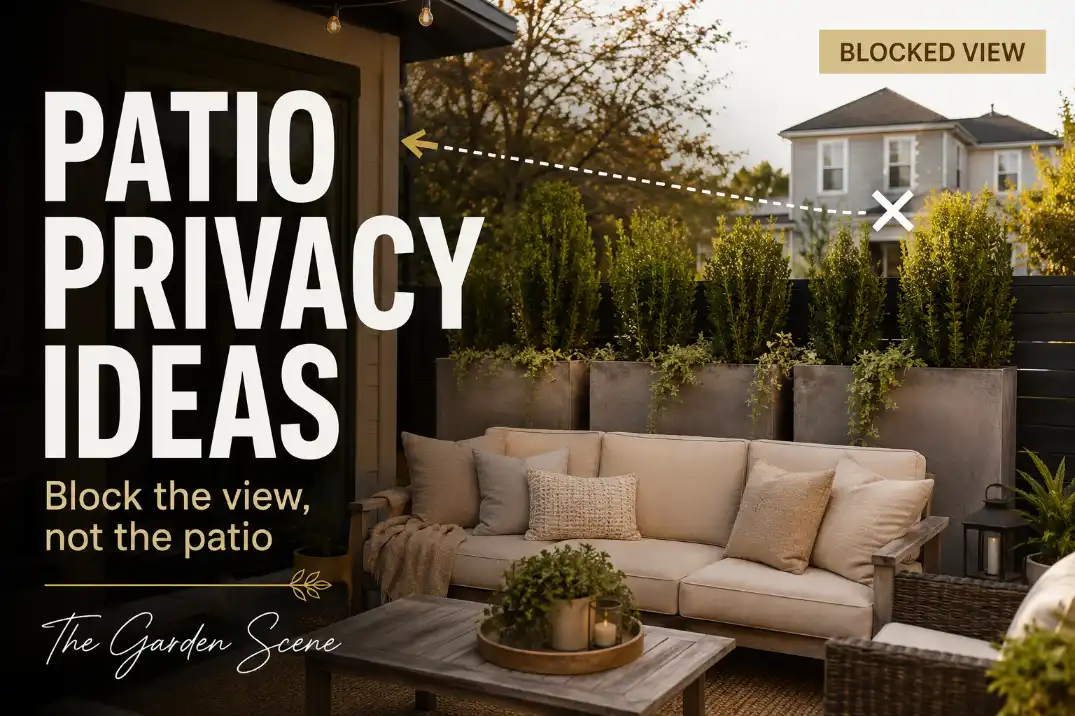
A patio usually feels exposed because of one bad sightline, not because the entire outdoor space needs to be closed in.
Before adding screens everywhere, sit in the main chair and look for the first view that makes the seating area feel watched: a neighbor window, an open fence gap, a driveway angle, or a second-story deck.
Then check whether the fix leaves at least 30–36 inches of clear walking space and keeps air moving above shoulder height.
The best patio privacy ideas block the view without turning the patio into a box. A 48–72 inch screen, planter wall, trellis, or curtain can often create enough seated privacy because most discomfort happens at eye level while sitting.
A taller fix is not automatically better. Once privacy starts making chairs hard to pull out, doors awkward to use, or airflow noticeably weaker after a hot afternoon, the solution has crossed into a layout problem.
Best Patio Privacy Ideas
Planter Wall Behind Seating
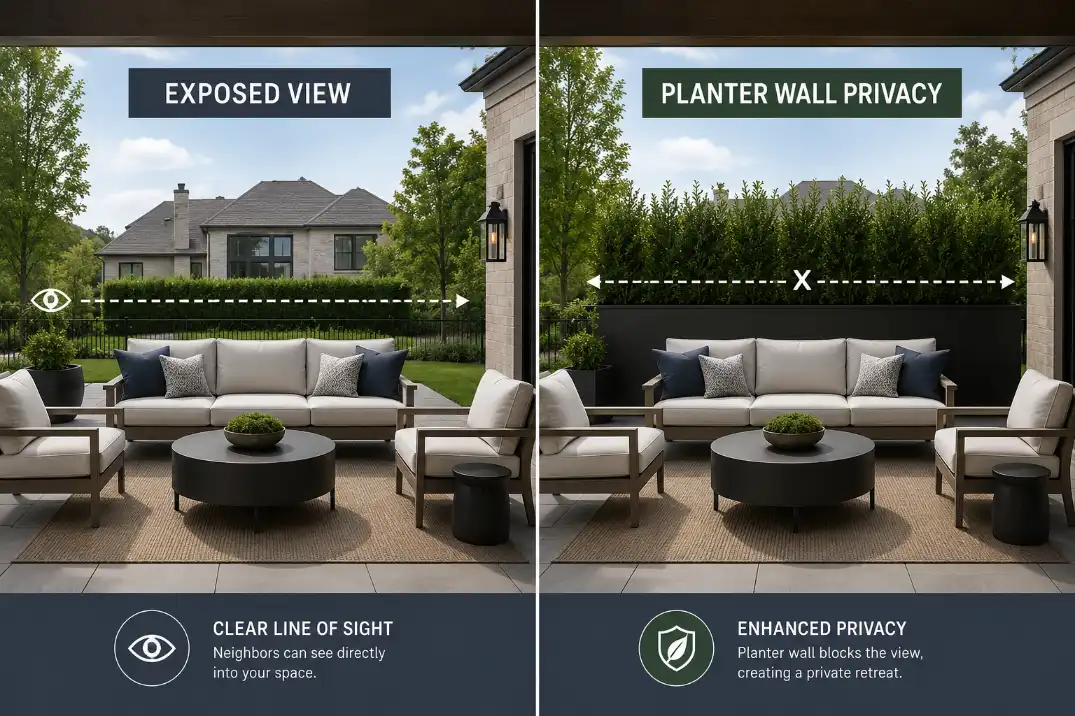
A planter wall behind the sofa is usually the strongest first move because it protects the exact place where people sit still the longest. It also feels softer than a bare panel. The planter creates weight at the patio edge, while shrubs, grasses, or upright foliage blur the view above it.
For most seating areas, the useful privacy height is not the full height of a fence. It is the seated sightline. A planter and plant combination that reaches about 5–6 feet from patio surface to top growth is often enough behind a sofa.
If the patio is small, avoid oversized box planters that eat into the floor. A slim planter wall that stays close to the edge protects the seat without stealing the room needed for a coffee table or side chair.
Best when: the main sofa or lounge chair faces an open neighbor view.
Avoid when: the planter would reduce the main walkway below 30 inches.
This works especially well when the patio backs toward a neighbor fence, open lawn, or side yard. If the entire backyard feels open rather than just the patio, a broader strategy like Backyard Privacy Ideas Without a Fence can support the bigger view problem without forcing this seating area to carry all the privacy work.
Pergola Side Screen
A pergola alone does not make a patio private. That is where people often overestimate it. The overhead frame changes the room-like feeling, but most privacy issues come from the side. The useful part is the side screen: slats, a narrow trellis panel, fabric shade, or a vertical plant layer attached to one side of the pergola.
This is strongest when the seating area is exposed from one direction, such as a neighbor’s deck or a side window. The screen should sit on the view side, not automatically on the back side.
If the patio gets strong afternoon sun, a side screen can also soften glare, but it should not block the main breeze. In humid climates, especially parts of Florida and the Southeast, a closed wall around a covered or semi-covered patio can make the space feel damp and still.
Best when: the patio needs side privacy, not full enclosure.
Avoid when: the pergola has no side treatment and only adds overhead structure.
Trellis Behind a Sofa
A trellis behind a sofa is a lighter version of a planter wall. It gives privacy through height instead of bulk, which is helpful on narrow patios. The tradeoff is time. A bare trellis is structure, not privacy. If the planting is young, expect the first season to feel partial, not finished.
Use this idea when the patio already has a clear furniture layout and only needs a vertical backdrop. A trellis that rises 60–72 inches behind the sofa can make the seating area feel framed without pushing furniture forward.
The mistake is treating the trellis as decoration and placing it where it looks nice from the yard instead of where it interrupts the uncomfortable view from the chair.
Best when: the seating area needs height but cannot afford bulky planters.
Avoid when: instant full privacy is required in the first season.
Tall Grasses Around Dining
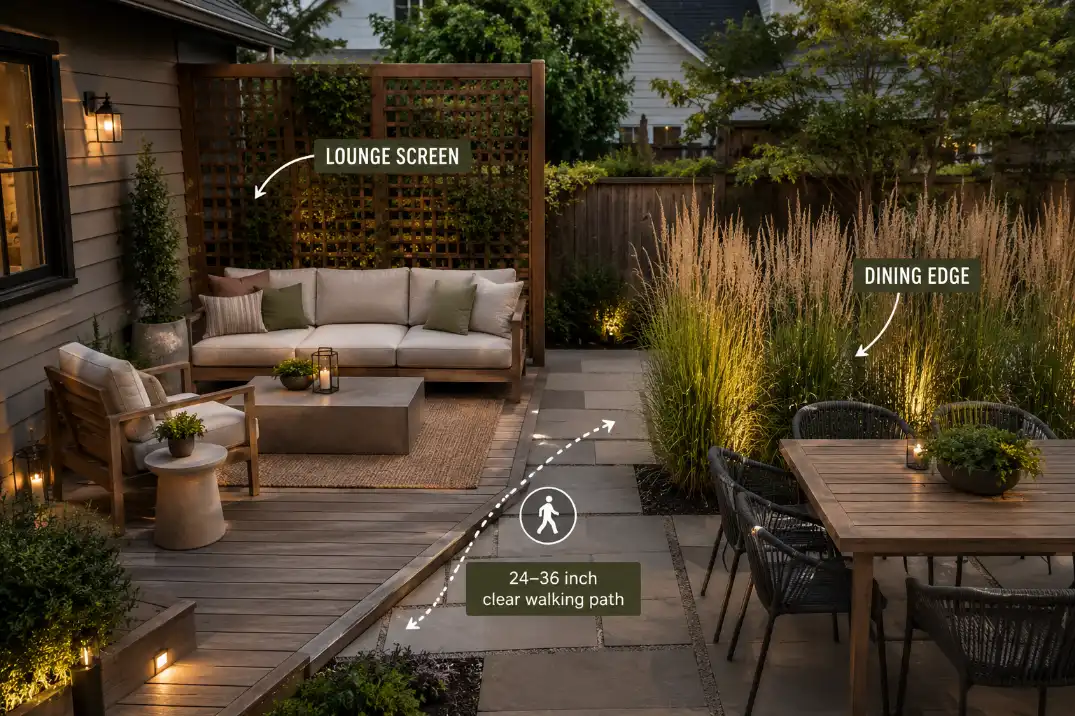
Tall ornamental grasses are better around dining than deep lounge seating because dining privacy usually needs a soft edge, not a hard wall. The chairs move, people stand up, and the table needs breathing room. A dense screen directly behind dining chairs often becomes annoying because it limits chair movement.
Use grasses along the exposed edge, not behind every chair. Leave about 30 inches behind dining chairs where people need to pull out and sit down. Grasses in the 3–5 foot range can blur movement and headlights without making the dining zone feel boxed in.
In northern states, remember that many grasses are cut back in late winter or early spring, so they may not provide the same privacy year-round.
Best when: the dining area needs a softer edge, not a solid wall.
Avoid when: winter privacy is essential and grasses will be cut back.
Corner Screen Panel
A corner screen panel is one of the most underrated patio privacy ideas because many patios are not exposed everywhere. They are exposed at one diagonal. A single corner panel can block the line from a neighbor window or side gate while keeping the rest of the patio open.
This is where a routine fix often wastes time: adding a long row of panels when the actual problem is a 6–8 foot diagonal view. A corner panel works best when paired with one planter or a small tree so it feels intentional rather than stuck on.
Best when: the exposed view comes from one diagonal angle.
Avoid when: the whole patio edge is open and needs a longer layered solution.
Privacy Umbrella Placement
A privacy umbrella is not a full privacy solution, but it can be useful when the view comes from above or from a slight angle. A tilted or cantilevered umbrella can interrupt a second-story sightline over a lounge chair, especially around pools, hot tubs, or open patios.
The condition people overestimate is shade coverage. Shade and privacy overlap, but they are not the same. An umbrella may cool the chair while doing almost nothing for the neighbor view.
Before buying a larger umbrella, test the angle with the existing one for 15–20 minutes during the time you actually use the patio. If the canopy does not cross the uncomfortable sightline, size alone will not fix it.
Best when: the privacy issue comes from above or from a high diagonal angle.
Avoid when: the view is straight across at seated eye level.
For patios where shade is also competing with movement space, Add Patio Shade Without Blocking Walkways is the better supporting decision than simply upsizing the umbrella.
Outdoor Curtains for Covered Patios
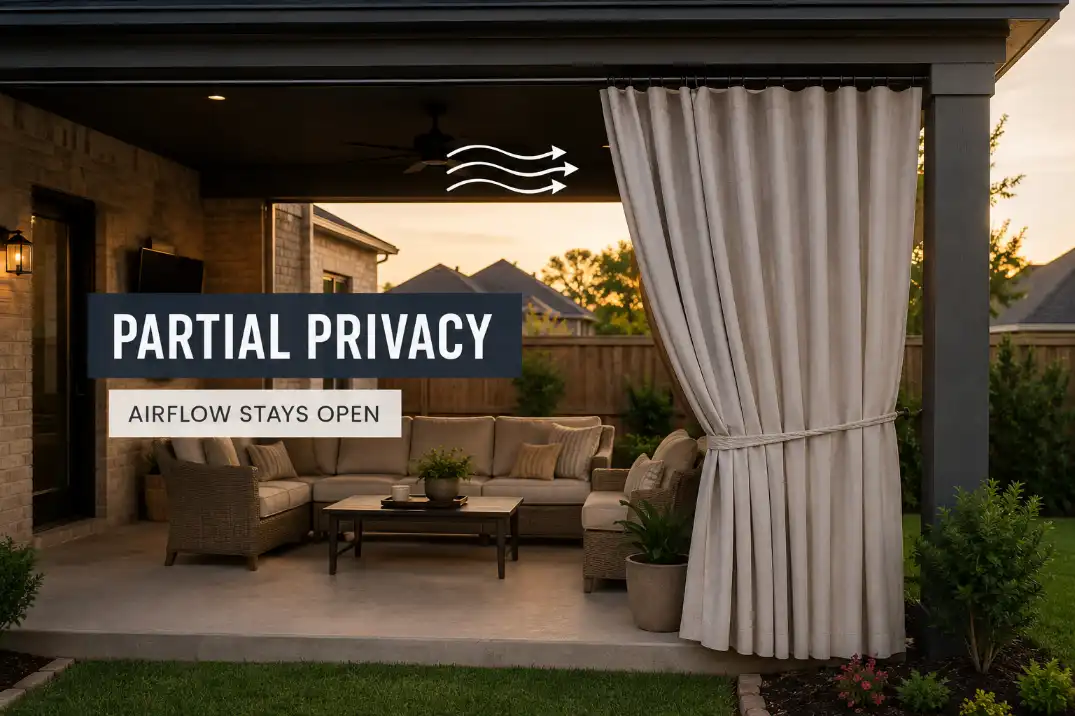
Outdoor curtains work best on covered patios because they need a stable frame. They are strongest as partial side privacy, not as full fabric walls. Closing every curtain panel can trap heat, block airflow, and make the patio feel temporary rather than designed.
A better setup is to close the most exposed side and leave the remaining opening loose. In many covered patios, keeping the curtain area 30–40 percent open preserves enough light and air while still softening the view into the seating area.
The underlying mechanism is simple: the eye stops at the fabric edge, while the patio still breathes above and around it.
Best when: a covered patio needs flexible side privacy.
Avoid when: wind exposure is high or the patio already feels humid and still.
Container Trees Along the Patio Edge
Container trees are one of the most polished ways to make a patio seating area feel secluded, but they are also easy to undersize. A small tree in a small pot often looks charming for a few weeks and then starts leaning, drying out, or failing to screen anything important.
For patio privacy, start with containers roughly 18–24 inches wide and deep for smaller ornamental trees or upright shrubs. In hot, dry regions such as Arizona, containers dry faster than in-ground planting and may need frequent summer watering.
In freezing climates, containers need material and drainage that can handle freeze-thaw cycles. The healthier condition is a stable, upright tree with consistent moisture; the failing condition is a stressed container plant that drops leaves exactly when privacy matters most.
Best when: the patio needs a polished, movable edge with real height.
Avoid when: the space is too hot, windy, or narrow for stable containers.
Bench With Built-In Privacy Planters
A bench with built-in privacy planters is especially useful on compact patios because it solves two problems with one footprint. It creates seating and a screen without adding a separate row of objects. This is stronger than placing loose chairs, loose planters, and a freestanding screen in the same small corner.
The key is keeping the bench depth honest. If the bench plus planter pushes too far into the patio, the area may look designed but feel cramped. On a small patio, this idea works best along one edge, with the planter behind or beside the seat rather than wrapped around all sides.
Best when: a small patio needs privacy and seating in the same footprint.
Avoid when: the built-in depth would make the patio harder to cross.
Mixed Screen and Plant Layer
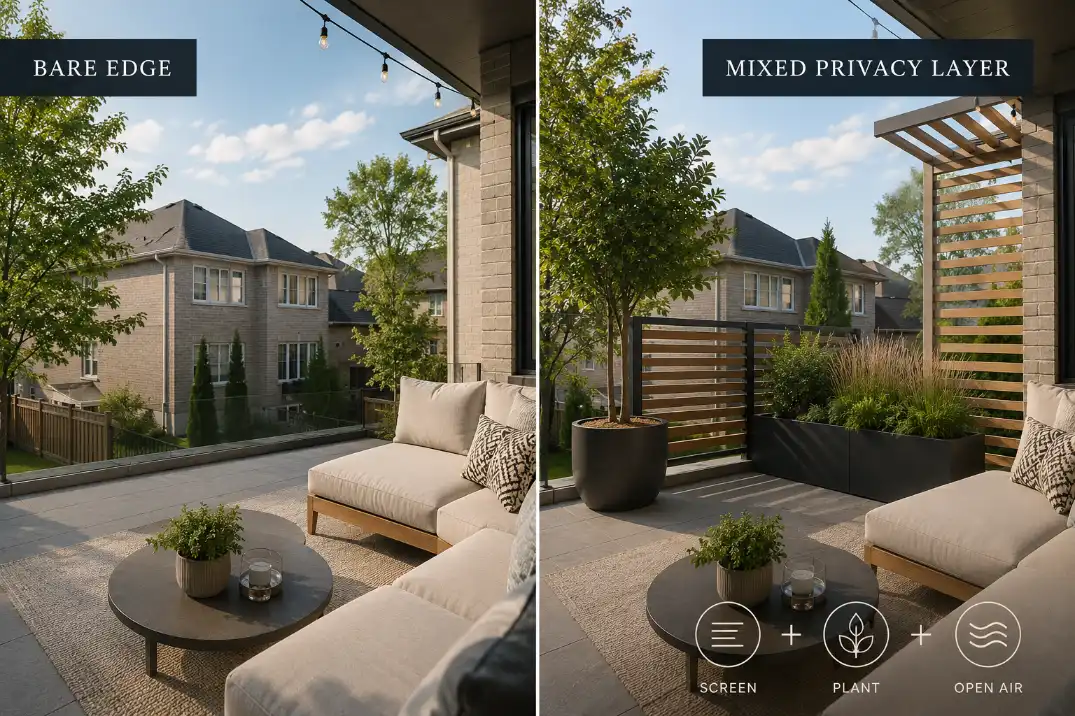
The most natural-looking privacy usually comes from a mixed layer: one solid or semi-solid element, one plant mass, and one softer vertical accent. A slatted panel alone can feel harsh. Plants alone may take too long. Curtains alone can feel flimsy. Together, they create privacy that looks built into the patio instead of added after the fact.
A good mixed layer might use a low side panel, a tall planter, and a container tree at the most exposed corner. The goal is not to hide the whole yard. It is to make the seating area feel protected from the first uncomfortable view.
Best when: the patio needs privacy that feels designed, not patched on.
Avoid when: every element repeats the same height and creates a flat wall.
Fastest, Softest, and Most Compact Privacy Choices
| Privacy goal | Best first idea | Why it works |
|---|---|---|
| Fastest visible change | Planter wall behind seating | Blocks the seated sightline immediately |
| Softest dining edge | Tall ornamental grasses | Blurs movement without crowding chairs |
| Most compact solution | Trellis or planter-backed bench | Adds height without using much floor area |
| Best covered patio fix | Partial outdoor curtains | Screens one side while keeping airflow |
| Best premium look | Mixed screen and plant layer | Combines structure, depth, and softness |
| Best high-view fix | Cantilever umbrella or pergola side screen | Interrupts upper or diagonal sightlines |
Patio Privacy Ideas by Seating Setup
Small Patio Seating Area
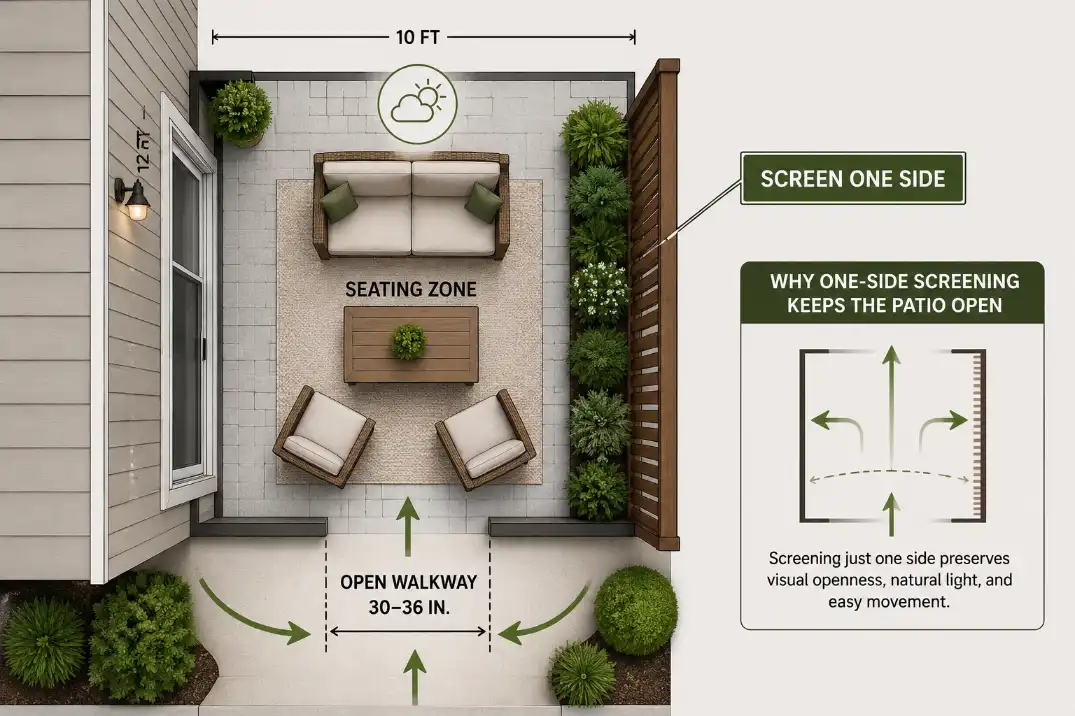
On a small patio, the winning move is usually screening one side, not all sides. Four-sided privacy looks logical in photos, but in real use it can make the patio feel smaller within a day. The threshold is practical: if the screen reduces the main path below 30 inches, the patio will feel harder to use even if it looks more private.
A one-side trellis planter, narrow slat panel, or tall planter row can protect the main seat while leaving the door, grill path, or chair movement open. If the furniture already feels tight, solve layout before adding height.
A privacy screen cannot fix a seating plan that leaves no circulation, and Patio Furniture Layout by Size can help keep the privacy decision tied to real clearances.
Outdoor Dining Patio
Dining privacy should protect the exposed edge while keeping chair movement easy. A tall planter or grasses along one side often works better than a rigid panel tight behind the chairs. If people have to turn sideways to sit down, the screen is in the wrong place.
For dining patios, the better test is not “can I see the neighbor?” It is “can guests pull out chairs, stand up, and walk behind the table without rubbing the screen?” If not, lower or soften the privacy layer.
Covered Patio
A covered patio already has a ceiling, so heavy side privacy can quickly make it feel closed. Curtains, side slats, or one trellis panel are usually enough. The strongest covered patio privacy keeps the upper portion breathable and screens only the view line into the seating zone.
This matters most in humid regions and shaded back patios, where still air can make the space feel warmer than the yard around it. If privacy makes the patio smell damp, hold heat, or dry slowly after rain, the screen is too solid.
For covered spaces where comfort is already marginal, Covered Patio Ventilation Mistakes is a more important companion issue than adding another curtain panel.
Patio Beside a Neighbor Fence
A patio beside a neighbor fence usually does not need a second fence-like wall. It needs layering. The fence may already block the lower view, but the hard vertical surface can still feel exposed because it reflects sound, glare, or the sense of being close to the property line.
Add depth in front of the fence instead of raising everything equally. A narrow planter, trellis panel, or container tree can create a more comfortable edge without making the fence feel taller and more severe. The symptom is “the patio feels exposed”; the mechanism is often not visibility alone, but the lack of depth between the seat and the boundary.
Patio Near a Pool or Hot Tub
Privacy near a pool or hot tub has a higher comfort standard because people feel more exposed in swimwear and while sitting still. Here, partial privacy is not always enough. The most important zone is usually seated eye level from the hot tub, chaise, or poolside chair.
Use a dense screen at the exposed angle, then keep access open around the water. A privacy fix that blocks the path to towels, steps, or the house creates a safety and usability problem.
The best layer is often container trees plus one narrow panel, not a long wall around the entire water area.
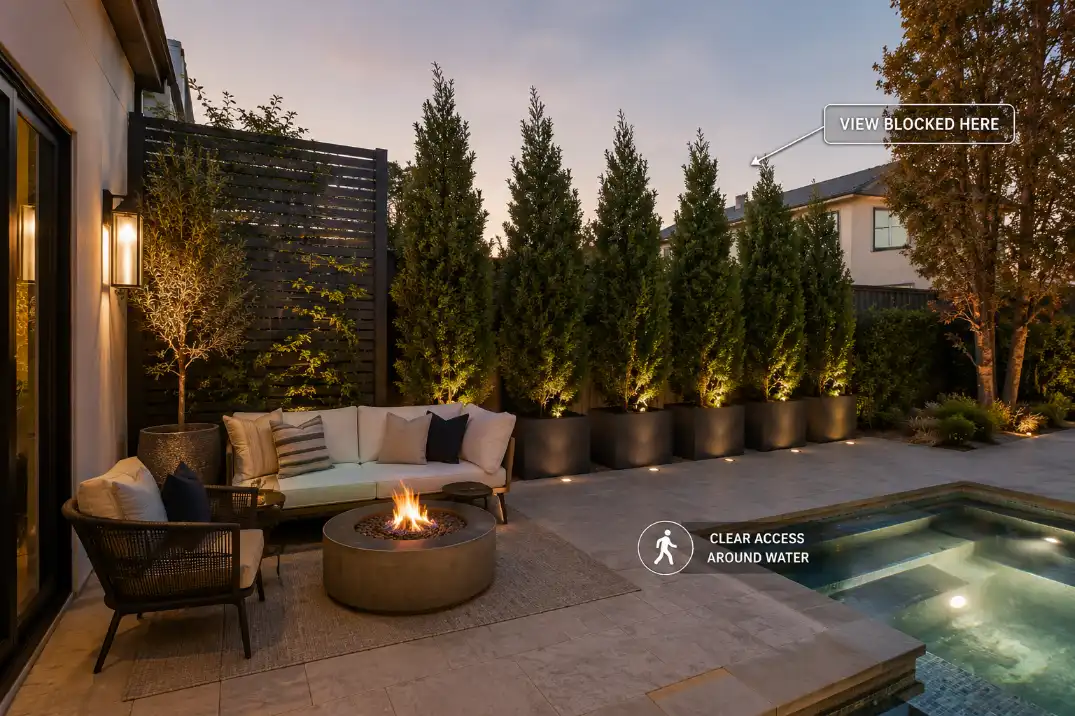
For water-adjacent patios where the issue is a direct view into the soaking or lounging zone, Pool and Hot Tub Privacy Fixes can support a more targeted layout without turning the whole patio into a closed enclosure.
How to Add Patio Privacy Without Making the Space Feel Cramped
Screen One Side Instead of All Sides
The first side to screen is the one that interrupts relaxation. That may be behind the sofa, beside the dining table, or diagonally across from a neighbor window. Screening the other sides may look more complete, but it often reduces comfort.
A patio privacy idea starts to fail when it solves the neighbor view but makes the chair, walkway, or door swing harder to use. That is the boundary where the standard fix stops making sense.
Keep the Main Walkway Open
Keep the primary route across the patio at 30–36 inches whenever possible. This is especially important between the back door and seating, between dining chairs and the house, or around a grill zone. Privacy elements should sit outside the movement line, not become obstacles people squeeze around.
A narrow passage is not only inconvenient. It also changes how often the patio gets used. People avoid outdoor spaces that require constant adjusting, even if the space looks beautiful.
Use Vertical Elements Carefully
Vertical elements are powerful because they use height instead of floor area, but they still create visual weight. A tall screen placed too close to the seat can feel like a wall. A trellis placed slightly behind the seating line feels more like a backdrop.
Use the tallest element where the view is worst. Keep softer or lower elements where the patio still needs openness. In windy areas, especially open corner lots or exposed coastal patios, tall freestanding screens need more stability than a light decorative panel can provide.
Leave Airflow and Light Above Seating
The difference between secluded and boxed-in is often the top third of the space. If privacy blocks everything from floor to roofline, the patio may feel smaller and hotter. Leaving light and air above the seated privacy zone keeps the space comfortable.
This is why slats, trellises, grasses, and partial curtains often outperform solid walls. They interrupt the view without stopping every breeze.
Best Plants and Features for Patio Privacy
| Privacy feature | Best use | Watch-out |
|---|---|---|
| Tall planters | Fast seated privacy behind sofas or along one edge | Can tip or dry out if undersized |
| Container trees | Polished year-round edge near lounge seating | Need large containers and consistent watering |
| Ornamental grasses | Soft dining privacy and movement blur | Seasonal cutback can reduce winter privacy |
| Trellis panels | Narrow patios needing vertical screening | Bare trellis gives limited first-season privacy |
| Pergola side screens | Side views into covered or semi-covered seating | Overhead structure alone does not block views |
| Outdoor curtains | Covered patios needing flexible privacy | Too much fabric can trap heat and moisture |
| Privacy umbrellas | Angled views and partial overhead exposure | Shade coverage does not guarantee privacy |
Tall Planters
Tall planters are the fastest way to test privacy because they are movable. Use them to confirm the sightline before committing to built-in screens or permanent structures. If two planters solve the feeling, a full wall is probably unnecessary.
Container Trees
Container trees create the most finished look, but they ask for more care. In hot climates, black or dark containers can heat up quickly on a patio surface. In cold climates, thin ceramic pots may crack through winter. Choose the container as carefully as the plant.
Ornamental Grasses
Grasses are useful when the patio needs motion, softness, and partial screening rather than a hard barrier. They are less useful when the view is direct and close, such as a neighbor window only a few feet away.
Trellis Panels
A trellis panel works best when paired with planting or placed behind seating as a clear backdrop. It is not the strongest instant privacy choice unless the panel itself has enough density.
Pergolas
A pergola makes a patio feel like a room, but it needs side treatment to create real privacy. Use it as a frame for screens, curtains, vines, or slats rather than expecting the overhead beams to do the privacy work.
Outdoor Curtains
Curtains are flexible, soft, and visually warm. They are also wind-sensitive. Use them where they can be tied back, opened, or partially closed depending on weather and time of day.
Privacy Umbrellas
A privacy umbrella is a precision tool. It works when the canopy intersects the actual view line. If the view comes straight across at eye level, a planter, screen, or trellis will usually outperform it.
Which Patio Privacy Idea Should You Choose First?
Choose the idea that solves the most uncomfortable view with the least footprint. For most patios, that means starting with the seating edge, not the entire perimeter.
If the main issue is a direct view behind the sofa, start with a planter wall or trellis. If the view comes from the side, use a pergola side screen, corner panel, or container tree.
If the patio is covered, test curtains before adding permanent panels. If the space is small, choose one-side privacy and protect the walkway first.
The strongest patio privacy setup is rarely the tallest one. It is the one that lets people sit, move, talk, and relax without feeling watched.
Quick Privacy Check Before You Build
- Sit in the main chair and identify the single worst view before adding anything.
- Keep the main walkway at 30–36 inches clear.
- Aim for seated privacy first, usually around 48–72 inches high.
- Use one strong screen side before enclosing multiple sides.
- Leave airflow and light above the seating zone.
- Choose movable planters first if you are unsure about the sightline.
- Stop adding privacy when furniture becomes harder to use.
Pro Tip: Test a screen location with a folding panel, tall cardboard, or temporary planter for one weekend before buying permanent materials. The right location is often a few feet different from where it looks best in a photo.
Questions People Usually Ask
What is the quickest way to make a patio seating area feel more private?
A planter wall behind the main seating is usually the quickest useful fix because it changes the seated view immediately. Curtains can be faster on a covered patio, but only if there is already a frame to hang them from.
How tall should a patio privacy screen be?
For seated privacy, 48–72 inches is often enough. Go taller only when the uncomfortable view comes from above, such as a second-story window or elevated deck.
Do plants or screens work better for patio privacy?
Screens work faster. Plants look softer and age better when they are healthy. The best result is often a combination: a modest screen for immediate privacy and plants to soften the edge over time.
What patio privacy idea should I avoid in a small space?
Avoid wrapping the patio on all sides unless the space is unusually generous. On small patios, a one-side screen or planter-backed bench usually feels better than full enclosure.
For broader official guidance on growing plants successfully in containers, see NC State Extension.