Last updated: July 2, 2026
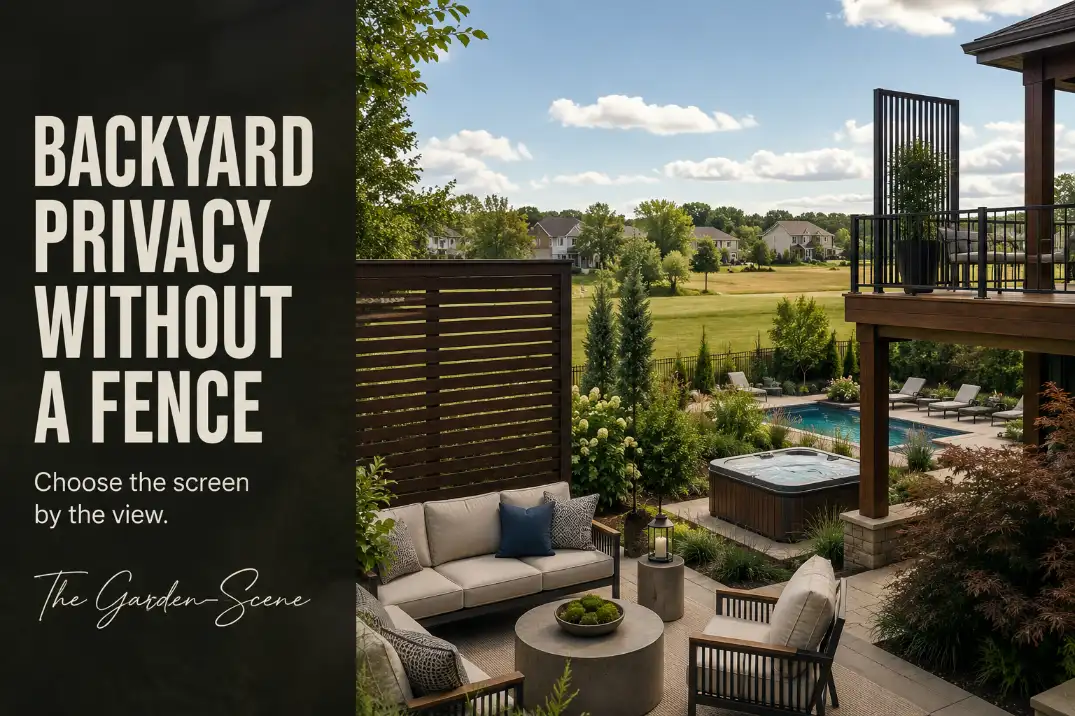
Backyard privacy without a fence is not mainly a question of what to add. It is a question of where the uncomfortable view lands.
That makes this different from front yard no-fence privacy. A front yard has to stay readable from the street, keep the entry open, and protect curb-facing areas without making the house look closed off. A backyard can be more direct.
The privacy problem usually shows up at a patio chair, deck edge, pool step, hot tub route, dining table, or open lawn edge.
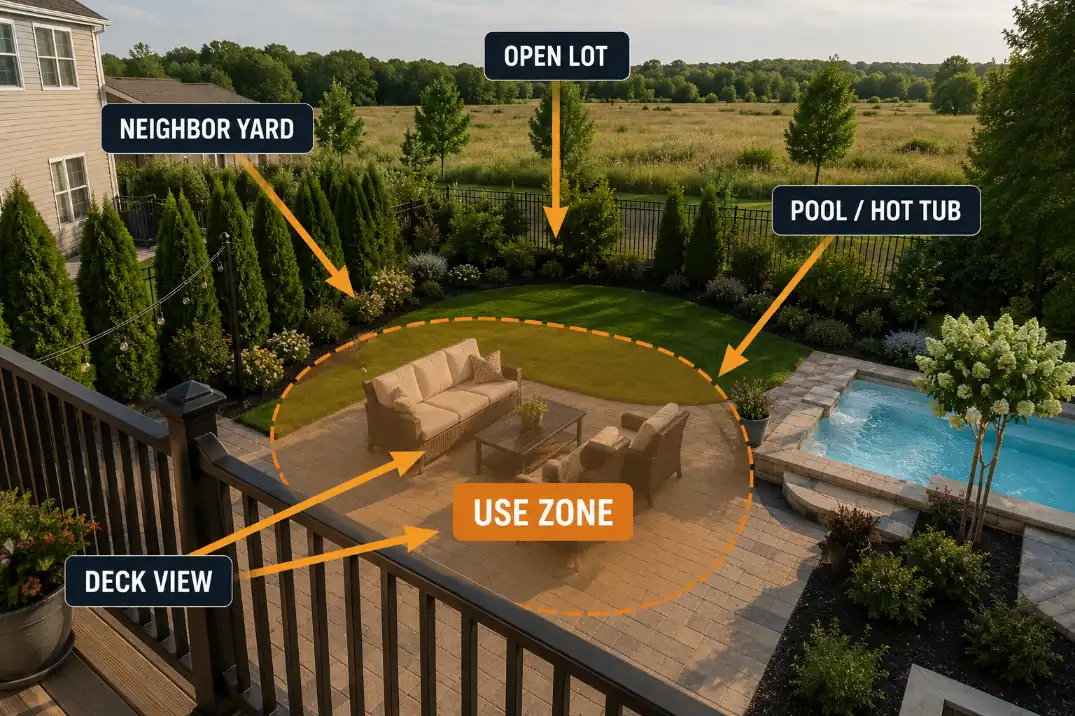
So the first decision is not “planters, pergola, shrubs, screen, or trees?” The first decision is whether the exposure comes from a neighbor yard, raised deck, upstairs window, pool-side angle, new construction lot, or open space beyond the property.
Once that is clear, the right no-fence idea becomes much easier to choose. Protect the place people actually use first. Then soften the wider yard only where it still feels too exposed.
Start With the Backyard Exposure, Not the Privacy Idea
The useful privacy layer belongs where the view becomes personal, not automatically where the property line begins.
A tall planter near a dining table can make a patio feel private even when the back boundary remains open. A shrub row along the fence line can soften a neighbor-yard view but do almost nothing for an upstairs window looking down into a hot tub.
A pergola can help with overhead exposure, but it may be wasted if the real problem is a diagonal view from the side.
Most backyard exposure falls into three patterns.
Ground-level exposure
Ground-level exposure comes from a neighbor’s patio, kitchen window, lawn, side gate, or shared boundary. It is usually the easiest backyard view to soften because the privacy layer can stay close to human height.
A 4- to 6-foot screen, planter grouping, trellis, shrub layer, or small tree cluster may be enough when the view is mostly horizontal. The placement matters more than the object. A screen near the seating area can outperform a taller screen far away.
Elevated exposure
Elevated exposure comes from second-story windows, raised decks, uphill lots, balconies, or homes that sit higher than yours. This is where low shrubs and short planters usually disappoint.
The view is coming down at an angle, so the privacy layer has to interrupt the line of sight vertically. That may mean a canopy tree, pergola edge, overhead filter, taller trellis, or layered planting placed where the view actually crosses the use zone.
Open-lot exposure
Open-lot exposure is not always about a nosy neighbor. Sometimes the backyard backs to a field, drainage area, golf course, construction lot, or wide shared green space.
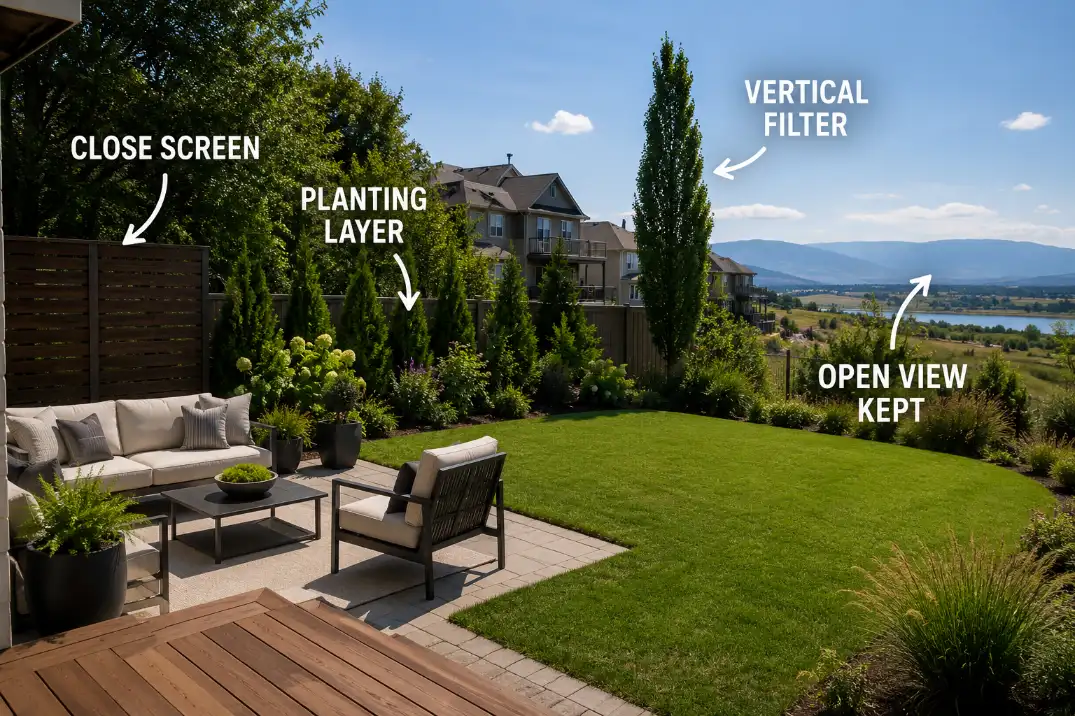
Full closure can make these yards feel smaller and less valuable. The better move is often selective screening: protect the patio, frame the exposed corners, and keep the best part of the open view.
Field Check:
Stand or sit where the backyard actually feels exposed. A boundary screen may look logical on paper, but privacy is judged from the chair, pool edge, hot tub step, or deck seat. Start there, then decide whether the property line needs a softer second layer.
The Main Backyard Privacy Zones Without a Fence
Choose the privacy zone before choosing the privacy feature. A backyard can have six different exposure problems, and each one asks for a different first move.
Patio or seating area exposure
A patio usually needs privacy at seated eye level first. The exposed point may be one chair, one dining bench, or one side of the conversation area. This is where close planters, trellis edges, partial screens, and seating-side planting often work better than a distant hedge.
For deeper seating-specific layout choices, use a focused guide to patio privacy around the seating zone.
Deck or raised sitting area exposure
Decks create a two-way privacy problem. You may feel exposed to neighbors, and you may also look directly into their yards.
A full-height wall around the deck can feel boxed in, especially on a small deck. Side-angle filters, railing-height planting, corner screens, and vertical elements near the most exposed side usually feel more natural.
Pool or hot tub exposure
Pools and hot tubs need privacy around vulnerable moments: entering, stepping out, drying off, sitting on the edge, or moving between the house and the water.
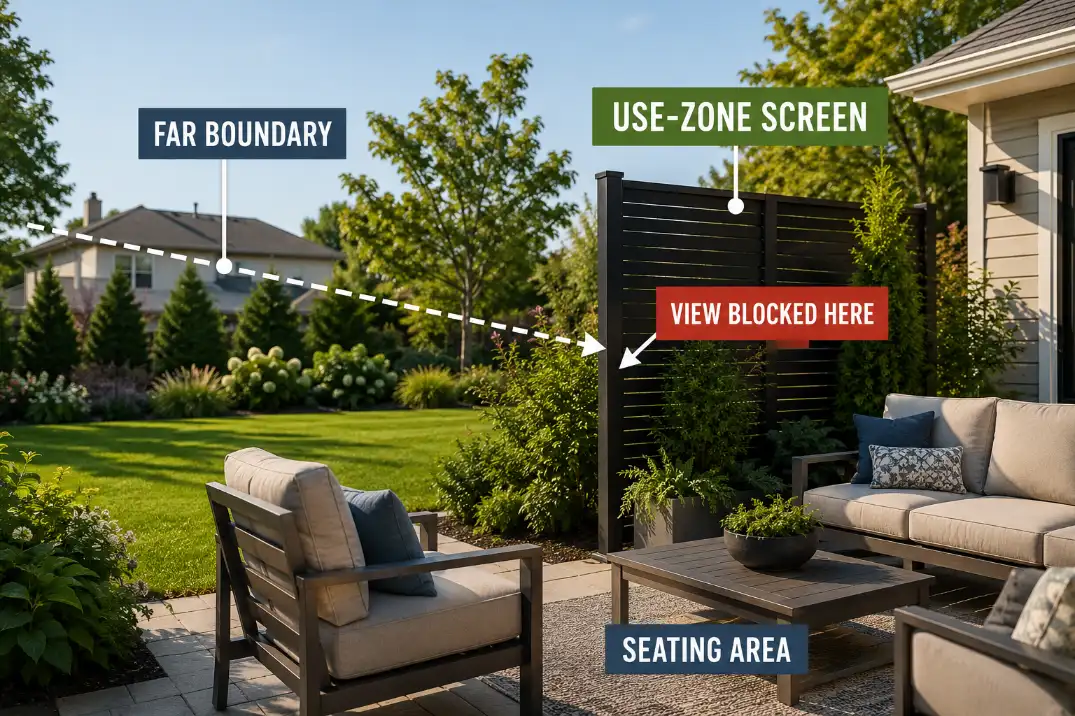
The mistake is screening only the far boundary while leaving the use route open. Privacy should protect the moments when exposure feels uncomfortable, not just the line on the property survey.
Neighbor yard or shared boundary exposure
A shared backyard boundary often needs softening rather than total closure. Layered shrubs, small trees, staggered planting, and partial screens can reduce the feeling of being watched while keeping airflow and depth.
This works best where the neighbor’s yard is close but not elevated.
Second-story or raised deck overlook
Upper views need vertical interruption. A low hedge may look good from the patio, but it will not interrupt a downward view from a second-story window or raised deck.
These exposures usually need canopy, pergola edge, taller planting, or a targeted screen where the sightline crosses the activity zone.
Open lot or new construction exposure
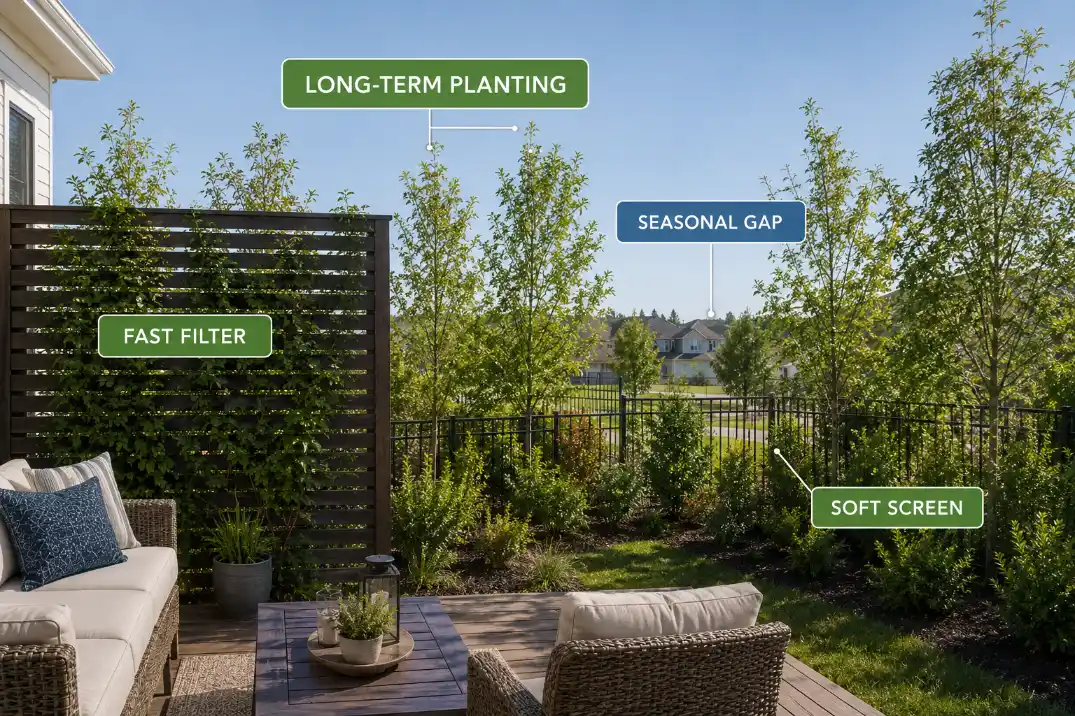
A new backyard with no screening can feel raw, but rushing into full enclosure may be the wrong move. Open-lot yards often need a temporary privacy layer near the patio while the long-term planting matures.
Keep the good view where it helps the yard feel larger, and screen the angles that make daily use uncomfortable.
Before choosing any idea, walk the yard and check:
- Where do you actually feel exposed: sitting, standing, swimming, grilling, or walking out the back door?
- Is the view coming from ground level, above, or across an open space?
- Does privacy need to happen close to the use zone or along the boundary?
- Would a full screen make the backyard feel smaller or darker?
- Do you still have 30–36 inches of clear movement space near doors, furniture, and dining routes?
- Will the screen still work during leaf-off seasons or while planting is still young?
Match the No-Fence Idea to the View Problem
The right idea is the one that interrupts the right view with the least unnecessary enclosure. Use this parent-level filter before choosing a specific material, plant, or structure.
| Backyard exposure problem | First no-fence privacy move | Best fit condition | Watch out for |
|---|---|---|---|
| Patio feels watched | Close planter screen, trellis edge, or partial pergola side | Seated privacy from one or two directions | Do not push every screen to the property line |
| Deck feels exposed | Side screen, railing-height filter, container trees, angled planting | Views crossing the deck from the side or rear | Avoid turning the deck into a solid box |
| Pool or hot tub feels open | Close-range screen near entry, sitting, and drying zones | Privacy needed during use, not just from the boundary | Preserve access for covers, steps, and service |
| Neighbor yard feels too visible | Layered boundary planting, staggered shrubs, small trees | Broad ground-level exposure along one side | Do not rely on one thin row if the view is direct |
| Upper window or deck looks down | Vertical interruption, canopy, pergola layer, taller trellis | Elevated diagonal sightlines | Short shrubs will not solve a downward view |
| Open lot feels bare | Selective corner screening and use-zone protection | Good view exists, but the yard feels exposed | Do not close off the whole open edge by default |
A small backyard may only need one strong privacy move. A large backyard may need two layers: one close to the patio or deck and one softer layer along the boundary. A pool yard may need a more intentional privacy pocket around the water while the rest of the lawn stays open.
The goal is not to combine every idea. It is to choose the first layer that changes how the yard feels during real use.
Use Close Screens Where Privacy Is Felt Most
A close screen is often the stronger first move when the problem is seated privacy, pool-edge privacy, or deck-side exposure.
That sounds counterintuitive because many homeowners look to the back boundary first. But the farther a screen sits from the use zone, the taller or denser it usually has to be to change the feeling. Around a dining table, lounge chair, or conversation area, a 4- to 6-foot visual filter near the activity can do more than a distant row of shrubs.
This works especially well for patios, compact decks, and outdoor rooms where one side feels too exposed. A trellis panel behind a sofa, a planter cluster near a dining edge, or a partial pergola side can create privacy without closing the whole yard.
Pool and hot tub areas need a slightly different read. The privacy point may be the steps, towel hook, changing route, or sitting edge rather than the full water surface. A screen that protects those moments can matter more than a screen that looks impressive from the back fence.
For more detailed use-zone planning, a separate guide on pool or hot tub exposure can handle that problem without turning this parent page into a pool article.
A boundary screen still has value. It softens the wider yard, reduces neighbor-yard visibility, and gives the landscape a finished edge. It just should not be the automatic first move.
| Privacy layer | Use it when | Trade-off |
|---|---|---|
| Close use-zone screen | The patio, deck, pool edge, or seating area feels watched | Needs careful placement so it does not block movement |
| Boundary softening | The whole side or back of the yard feels too open | May take longer and may not solve seated privacy by itself |
Use Plants for Softness, But Do Not Wait on Plants Alone
Planting is usually the best long-term privacy layer, but it is often a weak immediate fix.
A young shrub row, small tree, or newly planted hedge may need several growing seasons before it feels like a screen. Deciduous plants can also lose privacy strength in winter, and narrow evergreens can be too small to solve a wide view if they are spaced poorly.
That does not make planting a bad idea. It means planting should be given the right job.
Use a fast layer when privacy is needed now: tall planters, trellis panels, curtains, a partial screen, or a simple vertical filter near the use zone. Then use planting as the long-term soft screen: shrubs, small trees, layered planting, or canopy that becomes more convincing over time.
University extension guidance on landscape screens consistently points back to mature size, spacing, and plant selection rather than just how tall a plant looks at purchase.
The University of Minnesota Extension notes that living screens depend on choosing the right trees and shrubs and planting them at the right density and spacing in its guidance on trees and shrubs for windbreaks and living screens.
A practical sequence looks like this:
- Place the temporary or structural filter where privacy is needed immediately.
- Add planting behind or around it so the screen softens over time.
- Leave access for watering, pruning, furniture movement, and service paths.
- Recheck the view after one growing season before adding more layers.
This is especially important in newer yards. A bare backyard may feel urgent, but the long-term answer should not be forced into one rushed planting row. A more specific guide on new backyard privacy before planting matures is better for that sequencing problem.
Keep the Backyard Open Where Privacy Is Not Needed
A no-fence privacy plan should not make the backyard smaller just to make it feel safer.
Many yards work better with one strong privacy side and two or three lighter edges. A patio may need a screen on the neighbor-facing side while the lawn stays open. A deck may need a side-angle filter but not a solid rear wall. A pool may need privacy near the steps and seating, while the far lawn remains open for kids, pets, or circulation.
This is where generic privacy advice often overbuilds. It treats privacy as a perimeter problem. In a backyard, comfort is usually a zone problem.
Keep these areas open unless there is a clear reason to screen them:
- Back door routes and sliding-door landings
- Grill and serving paths
- Pool equipment, cover, and service access
- Lawn play areas
- Garden gates and side-yard access
- Good views that make the yard feel larger
For yards that back to fields, trails, drainage space, or shared green areas, the strategy should be more selective. A focused guide to backyard privacy when the yard backs to open space can go deeper into that kind of view-editing without treating the lot like a normal neighbor boundary.
Backyard No-Fence Privacy Mistakes That Usually Backfire
Common Mistakes
Copying front-yard logic into the backyard.
Backyard privacy is more use-zone driven. It does not need to preserve the same public-facing openness.Planting only the property line.
A boundary row can soften the yard, but it may not protect the patio, deck, pool, or hot tub where privacy is actually felt.Using short shrubs for elevated views.
A second-story window or raised deck needs vertical interruption, not just low planting. Use a deeper guide for second-story backyard privacy when the view comes from above.Closing every side of a patio or deck.
Full enclosure can make a backyard feel cramped, dark, and harder to use. Screen the side that matters first.Blocking pool or hot tub access.
Privacy around water should still leave room for covers, steps, towels, cleaning, and service movement.Choosing fast-growing plants only for speed.
Fast growth can mean more pruning, crowding, weak structure, or seasonal gaps. Mature size matters more than the label at the nursery.Treating a neighbor’s deck like a normal boundary view.
A raised active-use area has a different sightline and behavior pattern. For that situation, use a more specific guide on privacy from a neighbor’s deck.
A Simple Backyard No-Fence Privacy Plan
The simplest plan is to make one exposure decision before making any design decision.
First, identify the source of the view. Is it coming from a neighbor’s yard, raised deck, upstairs window, pool-side angle, new construction lot, or open land beyond the backyard?
Next, mark the use zone. The uncomfortable moment may happen at the dining table, lounge chair, deck edge, hot tub steps, pool seating, grill path, or back lawn. That location controls the first move.
Then choose the privacy layer that fits the exposure:
- Use a close screen when the exposed feeling happens while sitting or gathering.
- Use boundary softening when a whole side of the yard feels too open.
- Use a vertical filter when the view comes from above.
- Use open-view editing when the yard backs to a wide space you do not want to lose.
- Use a fast layer now when planting will take time to work.
- Use long-term planting to soften the yard after the first privacy problem is handled.
The right backyard privacy idea without a fence is not the tallest screen or the densest planting. It is the layer that interrupts the uncomfortable view without closing parts of the yard that still work well open.