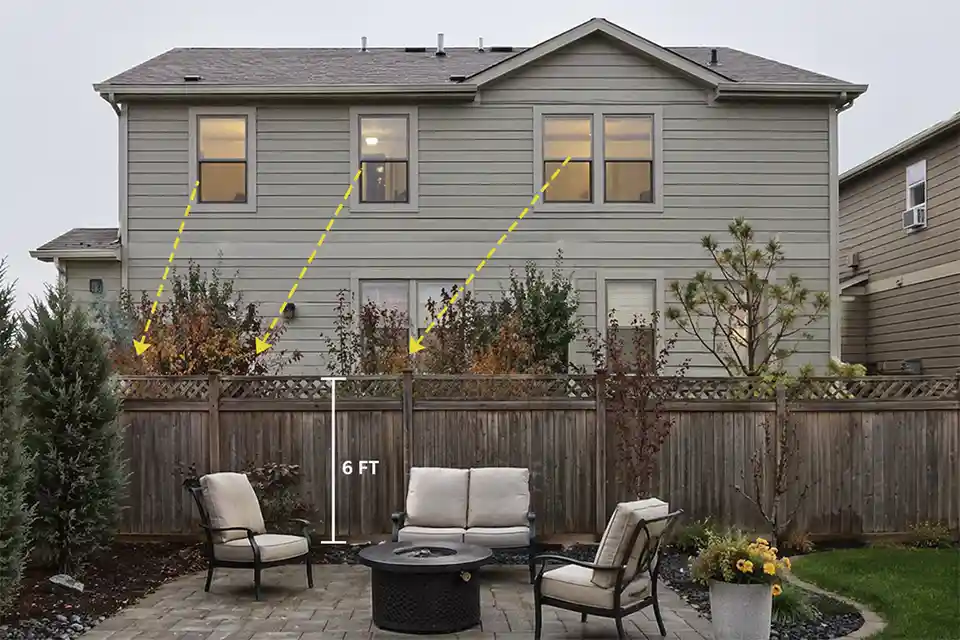
Second-story privacy problems are usually misdiagnosed. Most people treat them like a fence problem, then spend money on a taller-looking edge that barely changes the actual view. What matters first is the sightline.
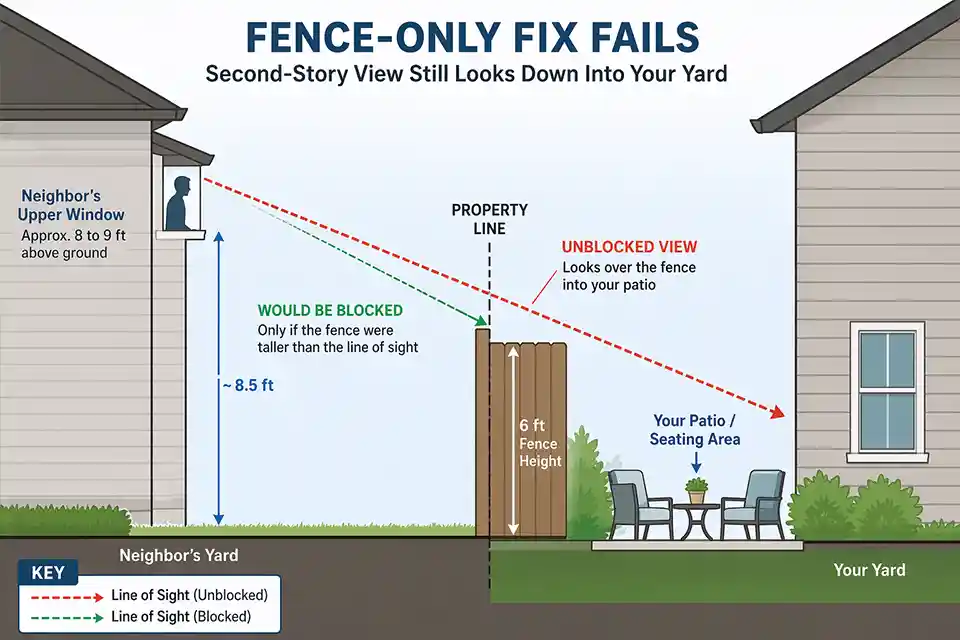
If a neighbor’s upper window sits roughly 10 to 18 feet above grade and your fence is 6 feet tall, the view can still clear that fence easily, especially if your patio sits 10 to 20 feet inside the yard. That is why a backyard can feel exposed even when the perimeter already looks private.
The first checks are simple. Stand where you actually sit, not at the fence. Note which upstairs windows face that spot most directly. Then ask one useful question: does the view fall into the living zone, or mostly into the lawn beyond it?
That distinction changes the fix. In most cases, what works best is blocking the downward angle over the seating area first, then softening the rest with planting.
Protect the living zone first, not the whole yard
The strongest privacy fixes for second-story windows are usually closer to the patio than to the property line. That sounds backward at first, but it matches the geometry of the problem.
The part of the yard that matters most
Most backyards have one or two exposure zones that do the real damage: a dining set, a grill area, a hot tub, a lounge pair, or the back-door patio where people spend time every evening.
If that zone is within about 8 to 15 feet of the house, perimeter screening alone is rarely enough. The fence is simply too far away and too low relative to the downward viewing angle.
You usually do not need to hide the entire yard. You need to make daily use feel less watched.
What readers usually misread first
The most common mistake is assuming the lawn and the patio need the same kind of privacy. They do not. Open lawn can tolerate some visibility without feeling unusable.
Seating areas cannot. Second-story privacy becomes much more intrusive when the line of sight falls straight into a chair grouping, dining table, spa, or poolside resting spot.
That is also why broad perimeter fixes disappoint so often. A fence may improve the edge while leaving the real problem untouched. Similar misreads show up in backyard privacy problems and fixes that fail, where the visible boundary fix feels logical but does not solve the actual exposure pattern.
What helps most, ranked by real outcome
Not all privacy fixes deserve equal weight here. Some change the experience quickly. Some only look like progress.
Best for immediate relief: overhead or near-overhead screening
If the exposure is concentrated over a patio or seating area, this is usually the highest-leverage fix. A pergola with tighter slats, an overhead screen, a louvered cover, or a partial canopy interrupts the downward angle where people actually sit. That matters more than adding another visual layer at the fence line 25 or 30 feet away.
Slat spacing around 1.5 to 3 inches can make a meaningful difference, especially when the structure is oriented to the strongest sightline. If the goal is evening privacy over a dining zone, this type of intervention can work immediately, not after 2 to 4 growing seasons.
Best long-term natural fix: one well-placed small tree plus layered shrubs
A single hedge row is often overrated in this scenario. Many shrubs start at 24 to 36 inches tall, need several seasons to create useful mass, and still do a poor job against upper-story views if planted in the wrong corridor.
In contrast, one well-positioned small tree or multi-stem specimen maturing in the 12- to 18-foot range can interrupt a specific window angle far more effectively. Underplanting with dense shrubs fills the lower gap and keeps the solution from feeling top-heavy.
The key is placement, not just height. A wrong plant at the property line is still the wrong fix. Fast-growing screens can also become thin or high-maintenance over time, which is why many “quick privacy” ideas disappoint, much like front yard fast-growing hedges.
Best when fence height is limited: privacy panels near the use zone
When HOA rules or local codes limit fence height, freestanding privacy panels or side screens often become the smarter answer. A screen placed 4 to 8 feet from a seating area can block the exact corridor that matters. That is far more efficient than trying to turn the whole perimeter into a fortress.
This is one of the clearest places where routine advice stops making sense. If your solution requires the equivalent of a 10- to 14-foot perimeter barrier to fix a single upstairs sightline, the strategy is wrong.
Most overrated fix: planting a hedge and waiting
This is the classic time-waster. It feels productive because something green goes in the ground. But unless the hedge sits directly in the view corridor and grows wide enough as well as tall enough, it often delivers years of anticipation for modest privacy.
In dry Arizona conditions, exposed windy sites, or colder northern climates with slower seasonal growth, the wait can be longer than homeowners expect.
Pro Tip: Take a photo from the chair or dining spot you use most, then draw the upper-window sightlines on the image before buying anything. That five-minute test usually reveals whether you need overhead cover, a side screen, or one well-placed tree.
A better comparison than “fence vs plants”
| Fix | Best use case | Where it falls short | Time to become effective |
|---|---|---|---|
| Taller fence alone | Mild edge exposure from similar-grade neighbors | Rarely solves upper-window views | Immediate, but limited |
| Hedge at property line | Softening the boundary over time | Too slow and often too low for second-story privacy | 2–4 years |
| Small tree + layered shrubs | One or two predictable sightlines from upper windows | Weak if placed outside the real corridor | 1–3 years |
| Pergola or overhead screen | Patio, dining, spa, or lounge exposure | Does less for wide-open lawn visibility | Immediate |
| Privacy panel near seating | Narrow, targeted sightline from one side | Can look forced if overused | Immediate |
| Re-zoned outdoor layout | Existing yard has one overexposed activity area | Requires flexibility in furniture or layout | Immediate |
When standard privacy advice stops working
When the neighbor sits uphill or your yard slopes down
This changes the problem fast. Even a modest grade shift can make the upper view more intrusive and reduce what a normal fence can accomplish. In those cases, targeted structures near the patio become even more important.
If the yard also has grade-related visibility issues, it can overlap with the same elevated-view logic seen in neighbors’ deck overlooks backyard privacy fixes.
When the privacy-sensitive zone is obvious
If you already know the problem area is the grill patio, hot tub corner, or lounge set by the back door, there is no reason to design as if the whole backyard is equally exposed.
Move the privacy budget to the use zone first. In practice, a better-placed layout plus one screening element often beats a much larger planting plan.
When you need relief this season
This is the dividing line many people underestimate. If you want privacy within a few weeks, plants are support material, not the primary fix. Structure has to do the heavy lifting. Trees and shrubs can complete the screen later, but they should not be asked to solve an immediate problem on their own.

Signs It’s a Sightline Problem
- The upstairs view falls directly into the spot where you sit most often
- Your fence is about 6 feet tall and the window still looks comfortably over it
- The exposed patio or seating zone sits within 8 to 15 feet of the house
- You are relying mainly on the back fence to solve the problem
- Your current planting is under 6 feet tall or less than about 3 feet thick
- The neighbor sits uphill or your yard drops away from the house
- You want meaningful privacy in less than one growing season
If four or more of those are true, a fence-only or hedge-only plan is probably too weak.
The clearest decision rule
If the exposure is narrow and concentrated over one outdoor living zone, block it at or above that zone first. If the exposure comes from several upper windows across a broad rear wall, use a layered approach: one structural blocker where people sit, then selective planting where the sightlines pass.
If you only have budget for one move, choose the fix that changes privacy this season, not the one that may look promising three summers from now.
The fix that works most is usually not the tallest thing on the property line. It is the screen placed where the upstairs sightline actually lands.
For broader official guidance, see Colorado State University Extension’s Visual Screens.