Last updated: June 19, 2026
When HOA rules cap fence height, the fence usually stops being the main privacy tool. In many neighborhoods, the backyard fence tops out around 5 to 6 feet.
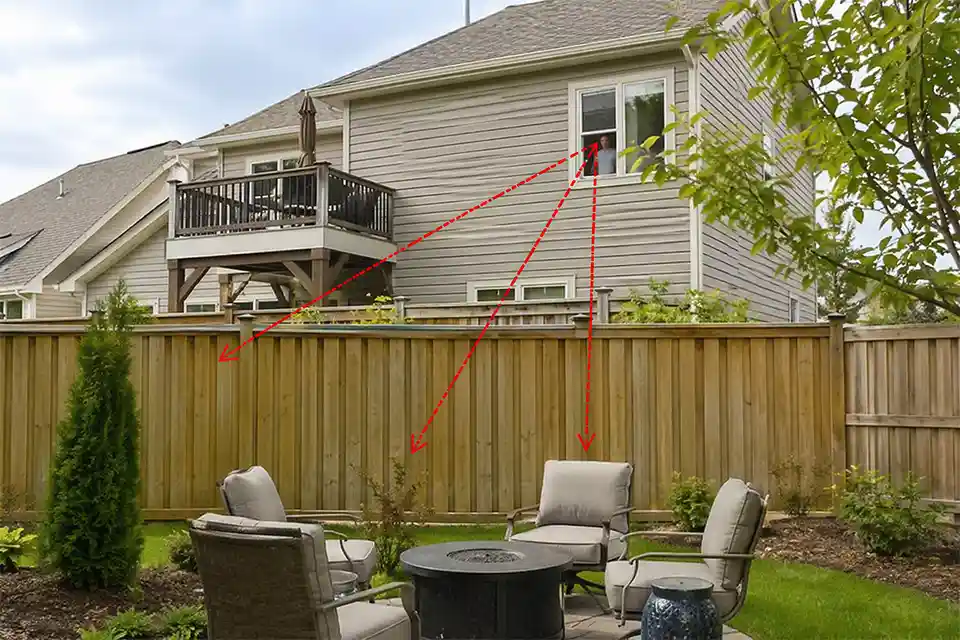
That sounds substantial until the real exposure comes from a raised deck, an upstairs window, or a neighboring yard that sits 2 to 4 feet higher than yours. At that point, the problem is not the boundary itself. It is the sightline above it.
That is why so many privacy upgrades disappoint. Replacing a fence with another fence in the same height range rarely changes how watched the yard feels. A thin hedge row often needs 3 to 5 years to become useful and may still stay sparse where privacy matters most.
The first checks are more practical than people expect: where the view starts, whether the exposed zone is the whole yard or one seating area, and whether the screen needs to work in all 12 months or mainly during leaf-off season.
If the fence is already at the HOA limit, the winning move is usually not another fence-edge upgrade. It is a targeted privacy layer that interrupts the exact view with less friction.
Why this is usually a sightline problem, not a fence problem
The privacy leak is often vertical
A compliant fence can perform perfectly well at ground level and still fail badly from above. That is the basic misread. If a neighbor is standing on a deck platform 8 to 10 feet above grade or looking down from a second-story window, even a solid fence can become visually short.
This is where homeowners often spend money in the wrong place. A nicer fence may improve finish and appearance, but if the old fence was already close to the height cap, the new one usually changes the look more than the privacy.
The use zone matters more than the property line
A dining table, lounge chairs, hot tub, or fire pit usually creates eye level around 3 to 5 feet above grade. That means a privacy element placed 4 to 8 feet from the patio can sometimes do more than a rear hedge planted 20 feet away at the fence line. Distance changes the angle. People consistently underestimate that.
This is one reason generic perimeter fixes disappoint. The visible edge feels like the obvious place to solve the problem, but the effective place is often closer to where people actually sit.
That same mismatch shows up in Backyard Privacy Problems: Fixes That Fail, where the logical-looking fix and the useful fix are not always the same.

What HOA limits usually change besides height
Some privacy upgrades read like fence extensions
In HOA neighborhoods, height is rarely the only practical issue. The bigger question is often what the added element looks like it is trying to be. A lattice topper, improvised rear-edge panel, or awkward add-on usually reads as a fence extension even if the homeowner thinks of it as a privacy feature.
That matters because fence-like additions tend to attract more scrutiny than a separate landscape or patio element inside the yard. The cleaner the fix looks as part of the overall design rather than a workaround bolted onto the boundary, the better its odds of feeling intentional.
The lowest-friction fixes usually stop fighting the fence line
This is the useful distinction. A rear-edge add-on tries to make the fence act taller. A patio-adjacent screen, offset planting layer, or small canopy tree solves the view without insisting that the fence do more than the rules allow.
That does not guarantee approval in every community, but it usually produces a solution that looks less confrontational and more designed.
Pro Tip: In HOA neighborhoods, the privacy move that blends into the yard usually creates less trouble than the one that makes the rear fence look obviously taller than everyone else’s.
Choose the fix by where the view starts
From a second-story window
This is the steepest angle, so a rear hedge by itself often underperforms. The better answer is usually a closer interruption: a pergola side screen, a slatted privacy panel near the seating area, or a small canopy tree offset to cut the downward line.
When the pressure comes from upstairs windows, solving only at the rear boundary usually takes too much height to be efficient. That is why this situation overlaps more with Second-Story Windows Ruining Backyard Privacy? What Helps Most than with general fence guidance.
From a raised deck
Deck exposure is usually wider and more active. People are standing, moving, and looking out at a shallower angle than from a window. Here, the strongest fix is often a combination: one vertical screen element plus enough planting depth below it to avoid a harsh, temporary look.
A slatted screen wall, pergola side screen, or offset privacy panel near the patio often works faster than waiting on plants alone. If the main view comes from a neighboring deck, Neighbor’s Deck Overlooks Your Backyard? Privacy Fixes That Actually Work follows the same logic from a more specific angle.
From a higher neighboring grade
This is one of the most underestimated versions of the problem. If the next yard sits 2 to 4 feet higher, a standard fence can function like a shorter fence even when it is technically compliant. Here, grade plus fence plus planting height has to be read together.
A layered screen on your side often works better than trying to force the boundary itself to do all the work.
From one diagonal corner view
This is often the highest-value fix in the whole yard. A single diagonal opening can make a dining zone or seating area feel exposed even when most of the yard is reasonably protected. In that case, a corner screen, offset tree, or targeted planted wedge can make the entire space feel more private without enclosing everything.
People usually overestimate how much perimeter screening they need. One blocked angle can change the yard more than a full rear-boundary project.

What actually works best under HOA limits
Fast privacy: solve it near the use zone
If privacy needs to improve within 6 to 12 months, a built screen close to the patio usually delivers the fastest result. That could be a slatted privacy panel, pergola side screen, freestanding screen wall, or even a planted container screen in a compact yard.
The key is speed plus angle control. Waiting for young shrubs alone is rarely the fastest route unless the privacy problem is mild.
Durable privacy: use layered planting only when the bed is deep enough
A thin hedge row squeezed into an 18- to 24-inch strip is one of the most common time-wasters in HOA-limited backyards. It promises privacy and delivers maintenance. A more realistic threshold is about 3 feet of bed width for a basic screening run. Around 4 to 6 feet is where layering starts to become genuinely useful.
That is the point where shrubs can overlap, lower gaps can soften, and the screen starts acting like a privacy layer instead of a narrow green line. This is also where more depth beats more height.
Overhead privacy: trees often outperform extra hedge height
When the view comes from above, another foot of hedge height may add cost faster than results. A small or medium canopy tree can interrupt the upper sightline sooner and more naturally than a hedge pushed toward 10 or 12 feet.
That matters in shared suburban yards where a tall living wall can start making the space feel boxed in, a pattern that also shows up in Backyard Layout Mistakes in Shared Fence Yards.
Timeline matters more than people think
Privacy this season, privacy in 2 to 3 years, and privacy in 5 years are not the same project. One screen wall can change the yard in a weekend. A shrub screen may need several growing seasons. A layered mix of screen, shrubs, and a small tree usually ages best, but it is not the quickest result on day one.
That is the point where many homeowners choose the wrong tool. They buy for the five-year vision when what they really need is a one-season fix.
Which fixes work, which fail, and which create more HOA friction
| Situation | Best-performing fix | Often fails | HOA friction level |
|---|---|---|---|
| Fence already at neighborhood max, deck overlooks yard | Patio-adjacent screen plus layered planting | Replacing fence at the same height | Medium |
| Upstairs window looks into one seating zone | Small canopy tree or vertical screen near the use zone | Rear hedge only | Low to medium |
| Neighboring yard sits 2 to 4 feet higher | Interior layered planting on your side | Fence topper gamble | Medium to high |
| Planting strip is under 3 feet wide | Built screen plus selective planting | Full hedge forced into narrow bed | Low to medium |
| Privacy is needed within 1 growing season | Hybrid screen now, planting later | Waiting on shrubs alone | Low to medium |
| Only one diagonal corner leaks privacy | Corner screen or offset tree | Screening the whole perimeter | Low |

When the standard fix stops making sense
Stop chasing hedge height when upkeep starts outrunning benefit
Once a hedge pushes past roughly 10 to 12 feet, pruning becomes harder, cost rises, and lower growth may thin if the upper canopy widens. At that point, more hedge stops being a simple answer and starts becoming a maintenance system.
Stop solving the whole perimeter if only one zone feels exposed
Many families do not need a fully privatized yard. They need privacy around one dining area, one pair of lounge chairs, or one spa corner. A local fix is often cheaper, cleaner, and more effective than wrapping the entire property line.
Stop investing at the fence edge when the rule itself is the barrier
This is the clearest decision rule in the article. If HOA height limits are what made the fence stop working, the next winning move is usually not another fence-edge move. It is a non-fence privacy layer that solves the sightline more directly.
Quick checklist for this exact scenario
- Your fence is already near the HOA cap, usually around 5 to 6 feet
- The exposure comes from above or from a neighboring yard that sits higher
- The privacy problem is strongest in one use zone, not everywhere
- The planting strip is too narrow for a dense hedge to mature well
- You want results within 6 to 12 months, not in 3 to 5 years
- A targeted screen would solve more than a full perimeter upgrade
The best HOA-limited privacy yards usually improve the right angle, not the entire boundary. If the fence is maxed out and the view still comes from above, stop paying for more fence logic. Solve the sightline instead.
For broader official guidance on privacy screening plants and layout, see University of Maryland Extension’s guide to mixed privacy screens.