Last updated: July 2, 2026
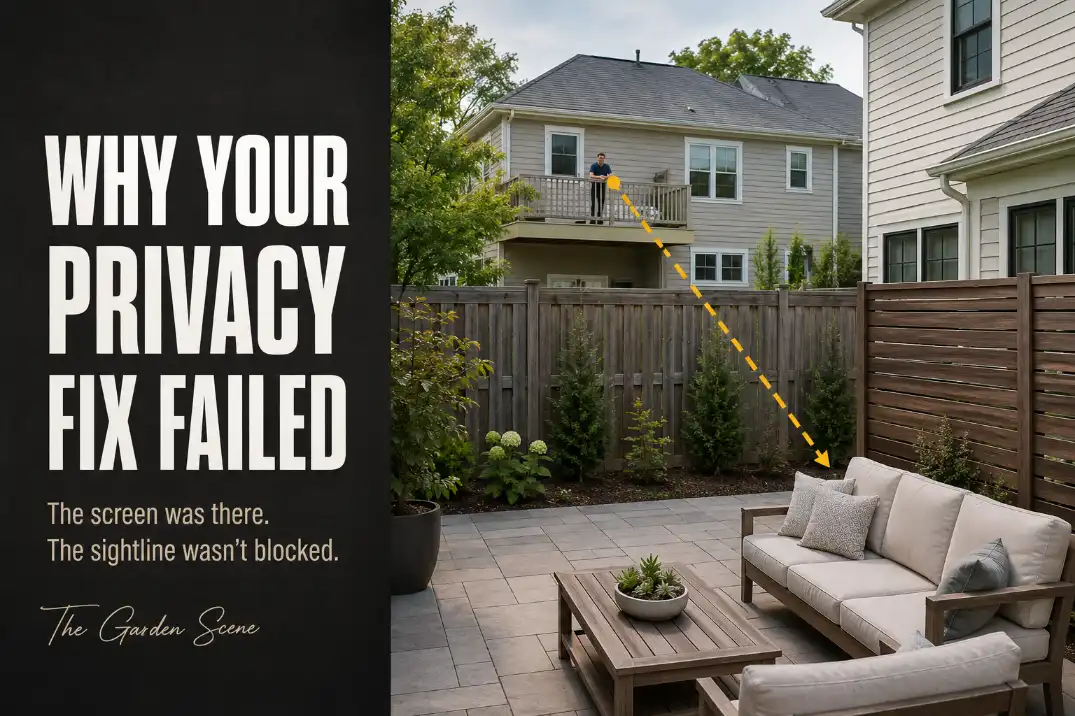
A backyard privacy fix can look finished and still feel useless. The fence is there. The hedge is planted. The screen is standing. The patio furniture has been moved once already. Yet when someone sits down, the yard still feels exposed.
That usually does not mean every privacy idea was wrong. It means the fix solved the wrong part of the problem.
Backyard privacy fails when the added fence, screen, hedge, planting bed, or layout change does not interrupt the actual view path. The missed condition may be height, density, angle, viewer position, seasonal gaps, slow-growing plants, or a seating area placed directly in the exposed zone.
This page is not a list of more backyard privacy ideas. It is a diagnosis: what you tried, why it failed, what condition it ignored, and what the next correction should be.
Why Backyard Privacy Fixes Fail Even When They Look Right
The first mistake is judging privacy from the object instead of the experience. A fence looks like privacy. A row of shrubs looks like privacy. A freestanding screen looks like privacy. But privacy is not created by the object itself; it is created when the object blocks the view between a viewer and the place where you actually use the yard.
That difference matters because most failed fixes are not completely useless. They are usually incomplete, misplaced, too narrow, too transparent, or aimed at the wrong viewer.
A fence may block the neighbor’s lawn but not their raised deck. A hedge may soften the boundary but leave the patio exposed for several years. A screen may block one straight-on view while a diagonal view still passes around it.
The right diagnosis starts with one question: where is the view actually coming from?
| Failed privacy fix | Why it still failed | Condition it ignored | Better next correction |
|---|---|---|---|
| Fence along the back boundary | The view comes from above or from the side | Viewer elevation or angle | Add a closer use-zone screen or layered side coverage |
| Hedge planted at the property line | It is too young, thin, or seasonal | Growth time and density | Use a temporary filter while the planting matures |
| Tall screen near the wrong edge | It blocks the yard, not the seating area | Actual sightline path | Move the screen closer to the exposed use zone |
| Lattice or slatted panel | It has height but leaks visibility | Density at eye level | Add layering, backing, or staggered coverage |
| Planting bed behind seating | It softens the view but does not block it | Viewer position and target zone | Place privacy between the viewer and the seat |
| Patio furniture moved slightly | The main use zone remains exposed | Seating orientation | Rotate, shift, or shrink the private pocket |
| More fence height | The problem is angle, not height | Width and line of view | Widen, wrap, or offset the privacy layer |
The table is not a menu of fixes. It is a way to stop wasting effort. Before adding another panel, another plant, or another layer, identify which condition the first attempt missed.
The Fix Blocked the Yard, Not the Sightline
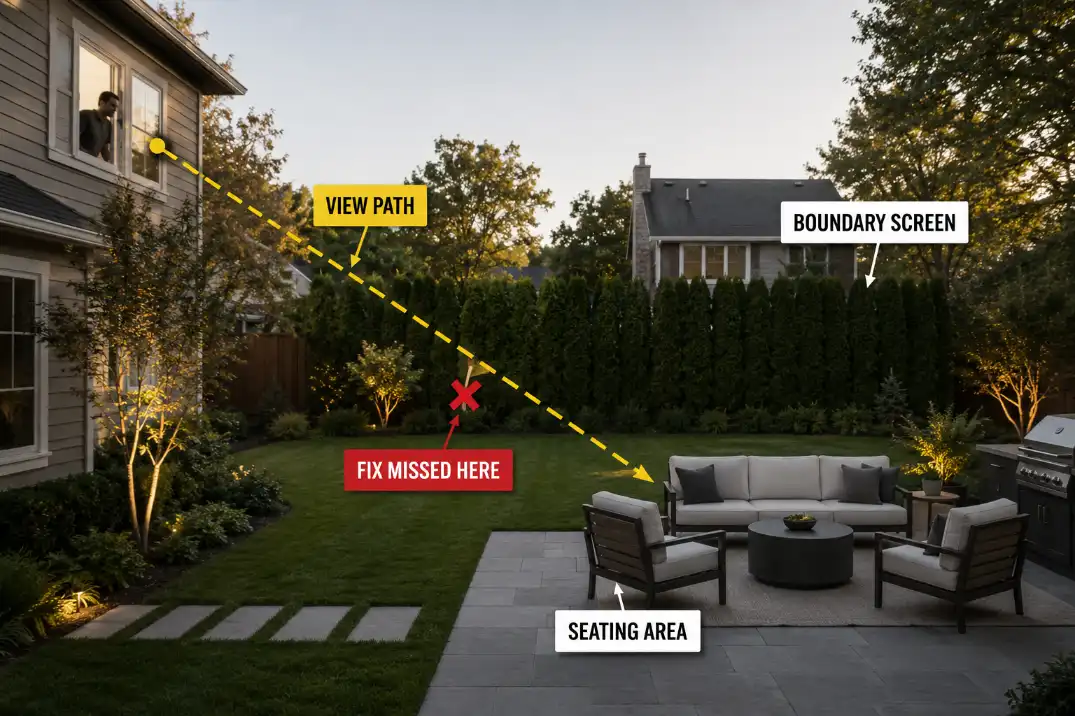
The most common privacy failure is a fix that sits in a logical place but not in the working sightline. Homeowners often place privacy at the property boundary because that is where fences, hedges, and planting beds seem to belong. But the boundary is not always where the view needs to be interrupted.
If the neighbor is looking from a deck, second-story window, side patio, or angled lot line, a boundary screen may sit too far away from the place you actually use. It may cover the back edge of the yard while the exposed patio remains visible from the side. It may block the lower part of the view while the seating area is still open above it.
A better test is to stand where the viewer is likely to be, then look back toward the patio, dining table, hot tub, or lounge chairs. The privacy layer should interrupt that line, not simply decorate the edge of the property.
When the failed fix is too far away, the next correction is usually closer placement. That may mean a partial screen near the seating area, a shifted planting mass, or a smaller private pocket rather than trying to screen the entire yard.
If the reader needs a broader non-fence framework after finding the missed view path, a page on a broader no-fence privacy framework can help route the next decision without turning this diagnosis into an ideas list.
Common mistake box: Adding more material before finding the view path
The first failed fix often leads to the wrong second fix. The homeowner adds taller panels, more shrubs, or a second screen in the same general area. That can make the yard feel more crowded without solving privacy.
Before adding anything, mark the viewer position and the exposed use zone. If the new material does not cross that line, it may add bulk without adding privacy.
The quick sightline test
Sit in the exposed chair, then have someone stand where the view comes from. If you can see their face, upper body, or movement through the privacy layer, the fix is not blocking the actual line of view. If the view is coming from an angle, repeat the test from the side, not just straight behind the yard.
That simple test usually explains why a privacy fix that looked reasonable from the house did not work during real use.
The Height Was Solving the Wrong View
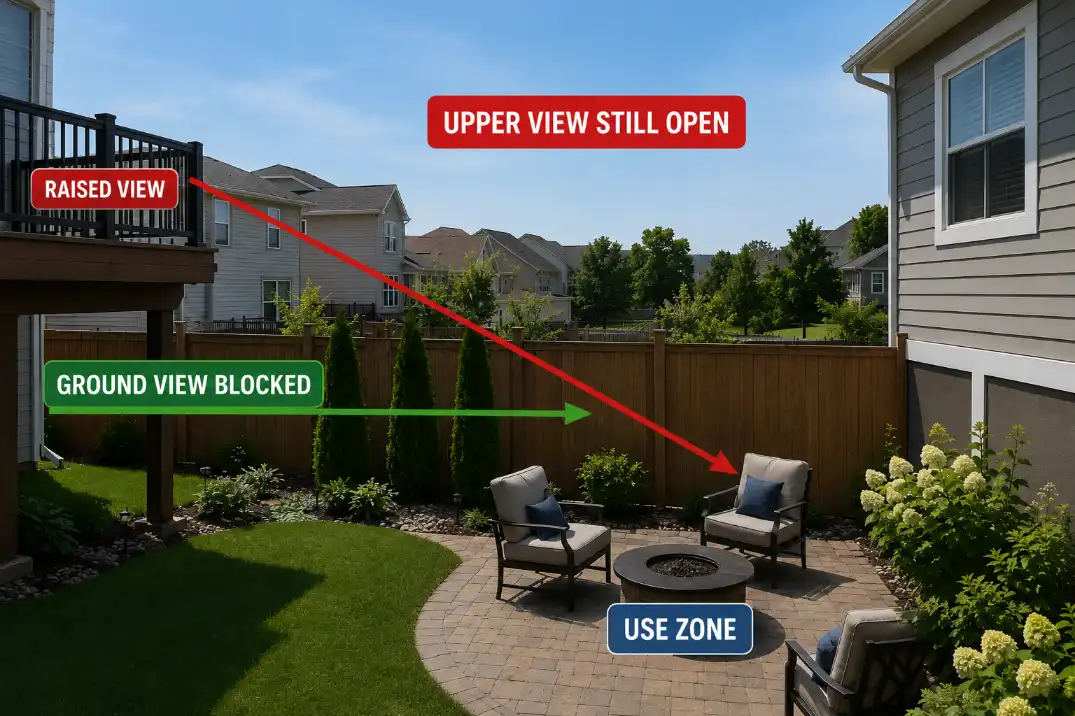
Height failure is tricky because the fix may work from one position and fail from another. A backyard fence may block a person standing at ground level. The same fence may do almost nothing against a raised deck, second-story window, uphill neighbor, or sloped lot.
This is why “make it taller” is not always the right answer. In many suburban yards, more fence height may be restricted by local rules, HOA standards, or neighborhood design expectations. Even when height is allowed, a taller boundary can feel heavy and still miss the view if the viewer is looking down into the use zone.
The diagnosis is not just “is the fence tall enough?” It is “tall enough from whose eye level?”
A ground-level fix works when the viewer and the use zone are roughly on the same plane. An upper-view problem needs a different kind of interruption. That might be a screen closer to the seating area, an overhead filter, a pergola-style layer, a tree canopy over time, or a shifted use zone that tucks under an existing structure.
Before adding height to a fence, it is worth checking whether the real issue is legal height, viewer elevation, or screen placement.
If the next move is likely to involve raising or replacing a fence, check fence height limits before adding height so the correction does not create a rule problem while trying to solve a visibility problem.
Field judgment: Height is often the most expensive wrong answer
When privacy fails from above, adding height at the boundary can feel like the obvious correction. But elevated privacy is usually about interrupting the view closer to the use zone, not building a taller wall at the far edge.
If the viewer is looking down, a close screen or overhead layer often changes the experience more than another foot of boundary height.
The Screen Had Height, But Not Enough Density
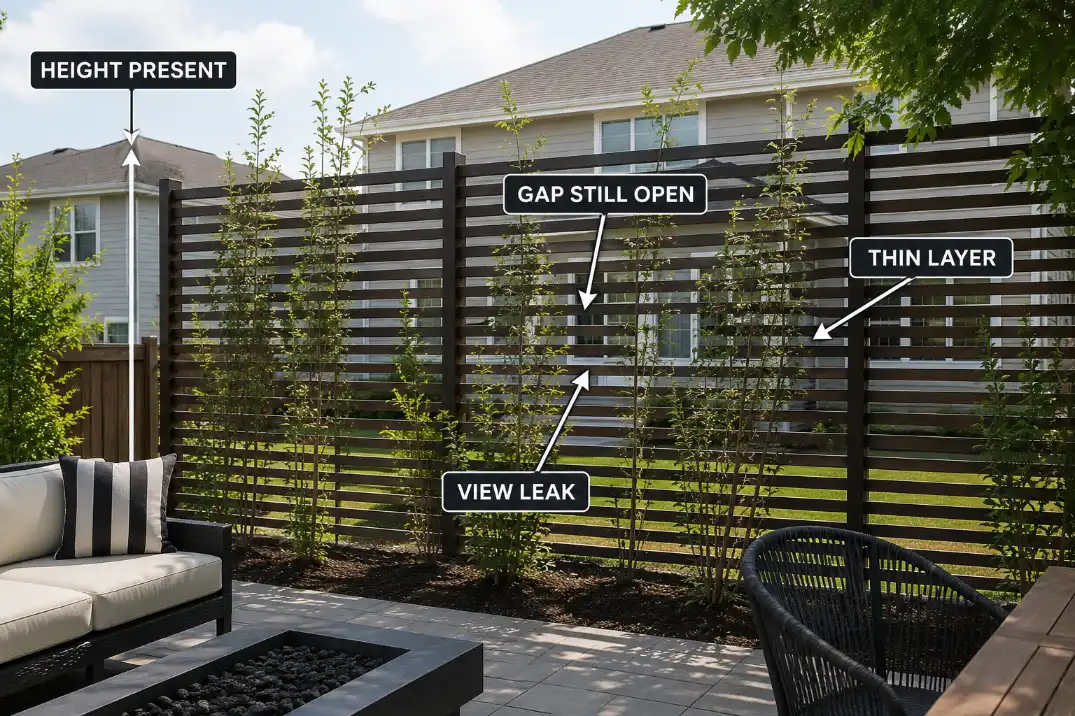
A privacy layer can be tall and still too transparent. This happens with lattice panels, slatted screens, young hedges, thin ornamental planting, bare lower shrub stems, deciduous seasonal gaps, and narrow planting strips that only soften the view.
The test is simple: can movement, clothing color, faces, or seated body outlines still be read through the layer? If yes, the privacy layer may be tall enough but not dense enough at the viewer’s eye path.
Density matters most where the view crosses the use zone. A screen with open slats may feel private when viewed from a distance but fail when the neighbor is close. A hedge may look full at the top while the lower third is open. A planting bed may create a nice green boundary but leave the seated eye-level zone exposed.
The correction is usually not one more tall object. It is a denser middle layer, a staggered layer, a backing panel, or a wider planting mass that closes the leak. For planting, the problem is often not species alone; it is the relationship between mature size, spacing, pruning, and the height where the view actually passes.
What density failure looks like
Density failure usually shows up in small moments. You notice a neighbor’s movement through the hedge. You can see patio chairs from the other side even though the screen is tall. Winter exposes a view that summer covered. A lattice panel blurs the background but does not actually block it.
Those clues matter more than the label on the fix. A “privacy screen” is not private if the view still passes through the center of it.
The Planting Was Asked to Work Too Fast
Planting is often the right long-term privacy layer, but it is a poor immediate fix when the yard is already exposed. Young shrubs and small trees may need time to gain height, width, and density. During that early period, the homeowner may feel as if the privacy plan failed, even if the plants are healthy.
The diagnosis here is expectation. Did the planting fail, or was it expected to perform like a mature hedge too soon?
A young row along the fence may eventually soften a neighbor view. But if the patio, pool, or dining area needs privacy this season, planting alone may not carry the job.
The next correction is often a fast filter paired with long-term planting. That can mean a temporary screen, a trellis, a partial patio filter, or a closer use-zone layer while the shrubs fill in behind it.
This is where the privacy plan should have two time frames: what blocks the view now, and what becomes the softer screen later.
If the immediate problem is a patio or deck that feels exposed while plants mature, a temporary privacy layer while planting matures is usually a better bridge than replacing the planting plan entirely.
Practical note: Young planting is not a failed hedge yet
The mistake is treating early-year planting like a finished wall. New shrubs may be doing exactly what they should biologically while still failing the privacy job today. The fix is not always “rip them out.” More often, the missing piece is a temporary or closer filter that carries privacy until the planting becomes useful.
The Seating Layout Stayed Exposed
Sometimes the privacy fix fails because the most exposed part of the yard never changed: the seating layout.
Privacy is felt from the chair, not from the property line. A yard can have a fence, planting, and screens and still feel exposed if the dining table sits in the most visible centerline. The same is true for a lounge set placed in the open middle of the patio, a hot tub facing the neighbor’s deck, or chairs arranged directly toward a side-yard view.
The correction may be less dramatic than adding another structure. Rotate the seating so backs face the exposed view. Pull chairs closer to the house wall or an existing corner. Create a smaller private pocket instead of trying to protect the whole lawn. Use the screen to protect the people, not the empty square footage around them.
If the diagnosis shows that only the seating area is failing, not the whole backyard, the next useful page is about privacy around a specific seating area. That keeps the fix focused instead of turning a small exposure problem into a full-yard project.
The use-zone test
Ask where people actually pause. Privacy matters most where someone sits with coffee, eats dinner, reads, talks, uses the hot tub, or stands at the grill. If those zones remain in the open sightline, the yard may technically have privacy features while the lived experience still feels exposed.
The Fix Was Too Narrow for the Angle of View
A narrow screen can work perfectly from one direction and fail completely from another. This is common on corner lots, shared fence yards, side-by-side patios, diagonal back lots, and yards where the neighbor’s active area is not directly behind yours.
From the house, the screen may look centered. From the neighbor’s angle, the view passes around the edge.
The diagnosis is width, not height. If the viewer can see around the privacy layer, making the screen taller will not solve the leak. The next correction is usually widening the coverage, offsetting the screen, wrapping the corner, or staggering a second layer so the angled line is interrupted.
This is also where planting rows often disappoint. A straight, narrow row along the back boundary may look tidy but fail against diagonal exposure. A staggered mass, angled planting pocket, or short return section can block more view with less visual heaviness than a long wall.
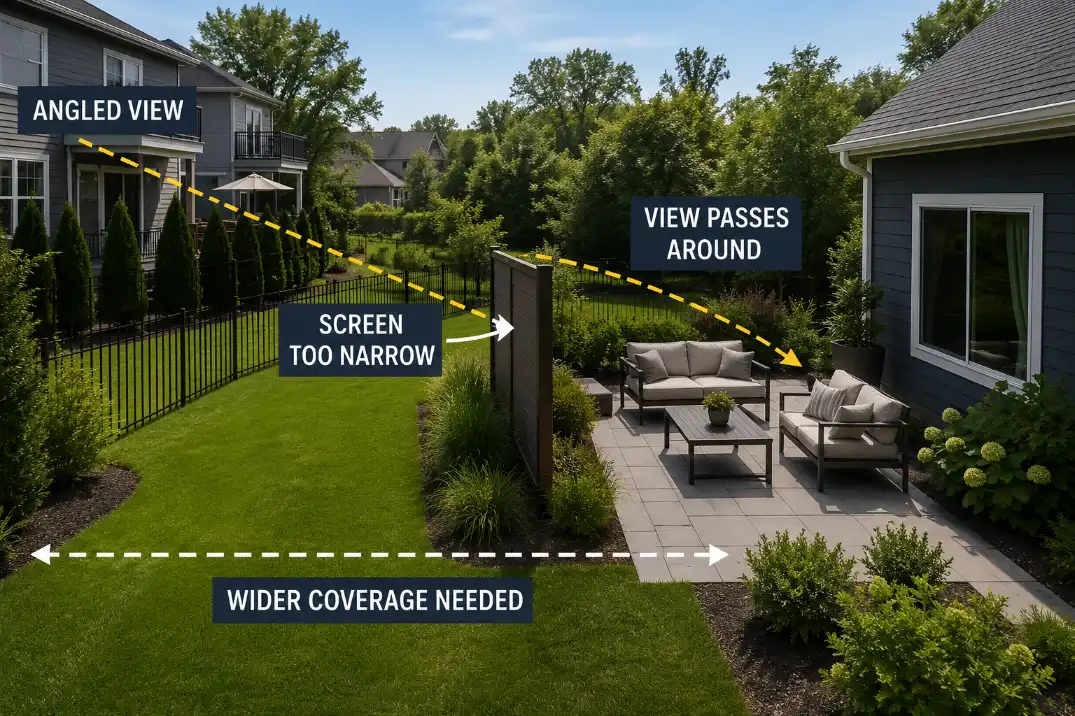
A privacy fix that fails from an angle is not necessarily in the wrong category. It may simply be under-sized for the view cone. The fix should widen the interruption, not restart the whole privacy plan.
How to Diagnose the Next Correct Fix
The next correct fix should come after the failure type is clear. If the first attempt failed because it missed the sightline, adding more of the same material in the same place will probably fail again.
If it failed because planting is too young, replacing the planting may waste a good long-term layer. If it failed because the seating is exposed, the most effective move may be a layout adjustment.
Use this field check before spending more money or effort:
- Stand where the viewer is, not only where you sit.
- Mark the exact use zone that feels exposed.
- Check whether the view is ground-level, elevated, side-angle, or diagonal.
- Look for visible gaps through the middle and lower part of the screen or planting.
- Test the layout from seated height, not only standing height.
- Decide whether the failure is height, density, width, timing, placement, or seating orientation.
- Choose the smallest correction that interrupts the actual view path.
- Route to a deeper page only after the failure type is clear.
If the failure is clearly a fence-type mismatch, then privacy fence options for suburban homes may help after the diagnosis. That route only makes sense when the failed fix was truly about fence form, placement, opacity, or fit—not when the real problem was a missed sightline or exposed seating layout.
Rules and neighborhood visibility can create a different kind of failure. In that case, the problem is not simply that the screen is too short or too light; it is that the next correction has to stay acceptable from the street, the neighbor side, or the HOA review point.
If the failure is tied to rules, visible structures, or neighborhood restrictions, HOA-friendly privacy approaches are a better next step than simply adding a taller or heavier screen.
The important move is to stop asking which privacy solution is best. Ask which condition the last solution ignored.
A failed backyard privacy fix usually failed for one of six reasons: it missed the sightline, solved the wrong height, lacked density, needed more time, left the seating exposed, or was too narrow for the angle.
Once that is clear, the next correction becomes smaller, sharper, and less likely to turn the yard into a crowded collection of half-working screens.
For plant-based privacy corrections, confirm regional fit and mature size guidance through your local Cooperative Extension; the USDA points homeowners to local Cooperative Extension gardening resources.