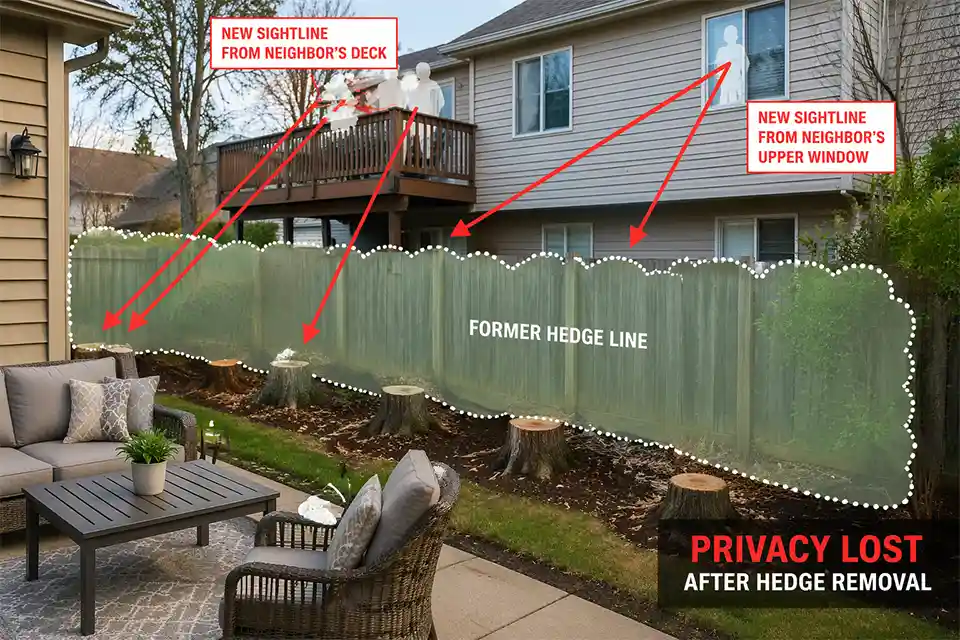
If privacy disappeared right after trees or hedges came out, the mistake is treating it like a simple planting gap. It usually is not. What changed is the sightline. In one day, the yard can go from lightly screened to fully exposed because the old planting was blocking a specific angle, not just filling space.
Start with three checks. First, identify where the new view comes from: ground level, a raised deck, or second-story windows.
Second, measure the open span. A gap under about 8 feet often behaves like a patch problem. A gap over 20 feet is usually a screen-system problem.
Third, decide what you actually lost: a dense sidewall, filtered height from canopy, or seasonal cover that only worked when leaves were on. That difference changes the fix.
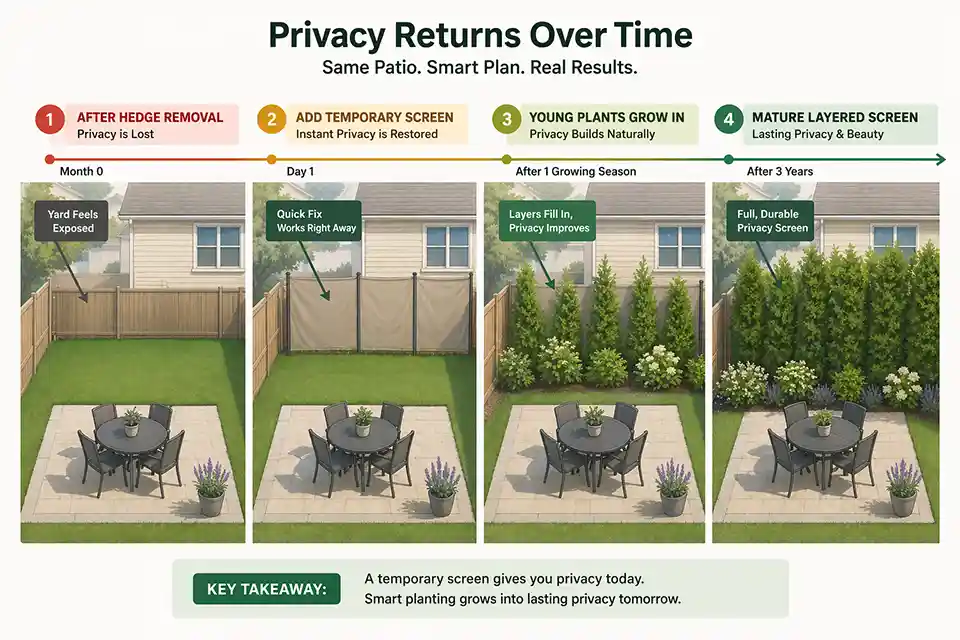
The quickest useful approach is usually two-stage. Restore functional privacy within days or weeks, then rebuild the long-term screen over the next 12 to 36 months.
If you skip the first stage and wait for planting alone, the yard often stays exposed much longer than expected.
What you actually lost when the screen came out
This is the point people misread most. They think they lost greenery, when what they really lost was a kind of screening.
When a hedge was removed, you usually lost a sidewall
A hedge acts like a lateral privacy barrier. It blocks views across the fence line at human height. If that hedge was dense from the ground up, removing it opens the yard fast and obviously. This kind of loss usually affects patios, dining areas, hot tubs, and rear windows first.
That means the first fix often does not need to be tall everywhere. It needs to interrupt the exposed line of sight where people actually sit.
When trees were removed, you usually lost height, filtering, and comfort at the same time
Tree removal is different. A tree line often softens upper angles rather than fully sealing off the boundary. Once the canopy goes, upper-story windows, uphill neighbors, or raised decks may suddenly see much deeper into the yard. That is why homeowners sometimes add a new fence and still feel exposed.
Tree removal also changes the site itself. Areas that stayed filtered and tolerable can become hotter, brighter, windier, and quicker to dry within one season. So the loss is not only visual. The yard may feel less protected and harder to replant at the same time.
A fence can replace a hedge better than it can replace canopy.
Seasonal privacy and year-round privacy are not the same thing
If the old screen was deciduous, it may only have worked well for about 5 to 6 months each year. That matters. Some yards feel private enough from late spring through early fall, then go visually thin in winter. If that was the old setup, replanting the same deciduous structure may restore the old look without solving the old weakness.
The practical threshold is simple: if you want privacy in January, your solution cannot depend on leaf-out timing.

Why the obvious fix often wastes a season
The most common reaction is to plant fast growers along the fence and hope the problem closes on its own. That sounds logical. It often is not enough.
Replanting the same line is usually too literal
What worked before may not work now. The old screen may have taken 8, 12, or 20 years to reach useful density. Replacing it with small new plants in the same line does not replace the privacy function in any meaningful short-term way.
This is especially true if the removed screen had mature width. A new row of narrow shrubs in 3-gallon pots can look like progress and still leave the yard exposed for 2 to 4 growing seasons.
Fast growth is not the same as fast privacy
People overestimate growth-rate labels and underestimate mature form. A plant that grows quickly upward but stays thin does not solve a wide sightline well. A row planted too tightly may look smart in year one, then compete, stress, and open patchy gaps in years two to four.
That is why repeating a single-species wall often turns into a second disappointment.
Fence height is one of the most overestimated fixes
A fence helps when the problem is mostly horizontal viewing. It helps far less when the view comes from above. If the new exposure is from a second-story room or a deck platform, adding more fence often improves the boundary and barely changes the feeling in the seating zone.
That is the same logic behind Second-Story Windows Ruining Backyard Privacy? What Helps Most. The symptom is exposure. The mechanism is angle.
What usually wastes time first
This is where people lose a season.
Waiting for small plants to solve an immediate problem
If the yard feels exposed now, small replacement shrubs do not restore privacy now. They only begin the long-term fix.
Treating a canopy-loss problem like a fence-line problem
Once trees are removed, the exposed view often comes from higher angles. That is why a simple boundary fix can look sensible and still fail functionally.
Copying the old plant line without rechecking the new view
The old screen may have been shaped by growth over many years, not by smart initial layout. Rebuilding the same line in the same place can lock you into the same weak geometry, especially if the real view now enters deeper into the yard.
What to do first if you need privacy back fast
The right first step is not always planting. It is restoring usable privacy.
Use a temporary screen where the view matters most
If one part of the yard feels exposed now, fix that zone now. Good temporary options include:
- freestanding privacy panels around 6 to 8 feet tall
- slatted screens attached to planters
- outdoor curtain panels
- a targeted overhead or side screen near the patio
- a narrow screen wall beside a lounge or dining area
This is not a lesser solution. It is what keeps the yard functional while long-term planting establishes.
Screen the use area before you rebuild the whole edge
A lot of homeowners instinctively work only at the property line. But if the exposed zone is a 10-foot dining pad located 15 feet away from the fence, a near-patio screen can deliver privacy much faster than waiting for boundary planting to mature.
That distinction matters more than people think. A boundary solution restores the edge. A near-use solution restores comfort.
Pro Tip: Sit in the exact chair you use most, then take one photo at seated eye level toward the opening. That image usually reveals the real privacy problem more honestly than standing at the fence.
Check local fence or structure limits before committing
If your best quick fix involves a taller panel, screen, or fence extension, rule limits matter early. In some neighborhoods, the better path is a code-compliant lower structure near the patio paired with layered planting behind it. That logic fits closely with Backyard Privacy and HOA Fence Height Limits.
Boundary line or near-patio screen? This is the real decision point
This is where the article should actually decide, not just describe.
Use the boundary when the whole edge opened up
If a long stretch of hedge came out and the yard feels exposed across most of the rear line, work at the boundary first. This is especially true when the unwanted view comes from neighbors moving through their yard, sitting at grade, or looking from nearby windows at similar elevation.
Boundary screening works best when the problem is broad and low.
Use a near-patio screen when the view is narrow but invasive
Sometimes the entire yard is not exposed. One sightline is. In those cases, rebuilding only the property edge is slower and less efficient than placing a screen much closer to the use zone.
A near-patio screen makes the biggest difference when:
- the exposed area is one seating or dining pocket
- the line of sight comes through a narrow opening
- the neighbor’s elevation is slightly higher
- the yard has limited planting depth at the fence
Use both when the view comes from above
This is the condition people underestimate most. If the old trees or tall hedge were screening upper windows or a raised deck, the real answer is often layered depth: a targeted near-field screen plus taller planting or canopy structure behind it.
That is why standard fence-line thinking often disappoints in yards similar to Neighbor’s Deck Overlooks Your Backyard? Privacy Fixes That Actually Work.

The long-term fix that usually works better
The most reliable permanent solution is rarely a flat replacement row. It is a layered screen.
Layer the screen by function, not by plant list
Think in roles:
- back layer for height and upper-angle interruption
- middle layer for bulk and visual density
- front layer for base coverage and softness
This matters because one row tries to do too many jobs at once. A layered screen spreads those jobs across depth. It also looks more intentional earlier, even before full maturity.
Mixed structure ages better than a single-species wall
A mixed screen is usually more resilient and visually fuller over time. It is less dependent on one plant shape, one growth rate, or one species staying perfect. It also handles irregular sightlines better, which matters when privacy was lost because one precise opening suddenly appeared.
This is where related mistakes show up. A privacy line that is too uniform often becomes brittle in the same way other backyard fixes become overly literal, a pattern that also appears in Backyard Privacy Fixes That Fail.
Expect the site to behave differently after removal
Once mature trees or dense hedges are gone, the site often gets hotter, brighter, windier, and quicker to dry out. New planting may struggle in the first summer even if the old screen once thrived there easily.
That means irrigation, mulch depth, and plant spacing matter more than before. About 2 to 3 inches of mulch is usually enough. More than that starts to become counterproductive around new planting. And if the area now gets full afternoon sun instead of filtered light, plant choice needs to reflect the new site, not the old memory.
What usually works, and what usually fails
| What changed | Best immediate fix | Best long-term fix | What usually fails |
|---|---|---|---|
| Short hedge gap under 8 feet | Targeted panel or dense screen planter | Staggered replacement planting | Waiting for small shrubs alone |
| Long hedge removal over 20 feet | Temporary privacy layer in the most-used zone | Layered boundary screen | One thin replacement row |
| Tree removal exposing upper views | Near-patio screen to interrupt angle | Mixed-height planting with taller anchors | Assuming a fence replaces canopy |
| Seasonal screen loss | Decide if winter privacy matters first | Evergreen or mixed all-season structure | Repeating deciduous-only screening |
| Narrow side-yard exposure | Slim vertical screen close to use area | Compact layered planting | Planting only at the far boundary |
When the standard fix stops making sense
A normal hedge stops being enough when the view is coming from above, the site is too shallow for meaningful depth, or the exposure is happening in one concentrated living zone rather than across the entire yard.
That is the point where copying the old screen stops being smart. The better move is to rebuild for the new sightline, not for the old plant line.
If the lost privacy is mostly from low lateral views, a boundary-led fix still makes sense.
If the loss came from removed canopy, elevated neighbors, or a suddenly open patio pocket, a layered system with near-field screening is usually the better answer.
The clearest next move
If a hedge came out and the exposure is mostly across the boundary, rebuild the edge but do not rely on a single thin row to do all the work.
If trees came out and the new view is coming from above, stop treating it like a fence problem. It is a height-and-angle problem.
And if the yard feels unusable right now, do not wait for planting to mature before you fix the experience. Restore privacy where you live first, then rebuild the long-term screen behind that.
Do not try to recreate the old plant line by reflex. Rebuild for the view that exists now.
For broader official guidance, see University of Maryland Extension’s guide to mixed privacy screens.