Last updated: April 15, 2026
If you need to stop erosion on a sloped backyard, the best product depends on how the slope is failing.
- Use erosion-control blankets for broad surface washout on bare soil.
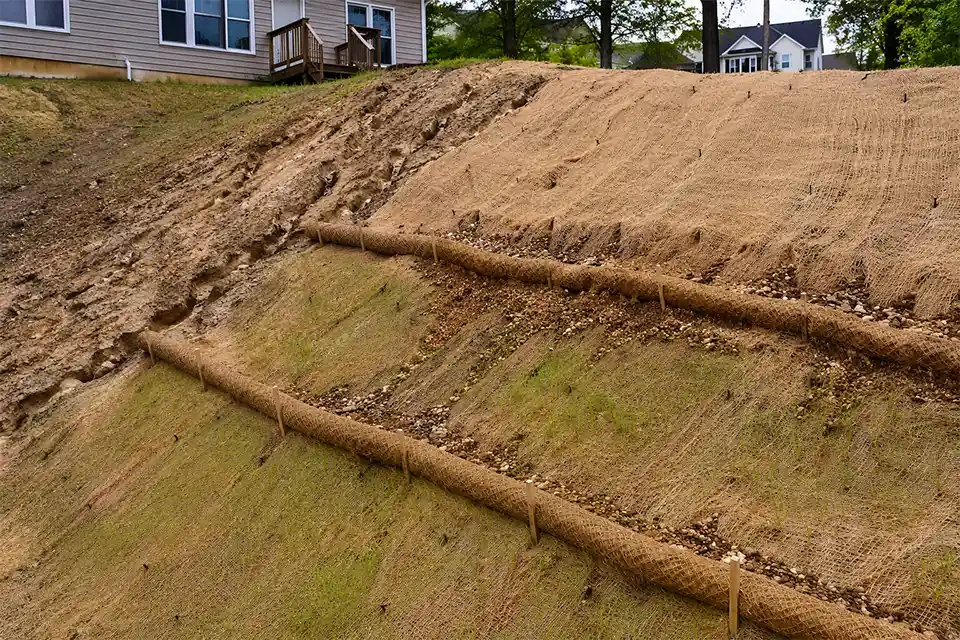
- Use coir wattles when water is forming grooves or mini channels.
- Use heavy-duty landscape staples when blankets or netting keep lifting or sliding.
- Use ground reinforcement grids when foot traffic, pets, or mower access keep stripping the slope bare.
- Do not buy slope products first if a downspout or drain is sending concentrated water onto the hill.
That is the core decision. Most erosion products fail because they are bought for the symptom people notice first, not the failure pattern causing the problem.
Quick Answer: Which Product Category Should You Start With?
For most homeowners, the fastest way to narrow the choice is this:
- Start with an erosion-control blanket if the slope is bare and the soil is washing off broadly after rain.
- Start with a coir wattle if you can see runoff grooves, small channels, or repeated wash lines.
- Start with heavy-duty staples or anchor pins if your blanket or mat keeps peeling up before it can do its job.
- Start with a ground reinforcement grid if the slope keeps going bare because of dogs, foot traffic, or a worn shortcut path.
- Stop shopping and diagnose first if the erosion is being fed by a drainage outlet or the slope shows signs of structural movement.
If you are unsure between categories, ask one question first: Is the slope losing soil evenly, or is water carving a path?
Why Most Sloped Backyard Erosion Fixes Fail
Backyard erosion usually gets treated too late and too generically.
Homeowners often buy:
- seed when the soil needs immediate cover
- mulch when water needs to be slowed down
- a blanket when the real issue is traffic damage
- a heavier product when the actual problem is an unfixed drainage source
That is why a useful buying guide has to start with diagnosis, not with a generic list of products.
Step 1: Identify the Type of Erosion You Have
Sheet Erosion: The Surface Is Washing Off Evenly
This is the most common backyard slope problem after clearing, grading, weed removal, or failed grass growth. You usually see a broad thinning of the surface rather than deep cuts.
Best category: erosion-control blankets
Usually not enough: seed alone, loose mulch, straw spread by hand
Channel Erosion: Water Is Cutting a Visible Path
If you see grooves, finger-like runoff paths, or repeat wash lines, water is concentrating instead of spreading out.
Best category: coir wattles, runoff barriers, and water redirection
Usually not enough: blankets alone, extra mulch, random rock
Wear Erosion: Traffic Keeps Tearing the Slope Up
This happens on dog paths, shortcut routes, mower access strips, and hillsides people keep crossing.
Best category: ground reinforcement grids or reinforced slope-access systems
Usually not enough: reseeding, mulch, another light blanket
This distinction matters more than buyers think. A better product in the wrong category still loses.
Step 2: The Best First Product for Bare Slopes
If the slope is mostly exposed soil and erosion is happening across the surface rather than in channels, erosion-control blankets are usually the best first product to browse.
They work because they do two jobs at once: they protect the soil immediately and they support long-term establishment underneath.
Why erosion-control blankets work
A good blanket helps by:
- reducing the impact of rain on bare soil
- slowing shallow runoff across the surface
- holding seed in place
- keeping the slope stable long enough for roots to take over
This makes blankets a strong first buy for:
- freshly cleared slopes
- newly graded backyard banks
- slopes where grass seed keeps washing away
- bare hillsides where mulch never stays put
What to look for in erosion-control blankets
Inside this category, these are the buying filters that matter most:
Material type
- Straw blankets: better for lighter-duty, shorter-term stabilization on milder slopes
- Wood fiber blankets: often a solid middle ground for seeded backyard slopes
- Coir blankets: better for steeper slopes, harsher exposure, or slower plant establishment
- Heavy-duty synthetic or reinforced mats: better for tougher use, longer stabilization windows, or repeated wear
Duty level
For real backyard slope problems, light-duty products are often too flimsy. Medium- to heavy-duty is usually the safer starting point.
Anchoring friendliness
A blanket needs to pin down tightly and overlap cleanly. If it bridges above the soil instead of hugging it, it is easier for water and wind to get under it.
Coverage size
Wider rolls can reduce seams and weak spots on a broad slope.
Best for
- broad washout on bare soil
- newly seeded banks
- moderate backyard slopes
- slopes that need temporary protection while vegetation establishes
Skip if
- runoff is already forming channels
- the hill is a high-traffic route
- concentrated discharge is hitting the slope from above
If your slope is mostly losing surface soil, browse this category before mulch and before another bag of seed. It is the product class most likely to solve the immediate problem.
If the slope is bare and washing out broadly, this is the category to browse first because it protects the soil immediately instead of asking seed or mulch to do a job they cannot do fast enough.
You can also see which landscape edging tools and upgrade paths are most likely to hold the line before reworking the border again.
| BEST FIRST PURCHASE FOR BARE SLOPES |
|---|
| Erosion-Control Blankets |
| Best for sloped backyards where exposed soil keeps washing off after rain but runoff is still spread across the surface. |
| This category works because it protects the soil immediately while seed, roots, or groundcover establish underneath. |
| Look for medium- or heavy-duty blanket material, the right fiber type for your slope, and enough width and anchoring support for clean overlap. |
| 🔴 SHOP erosion control blankets |

Step 3: When a Blanket Is Not the Right First Buy
A blanket protects exposed soil. It does not solve every runoff pattern.
If water is forming grooves or cutting repeat paths down the hill, the stronger first move is often coir wattles.
The Best Product for Runoff Grooves and Mini Channels
If the slope shows trenching, small gullies, or wash lines below a drain outlet, hardscape edge, fence line, or stair landing, coir wattles usually deserve priority.
Why coir wattles work
They interrupt moving water, slow it down, and catch displaced sediment before the problem gets worse.
They are especially useful when placed:
- across the slope on contour
- at the toe of the slope
- below a runoff source
- above a section that keeps washing out
What to look for in coir wattles
- Dense coir fill for better sediment capture and longer life
- Enough diameter for the flow you are dealing with
- Flexible construction so the wattle sits tight to the contour
- Strong stakes or anchoring
- Long enough sections to reduce gaps across the runoff path
Best for
- concentrated runoff
- small channels or grooves
- toe-of-slope washout
- fence-line erosion
- slopes below downspouts or drain outlets
Skip if
- the issue is only light, broad surface erosion
- the slope is moving structurally
- you still have not fixed the water source feeding the problem
If the erosion has a visible path, wattles are usually a better fit than another blanket because the problem is moving water, not just exposed soil.
Step 4: The Supporting Product Most People Underrate
A lot of erosion-control products do not fail because the category was wrong. They fail because the installation hardware was too weak.
If blankets are lifting, seams are opening, or logs are shifting, the missing category is often heavy-duty landscape staples or anchor pins.
Why staples and anchor pins matter
On sloped ground, the product has to stay tight to the soil. Once water or wind gets underneath, performance drops fast.
What to look for
- longer staple length for loose or sandy soil
- thicker wire gauge for better hold
- enough quantity for tight spacing on seams and edges
- slope-friendly shape that pins fabric down firmly
- rust resistance if exposure time will be longer
Best for
- erosion blanket installs
- wattle installs
- reinforcement mats
- slopes where previous products “didn’t stay put”
Skip if
- you expect anchoring hardware alone to stop erosion
If your frustration is that the product will not stay in place long enough to work, browse this category before you replace the main product. In many backyard installs, anchoring is the difference between early failure and a stable fix.
| BEST FIX FOR PRODUCTS THAT WON’T STAY PUT |
|---|
| Heavy-Duty Landscape Staples |
| Best for sloped backyard installs where blankets, netting, or wattles keep lifting, curling, or sliding out of place. |
| This category works because slope-control products only perform when they stay tight to the soil and resist runoff and wind. |
| Look for longer staple length, thicker wire gauge, and enough quantity for tighter spacing on edges, seams, and overlaps. |
| 🔴 SHOP landscape staples |
Step 5: If the Slope Keeps Going Bare Because People or Pets Use It
Some slopes are not mainly failing because of rainfall. They are failing because the surface gets disturbed over and over.
That is when ground reinforcement grids make more sense than another blanket.
The Best Product for Traffic-Damaged Slopes
If the same path keeps turning bare because of dogs, kids, foot traffic, or mower access, ground reinforcement grids are usually the better first category.
Why they work
They add structural support to the surface so the slope can handle wear without constantly shedding soil.
What to look for
- load support matched to real use
- permeable construction
- anchoring designed for slope installs
- enough depth or mat strength for gravel, soil, or planted infill
- UV durability if exposure is high
Best for
- dog paths
- shortcut routes
- mower strips
- access paths on hillsides
- sloped sections beside steps or play zones
Skip if
- nobody walks there
- the issue is broad sheet erosion after rain
- you are trying to treat the whole slope like a path
If wear is what keeps the slope bare, stop rebuying cover products for a traffic problem. Reinforce the worn zone first, then stabilize the rest of the slope separately.
| BEST FOR PETS AND FOOT TRAFFIC |
|---|
| Ground Reinforcement Grids |
| Best for sloped backyard areas that keep going bare because people, pets, or equipment wear the surface down. |
| This category fits because it adds structural support where seed, mulch, and blankets keep failing under repeated use. |
| Look for permeable construction, slope-rated anchoring, and enough grid depth or mat strength for the expected traffic load. |
| 🔴 SHOP ground reinforcement grids |

Products That Usually Get Too Much Credit
Some categories get bought constantly because they sound helpful, not because they are the best first fix.
Loose mulch
Useful as a finish layer, moisture aid, and appearance upgrade. Weak as a first-line erosion fix on an active slope.
Seed only
Important for long-term recovery. Weak for immediate protection on bare erosion-prone soil.
Decorative rock
Sometimes helpful in a real runoff-control system. Often overused as a cosmetic patch that creates a different maintenance problem.
Thin weed fabric
Commonly bought, rarely strong enough to solve true backyard slope erosion.
Best Product Category by Backyard Scenario
Use this as the fast decision map.
Bare slope after clearing or grading
Browse first: erosion-control blankets
Add next: seed or planting
Do not start with: mulch alone
Visible grooves after rain
Browse first: coir wattles
Add next: blanket where the rest of the slope is still exposed
Do not start with: another bag of mulch
Blanket keeps sliding or peeling up
Browse first: heavy-duty landscape staples
Add next: tighter overlap and better soil contact
Do not start with: assuming the main product category is wrong
Dog path or shortcut on the hill
Browse first: ground reinforcement grids
Add next: separate stabilization for the rest of the bank
Do not start with: reseeding the same worn strip again
Downspout or drain outlet hits the slope
Do not buy stabilization products first.
Correct the water path first, then stabilize the damage.
DIY vs. When to Stop Buying Products and Reassess
Not every backyard erosion problem should be treated like a simple shopping decision.
Usually DIY-friendly
- light to moderate sheet erosion
- exposed soil after clearing or grading
- mild channeling
- traffic damage on a defined path
- slopes that need temporary protection while planting establishes
Borderline DIY
- repeated failure after prior fixes
- long slopes with multiple runoff paths
- erosion near stairs, patios, edging, or fences
- steeper banks where materials keep sliding off
Likely beyond a simple product fix
- the slope is bulging, cracking, or slipping
- a retaining wall or fence footing is being undermined
- runoff is coming from an unfixed drainage issue
- light stabilization products fail every time
- the problem looks structural, not just surface-level
If you are in the last group, the next decision is probably not which erosion product to buy. It is whether the slope or drainage layout needs a more serious correction.
Final Verdict: What Should You Buy First?
If you want the clearest answer:
- Buy erosion-control blankets first for broad washout on bare soil.
- Buy coir wattles first for runoff grooves and mini channels.
- Buy heavy-duty staples with blankets or wattles when staying power is part of the problem.
- Buy ground reinforcement grids first for dog paths, foot traffic, and worn access strips.
- Do not buy slope products yet if the real issue is concentrated discharge or slope movement.
The best erosion product is usually not the heaviest-looking one. It is the category that matches the way your slope is actually failing.
FAQ
What is the best product to stop erosion on a sloped backyard?
For many backyards, the answer is an erosion-control blanket if the soil is washing off broadly. If water is cutting grooves, coir wattles are often the better first product.
Do erosion-control blankets really work on slopes?
Yes, when the problem is bare soil and broad surface washout. They work best when pinned tightly and used as temporary protection while vegetation establishes.
Are coir wattles better than erosion blankets?
Only when the problem is concentrated runoff. Wattles slow moving water. Blankets protect exposed soil. They solve different problems.
What should I use for a dog path on a slope?
A ground reinforcement grid is usually a better fit than reseeding or adding more mulch because it stabilizes the worn surface under repeated use.
Will mulch stop erosion on a hill?
Sometimes on a mild slope with light runoff. On an active backyard slope, mulch is usually not the strongest first purchase.
When should I avoid buying erosion products and fix drainage first?
When a downspout, drain outlet, or other concentrated water source is feeding the erosion. If the water path is wrong, surface products usually become a temporary patch.
Related Articles
- Why sloped backyards often have drainage, erosion, and safety problems at the same time
- What to do when bare soil keeps washing out on a backyard bank
- How to fix loose rock that keeps shifting on a sloped hillside
- Why mulch keeps sliding down a sloped planting bed
- What fence-line erosion on a sloped backyard usually points to
- Signs your sloped backyard may need more than a surface fix