Last updated: April 14, 2026
Loose rock on a sloped backyard hillside is usually not a rock problem first. It is a runoff-path problem and a slope-control problem, with the stone acting as the visible symptom.
Before you buy more material, check three things: where water enters the slope, whether the grade is steeper than about 3:1 (roughly 33%), and whether the rock is loose decorative stone with no real restraint.
If the rock shifts more than 2 to 3 inches after one heavy rain, or if you see channels deeper than about 1 inch within 24 to 48 hours of a storm, the slope is already telling you that surface rock alone is not enough.
That distinction matters because minor settling and true erosion are not the same repair. If the rock moves but the soil stays in place, you may only need a better surface system.
If the rock and soil move together, the real problem is water gaining speed across too much uninterrupted slope. That is when adding more stone starts wasting time.
Figure out whether the rock is drifting or the hillside is eroding
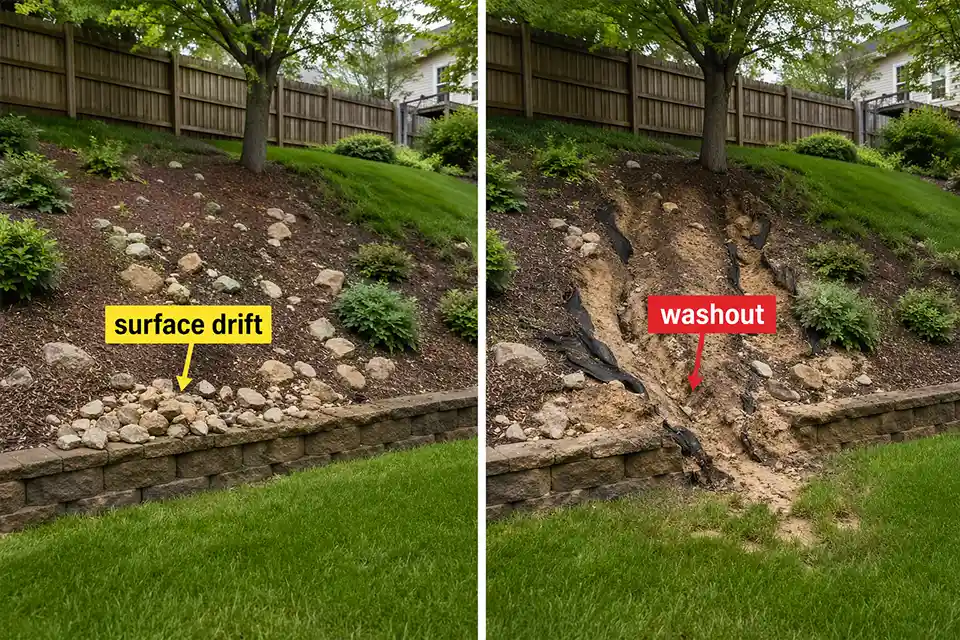
Minor drift is mostly a surface problem
Minor drift usually looks like a thin line of rock collecting at the bottom of the slope, a few shallow bare patches, and no real cuts in the soil underneath. This often happens on slopes under about 20% to 25%, especially when the surface layer is rounded stone, pea gravel, or small decorative rock that cannot interlock.
You can still keep rock on many slopes in this category, but only if the water path is under control.
Washout is a different category
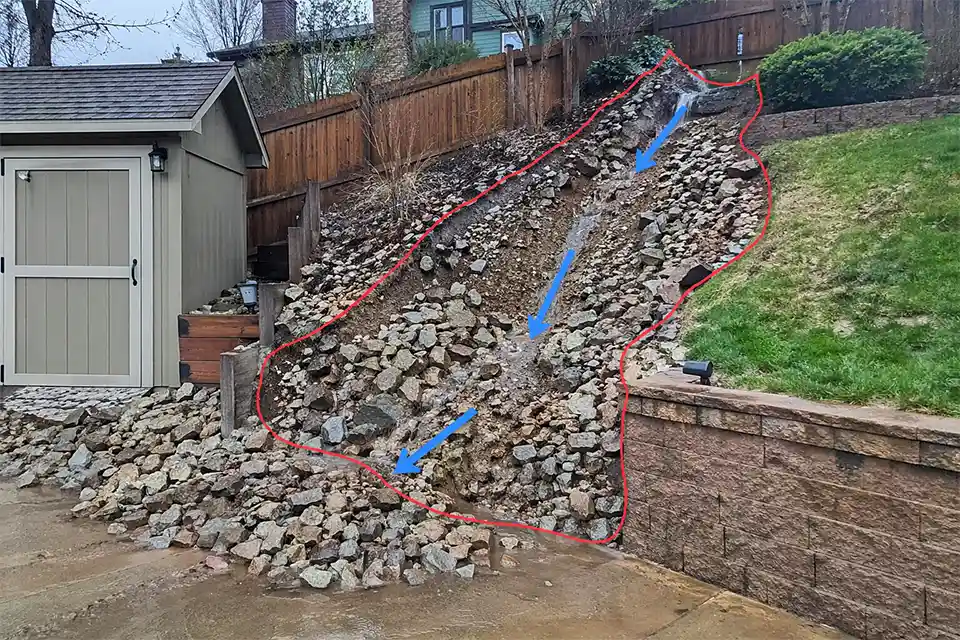
Washout means the hill is losing both stone and soil. The clue is repetition. You see the same strip fail after every storm, often with small rills, exposed fabric, or narrow runoff streaks. Once the soil is going too, the issue is no longer “how do I stop rocks from sliding?” It becomes “why is runoff cutting a path here?”
That same mechanism shows up in broader Sloped Backyard Problems: Drainage, Erosion, and Safety. Loose rock is often just the first visible sign.
What actually causes loose rock to keep sliding
Concentrated runoff is the main driver
In most backyards, the stone is not moving randomly. Water is being concentrated by a downspout, sump outlet, patio edge, mower track, compacted strip, or subtle low path in the yard. If the same narrow band keeps failing, that is your strongest clue.
A simple field test helps. Dig a hole about 12 inches deep, fill it with water, and watch how it drains. If water is still sitting there after about 30 minutes, infiltration is already weak. If it is still there after 24 hours, the subsoil is poor enough that saturation and runoff are probably working together.
The wrong stone type makes the outcome worse
Pea gravel and rounded river rock are poor performers on slopes because they roll instead of locking together. Small decorative rock under about 3/4 inch usually moves first. Angular stone in the roughly 1.5-inch to 3-inch range tends to behave better because the pieces wedge into each other.
This is where homeowners often overestimate weight and underestimate shape. Heavier rock can still fail when the runoff path stays the same.
Landscape fabric is often misread as erosion control
Standard weed fabric is not the same as a slope-stabilizing layer. On a hillside, fabric over smooth hard-packed soil can act like a sliding plane. That is why some slopes fail as a sheet rather than one stone at a time.
The same logic often appears in How to Stop Mulch Sliding on a Sloped Planting Bed. Different surface, same mechanism.
Can you keep rock on this slope, or should you switch systems?
Keep rock if…
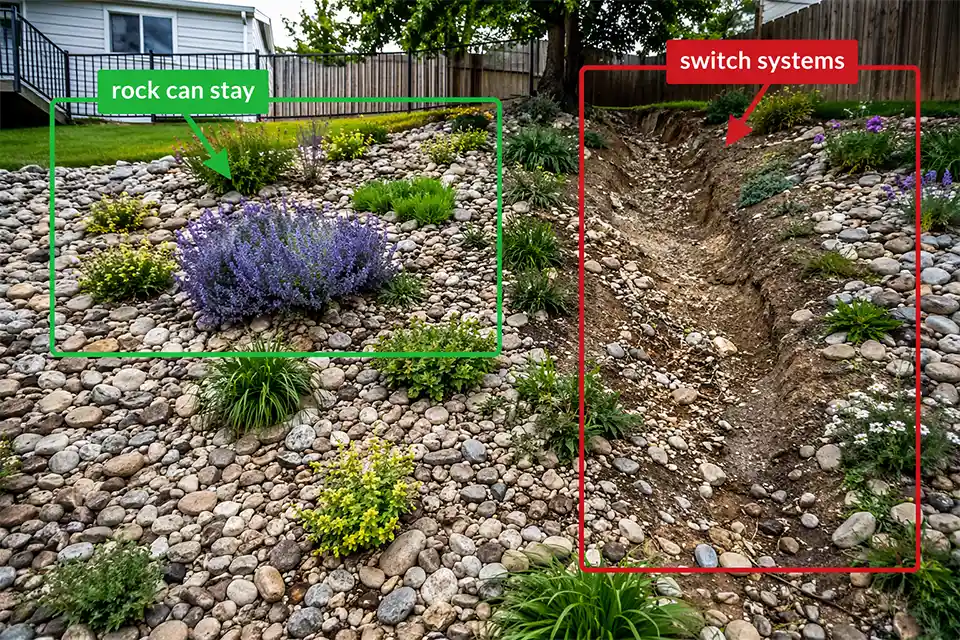
You can usually keep rock as the finish if the slope is gentler than about 3:1, the movement is mostly surface drift, runoff can be redirected, and the hillside can be interrupted with edging, contour breaks, or planting pockets.
Stop forcing rock if…
Stop trying to make decorative rock do all the work when the slope is steeper than 3:1, the soil and stone are moving together, channels reform after one or two storms, or the toe of the hill starts bulging outward. At that point, you are not deciding between two nice-looking finishes. You are deciding whether the slope gets stabilized or keeps failing.
Before adding more rock to an unstable hill, it helps to review what to use for erosion on a backyard slope so the product matches the actual problem instead of just covering it.
The repair sequence that actually changes the outcome
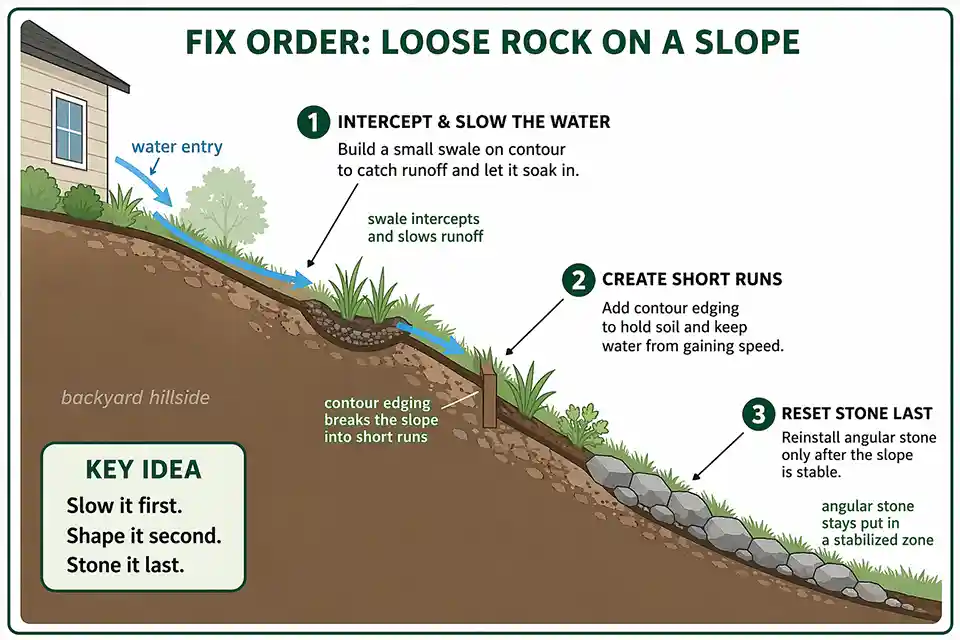
1. Fix the water path first
Do not start by adding more rock. Follow the water. Extend downspouts. Reroute discharge. Break up a straight downhill run with a shallow swale, a low berm, or a defined drainage strip that carries water where you want it to go.
If runoff is already leaving your property, handle that early. The same logic applies in When Water From a Sloped Backyard Runs Into a Neighbor’s Yard.
2. Pull back the failed strip and inspect the base
Remove the displaced stone from the actual failure zone instead of topping it off. If the base is smooth, crusted, or channelized, loosen the top 2 to 3 inches and reshape it so it slows water instead of shedding it. Several shallow rills are not random damage. They are flow lines.
3. Rebuild with interruption, not just replacement
If rock still makes sense, reinstall with angular stone, edge restraint, and interruption points. Those interruption points can be contour bands, low retaining edges, short check strips, or planted pockets that shorten the uninterrupted run of the slope.
Pro Tip: When only one narrow strip keeps failing, treat it like a drainage route in disguise. Matching the rest of the hillside is less important than stopping the repeat washout.
What to do before the next storm
If you do not have time for a full rebuild yet, focus on limiting damage.
What helps right away
Do not add fresh loose stone to an active failure strip. Extend any obvious outlet that is dumping onto the slope. Cover exposed soil with a temporary erosion-control blanket or coir mat rather than ordinary weed fabric. Mark the upper and lower edges of the moving area so you can measure how far it shifts after the next rain.
What usually wastes time
Spraying adhesive over a slope with uncontrolled runoff rarely solves much. So does topping off the washed area with the same small decorative rock that already failed. Those are patches, not corrections.
Quick decision guide
| Condition | What usually fails | What usually works better | Why |
|---|---|---|---|
| Mild slope under 20% | Small rounded gravel | Angular stone with edging | Better interlock and less rolling |
| Moderate slope 20%–33% | Loose rock on slick fabric | Angular stone plus runoff control and contour breaks | Water speed starts controlling the outcome |
| Steep slope over 33% | Full decorative rock coverage | Terracing, planting, blanket, or structure | Loose surface material becomes unreliable |
| Narrow strip below downspout | Adding more stone | Outlet extension and a defined flow path | The real problem is concentrated discharge |
| Fresh bare slope after repair | Weed fabric only | Coir or jute blanket during establishment | Temporary stabilization protects the soil |
When standard fixes stop making sense
There is a point where this stops being a surface-material problem. That point usually arrives when channels reform after one or two significant storms, the downhill toe gets soft or starts bulging, or nearby hardscape starts to shift.
If there is a wall, fence, or patio edge involved, watch for linked signs from Retaining Wall Failure Signs in a Sloped Backyard. Loose rock can be the first symptom while the deeper structural problem is still developing.
Quick diagnostic checklist
- Rock moves more than 2 to 3 inches after one heavy rain
- Channels deeper than about 1 inch keep coming back
- A 12-inch test hole drains slowly or still holds water after 24 hours
- The slope is steeper than about 3:1
- The same downhill strip fails every time
- Fabric, compacted subsoil, or bare washout streaks are already visible
If two or three of those are true, buying more of the same rock is probably the wrong next step.
Loose rock on a sloped backyard hillside is fixable, but only when the fix matches the mechanism. On mild slopes with minor drift, better stone and better restraint may be enough.
On moderate slopes, rock can stay only if runoff is controlled and the hillside is interrupted. On steep slopes with repeated soil loss, decorative rock is no longer stabilization. It is just a finish that keeps failing.
A closely related example is Bare Soil Washout in a Sloped Backyard, where the same runoff pattern keeps stripping the surface.
That broader erosion logic matters here too, especially when water is concentrating into one repeated flow line instead of spreading evenly across the hill.
For broader official guidance, see Control Heavy Runoff – Solving Drainage and Erosion Problems.