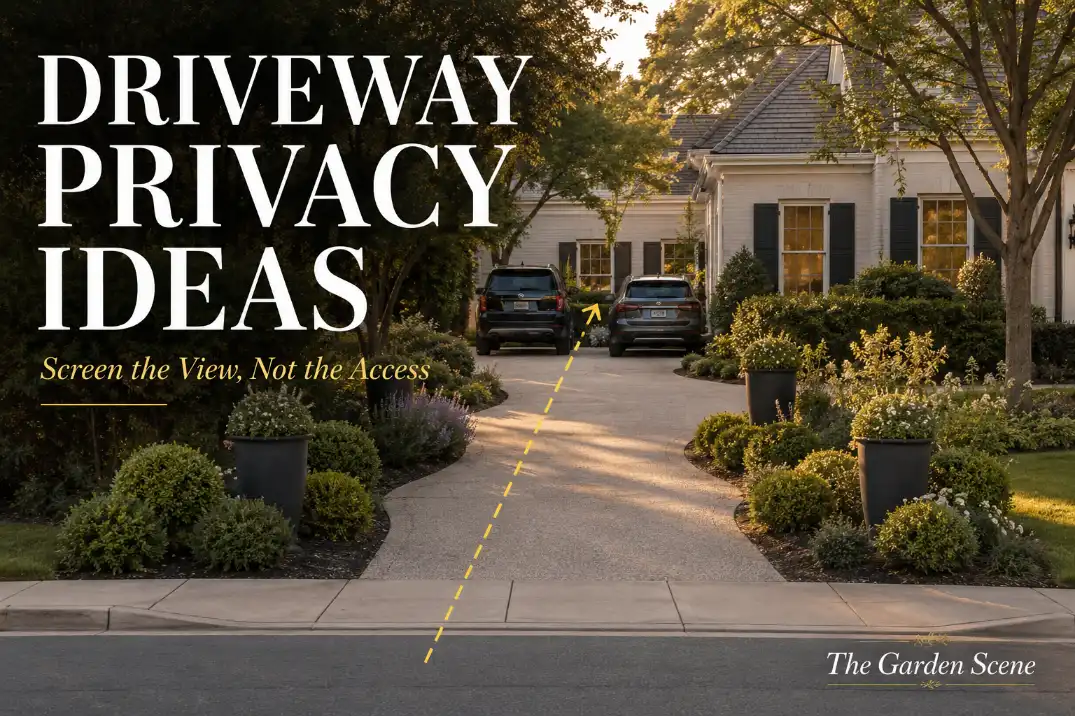
A driveway feels too open when the view travels straight from the street, sidewalk, porch, or neighboring driveway into the parked-car zone.
The first mistake is treating it like a general front yard privacy problem. Driveways have a different limit: you need screening, but you still need car-door clearance, safe backing visibility, and a driveway mouth that does not feel squeezed.
Start by standing at the curb and looking toward the driveway at about 5 feet high, close to normal eye level. If the parked car, garage approach, or front windows are fully visible in one clean line, the yard needs a privacy interruption.
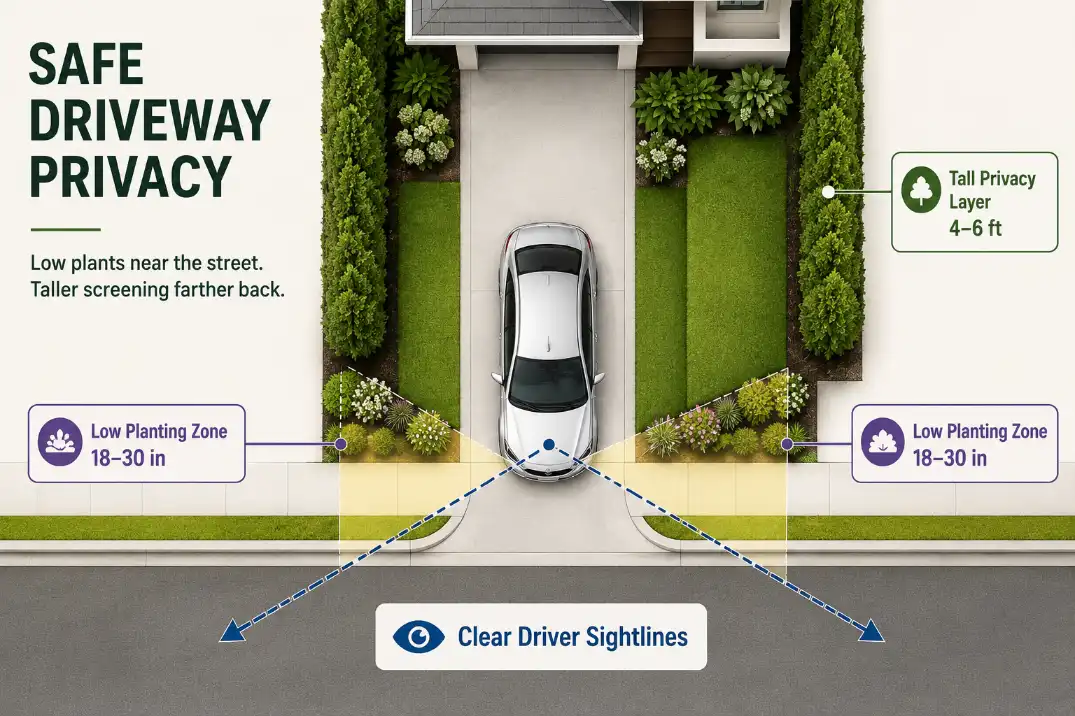
Most front driveway privacy works best between 3 and 6 feet tall, but the street end should usually stay lower, often around 18 to 30 inches, so the driveway remains safe and usable.
Best Driveway Privacy Ideas for Front Yards
The best driveway privacy ideas do not try to hide the whole driveway. They break the most exposed view while keeping the driveway easy to use every day.
Tall Planters at the Driveway Edge
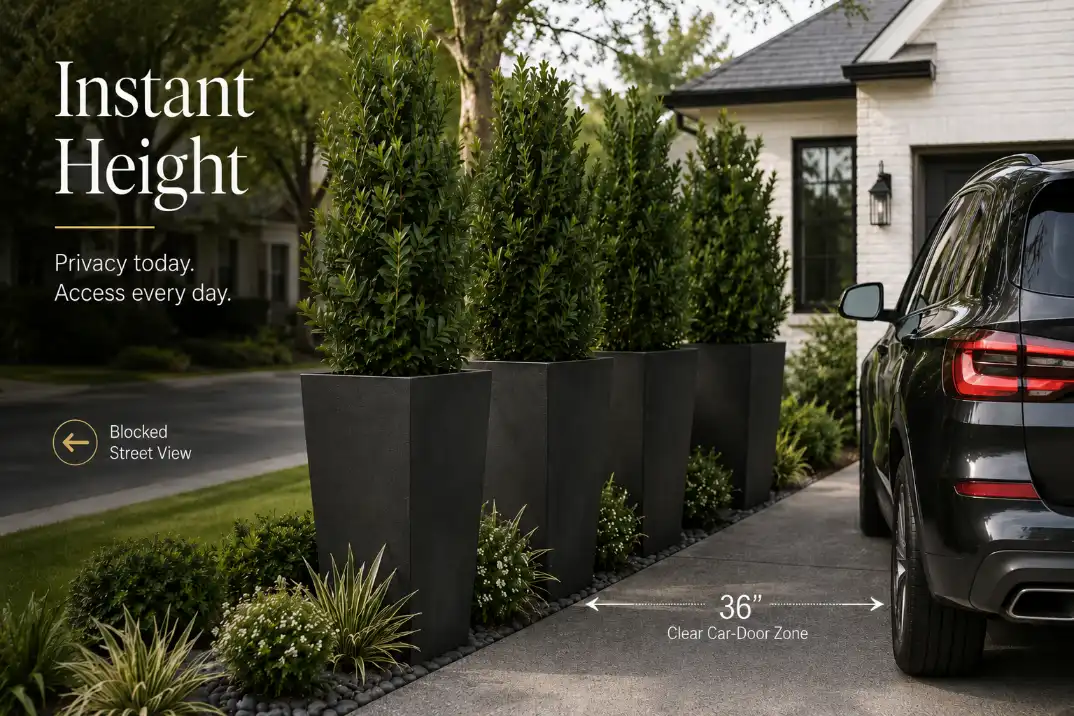
Tall planters are the quickest way to add driveway privacy because they create height without waiting years for shrubs to mature. They work especially well when the driveway edge is plain concrete, asphalt, or pavers with no planting bed.
For this idea to feel intentional, use fewer, larger planters instead of many small pots. Two or three rectangular planters, each about 24 to 36 inches wide, usually look more premium than a scattered line of containers. The planted height should land around 4 to 5 feet if the goal is to soften views into parked cars or the front entry path.
The important detail is clearance. Keep about 30 to 36 inches beside the parked-car zone so doors can open comfortably. A planter that looks perfect when the driveway is empty can become irritating once a car, groceries, kids, or delivery boxes are involved.
This is also a smart test before committing to permanent planting. A hedge may take 2 to 5 years to become useful; large planters change the sightline immediately.
Best for: exposed parked-car areas, plain driveway edges, HOA-limited yards, and homes that need privacy quickly.
Avoid if: the driveway edge has less than 30 inches of usable clearance or the containers cannot be weighted against wind.
Staggered Shrub Islands
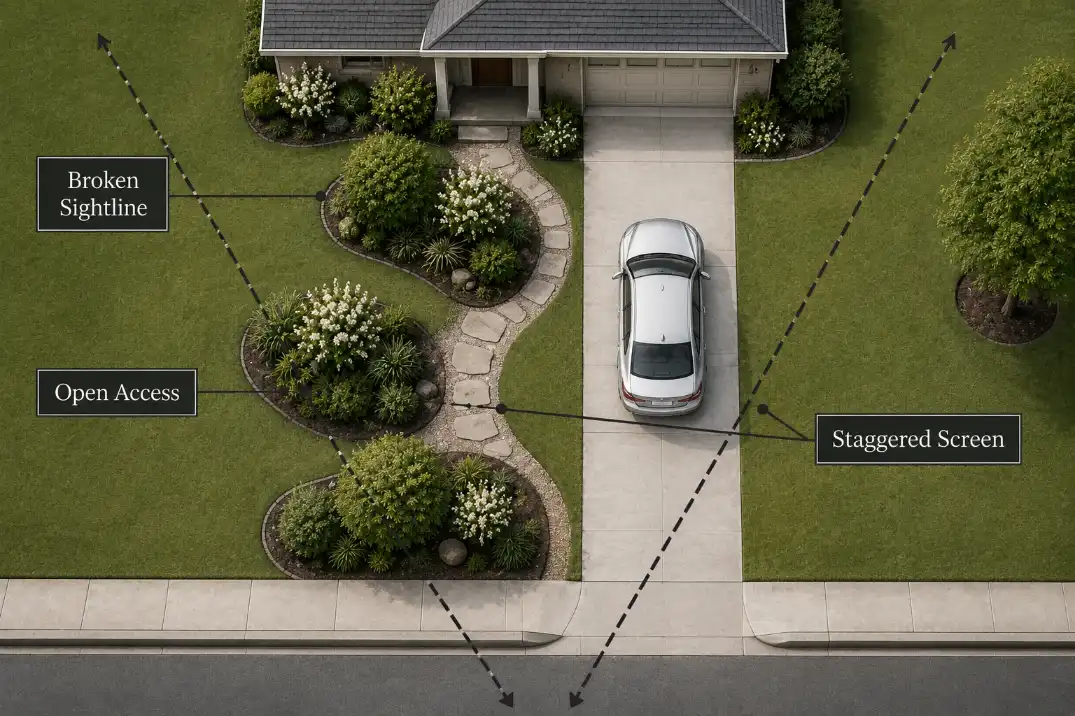
Staggered shrub islands are often better than a straight hedge because they interrupt views from several angles without building a visual wall. This matters on driveways because the view rarely comes from only one direction. A person may see the driveway from the sidewalk, the street, the porch, or a neighboring front walk.
Instead of planting one continuous row, place shrubs in offset groups along the driveway edge. Leave walking gaps and keep the driveway edge usable. A staggered layout can make a front yard feel private even when parts of the driveway remain visible.
This is where homeowners often overestimate the value of density. More plants do not automatically mean better privacy.
If the planting becomes too thick, it can make the driveway feel narrow and harder to maintain. The better goal is not total coverage; it is a broken sightline.
Best for: driveways visible from multiple angles, wide front yards, and homes where a hedge would feel too rigid.
Avoid if: the planting groups would block the main walking route or spill into the car-door zone within 2 to 3 years.
Low Wall With Ornamental Grasses
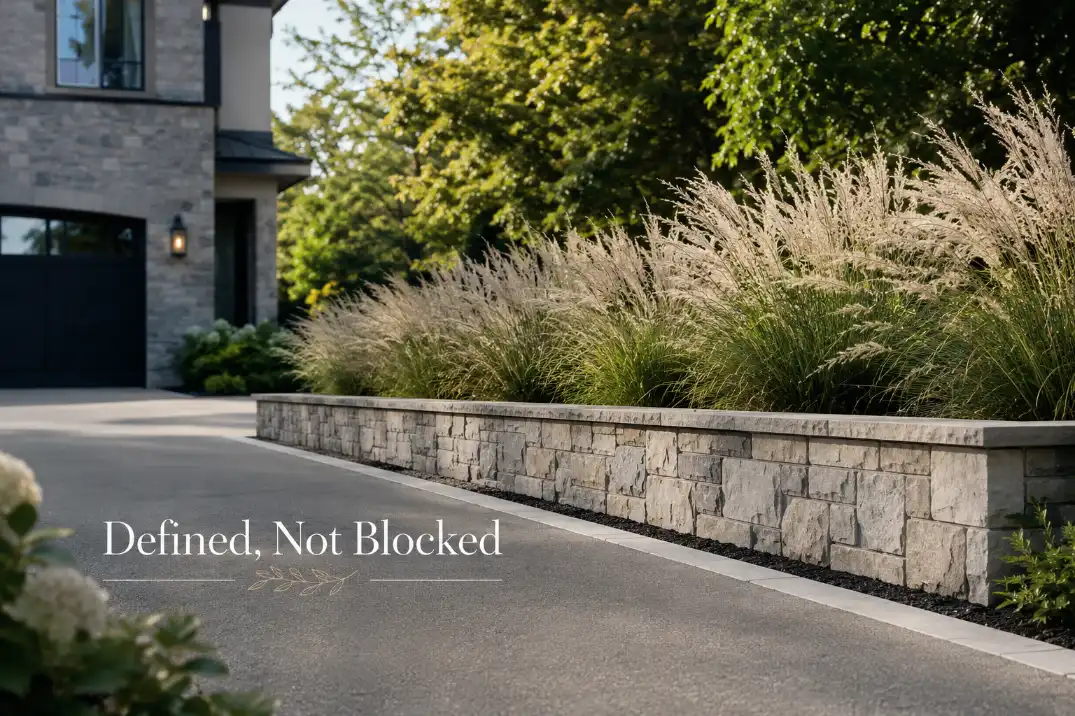
A low wall with ornamental grasses is a strong choice when the driveway feels visually exposed but does not need full screening. The wall defines the edge; the grasses soften the view above it.
A wall around 24 to 30 inches high is usually enough to make a driveway feel more designed. Add grasses behind or beside it so the privacy layer has movement instead of becoming a hard boundary. This is especially useful on wide driveways where planting alone can look too small against the concrete.
The condition people underestimate is winter and water movement. In northern states, a wall too close to the driveway can interfere with snow storage or get damaged by plow spill. In rainy Midwest regions, a wall placed across a drainage path can create puddling after storms.
If water already crosses the driveway during heavy rain, solve that before making the wall permanent.
Best for: wide driveways, modern front yards, and spaces that need structure more than full privacy.
Avoid if: the driveway edge is used for snow storage, drainage crosses the area, or the wall would narrow access.
Driveway Entrance Planting Pair
A planting pair at the driveway entrance can make an open front yard feel more composed, but this idea has to be handled carefully. The entrance is not the place for the tallest or densest privacy screen.
Use two upright shrubs, small ornamental trees, or large planters set back from the curb rather than placed directly at the driveway mouth. The pair should frame the entrance, not squeeze it. On driveways around 10 to 12 feet wide, bulky planting at the mouth can make the space feel tighter than it is.
The better move is to keep the street-side edge visually lighter, then increase privacy farther back near the parked-car area.
If the entire front yard also feels exposed beyond the driveway, ideas from Front Yard Landscaping Privacy Ideas can support the broader lawn and planting layout without changing the driveway-specific screen.
Before adding anything tall near the driveway mouth, check local visibility rules or HOA planting limits, especially on corner lots.
Best for: open driveway entrances that need framing, not full screening.
Avoid if: the plants would sit directly in the street sightline or make backing out feel blind.
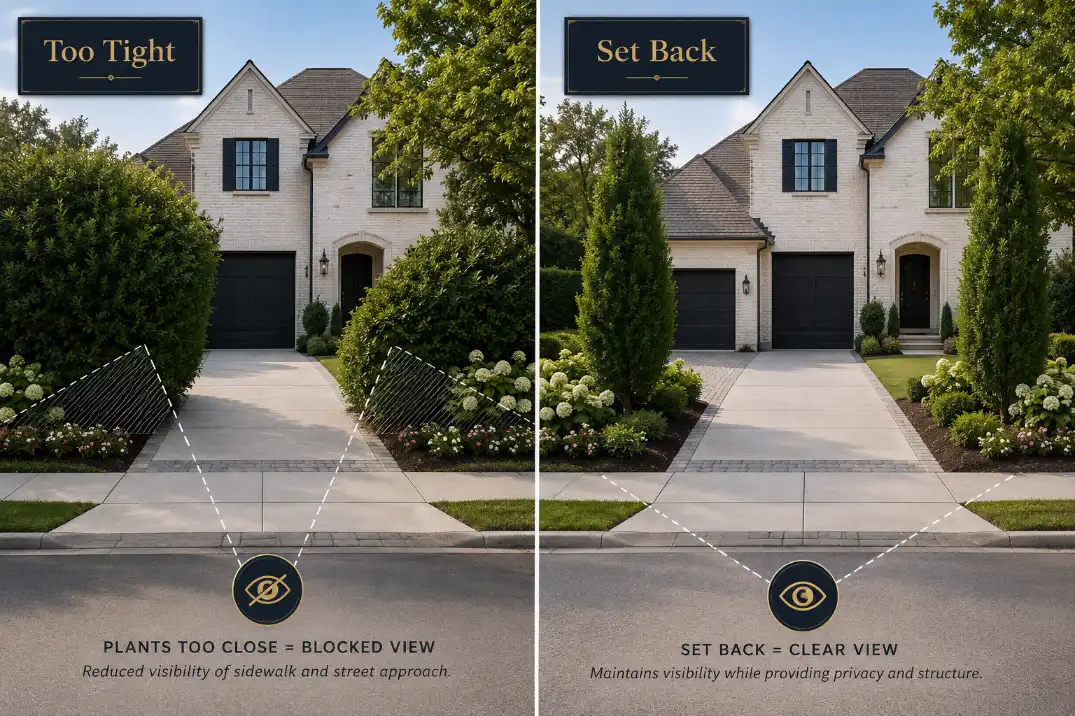
Side Yard to Driveway Screen
Some driveway privacy problems begin along the side yard, not the front lawn. If the driveway runs beside a blank wall, side gate, trash-bin area, utility zone, or neighbor-facing strip, that long exposed line can make the whole front yard feel open.
A slim side screen can solve this better than adding large plants near the street. Use upright shrubs, a narrow trellis, or a decorative screen softened with grasses. Even a 12- to 18-inch planting strip can help if the plant choices stay narrow and the soil is improved.
This is a good place to be precise. A plant that matures 5 feet wide does not belong in an 18-inch strip beside a driveway. Use columnar forms, climbing plants on a panel, or tall planters instead.
Best for: driveways beside house walls, side gates, trash storage, utility zones, or neighbor-facing strips.
Avoid if: the screen would trap access to meters, gates, hoses, or service paths.
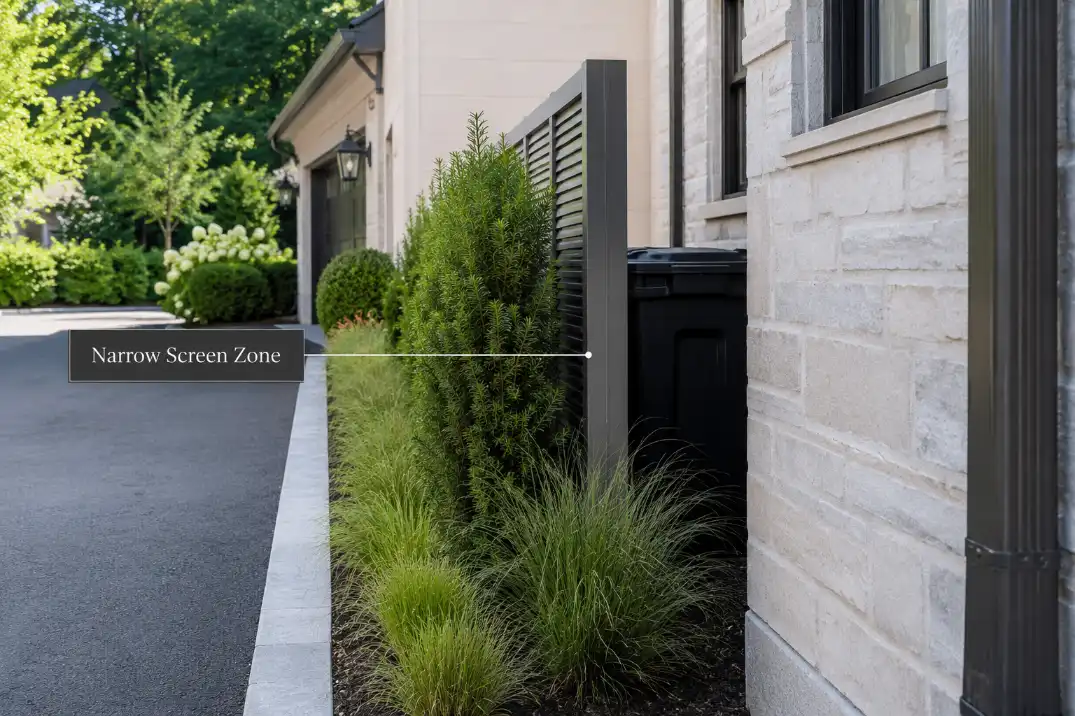
Portable Planter Screens
Portable planter screens are useful when the driveway needs privacy but digging is not practical. They are especially helpful for renters, HOA-limited homes, recent hardscape installations, or areas with unknown utilities.
The main weakness is stability. A tall lightweight screen can catch wind, especially in open suburban lots. If gusts commonly reach 20 to 30 mph, use heavier containers, lower planting, or a screen anchored to a stable base.
This fix is practical, but it should not look temporary. Matching planter materials and repeating one plant form will make it feel designed.
Best for: temporary privacy, rental homes, uncertain layouts, and places where planting beds cannot be added yet.
Avoid if: the driveway is highly exposed to wind and the planters cannot be weighted or secured.
Narrow Evergreen Strip
A narrow evergreen strip can provide year-round driveway privacy, but only if the bed is wide enough for the mature plant. This is one of the most common driveway mistakes: planting young evergreens that look perfect at installation and then grow into the car path within a few seasons.
If the bed is less than 24 inches deep, avoid broad evergreens. If the bed is closer to 36 inches deep, upright shrubs become more realistic. Always check mature width before height. A 6-foot-tall shrub that matures 5 feet wide is not a narrow driveway plant.
For smaller front yards, the same spacing logic matters even more. Small Front Yard Privacy Ideas can help where the driveway is only one part of a tight frontage, but the driveway edge itself still needs enough clearance to function.
Best for: year-round privacy where the driveway bed has enough depth for mature growth.
Avoid if: the strip is under 24 inches deep or the shrub’s mature width would push into the driveway.
Decorative Screen With Soft Planting
A decorative screen works best when it blocks one specific view: a parked car from the porch, a trash area from the street, or a neighbor-facing side of the driveway. It should not be used as a substitute for a full front-yard plan.
The weak version is a bare panel dropped beside the driveway. It may block the view, but it often looks like a patch. The stronger version uses a screen with low shrubs, grasses, or a vine so the panel feels integrated into the landscape.
Best for: one targeted privacy problem, especially beside a porch, side gate, or utility zone.
Avoid if: the panel would become a long fence-like wall along the driveway.
Driveway Privacy Ideas by Exposure Type
Driveway privacy depends less on how open the yard is and more on where the exposure comes from. The same planter, shrub, or screen can be right in one driveway and wrong in another.
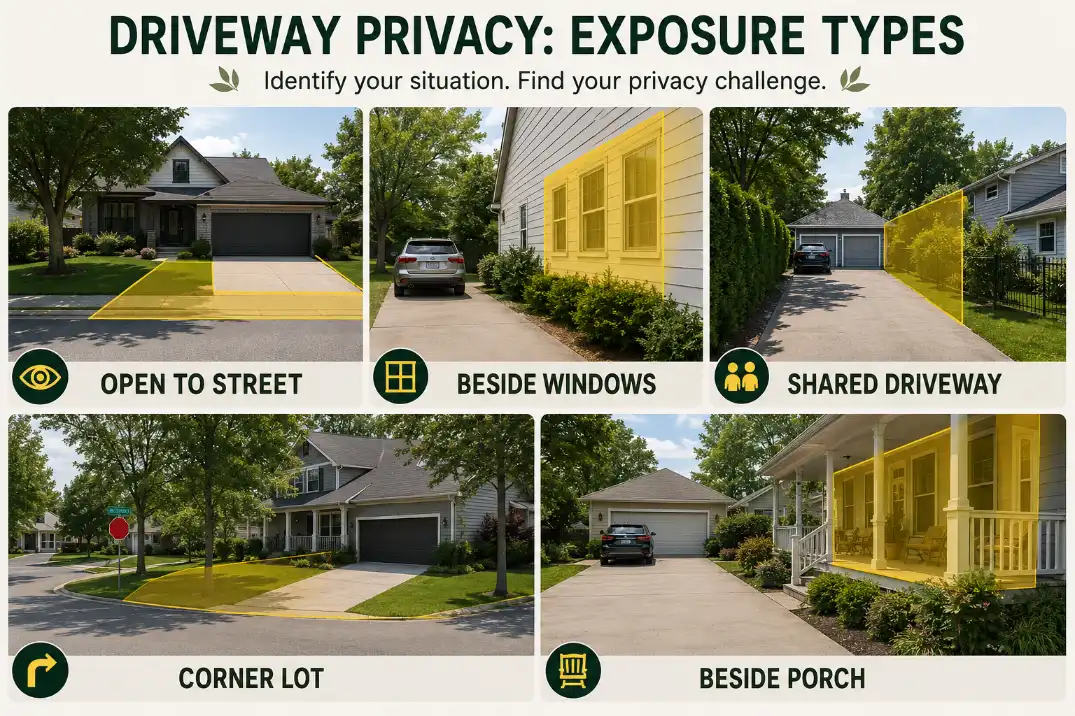
| Driveway Exposure | Best Privacy Move | What to Avoid |
|---|---|---|
| Open to the street | Staggered shrubs or planters set back from curb | Tall solid planting at the driveway mouth |
| Beside front windows | Taller screening near the house | Blocking window light with dense evergreens |
| Shared driveway | Portable planters or slim screens outside the shared path | Planting into shared access space |
| Corner driveway | Low planting near street, taller layer farther back | Tall shrubs in visibility zones |
| Beside porch | Decorative screen with soft planting | A hedge that disconnects porch from driveway |
Driveway Open to the Street
When the driveway is open directly to the street, the strongest privacy layer is usually not at the curb. It should sit slightly deeper into the yard, where it can screen the parked-car area without blocking street visibility.
Use lower planting near the public edge, then step up to taller plants closer to the house. This creates privacy where people actually feel exposed, not where the driveway needs to stay visually open.
Driveway Beside Front Windows
If the driveway runs beside front windows, focus on the window-facing view. A 4-foot planting group near the house may do more than a long hedge along the whole driveway.
The common misread is assuming the entire driveway needs screening. Usually it does not. The sensitive area is the line between the car, the window, and the sidewalk.
If the driveway also affects how private the porch feels, Front Porch Privacy Ideas can support that porch-facing layer without turning this driveway article into a porch privacy guide.
Shared Driveway Privacy
A shared driveway needs privacy that respects movement. Use portable planters, narrow screens, or planting pockets that stay fully outside the shared travel path.
This is where a hedge often becomes the wrong fix. Even if it starts on your side, mature growth can lean into the shared lane. A slim screen or contained planter usually creates fewer conflicts.
Corner Driveway Visibility
Corner driveways need the most restraint near the street. Because cars, pedestrians, and cyclists can approach from more than one direction, tall dense plants near the corner create a safety issue.
Use low planting in the visibility zone and move taller privacy features deeper into the lot. A good working range is 18 to 30 inches high near the street-facing sightline, then 4 to 6 feet where the driveway is farther back.
Driveway Beside the Porch
When the driveway runs beside the porch, the privacy goal is usually emotional as much as visual. The porch feels less restful when every parked car, delivery drop-off, or neighbor movement sits in the same view.
A decorative screen with soft planting can separate the porch from the driveway without making the front yard feel closed. Keep it targeted. One good screen placed near the porch edge is usually better than a full driveway hedge.
How to Add Driveway Privacy Without Blocking Access
The best driveway privacy design is one that still works on an ordinary Tuesday: doors open, guests can walk to the entry, delivery drivers can find the path, and the driver can back out safely.
Keep Car Door Clearance Open
Measure privacy placement with the car in the driveway. Do not estimate from an empty slab. A comfortable door-opening zone is usually 30 to 36 inches. If the privacy layer begins inside that space, daily use will feel cramped.
This is where a beautiful design can fail quickly. The symptom is scratched leaves, broken stems, or people stepping into the planting bed. The underlying mechanism is not plant choice; it is bad clearance.
Protect Sightlines Near the Street
Near the driveway entrance, visibility matters more than privacy. Tall shrubs at the mouth of the driveway may hide the car from the street, but they can also hide the street from the driver.
The safer pattern is simple: low near the street, taller farther back. This still gives privacy where the driveway feels exposed while keeping the exit readable.
Use Staggered Screening Instead of a Wall
A solid wall or dense hedge can feel like the cleanest solution, but it is often too blunt for a driveway. Staggered screening gives the eye enough interruption to feel private without creating a hard barrier.
This is the condition many people underestimate: partial privacy often works. A passerby does not study the driveway the way the homeowner does. Break the main sightline, soften the car shape, and add a foreground layer; the space will usually feel much less exposed.
Keep the Walkway Separate From the Privacy Layer
If the walkway crosses or follows the driveway, privacy planting should not push people into the car path. A clean walking route makes the whole front yard feel more intentional.
For homes where a fence is not allowed or would feel too harsh, ideas from Front Yard Privacy Ideas No Fence can support the softer no-fence approach, while this driveway layout should still protect clearance and sightlines first.
Pro Tip: Mark the proposed privacy edge with nursery pots, cones, or cardboard boxes for 48 hours before planting. Use the driveway normally, then adjust the line before committing.
Best Plants and Features for Driveway Privacy
Driveway plants face more stress than plants in open beds. Pavement reflects heat, roots may have limited soil, and winter driveways may receive salt spray or salty runoff. The right feature depends on width, height, maintenance, and exposure.
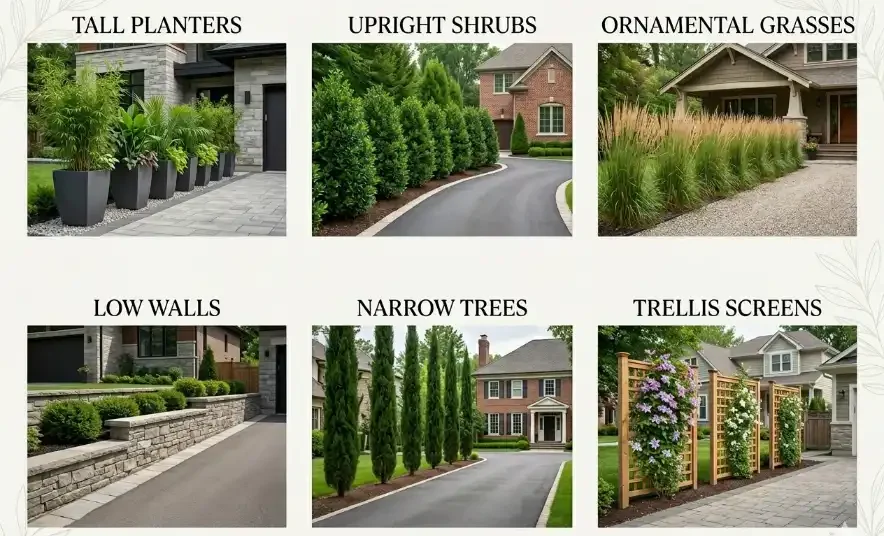
| Feature | Privacy Speed | Commitment | Best Use |
|---|---|---|---|
| Tall planters | Immediate | Low | Testing privacy before permanent planting |
| Staggered shrubs | 1–3 seasons | Medium | Breaking angled views along driveway edges |
| Low wall + grasses | Immediate structure, seasonal softness | High | Defining wide driveways without a harsh fence |
| Trellis screen | Immediate | Medium | Narrow side-driveway exposure |
| Evergreen strip | 2–5 years | High | Year-round privacy where bed depth is adequate |
Tall Planters
Best for immediate privacy, hardscape-heavy driveways, and spaces where digging is difficult. Avoid tiny containers near hot pavement. In dry or desert climates, a planter under 18 inches wide can dry out quickly in summer and may need frequent watering.
Good plant directions include upright evergreens, compact grasses, clipped shrubs, or mixed seasonal planting with one strong vertical form. The planter should look like part of the driveway design, not a leftover patio container.
Upright Shrubs
Best for permanent screening when the bed has enough depth. Prioritize mature width. For humid climates, leave airflow around dense shrubs where possible; crowded planting against pavement can stay damp and become harder to maintain.
Useful categories include columnar arborvitae, upright juniper, compact holly, or other narrow shrubs suited to the local climate. The category matters more than the plant label: choose upright growth, predictable width, and tolerance for driveway heat.
Ornamental Grasses
Best for soft, filtered privacy. Grasses are useful beside low walls, driveways, and entry paths because they move with wind and do not feel heavy. Their drawback is seasonal cutback. In many regions, they may be reduced in late winter or early spring, leaving a shorter screen for several weeks.
Common directions include switchgrass, feather reed grass, muhly grass, or other upright clumping grasses. Avoid spreading grasses where the driveway edge needs to stay clean.
Low Walls
Best for structure and definition. A low wall makes the driveway edge feel designed, especially when paired with grasses or shrubs. Avoid walls where they interfere with drainage, snow storage, or car movement.
A wall alone is usually not enough for privacy. Its real value is creating a base layer that makes the planting above it feel more intentional.
Narrow Trees
Best when the driveway needs vertical softness or screening from upper windows. Avoid them in very narrow strips. A tree in an 18-inch bed beside pavement is usually a long-term maintenance problem, not a privacy solution.
Possible directions include columnar hornbeam, serviceberry, or slim ornamental evergreens where the climate and space allow. Keep branches away from vehicle doors, mirrors, and garage approaches.
Trellis Screens
Best for narrow side-driveway conditions where vertical privacy matters more than bed depth. Use them to block one clear view, not to imitate a full fence. A trellis looks strongest when softened with planting.
Climbing plants can help, but the panel should still look finished before the vine fully fills in. Otherwise, the driveway may look unfinished for a full growing season or longer.
Quick Driveway Privacy Checklist
- Identify the main view line from the street, sidewalk, porch, or neighboring driveway.
- Keep 30 to 36 inches clear where car doors open.
- Use 18- to 30-inch planting near street sightlines.
- Move 4- to 6-foot privacy layers farther back from the driveway mouth.
- Avoid shrubs that will outgrow the planting strip within 2 to 3 years.
- Choose planters, screens, or staggered groups before defaulting to a hedge.
Questions People Usually Ask
How tall should driveway privacy planting be?
Most driveway privacy works between 3 and 6 feet tall. Use lower planting near the street and taller layers near parked cars, front windows, porch edges, or side-yard exposure.
What is the fastest driveway privacy idea?
Tall planters are usually the fastest useful fix. They add height immediately, can be moved after testing the layout, and do not require waiting years for a hedge to fill in.
Is a hedge a good driveway privacy solution?
A hedge works only when there is enough bed depth, driveway clearance, and safe visibility. In tight driveways, staggered shrubs, planters, or slim screens are often better.
What should I avoid near the driveway entrance?
Avoid tall dense shrubs, solid panels, or bulky planters placed directly at the driveway mouth. The entrance needs clearer visibility than the inner driveway. Keep the first street-facing zone lower, then move taller privacy features farther back.
Can driveway privacy look good without blocking the driveway?
Yes. The strongest driveway privacy usually filters the view rather than closing the space. A layered edge, set-back planting pair, or narrow side screen can make the driveway feel private while keeping access clear.
For broader official guidance on plant stress near driveways and deicing areas, see the University of Minnesota Extension.