Last updated: June 28, 2026
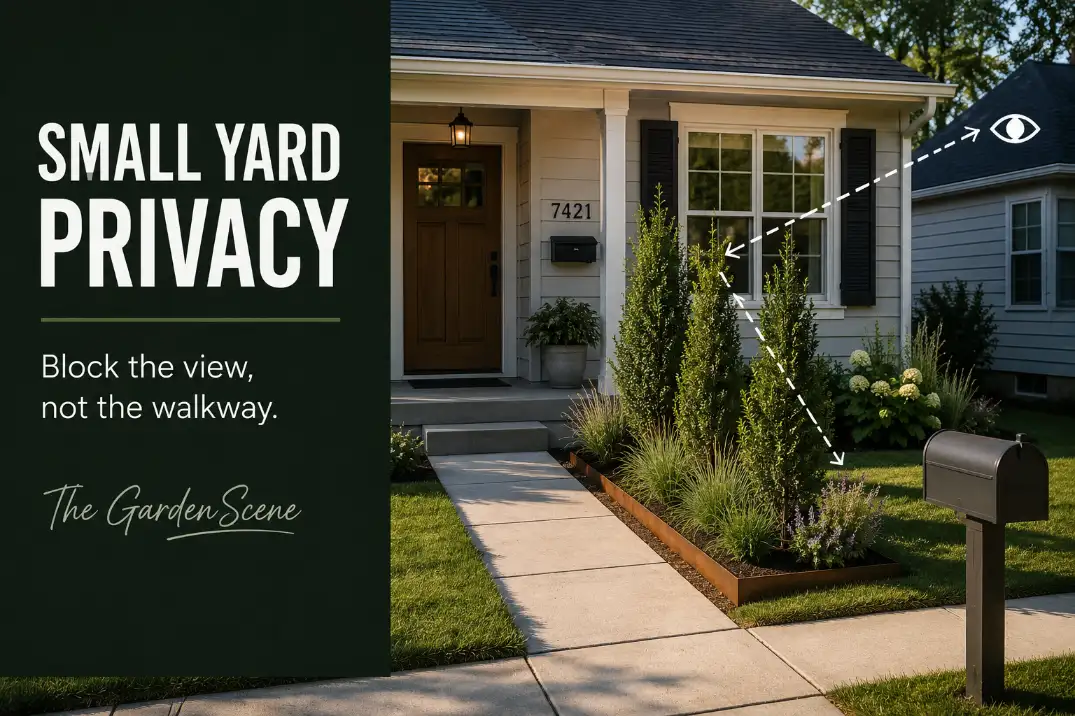
Small front yard privacy landscaping fails when the plant comes before the layout. A shrub that looks modest at the nursery can crowd a walkway in two seasons. A hedge that seems private from the sidewalk can make the front door feel hidden. A trellis that protects one window can still leave the porch exposed if it sits off the actual view line.
The better starting point is not “What should I plant?” It is “Which view needs to be interrupted, and how much usable space remains after the walkway, entry, window, and mature plant width are protected?”
In a small setback, every inch has a job. The sidewalk, driveway edge, front walk, porch step, package drop area, and house number still need to function after privacy goes in. A good layout protects the exposed spot without making the approach feel closed.
Start With the View Line, Not the Plant List
Small front yards rarely need a full privacy wall. They usually need one exposed angle softened enough that the window, porch chair, or front room no longer feels open to every passerby.
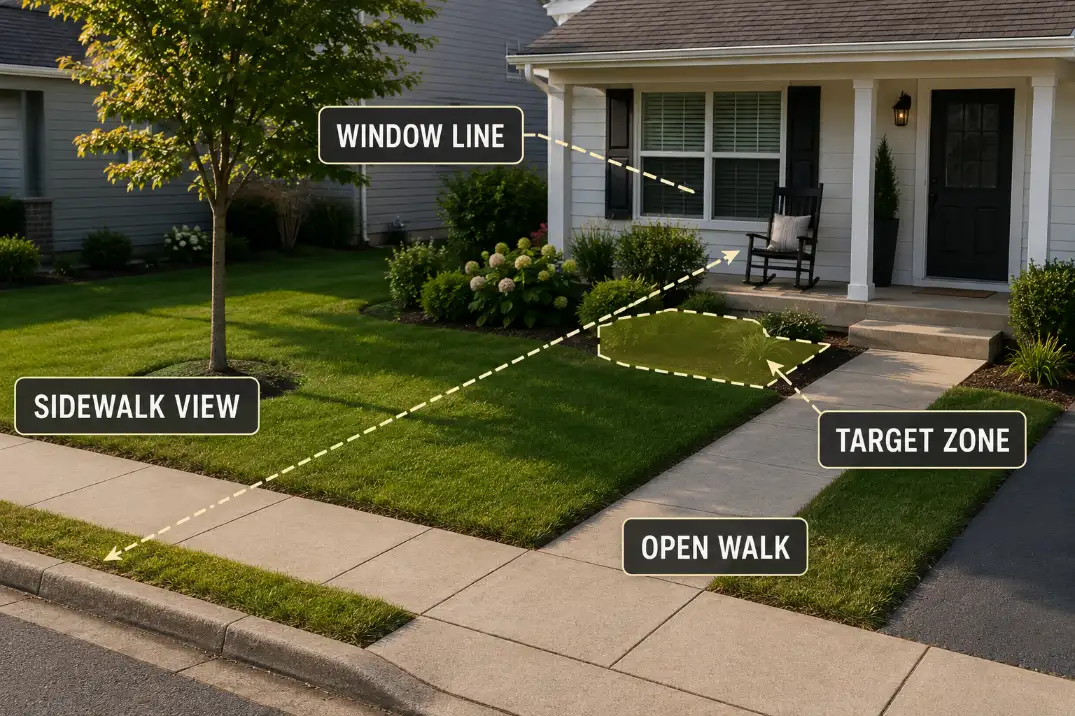
Stand where the view starts, not where the plant will go. That may be the public sidewalk, the curb, a neighbor’s driveway, a bike lane, or the street-facing approach to your house. Then look back toward the part of the yard or house that feels exposed.
The common view lines are simple:
- sidewalk to front window
- street to porch chair
- driveway to front door
- neighbor window to front room
- corner-lot traffic to porch seating
The layout decision is whether that view needs to be blocked, filtered, or redirected. Blocking uses a taller, denser element to interrupt most of the line. Filtering breaks the view enough to make the space feel less exposed while the yard still reads open. Redirecting shifts attention away from the window or chair without building a full screen.
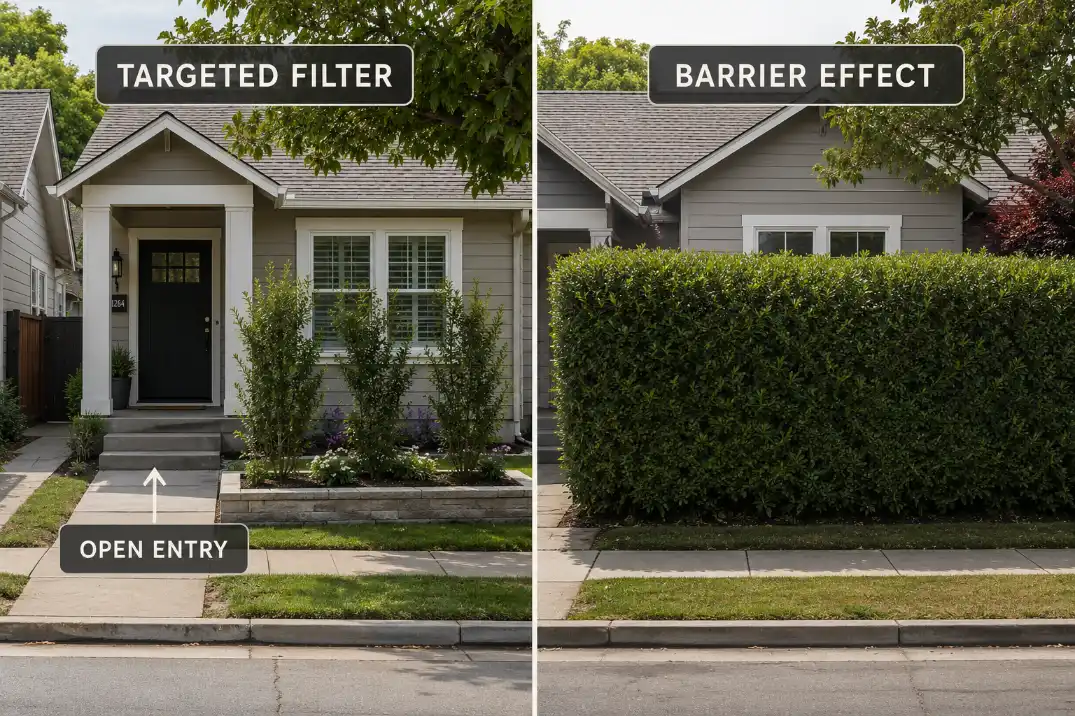
In a small front yard, filtering usually works better than blocking. A full barrier can make the setback feel shorter, hide the entry, and create a wall of plant mass right where the house needs breathing room. That is why small-yard privacy should begin as a targeted sightline problem.
If the setback itself is the main constraint, a related planning page on front yard design with minimal setback space can help frame how little room many entries actually have before planting begins.
Measure the Small Setback Before You Choose the Privacy Form
Once the exposed view is clear, measure the space that can actually hold privacy landscaping. In a small front yard, “available yard” and “plantable yard” are not the same thing.
The most important measurements are not decorative. They decide whether the privacy solution can exist without becoming the next problem.
| Measurement | What to Check | Why It Matters | Layout Decision |
|---|---|---|---|
| Bed depth | Distance from walkway, wall, porch, or sidewalk edge to the planting zone | Determines whether a slim filter, single row, or layered bed can fit | Shallow strip vs deeper bed |
| Sidewalk distance | How close public movement is to the window or porch | Shows whether privacy needs height, density, or just angle control | Filter view vs block view |
| Window height | Sill height and the line people can see through | Prevents planting too low or too tall for the actual exposure | Low planting vs mid-height screen |
| Walkway clearance | Clear usable walking width after mature plant spread | Keeps the entry functional | Preserve at least a 36-inch clear route |
| Mature plant width | Expected full spread, not nursery size | Prevents future crowding into the walk, siding, or porch | Choose narrow form or leave growth room |
The 36-inch walkway clearance is a practical planning threshold because front walks need to work for visitors, deliveries, bags, strollers, and normal movement at the door. It is not the only rule that matters, but if privacy landscaping reduces the usable route below that point, the yard may feel private for the wrong reason: people have to squeeze through it.
Use this order before choosing any plant or structure:
- Stand at the exposed view line and mark what needs filtering.
- Mark the walkway and entry route that must stay open.
- Measure the real bed depth after that clear route is protected.
- Check the window height or porch seating height the privacy must address.
- Compare the available depth with mature plant width, not nursery size.
- Choose the smallest privacy form that interrupts the view without filling the setback.
This sequence keeps the decision in the right order. The privacy form comes last because the space decides what can work.
Keep the Walkway and Entry Clear First
The front yard has to do more than look private from the street. It has to bring people to the front door without confusion.
That means some areas should stay visually open even if they feel exposed. The front door should be readable from the walkway. The house number should not disappear behind branches. The package drop area should not require stepping around a planter.
The mailbox route, porch step, and driveway edge should still make sense to someone who has never visited before.
Privacy landscaping becomes a problem when it steals from these movement zones. A shrub that leans into the walk, a planter that narrows the turn at the porch, or a trellis placed too close to the door can make the whole front yard feel defensive instead of welcoming.
The decision here is where privacy cannot go.
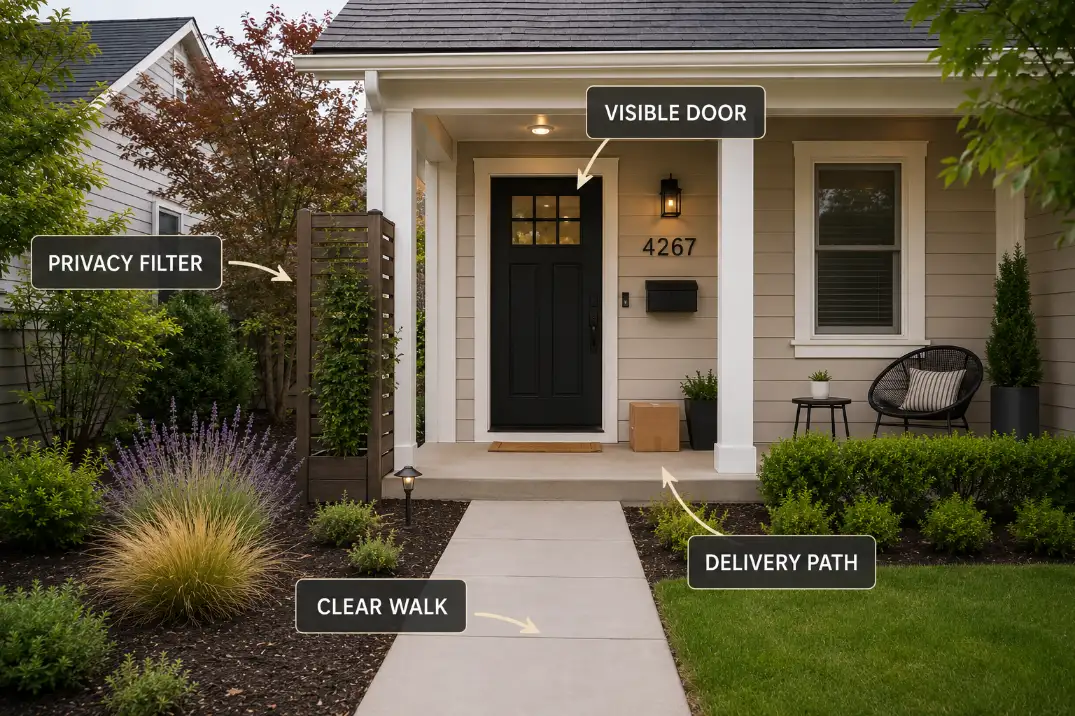
A good small-yard privacy layout usually protects these spaces first:
- a clear front walk, preferably at least 36 inches usable width
- a visible door from the public approach
- an uncovered house number or address marker
- a package drop zone near the door
- enough room to turn at the porch or steps
- a route from driveway or sidewalk that does not feel pinched
This is especially important on homes where the front walk already bends around a driveway or narrow planting bed. If the entry itself is easy to miss, solve that before adding more screening. A privacy layout should support visibility, not fight it.
For that reason, front-yard privacy often overlaps with basic entry usability, including house number visibility in the front yard when planting sits close to the door or porch.
Match Planting Depth to Mature Width
The most common small-yard privacy mistake is sizing the layout from how the plant looks on purchase day. That is the wrong size.
A privacy shrub in a container may look narrow enough beside a walkway, but its mature spread is what decides whether it belongs there. If the mature width pushes into the walking route, presses against siding, covers the window, or removes pruning access, the layout is already too tight.
This is where a small yard needs discipline. A plant that reaches 4 feet wide does not belong in a 2-foot-deep bed beside a front walk unless the homeowner accepts constant pruning and a clipped look.
A plant that wants to grow tall and full may be useful for privacy, but only if the setback can handle the width as well as the height.
Mature width affects four things:
Walkway edge
The plant should not grow into the clear route. If the bed sits beside the main front walk, leave enough room for the mature spread to stay out of the walking line, not just out of it on planting day.
Siding and windows
Plants placed too close to the house can crowd siding, trap moisture, or make windows difficult to maintain. For privacy near a street-facing window, the better solution may be a narrow upright form, a small layered bed set away from the wall, or a trellis placed on the sightline rather than against the glass.
Pruning access
Small front yards often fail because every planted edge becomes hard to reach. If the only way to prune is by standing in the walkway or leaning into the porch steps, the layout will become annoying even if it looks good the first season.
First-season gaps
Privacy landscaping should not be judged only by the first month. Leaving gaps can feel unfinished at first, but it may prevent the yard from becoming a green wall after 2–3 years. In small setbacks, staged privacy is usually safer than instant privacy.
This does not mean every plant must be tiny. It means the plant form has to match the depth. Narrow upright plants, clipped forms, low-to-mid shrub filters, espalier-style trellis planting, or planter-edge combinations can all work when the mature width stays inside the available zone.
Use Layered Planting Only When the Bed Has Enough Depth
Layered planting can make small front yard privacy feel softer than a single hedge, but only when the bed is deep enough to hold actual layers. If the bed is too shallow, layers become crowding.
A true privacy layer usually has a front edge, a middle filter, and a background or accent. The front edge may stay low near the walkway. The middle layer does the privacy work. The background may be the house wall, porch rail, existing foundation planting, or a taller accent placed away from the entry.
That does not mean every small yard needs three rows of plants. A very shallow bed may only support one clean privacy line. A medium bed may handle a low front edge with one mid-height filter. A deeper bed may allow a more complete layered composition.
The window height matters here. If the exposed view is through a low front window, a mid-height filter may be enough. If the window sits higher or the sidewalk is slightly elevated, low planting may look attractive but do little for privacy. If the porch chair is the exposed point, the filter may need to sit at the side angle rather than directly in front of the porch.
The layered decision should follow depth:
- very shallow bed: use a slim filter, planter edge, or narrow vertical element
- moderate bed: use one low edge plus one mid-height filter
- deeper small-yard bed: use layered planting with room for mature spread
- unclear depth: mark the mature plant width on the ground before planting
The goal is not to fill every inch. It is to interrupt the view while keeping the front yard readable. When the bed has enough depth, a separate guide to front yard privacy layering without a fence can support the next step without forcing this parent page into a full planting recipe.
Choose the Smallest Privacy Form That Solves the Sightline
After the view line, walkway clearance, bed depth, window height, and mature width are known, the privacy choice becomes much simpler. You are not choosing from every possible front yard privacy idea. You are choosing the smallest form that solves the measured exposure.
| Privacy Form | Works Best When | Space Need | What It Can Accidentally Block |
|---|---|---|---|
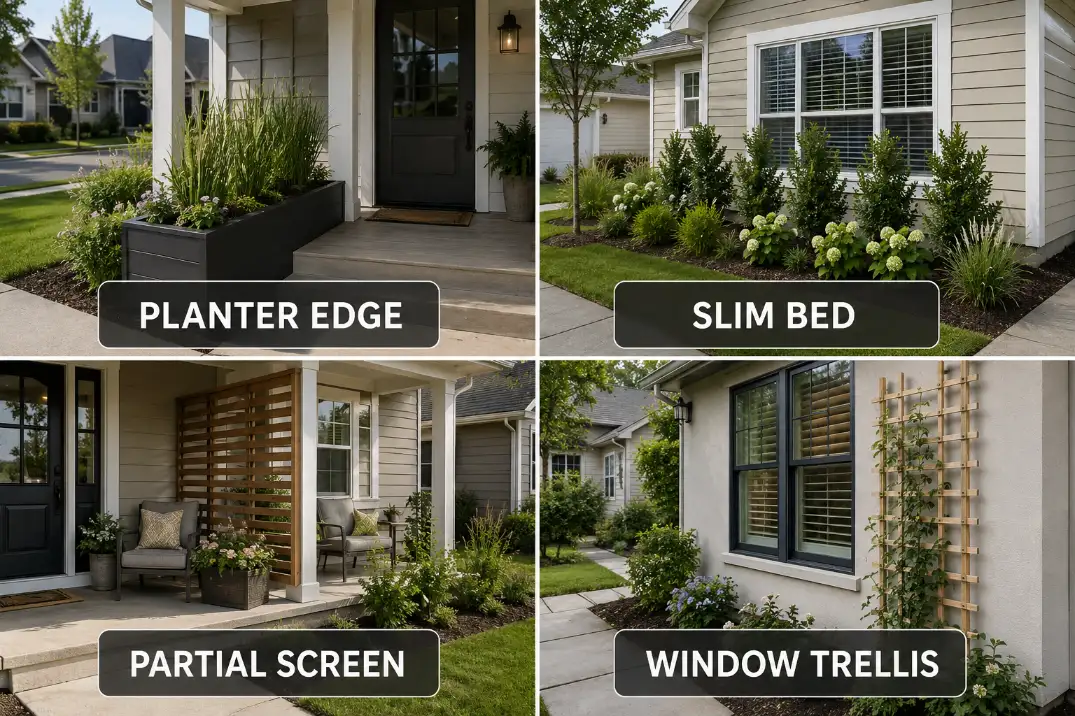
| Slim planting strip | The view is narrow and the bed is shallow | Low to moderate depth | Walkway edge if mature spread is ignored |
| Planter edge | Privacy is needed near a porch or seating angle | Flexible, but needs stable placement | Package route, porch turn, door approach |
| Low-to-mid shrub filter | Window or porch exposure needs soft screening | Enough depth for mature width | Window light, house number, walkway |
| Window trellis | One window line is the main issue | Narrow footprint with vertical control | Window access or house facade if oversized |
| Partial porch-side screen | Porch seating is exposed from one side | Side placement near seating, not across entry | Door visibility and open approach |
| Layered bed | The yard has enough depth for multiple plant zones | Moderate to deeper front bed | Small setback if layers are packed too tightly |
This is where many small front yard layouts go wrong. The homeowner sees the exposure, then responds with the biggest privacy tool available. But a small setback usually rewards precision.
A planter edge can solve a porch-side view better than a hedge. A narrow trellis can handle one window better than a full shrub wall. A mid-height filter can soften the sidewalk view without making the door disappear.
A targeted filter is usually the first option to test. It sits on the view line, not automatically along the property line. That difference matters. A property-line hedge may look logical from a plan view, but if the exposed angle comes from the sidewalk toward one window, the hedge may require far more plant mass than a smaller filter placed closer to the target zone.
For homes close to traffic or a curb, the same principle applies: do not screen the entire frontage if only one angle creates the privacy problem.
Layouts that sit close to the street need careful placement, and a deeper child page on front yard screening layouts close to the street can help when the sidewalk or curb is the dominant pressure.
Where Child Pages Fit Into the Plan
This page is the planning system. It decides what can fit and where privacy belongs. Child pages should solve the more specific decisions after that framework is clear.
If the main issue is choosing plant types for traffic, heat, salt, or reflected glare, that belongs in plant-selection guidance rather than this layout overview.
A home on a busy street, for example, may need plants that tolerate more stress than a quiet suburban cul-de-sac; that is where a page on choosing front yard plants for busy streets fits naturally.
If the issue is one exposed front window, the next step should focus on window-height screening, not the whole yard.
If the issue is porch seating, the next step should look at partial porch-side privacy, planter placement, or a screen that protects the chair without hiding the front door.
If the issue is a very narrow bed, the next step should focus on plant form and mature width, not layered planting.
If the issue is “no fence allowed,” the next step should compare fence-free screening methods, but only after the sightline and setback measurements are known.
This parent article should not try to solve every one of those choices in full. Its job is to keep the homeowner from choosing the wrong category before the yard has been measured.
Plan for the Yard You Will Have in Three Years
Small front yard privacy should be designed for the yard after growth, not just the yard after installation.
The first season may look lighter than expected. That is often acceptable. A little openness between young plants can preserve airflow, walkway clearance, and window light while the planting settles in.
Trying to force instant privacy with oversized or tightly spaced plants usually creates the opposite problem later: a front yard that feels blocked, dark, or hard to maintain.
Think in three stages.
In the first season, the layout should prove that the target zone is correct. The filter should interrupt the intended view without interfering with the front walk or door. If it sits in the wrong place, that will show up quickly.
After 2–3 years, the plant spread and density become more important. This is when a planting that looked modest can begin to lean into the walkway, cover a house number, or crowd a window. The layout should still preserve the same clear route it had on day one.
At mature size, the privacy element should look intentional rather than forced. It should still allow pruning access, keep the window usable, leave the entry visible, and avoid turning the setback into a wall of growth.
That is the real standard for small front yard privacy landscaping: not maximum screening, but controlled screening. Measure the view first, protect the route second, size for mature growth third, and choose the smallest privacy form that does the job.
For broader planting guidance, University of Minnesota Extension notes that choosing a location with mature height and width in mind is part of right plant, right place planning: University of Minnesota Extension.