Last updated: June 29, 2026
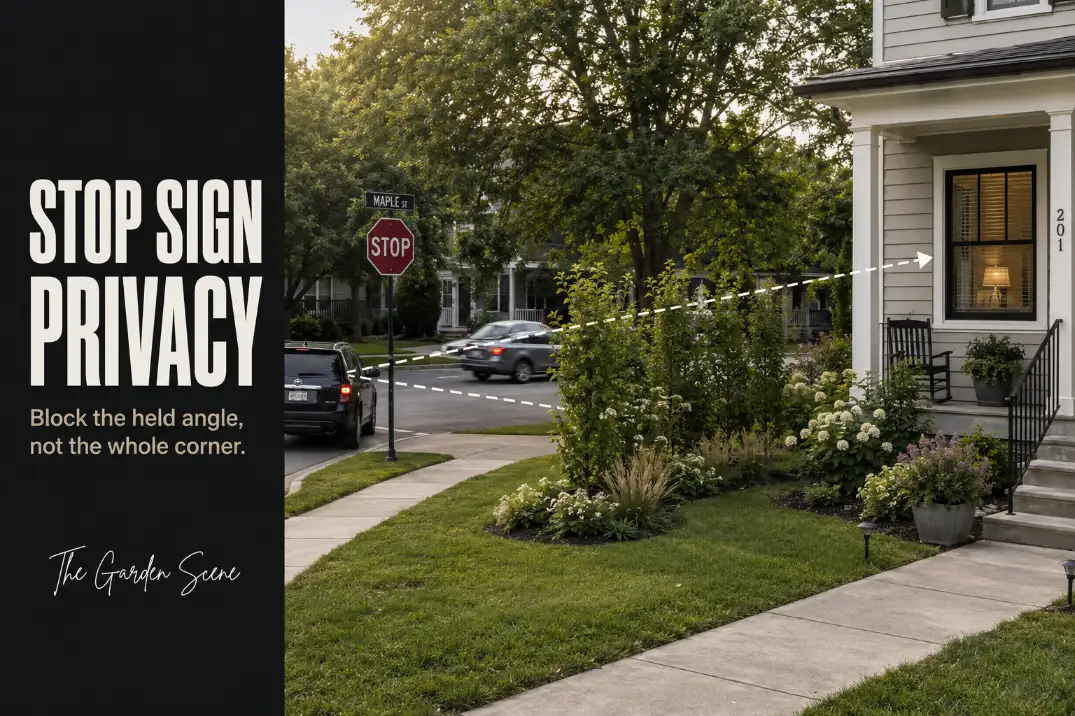
A stop sign privacy problem is different from a normal busy-street problem because the view does not just pass by. Cars stop, pause, creep forward, turn, or queue at an angle that can line up directly with a porch, front window, dining room, or entry.
That pause is the issue. A vehicle may only be there for a few seconds, but it is long enough for the view to feel fixed instead of passing.
The wrong fix is to screen the whole corner like the entire street is the enemy. The better fix is to find the exact vehicle position that creates the view, then interrupt that angle without closing off the front yard.
For homeowners who already deal with broader street exposure, the general strategy may overlap with front yard privacy problems on busy streets, but a stop sign or intersection needs a tighter layout decision.
Why Stop Sign Privacy Feels Different From Normal Street Privacy
Moving traffic usually creates a passing glance. A stop sign creates a stationary viewpoint.
That changes the layout problem. A driver may stop near the corner, look left or right, then sit for a moment while waiting for a gap. A passenger may face sideways toward the house. A turning vehicle may briefly aim its windshield or side window toward a front room. At busy times, a short queue can repeat the same view over and over.
The uncomfortable part is not always the number of cars. It is the position of the car when it pauses.
A front yard that feels fine most of the day can feel exposed during school pickup, evening commute, weekend park traffic, or any period when vehicles wait at the intersection. If the house has a low front window, raised porch, corner-facing living room, or short setback, the sightline can feel much more direct.
Layout note:
This is not the same as ordinary moving-traffic privacy. If cars are simply passing the frontage at speed, the solution usually focuses on a broader street-facing buffer. At a stop sign or intersection, the first move is narrower: identify the one fixed angle that makes the home feel watched. Solving the wrong traffic pattern often leads to too much screening in the wrong place.

Find the Exact Vehicle Position That Creates the View
Do not start by choosing plants, panels, or fence height. Start by finding the car position that actually sees into the house.
Stand inside the exposed room first. Look out from the place where the view bothers you most: the sofa, dining table, front desk, hallway, or porch chair. Then look for the exact spot outside where a stopped or turning vehicle lines up with that view.
The source may be one of several positions.
Stop line position
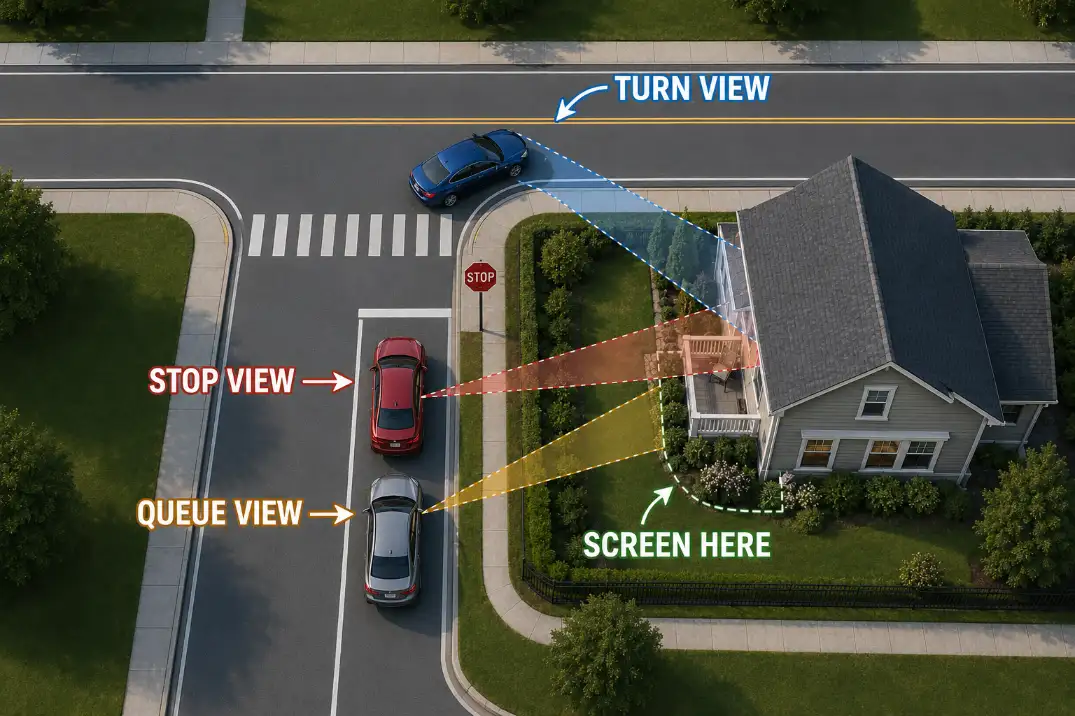
This is the most obvious one. A car stops at or near the stop sign and faces across the corner. If the driver’s side window or windshield points toward your window, the screen often needs to sit between the stop line and the exposed room, not across the full frontage.
Rolling stop point
Many drivers do not stop exactly where the sign is. They may creep forward to see cross traffic. That second position can create a better view into the home than the official stop line.
This is why a screen placed too close to the sign may fail. It blocks the legal stop position but misses the real pause point.
Turn approach
A car preparing to turn may angle across the corner before it moves. That can create a diagonal sightline toward a porch or front window. In this case, a straight hedge along the street may not be the best fix. The screen may need to sit slightly inside the yard, angled or offset to catch the diagonal view.
Post-turn view
Some privacy problems happen after the turn, when the vehicle straightens out and briefly faces the house from the side street. If that is the case, the solution belongs along the post-turn sightline, not at the stop sign itself.
Queue position
At certain times, the first car is not the only problem. The second or third car in line may sit farther back with a cleaner view into the house. A narrow screen aimed only at the stop sign may miss those queued-car positions.
A useful test is to check the view in the evening with interior lights on. Windows that feel modest in daylight can become much more visible after dark. You do not need a complicated survey; you need to know which outdoor pause point lines up with the room.
For homes where the sidewalk sits only a few feet from the glass, the stop sign problem may combine with a close-window problem.
In that case, the layout logic from front yard privacy when the sidewalk runs close to windows can help, but the intersection angle still needs its own test.

Choose the Screen Zone by Vehicle Behavior
The right screen zone depends on how the vehicle sees the house. A stop-line problem, a turning problem, and a queue problem do not always need the same placement.
The goal is not to hide the entire home from the street. The goal is to place one interruption where the direct view crosses the yard.
| Vehicle behavior | Likely screen zone | Main layout warning |
|---|---|---|
| Stop-line view | Between stop position and exposed window, usually inside the yard | Do not place the screen in the public edge or sight triangle |
| Turn-angle view | Offset along the diagonal view path | A straight frontage hedge may miss the angle |
| Queued-car view | Slightly wider or layered screen zone | Do not design only for the first car |
| Post-turn view | Side-facing or corner-return screen zone | Do not confuse it with the stop sign position |
If the view comes from the stop line, a short mid-height planting group or panel may work better than a long hedge. If the view comes from a turn, the screen may need to sit at a diagonal or near the side of the exposed window.
If the view comes from queued cars, a single narrow panel can feel too thin, and a mixed layer may be more forgiving.
This is where many front yard screens fail. They follow the property line because that feels logical on a plan. But the actual view may cut across the corner. A screen that looks centered from the street may not sit on the sightline at all.
For close-to-street lots, the screen also has to leave the entry readable. The best layouts interrupt the view while keeping the walkway, door, house number, and visitor route obvious. If your frontage is shallow, front yard screening layouts close to the street can support that placement decision without turning the corner into a wall.
Keep the Corner, Sidewalk, and Driveway Visibly Safe
A stop sign or intersection privacy fix has one hard limit: it cannot make the corner less visible.
That matters more here than in a typical front yard privacy layout. A dense hedge, tall panel, or solid fence near the curb may block the exact view you dislike, but it can also block drivers, cyclists, pedestrians, delivery vehicles, and anyone backing out of the driveway.
Start by separating private yard space from public edge space. The sidewalk, curb strip, and corner visibility area are not the right places for a solid privacy move.
Even if the yard feels exposed there, the safer screen zone is usually set back inside the property, where it can interrupt the house-facing view without hiding the intersection.
Watch the sight triangle
Many municipalities use some version of a sight triangle or vision clearance area at corners. The exact size and height limits vary by city, county, and street type, so there is no single universal number to copy.
The practical rule is simple: keep the corner visually open enough for drivers and pedestrians to see each other.
Keep the sidewalk readable
A privacy screen should not make pedestrians feel squeezed or hidden. If someone walking along the sidewalk has to pass beside a tall blank screen at the corner, the yard may feel more private, but the public edge can feel worse.
Low planting near the sidewalk can soften the edge. The more solid or tall the screen becomes, the farther back it usually belongs.
Protect driveway exit visibility
If your driveway is near the intersection, privacy placement becomes even more sensitive. A screen that blocks a stopped-car view may also block your view when backing out or pulling forward.
This is a good place to test from the driver’s seat, not just from the living room. Sit in the vehicle at the driveway exit and check whether the proposed screen hides approaching cars, bikes, or pedestrians.
Use Targeted Height Instead of a Full Frontage Wall
A fixed vehicle view often needs less height than homeowners assume.
Most stop sign privacy problems come from a seated driver or passenger view toward a lower front window, porch, or room. That does not automatically require a tall fence across the full frontage. A mid-height screen, layered planting, or offset panel may be enough if it sits directly on the sightline.
Low planting helps the yard feel less exposed, but it rarely blocks a seated vehicle view by itself. Mid-height screening is usually the working layer for stop-line and turn-angle privacy. Taller screening should be reserved for cases where the house sits high, the window is elevated, or the view comes from a taller vehicle or uphill road angle.
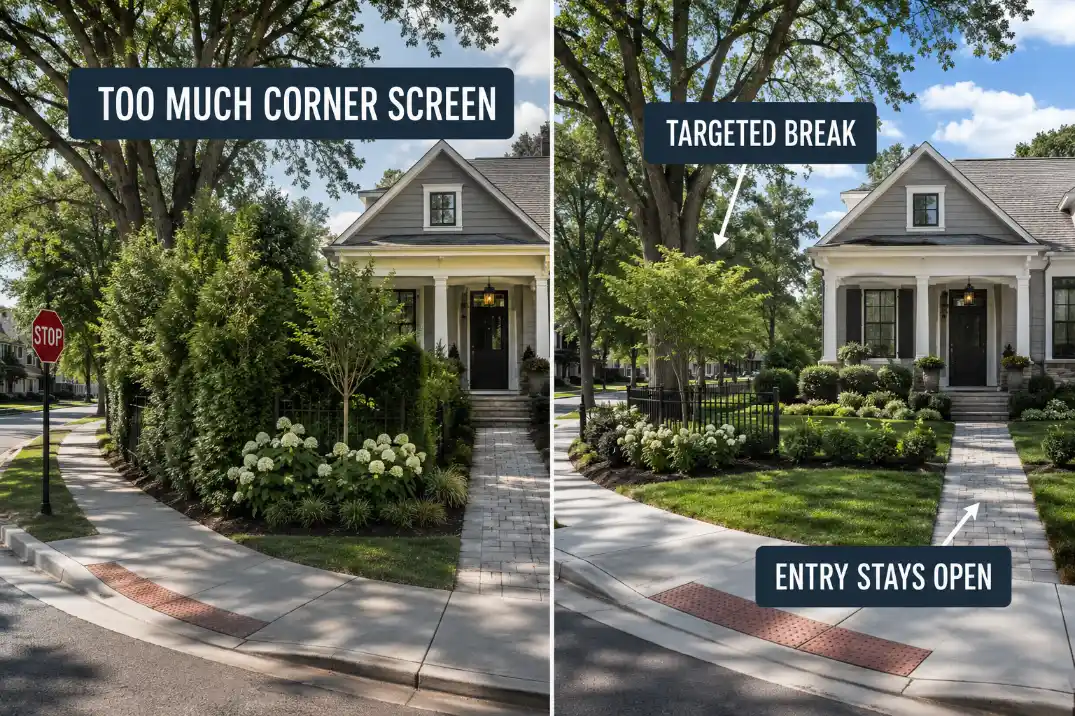
The danger is overbuilding. A full frontage wall can make the entry feel closed, hide the front door, reduce curb appeal, and create a heavier corner presence than the problem requires. If the home already feels tight to the street, over-screening can make the yard look smaller and less welcoming.
The better question is not “How tall can I go?” It is “What height breaks the seated view from the stopped position while leaving the front yard open?”
This is also where entry privacy and curb appeal overlap. If the screen blocks the vehicle angle but makes the door disappear, the layout has traded one problem for another.
A focused approach like front entry privacy that does not feel closed off is usually a stronger fit than a continuous barrier.
Where Plants, Panels, and Mixed Screens Fit
Once the screen zone is clear, the material choice becomes easier.
Plants work well when the screen can sit inside the yard and soften the view without looking like a hard barrier. They are especially useful when the front yard still needs to feel residential, layered, and welcoming.
The tradeoff is time. A plant-based screen may give partial help in the first season but often needs a few years to become reliable, depending on plant type and starting size.
Panels work better when the view is narrow and specific. A short section of slatted screen, open fence panel, or architectural privacy panel can interrupt a stop-line angle without needing a long hedge. The risk is placement. A panel that is too close to the curb or too visually heavy can make the corner feel defensive.
Mixed screens are often the strongest answer for intersections. A low foreground layer softens the public edge, while a mid-height layer inside the yard blocks the fixed view. This keeps the corner from looking sealed while still doing the privacy work.
Temporary screens can also help before committing. A movable planter, temporary panel, or even a simple marked stake-and-string test can show whether the chosen zone actually blocks the vehicle angle.
The test should happen from both sides: inside the exposed room and from the approximate stopped-car position.
For homeowners who want the softest version of this strategy, privacy plants and planters for front yard privacy can help route the material choice after the sightline zone is already chosen.
The key is to avoid choosing a product category before choosing the view path. A beautiful planter in the wrong angle is still the wrong screen.
Common Mistakes That Make Intersection Privacy Worse
Intersection privacy can go wrong quickly because the instinct is to block the corner instead of the view.
Where people go wrong:
- Screening the whole corner when only one stopped-car angle is causing the problem.
- Placing a tall hedge, panel, or fence where it reduces sidewalk, driveway, or intersection visibility.
- Copying a moving-traffic privacy solution when the real problem is a paused or turning vehicle.
- Planting along the property line even though the sightline cuts diagonally across the yard.
- Placing the screen too close to the public edge instead of setting it back inside the yard.
A good intersection privacy layout should still let the front yard breathe. Visitors should see the door. Drivers should see the corner. Pedestrians should not feel boxed in. The house should gain privacy without looking like it is hiding from the street.
If the exposure is mainly from repeated waiting near a school route, park edge, or transit point, that becomes a different fixed-view problem.
In that case, the layout logic in front yard privacy problems near schools, parks, or bus stops may fit better than a stop-sign layout.
The Best Fix Blocks the Held View, Not the Intersection
A stop sign privacy fix should be judged from the pause point, not from the curb.
If the screen blocks the view from the stopped or turning vehicle while the front walk, door, sidewalk, driveway, and corner visibility remain open, the layout is doing its job. If the screen hides the whole frontage but misses the actual vehicle angle, it is only creating a heavier yard.
The best fix is usually targeted: find the fixed angle, place the interruption inside the yard, tune the height to the seated view, and keep the public edge safe. That approach gives the home more privacy without turning the intersection into a wall.
Before building near a corner, check your local visibility and fence rules. Fairfax County’s guidance on sight distance on corner lots is a useful example of how local rules may limit fences and vegetation in corner visibility areas.