
Last updated: July 5, 2026
A front yard near a busy road is not harder to maintain because it is automatically “messier.” It is harder because the road keeps delivering new material into the same exposed bands: dust, grit, wrappers, leaves, dirty splash, and winter salt residue.
That changes the maintenance decision. The goal is not to clean the entire front yard more often. The goal is to read the yard from the road inward and identify which edge is taking the hit first.
The curb band, sidewalk strip, lawn face, walkway, and porch approach do not receive the same pressure. One zone may collect grit. Another may catch trash. Another may show splash marks after every storm. If those zones are treated like protected ornamental beds, the yard starts needing constant rescue.
This article stays on maintenance pressure. It is not about blocking views from traffic, reducing road noise, or choosing every plant for a busy street. Those may matter, but the work here is more physical: dust, debris, splash, salt, and the repeat cleanup they create.
Why Busy Roads Change Front Yard Maintenance
Busy-road maintenance is a deposit pattern. Vehicles move air, throw grit, stir dust, and push dirty water toward the curb. Wind then carries light debris until it meets the first obstacle: a low shrub, a raised edging lip, a mailbox bed, a fence base, or the inside corner of a walkway.
The early signs usually appear before the yard looks truly neglected. Leaves near the street look dull. Porch rails collect a gray film. Mulch develops a dirty crust near the curb. The front walkway looks tracked even when foot traffic is normal. A narrow grass strip near the road thins faster than the inner lawn.
The common mistake is treating those signs as separate chores. Dust gets rinsed. Mulch gets refreshed. The lawn strip gets reseeded. Debris gets picked out by hand. But if the road keeps feeding the same pressure band, the same chore returns.
The prevention move is to stop maintaining the road edge like a quiet interior bed. Near traffic, the front edge needs to be easy to sweep, rake, rinse, or reset without disturbing the entire yard.
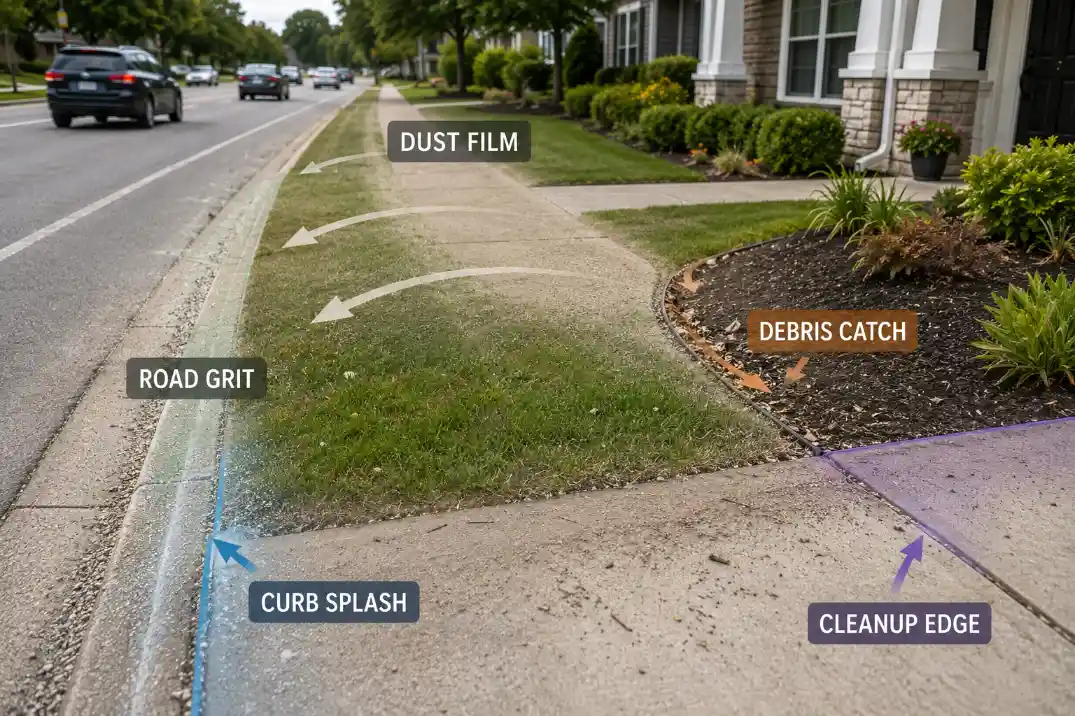
A quiet front yard can often tolerate delicate mulch lines, pale stone, low ornamental planting, and thin lawn strips. A busy-road yard tests those choices repeatedly. The stronger approach is to design the front edge as if it will be hit, not as if it will stay clean by default.
Map the Road Pressure Bands Before You Fix Anything
The first useful test is simple: look after weather or traffic has done its work. After heavy rain, snowmelt, dry wind, or leaf drop, the road will show you where the yard is weakest.
The curb band takes the hardest splash and grit. The sidewalk strip catches salt, dust, foot pressure, and windblown litter. The lawn face receives a softer but wider layer of road dust. The walkway becomes the track line that carries grit toward the entry. The porch or landing shows what makes it all the way to the house.
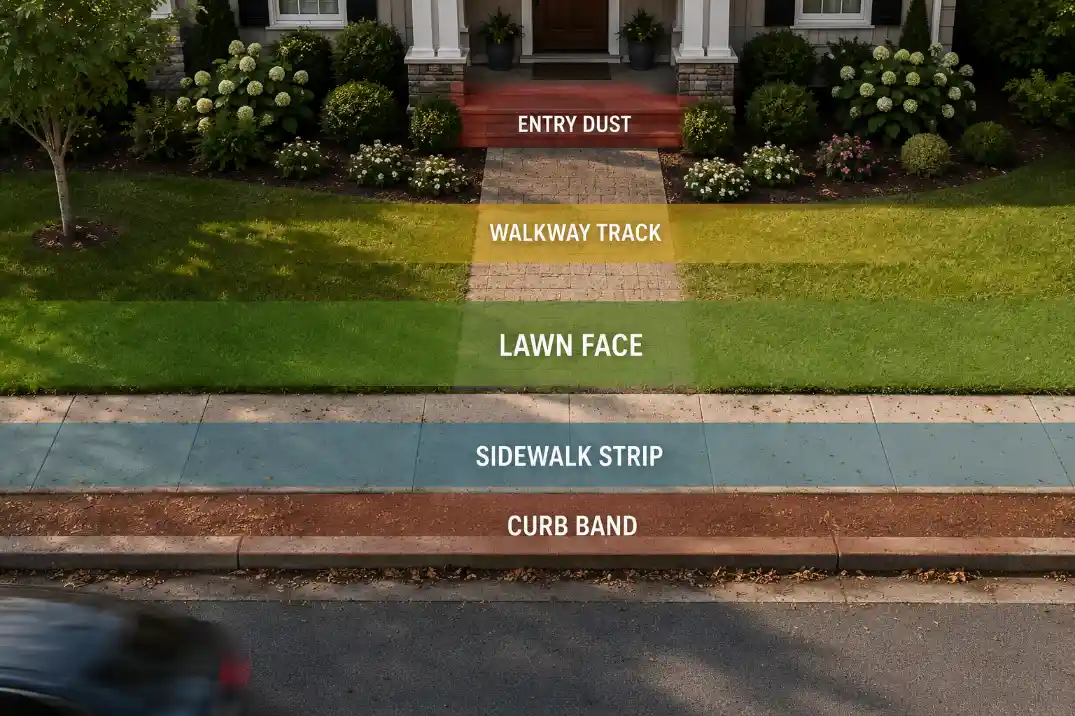
The early sign of a pressure band is repetition. If the same corner always catches wrappers, it is a debris catch zone. If mulch keeps crusting or moving near the curb after rain, it is a splash band. If lower leaves look dusty soon after cleaning, that is an airborne dust zone. If the entry mat fills with grit after windy traffic days, the road is reaching the front door through the walkway route.
Use that map before changing materials. A fresh mulch layer will not help if the issue is dirty splash. Reseeding a narrow lawn strip will not hold if salt, grit, and heat keep stressing the same edge. Adding more planting can make cleanup worse if the planting sits exactly where debris naturally stops.
| Early sign | Likely road pressure | Prevention move | What to avoid |
|---|---|---|---|
| Gray film on leaves, railings, or windows | Airborne traffic dust | Use washable surfaces and open plant spacing | Treating dust as a plant disease first |
| Wrappers, leaves, and grit collect in one edge | Windblown debris catch zone | Simplify the edge so it can be swept or raked | Dense low planting that hides debris |
| Mulch crusts, floats, or stains near curb | Curb splash and runoff | Use a cleaner, heavier, or better-contained edge | Fine mulch directly in the splash band |
| Grass thins along road or sidewalk | Salt, splash, heat, traffic, or grit stress | Convert the weakest strip into a more durable maintenance band | Reseeding the same fragile strip repeatedly |
| Grit reaches the porch or entry | Walkway tracking route | Interrupt dirt before the landing | Letting debris move all the way to the door |
The point is not to hardscape every exposed zone. It is to stop asking the dirtiest band to behave like the protected inner yard.
The Main Problems: Dust, Debris, Splash, and Salt
Each road pressure leaves a different clue. Reading the clue matters because the wrong fix can create more work than the original problem.
Dust That Settles Everywhere
Dust is the quietest problem because it does not always look like damage. It dulls broadleaf plants, settles on porch rails, marks window sills, and makes dark hardscape look faded. During dry, windy stretches, traffic keeps that dust moving.
The prevention move is not constant washing. It is choosing surfaces and planting positions that can be cleaned without drama. Smooth porch edges, simple rail details, open plant spacing, and accessible bed edges make dust easier to remove. Dust becomes high-maintenance when it settles into dense planting, rough decorative surfaces, or layered objects near the road.
Debris That Collects Along Edges
Road debris rarely spreads evenly. It stops where the yard gives it a trap.
Low shrubs, uneven edging, mailbox beds, fence bases, curb cuts, and deep corners can all become catch points. If the same spot always collects leaves, wrappers, grit, or seed pods, it is not random. The edge is acting like a net.
The prevention move is to simplify the trap. Raise or thin the planting slightly, clean up broken edging, avoid deep pockets at the curb, and keep at least one easy line where debris can be swept, raked, or blown out without reaching through plants.
Splash That Stains and Moves Mulch
Curb splash shows up after rain, snowmelt, irrigation runoff, or street cleaning. It leaves dirty marks on mulch, gravel, low walls, walkway edges, and sometimes lower siding or porch steps.
Fine mulch is often the first material to expose the problem. It floats, crusts, sticks to walks, or migrates into grass. Light gravel may look clean when installed but show dirty splash quickly. A low bed with no firm edge can become a repeated cleanup line.
For the narrow-strip version of this issue, route the detail to curb splash and road salt pressure in sidewalk strips. Here, the maintenance rule is simpler: the closer a material sits to splash, the easier it must be to reset.
Salt Residue That Stresses the Curb Zone
In cold regions, deicing salt creates a delayed maintenance problem. It may arrive through plowed snow, tire spray, sidewalk runoff, or curbside meltwater. The damage may not read as “salt” at first; it may show up as browning, thinning, weak spring growth, crusty soil, or a strip that never seems to recover.
University of Minnesota Extension explains that deicing salts can damage plants through root absorption and salt spray, with symptoms such as browning, foliage loss, and decline.
The prevention move is to treat the salt-exposed edge as a stress zone. Keep sensitive planting out of direct splash, avoid piling salty snow into ornamental beds, and inspect the curb band after winter thaw instead of waiting until the yard looks poor later in spring.
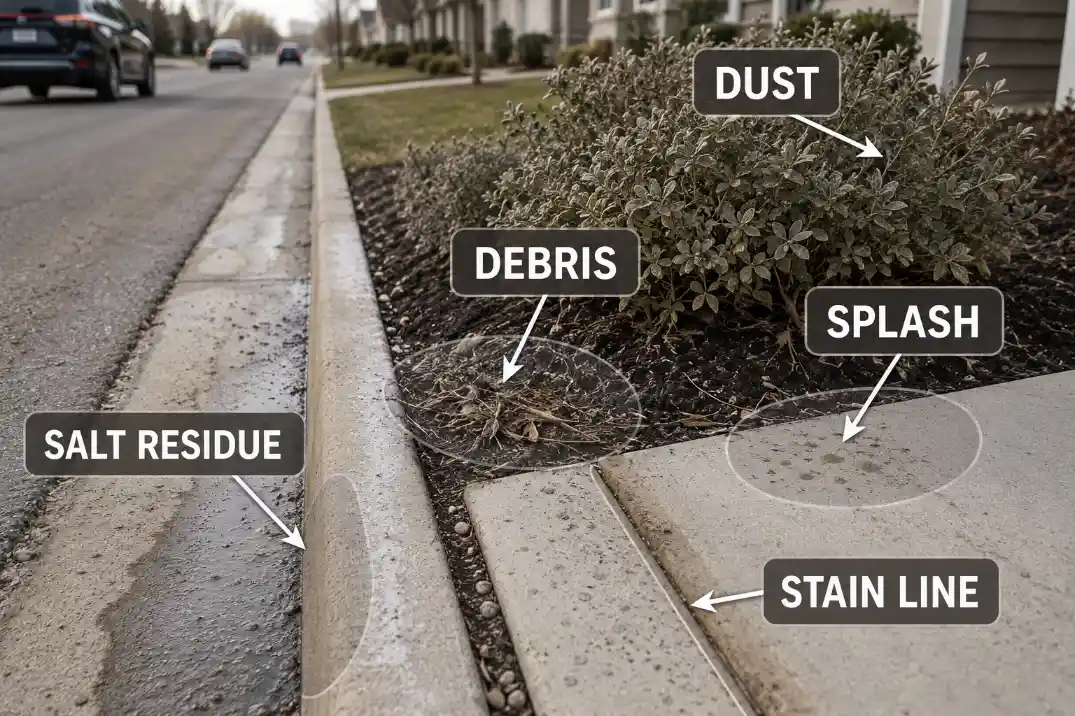
Common Mistake: Treating the Curb Edge Like a Protected Garden Bed
The curb edge is not the same as the planting area near the porch. It receives tire spray, windblown grit, trash, salt residue, and dirty runoff first. Delicate mulch, low dense plants, and fussy ornamental details can turn that band into a cleanup trap. The better move is to make the curb band durable, visible, and easy to reset.
Fragile Front Yard Choices Make Road Exposure Worse
Some front yard choices are not bad choices. They are just weak choices for the road-facing band.
Fine shredded mulch may look clean for a short time, then crust with dust or move after splash. Thin lawn strips can become permanent repair zones when they sit between the curb, sidewalk, and traffic spray. Low dense plants can hide wrappers and leaves until cleanup becomes hand work. Pale stone can show every dirty splash mark. Lightweight edging can shift and let gravel, mulch, and grit migrate into the lawn.
The early sign is maintenance that does not hold. You clean the same edge and it looks messy again after one storm. You refresh mulch and the curb side dirties first. You trim a narrow strip and it still reads rough because debris keeps collecting along it.
Editorial Note:
A busy-road front yard needs a working edge. That does not mean ugly. It means the dirtiest part of the yard should be durable enough to sweep, rinse, rake, or reset without damaging the design. The closer a bed sits to traffic splash, the less it should rely on delicate texture, hidden corners, or materials that only look good when perfectly clean.
Planting still matters, but this article should not turn into a plant list. If the main problem is choosing plants that can handle dust, wind, heat, and street exposure, use a dedicated guide to front yard plants for busy-street exposure. Here, the maintenance rule is narrower: do not place the most fragile plants or surfaces where the road does the most damage.
Maintenance Moves That Reduce Repeat Cleanup
The best maintenance move near a busy road is usually a better reset zone, not a bigger chore list.
Start at the curb. If the first few feet from the road always carry splash, grit, or debris, design that area so it can be cleaned quickly. A cleanable edge might be a firmer border, a simpler mulch line, a more durable strip, or a planting layout that does not catch every piece of litter. Then look at the walkway.
If grit travels from the sidewalk or driveway to the porch, the path is acting as a dirt route. The prevention move is to interrupt that route before it reaches the entry.
Clearer walkway edges, less loose material beside the path, and a landing that catches dirt before the door can reduce the amount of road residue that reaches the house.
For a more entry-focused version, see front entry dirt control.
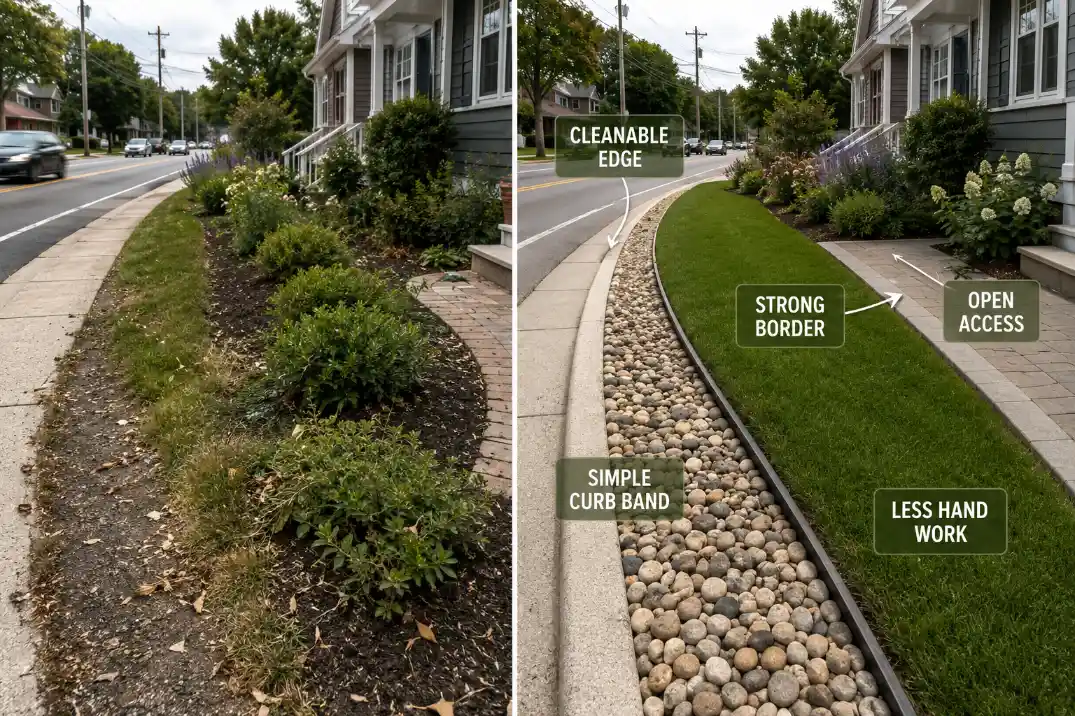
A useful prevention order looks like this:
- Observe after weather or traffic stress. Look after heavy rain, snowmelt, dry windy periods, or leaf drop. That is when the pressure pattern is easiest to see.
- Identify the repeated band. Mark where dust settles, debris catches, splash lands, or grit tracks.
- Remove the fragile detail from that band. Do not keep replacing the same fine mulch, thin grass, or debris-trapping planting if the road keeps defeating it.
- Make the edge easy to reset. The goal is a curb-facing zone that can be swept, raked, rinsed, or lightly cleaned without disturbing the whole front yard.
| If this keeps happening | First priority | Better prevention move |
|---|---|---|
| Mulch keeps washing or crusting near curb | Surface control | Use a simpler, better-contained edge |
| Debris hides under low plants | Cleanup visibility | Open the planting edge or move dense texture inward |
| Grit reaches the porch | Tracking control | Clear the walkway route and catch dirt before the landing |
| Lawn strip keeps thinning by road | Exposure tolerance | Stop treating the strip like protected lawn |
| Cleanup tools cannot reach the dirty band | Access | Simplify the route before adding more planting |
A narrow strip near traffic often faces heat, foot pressure, reflected light, salt, and debris at the same time. If that strip is failing, more decorative detail can make maintenance worse.
A simpler strip with clearer edges is often easier to keep presentable; the detailed strip-level version belongs in sidewalk strip maintenance under heat and traffic pressure.
The strongest clue is repeat work. If the same maintenance task keeps returning in the same place, that part of the yard is not asking for more effort. It is asking for a different role.
When the Problem Is Bigger Than Road Dust
Some busy-road problems touch the same front yard edge but need a different decision path. Knowing the boundary prevents the maintenance article from becoming the wrong fix.
If the yard feels exposed to cars or pedestrians, that is a privacy problem. If the main discomfort is traffic sound, that belongs to a road-noise strategy. If the yard sits on a corner lot, the pressure may come from two street faces, more visible cleanup zones, and sightline constraints.
If the road edge is not the only issue because there is no room to move a mower, rake, cart, hose, or cleanup tool through the front yard, the better next read is front yard maintenance when cleanup access is tight. A busy road creates debris, but poor access can turn that debris into a much bigger maintenance problem.
HOA expectations can also change the answer. A curb band that would be practical in one neighborhood may need a cleaner visual standard in another. That does not mean the road pressure disappears. It means the maintenance edge has to be both durable and visibly controlled.
The boundary is simple: if the problem is residue, splash, debris, salt, and repeat cleanup, stay with the pressure-band model. If the problem is visibility, sound, rules, or access, route to the page that owns that constraint.
A Busy-Road Front Yard Needs a Working Edge, Not Constant Rescue
A front yard near a busy road will never behave like a protected garden bed set deep inside the property. The road will keep adding dust. Wind will keep moving debris. Rain will keep splashing dirty water at the curb. Winter salt may leave stress that does not show up until later.
That does not mean the yard has to look rough. It means the most exposed band needs to be honest. Make it cleanable. Make it visible. Keep fragile details out of the dirtiest line. Give yourself access to reset it after storms, dry traffic periods, winter thaw, and leaf drop.
The best busy-road front yard is not the one that pretends the road is not there. It is the one that absorbs pressure at the edge, protects the more ornamental areas behind it, and stays presentable without needing constant rescue.