
Last updated: July 5, 2026
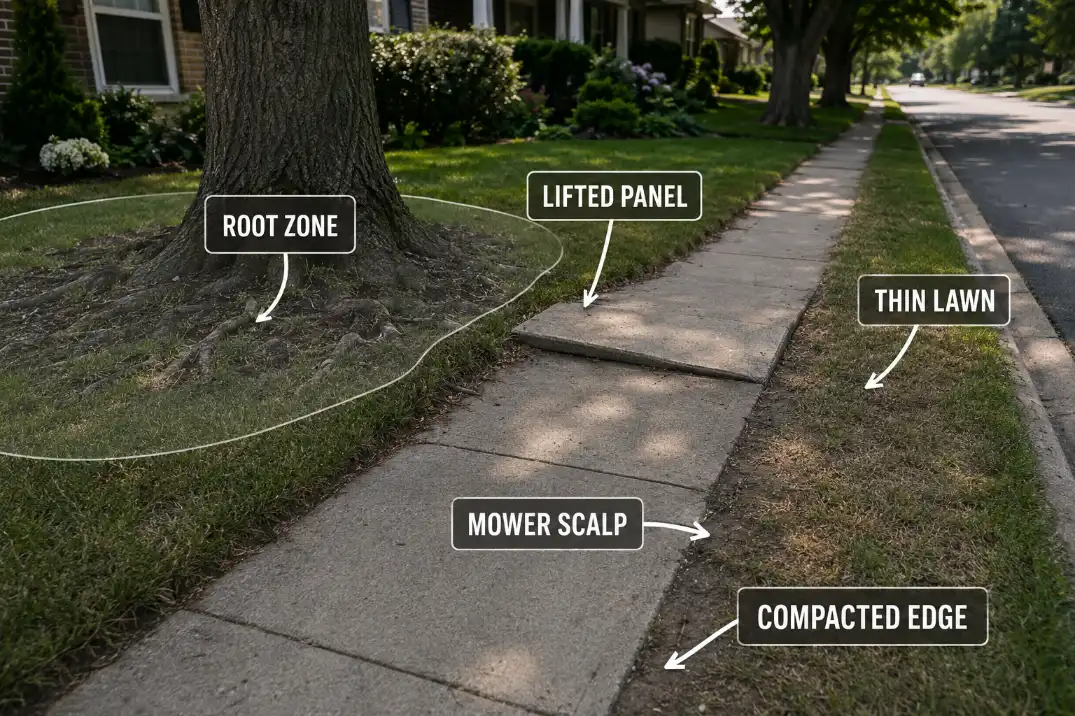
A lifted sidewalk panel beside thinning front yard grass is not a choice between “fix the concrete” and “fix the lawn.” The real decision is whether the yard is showing one connected pressure line: mature roots near the surface, rigid pavement above them, compacted soil beside them, and turf that keeps getting asked to grow where the surface no longer behaves like normal lawn.
The raised concrete is the part people trip over. The bare grass is the part homeowners keep trying to reseed. The exposed roots are the part that make mowing awkward. But the useful diagnosis starts where those symptoms overlap.
The common mistake is to patch the most visible symptom first. Grind the concrete, add sod, bury the roots, trim the edge lower, and the front yard may look cleaner for a short time. But if the root zone, sidewalk edge, and lawn surface are still fighting each other, the same pattern usually returns.
This is a diagnosis article first. Not a plant-selection guide. Not a municipal sidewalk guide. Not a tree-removal guide. Before anything gets cut, covered, leveled, or replaced, the damaged edge has to be read as a system.
Why Tree Roots, Sidewalk Lift, and Lawn Damage Usually Show Up Together
The sidewalk and lawn usually fail together because they are sitting inside the same shallow root zone, not because both surfaces happen to be unlucky.
Tree roots do not stay politely below the lawn where homeowners wish they would. Many important roots live close to the soil surface because that is where oxygen, moisture, and organic matter are easier to reach. In a natural setting, that shallow root area can spread under leaf litter and loose soil. In a front yard, it often runs into concrete, compacted turf, driveway edges, and regular mower traffic.
A sidewalk panel is rigid. A tree root zone is not. Roots thicken slowly, soil shifts, water moves, and concrete has very little ability to adjust. When root pressure changes the soil support under or beside a slab, the panel may lift, tilt, crack, or rock.
The lawn damage beside it is part of the same story. Grass in that zone may be growing in shallow soil, under partial shade, beside hot concrete, and over roots that compete for water. A mower may scalp high spots. A string trimmer may nick exposed roots. Foot traffic may compact the strip while people step around the uneven sidewalk.
That is why this kind of front yard problem feels so persistent. It is not just “bad grass” or “bad concrete.” It is a narrow conflict zone where the tree is still growing, the sidewalk is trying to stay flat, and the lawn is expected to behave like open turf.
Broader design choices around front yard tree root zones matter because this area usually needs a different standard than a normal lawn panel. The diagnosis starts by accepting that the root zone is already controlling the surface.
| Visible symptom | More likely meaning | First thing to check |
|---|---|---|
| One panel edge is raised near a visible root | Root pressure may be affecting that panel directly | Whether the root runs under, beside, or across the lifted edge |
| Several panels are uneven in a row | Soil movement, drainage, base failure, or repeated root pressure may be involved | Whether the movement follows the tree line, water path, or sidewalk joints |
| Grass is thin only near the tree and sidewalk | Shallow soil, shade, compaction, and root competition may be combining | Where turf fails most: under canopy, beside concrete, or over exposed roots |
| Turf is scraped or brown over raised roots | Mower scalping may be repeating in the same high spots | Whether damage appears after mowing rather than after dry weather |
| Soil washes out beside the panel after rain | Water movement may be exposing roots and weakening the lawn edge | Where runoff collects, cuts across, or leaves sediment |
| Concrete is cracked, tilted, or rocking | The surface may be unsafe or unstable, not just ugly | Whether the panel moves under foot traffic or creates a clear trip point |
What the Lifted Sidewalk Is Really Telling You
A lifted sidewalk panel should be read by its movement pattern, not by the nearest visible root alone. The useful question is not simply “Is there a tree root?” It is “What kind of surface movement is this panel showing?”
A single raised edge near a trunk or visible surface root points toward root pressure. The root may be directly under the slab, but it may also be pushing from the side or changing the soil support below the panel. You may see a clean height difference at one joint, a hairline crack across the panel, or a tilt that throws water toward one side.
Multiple uneven panels tell a broader story. If several slabs rise and fall across the same stretch, the issue may include poor base preparation, settling, freeze-thaw movement in colder regions, drainage under the walk, or several roots working through the same corridor. The tree may still be part of the pattern, but it is not automatically the only cause.
Look closely at the joint lines. A panel lifted at one corner reads differently from a panel that rocks when stepped on. A tilted slab that sends water into the lawn reads differently from a slab with one clean root-shaped ridge beneath it. A sidewalk that has already been patched, shaved, or filled may be showing a recurring pressure, not a new cosmetic flaw.
The safety signal matters too. A raised edge that catches shoes, wheels, strollers, or delivery carts is no longer just a curb-appeal issue. It affects how people enter, cross, and maintain the front yard. That does not turn this into a legal guide; it simply means the sidewalk has to be diagnosed as a use surface, not just a border.
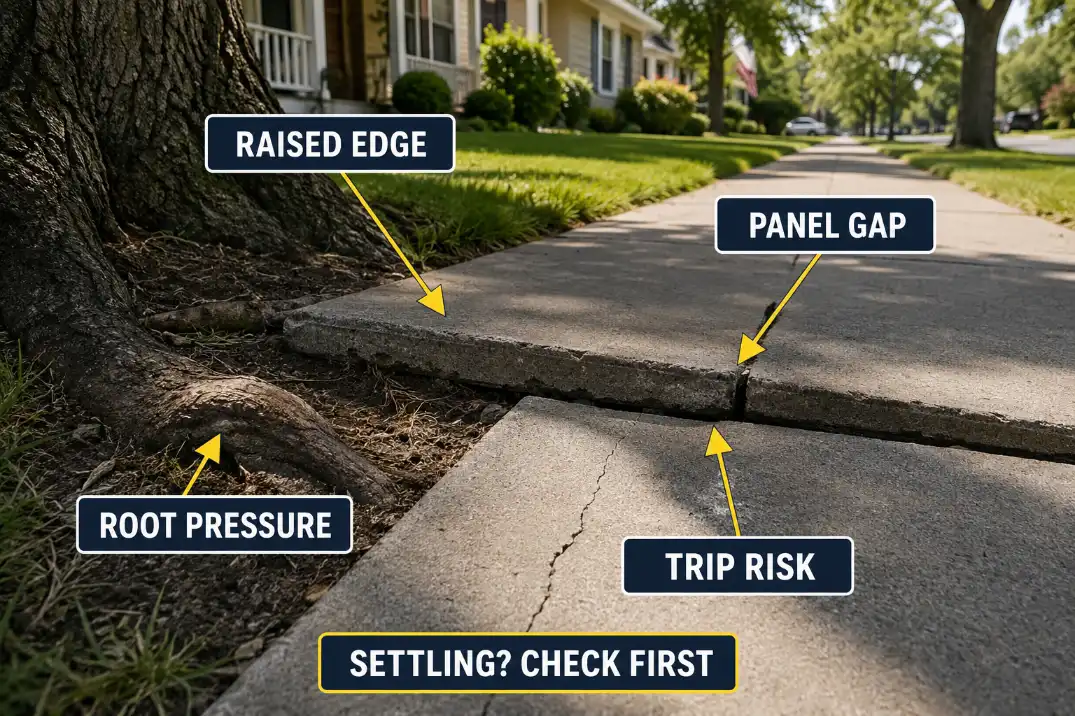
The wrong read is to assume every lifted panel needs the same response. Some situations are mainly surface repair. Some need a tree-health review. Some need the walkway edge redesigned around the root zone. Some may involve a public sidewalk process outside the scope of a landscape article.
The useful read is slower: where is the lift, what else is failing nearby, and does the same pressure show up in the lawn?
Why the Lawn Fails Around the Same Root Zone
When grass fails beside a lifted sidewalk, the lawn is often reporting a surface conflict rather than a simple lawn-care mistake.
The first problem is usable soil. Surface roots occupy space where grass roots would otherwise spread. Even if the top looks like lawn, the grass may be sitting over a shallow, crowded root zone. Water disappears faster, the mower rides unevenly, and thin soil dries out sooner along the concrete edge.
The second problem is light. A mature shade tree may not create deep shade all day, but even filtered shade can weaken turf when it is combined with root competition and compacted soil. Grass that might survive in open shade may fail when the soil is shallow and the sidewalk reflects heat along the edge.
That is where homeowners often misdiagnose the lawn. Bare patches look like a call for more seed, more fertilizer, or a different watering routine. But if the grass is failing under the canopy, over raised roots, and beside compacted concrete, the lawn is reporting a site condition. It is not just underperforming.
The detailed lawn side belongs in a separate shade diagnosis, especially when the main symptom is grass struggling under front yard shade trees. Here, the key point is narrower: when sidewalk lift and turf failure appear in the same root zone, the lawn cannot be judged by normal open-yard standards.
Mowing makes the pattern worse. Raised roots lift the mower deck. The blade catches high spots. The operator tilts or turns around the sidewalk edge. A strip that was already thin becomes scalped in the same places every week. Then the exposed soil heats, dries, and compacts faster.
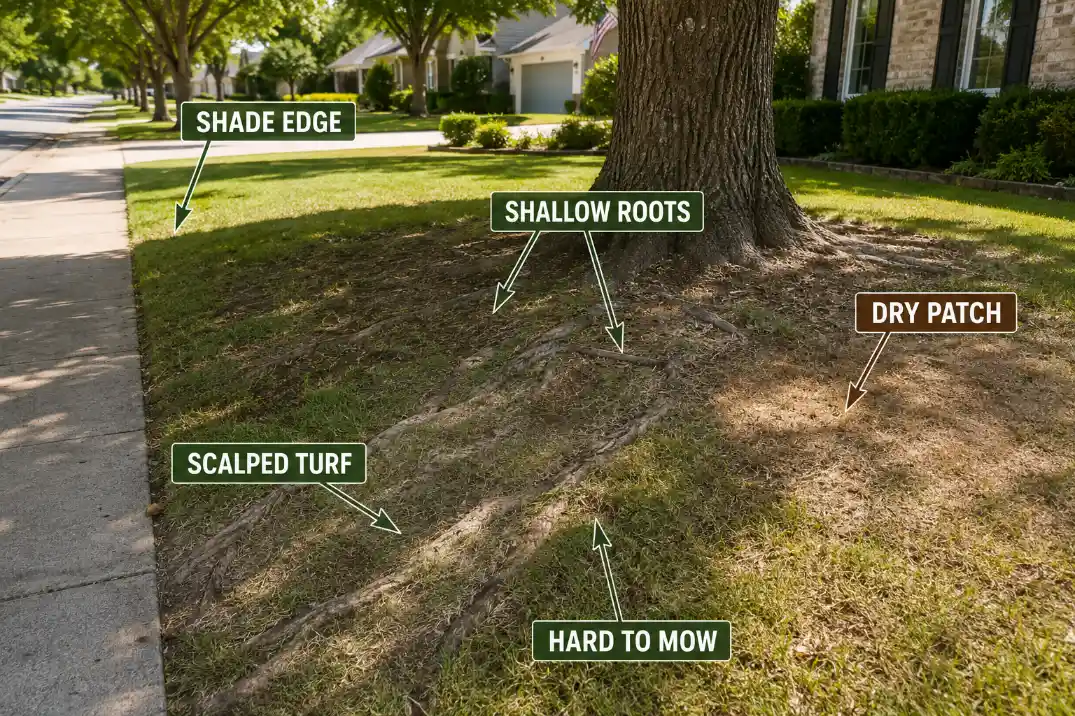
The test is simple: watch whether the damaged turf follows the root path, the shade line, the sidewalk edge, or the mower turn. If the thinnest grass sits exactly where all four overlap, reseeding alone is not a fix. It is a temporary cover over the same pressure.
How to Read the Damage Pattern Before You Touch Anything
The first field check is not a tool; it is a walk along the damaged edge. Stand at one end of the sidewalk and look down the panel line. A raised corner, a tilted slab, and a rocking panel each point to a different kind of movement.
If the lift is strongest beside the tree and fades away from it, root pressure is more likely. If the unevenness continues beyond the tree zone, soil movement or drainage may be part of the picture.
Then read the root flare and surface roots. Exposed roots near the trunk are not the same as roots appearing several feet away because soil has eroded. A large root running straight toward the lifted panel means something different from a web of smaller roots exposed by repeated mowing and runoff.
Look at the lawn after rain. If water collects beside the raised panel, the soil may stay soft in one area and dry out in another. If runoff cuts across the grass and leaves bare soil behind, the roots may be exposed more by washout than by upward growth alone. Water does not need to be the main cause to make the damage worse.
The soil itself matters, but this section should stay diagnostic. Compacted soil beside a sidewalk often looks smooth, hard, and thin. Grass roots struggle there. Tree roots may stay closer to the surface. Mower wheels leave repeated tracks.
If the whole front lawn has weak growth, weeds, and thin soil, the root-zone issue may be layered over a larger poor soil and patchy front yard grass problem.
The most useful field sign is repetition. One bare spot may be a lawn problem. One raised panel may be a hardscape problem. But a raised panel, visible roots, scalped turf, compacted soil, and dry patches all touching the same edge usually means the surface is telling one connected story.
Also note where the damage is located. A public sidewalk, private front walkway, driveway edge, and small lawn panel all create different next steps. The diagnosis can still be the same, but the responsibility and repair path may change. Do not skip that distinction just because the root is visible.
The Fixes That Usually Make Root and Lawn Damage Worse
The first fix should not be the one that makes the yard look flat fastest. With tree roots and sidewalks, the fastest cosmetic move is often the one that hides the evidence you needed to read.
The most dangerous quick fix is cutting a large exposed root because it is in the way. That may seem logical when the root is lifting concrete or catching the mower, but large roots can be part of the tree’s support and water system. Cutting them without qualified guidance can injure the tree, reduce stability, and still fail to solve the sidewalk problem.
The second common mistake is burying the roots under a deep layer of soil. It feels gentle because nothing is being cut, but deep fill can reduce oxygen around roots and hold moisture against the wrong parts of the tree. A light surface adjustment is different from smothering the root zone.
Repeated sod is another expensive-looking fix that often fails quietly. New turf may green up for a short time, especially with extra watering. Then the same shade, shallow soil, root competition, mower scalping, and concrete-edge heat return. The lawn fails again, and the homeowner assumes the grass was the problem.
Common mistakes that hide the diagnosis
- Shaving or cutting large roots just to make mowing or concrete work easier.
- Piling deep soil or mulch over exposed roots to make the lawn look flat again.
- Replacing sod repeatedly without changing the root-zone pressure that killed the last turf.
- Grinding or patching a sidewalk edge without asking why the panel moved in the first place.
Grinding concrete can reduce a small trip edge, but it does not explain why the panel lifted. Patching gaps can hide water movement. Filling low spots can move runoff somewhere else. These actions may still be part of a professional repair plan, but they should not be the first diagnosis.
The same caution applies to covering the area. A new surface, border, or planting bed may reduce mowing friction, but if drainage is still poor or the tree root zone is already stressed, the cover can create a cleaner-looking version of the same problem. Appearance is not the same as resolution.
When the Problem Is a Tree Issue, a Sidewalk Issue, or a Yard Design Issue
The next path should be chosen by the strongest risk signal, not by the symptom that bothers you most.
If the tree shows stress, decay, major root injury, a lean, cracked soil near the base, or large roots that someone has already cut, the tree side deserves professional attention first. A lifted sidewalk is annoying. A compromised mature tree is a different level of risk.
If the sidewalk has a clear raised edge, rocking panel, repeated cracking, or a trip point along a public route, the sidewalk condition has to be taken seriously as an access and safety issue. This article does not decide municipal responsibility, property-line rules, or local repair process. It simply keeps the diagnosis honest: a public walking surface is not just a lawn border.
If the tree appears healthy but the lawn is failing over shallow roots, the design problem may be that turf is being forced into a root zone where it no longer belongs. That does not mean filling the area with random plants. Planting depth, root protection, shade, and future maintenance all matter.
For that next layer, route the decision toward front yard plants in shallow tree-root soil rather than trying to solve plant choice inside this diagnosis.
A private walkway or lawn edge may be easier to redesign than a public sidewalk. A repeated mowing problem may be reduced by changing the edge standard. A patch of lawn that keeps failing may need to stop being treated as turf. But those decisions come after the root, surface, and safety signals are understood.
If the tree is near a property line or the damage seems connected to a tree outside your yard, slow down before assuming control of the whole problem. A root can cross a boundary, but ownership, maintenance responsibility, and neighbor communication are separate issues.
That is where neighbor tree maintenance problems become a different article, not a footnote.
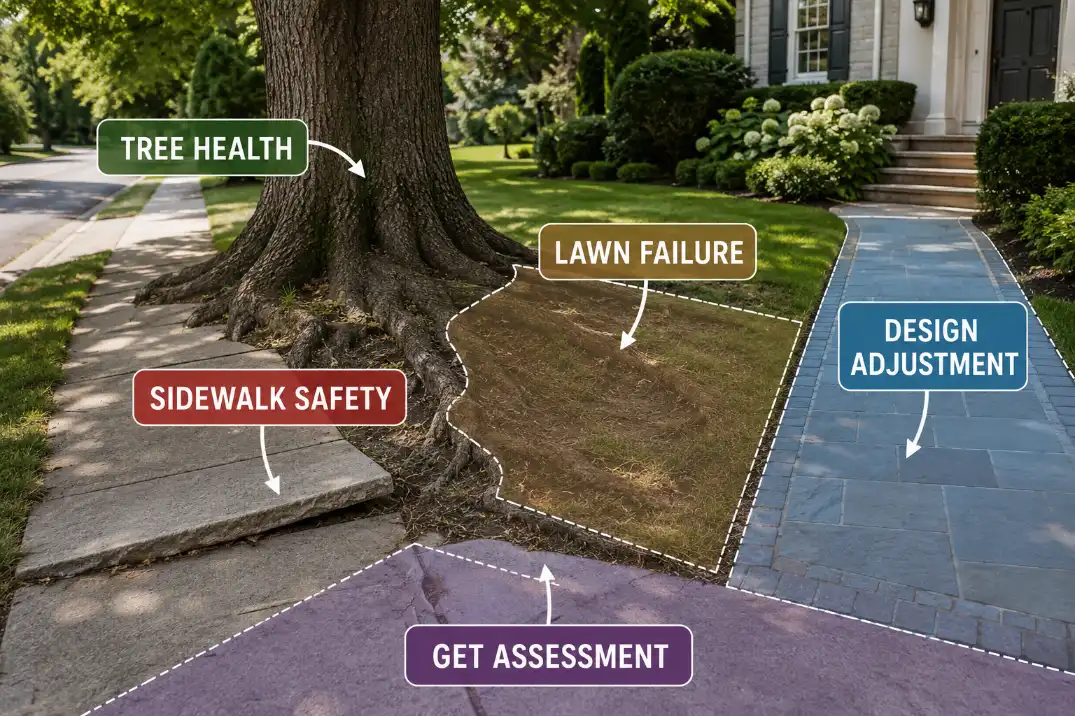
The wrong hierarchy is: make it flat, make it green, make it look fixed.
The better hierarchy is: protect the tree, remove the safety risk, stop the repeated maintenance damage, then decide what the edge should become.
A Better Way to Think About This Front Yard Edge
The goal is not to win against the roots. A mature tree root zone is not an obstacle sitting in an otherwise normal yard. It is one of the forces shaping the yard.
The lifted sidewalk, exposed roots, and damaged grass are warning signs that the front yard edge has reached a conflict point. The sidewalk wants a stable plane. The lawn wants shallow, even, open soil. The tree wants oxygen, water, and space near the surface. When all three are forced into the same narrow strip, something usually gives.
A good diagnosis does not rush to blame the tree or rescue the grass. It asks which surface is failing, where the root pressure is visible, where the mower damage repeats, where water moves, and whether the walking surface is still safe.
Once that pattern is clear, the next decision becomes much cleaner. Some yards need an arborist’s opinion. Some need sidewalk or walkway repair. Some need the lawn expectation changed around the root zone. Some need all three in the right order.
Treat the lifted sidewalk and damaged lawn as connected evidence, not separate chores. That is how you avoid cutting the wrong root, patching the wrong surface, and reseeding grass that was never going to hold.
For additional root-pruning safety context, see the University of Florida IFAS root pruning guidelines.