Last updated: July 4, 2026
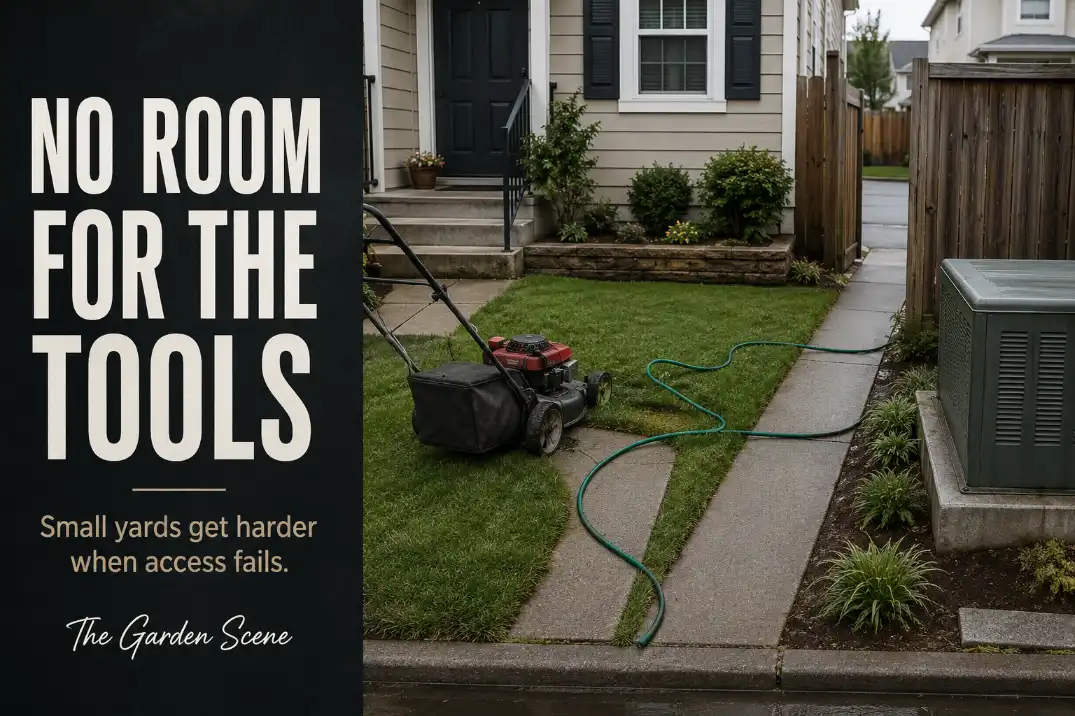
A small front yard is only easy to maintain if the tools can actually work inside it. If the mower cannot turn, the wheelbarrow cannot pass, the hose catches on every edge, and the blower has nowhere to push debris, the yard may be small on paper but heavy in practice.
That is the access test most small-yard layouts fail. The problem is not always the grass, the plants, or the weekly routine. The problem is that normal maintenance equipment cannot enter, turn, reach, and exit without forcing the homeowner into hand work.
This page is not a general small front yard maintenance plan. It is a diagnosis of what changes when the mower, cart, hose, blower, aerator, or basic maintenance tools cannot move through the front yard cleanly. The useful fix is not “do more maintenance.” It is to reshape the yard so fewer areas depend on equipment that the layout blocks.
Why a Small Front Yard Gets Harder When Tools Cannot Reach It
The break point is not yard size. It is the moment a routine task stops being a tool pass and becomes a series of small manual corrections.
A mower needs more than grass under its wheels. It needs a clean way in, enough room to turn, and an exit path that does not require lifting, reversing, or chewing up a bed edge. A compact lawn rectangle beside a driveway may take only a few minutes to mow. A front yard split into narrow strips around a walkway, porch step, mailbox, and planting bed can take longer because the mower is constantly being repositioned.
Wheelbarrows and carts expose the same problem. Mulch, soil, debris bags, edging material, and replacement plants still have to reach the work area. If the route from the driveway to the bed is blocked by narrow steps, tight planting, decorative stones, or a fence gap, the yard starts demanding hand-carried maintenance.
Hoses create another access failure. A hose bib may be close to the front yard, but if the hose has to wrap around porch columns, snag on shrubs, drag through mulch, or cross a tight walkway, watering becomes slower and messier than expected. In a small yard, one bad hose route can disturb half the planting edge.
Cleanup tools need direction. If a narrow lawn strip is boxed in by curb, wall, planting edge, and walkway, debris has no clean exit route. Leaves, grit, seed pods, clippings, and mulch fragments collect in corners. Instead of blowing debris along a clear edge, the homeowner ends up chasing it from one trap to another.
Aeration and heavier seasonal work reveal the problem even more clearly. A tiny lawn patch may still be called lawn, but if heavier equipment cannot reasonably reach it or turn on it, the maintenance plan becomes theoretical.
Any lawn area that can only be serviced by hand should be judged differently from a lawn area that normal tools can maintain.
Limited equipment access is a layout problem before it is a maintenance problem.
Find the Access Choke Points Before You Redesign Anything
Do not start by choosing plants or removing grass. Start by tracing the maintenance route. The useful question is simple: where does each tool stop doing its job?
Begin at the real entry point: driveway, front walk, garage edge, gate, curb opening, or narrow passage from the side. Then follow the route a mower, cart, hose, blower, debris bag, or hand tool would need to take.
A walkway can feel comfortable for guests but still block a wheelbarrow once plants lean into it. A fence gap can allow hand tools through but not a mower. A utility box may not ruin curb appeal, yet still force trimming around three awkward edges. A porch step may create the lift point where every bag of mulch or debris has to be carried instead of rolled.
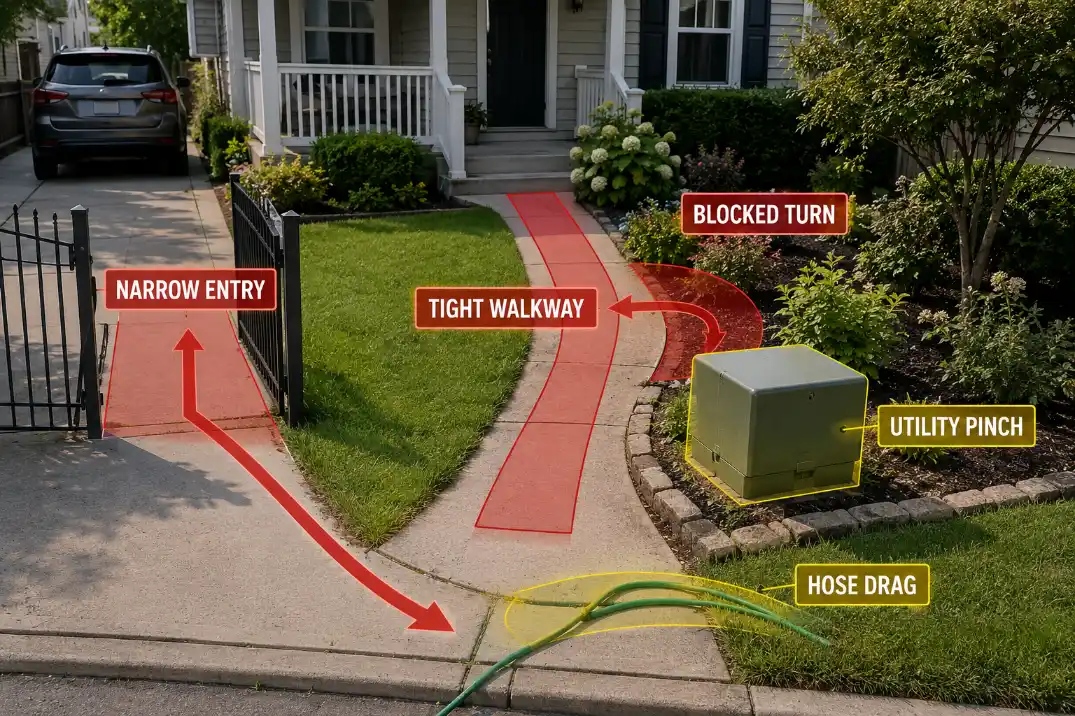
The best access diagnosis usually finds one or two pressure points that create most of the frustration. It is rarely the entire front yard. More often, one narrow pass, one bad turn, one deep bed, or one isolated lawn piece forces the switch from equipment work to hand work.
| Access clue | Likely maintenance problem | First check |
|---|---|---|
| Mower fits in but cannot turn | Repeated backing, lifting, and string trimming | Watch the full mowing route, not just the entry |
| Wheelbarrow cannot pass the walkway | Mulch, soil, and debris must be hand-carried | Check the route from driveway to bed |
| Hose catches on fixtures or plants | Watering disturbs mulch and damages edges | Pull the hose along the real path before planting more |
| Blower pushes debris into corners | Cleanup takes longer than the yard size suggests | Find where debris has no exit route |
| Small lawn islands sit behind obstructions | Lawn care becomes mostly trimming | Decide whether the turf is still worth servicing |
A quick access audit should happen before any redesign:
- Mark where a mower, cart, hose, and debris bag would enter the front yard.
- Identify any place where equipment must be lifted, reversed, folded, or dragged.
- Notice lawn pieces that cannot be cut in smooth passes.
- Check whether beds can be reached without stepping into plants.
- Pull the hose along the actual route and watch where it snags.
- Treat any zone that normal equipment cannot reach as a hand-work zone.
Utility boxes and mailboxes deserve special attention because they often look like small obstructions while quietly controlling the whole maintenance pattern.
If those fixtures are the main reason the mower cannot turn or the bed edge cannot be cleaned, the more specific issue belongs with front-yard utility and mailbox obstruction patterns, not a general small-yard care plan.
Small Lawn Pieces Create the Most Equipment Pressure
A lawn piece earns its place only if it can be serviced cleanly. In small front yards, the hardest turf is often not the biggest area; it is the leftover patch.
These fragments appear beside driveways, between walks and porches, behind mailboxes, around utility boxes, and inside narrow bed curves. They seem harmless because they are small. But small turf with bad access often requires more trimming, edging, and correction per square foot than a larger, simpler lawn panel.
A serviceable lawn lets the mower enter, make a clean pass, turn without damaging edges, and leave without being lifted over hardscape. A lawn fragment does not.
It may be too narrow for a smooth mower path, too awkward for a turn, or too broken up by curves and obstacles. The mower touches the area, but the string trimmer finishes the job every time.
That distinction matters because trimming is not a minor detail in a tool-limited yard. It becomes the maintenance system. Every inside corner, utility edge, walkway pinch, and tiny turf tail adds another place where the mower cannot finish.
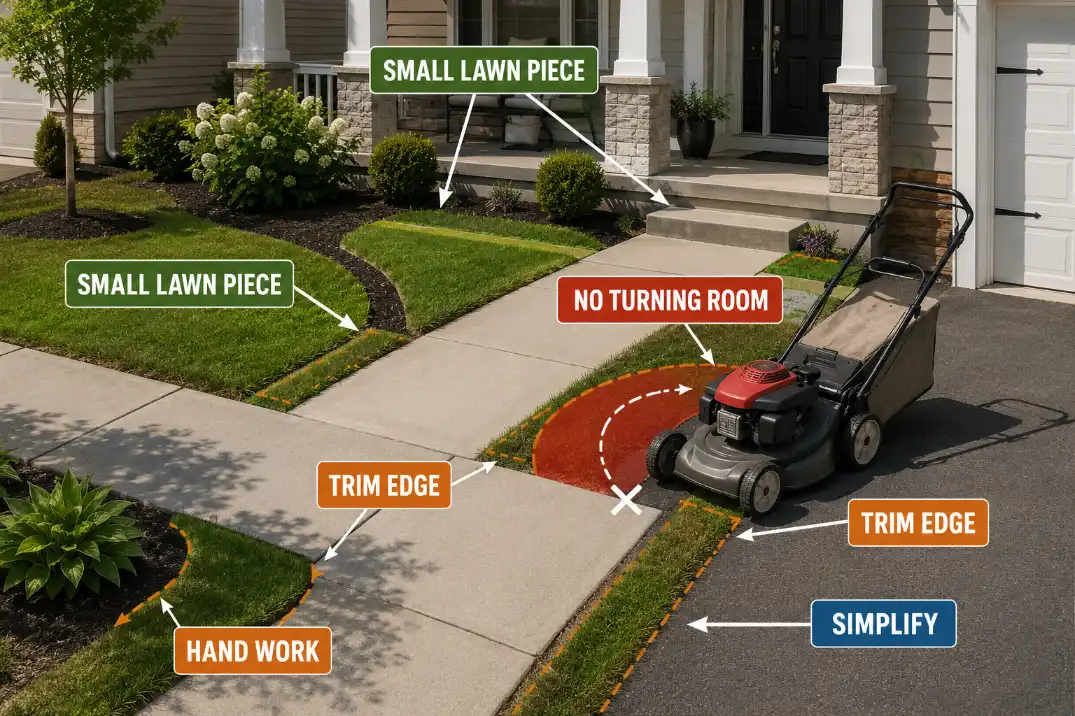
Aeration exposes the same weakness. A turf patch may be worth mowing, but if heavier equipment cannot reach it, that patch will not receive the same care as the rest of the yard. Over time, these areas often thin out, collect weeds along the edges, or become uneven because they are maintained differently.
The practical decision is not “lawn or no lawn.” It is whether each lawn piece is serviceable. A single reachable lawn panel may make sense. Three leftover turf scraps that require lifting, trimming, and edge cleanup after every mowing usually do not.
Field judgment: when a lawn patch cannot be mowed in a clean pattern, cannot be reached by heavier care equipment, and still needs hand trimming every growth cycle, treat it as a layout failure before treating it as a turf problem.
Beds, Corners, and Edges Become Hand-Work Zones
A planting bed is not low maintenance if the homeowner cannot reach the work. Bed shape, depth, and edge access matter as much as plant choice in a small front yard.
The most common issue is bed depth. A front bed may look balanced from the street, but if the back of the bed cannot be reached from the walkway, driveway, or lawn edge, every weed, fallen leaf, broken stem, or mulch correction requires stepping into the bed. That compacts soil, damages plants, and makes routine cleanup slower.
Tight inside corners create another pressure point. A bed that curves sharply around a walkway may photograph well, but it gives debris and clippings a place to collect. If a blower cannot move material out of the pocket and a rake cannot work cleanly, the corner becomes a hand-pickup zone.
Edges also matter more when tools have limited access. A clean edge between lawn and bed is easy to maintain when the mower can follow it and the trimmer has room to work. A narrow edge squeezed between a walk, lawn strip, and planting mass becomes a repeated detail task.
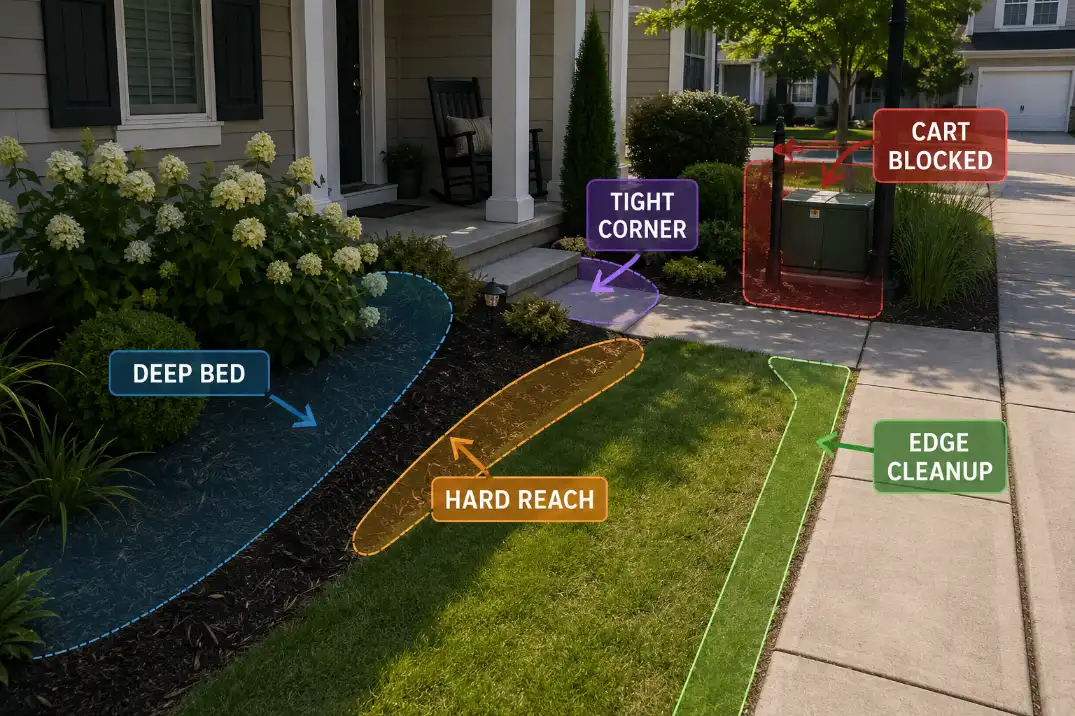
Mulch can make this worse if the bed is hard to service. Without a clean cart route, fresh mulch has to be carried in bags or buckets. Without a stable edge, it spills into lawn or walkways. Without reach, weeds and debris stay longer than they should. The bed may be “low maintenance” on paper, but the access pattern says otherwise.
Common mistakes:
- Keeping tiny turf strips because they look tidy from the curb, even though they require trimming more than mowing.
- Extending beds deeper than a person can comfortably reach from a hard edge or serviceable lawn.
- Adding curves, stones, pots, or decorative pieces exactly where a mower, hose, cart, or blower needs clearance.
The field test is blunt: if a feature blocks the tool that maintains the area around it, the feature is not just decoration. It is part of the maintenance problem.
Shift the Layout Toward Lower-Equipment Maintenance
The fix is not to make every inch reachable by every tool. The fix is to stop assigning equipment-dependent maintenance to areas where equipment cannot work.
Start with lawn shape. Keep lawn where it can be mowed in clean passes. Reduce, reshape, or convert lawn pieces that exist only as leftover strips around obstacles. A smaller continuous lawn is often easier than a slightly larger lawn broken into fragments.
Then look at the maintenance path. This does not have to be a formal walkway. It can be a clear strip along the driveway, a reachable edge beside a bed, or a practical route from the garage to the front planting area. The point is to let tools, debris bags, hose movement, and seasonal materials move through the yard without fighting the design.
Beds should be reachable from at least one stable edge. A front bed that can be weeded, mulched, and cleaned from the walkway, driveway, or lawn edge will stay easier to manage than a deep bed that requires stepping into the planting zone. If the bed is deep, it needs access logic: a stepping point, a gap, a service edge, or a narrower planting depth.
Corners should be simplified where equipment already struggles. A tight curve around a small lawn patch may look softer, but if it creates a weekly trim pocket, the shape is working against maintenance. Straightening a short edge, widening a service gap, or removing a leftover turf notch can reduce more work than changing the plants.
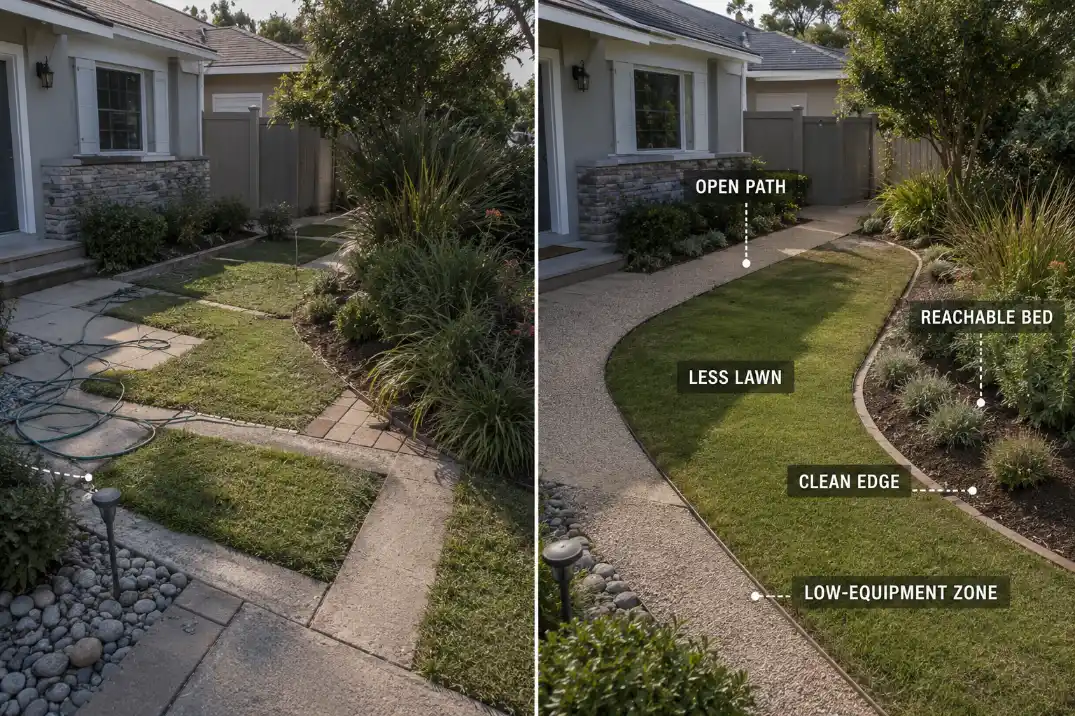
Hose routes deserve the same design attention. If the hose has to scrape over mulch, snag on shrubs, or cross the front walk awkwardly, the watering layout is too dependent on effort. Keep hose movement along durable edges where possible. Avoid planting fragile edges directly in the hose’s natural path.
Cleanup also needs an exit route. A blower or rake needs somewhere to move leaves, grass clippings, and grit. If every edge traps debris, cleanup becomes a series of small rescues. A clean edge along the driveway, sidewalk, or lawn panel gives debris somewhere to go before it is collected.
Visible-front-yard expectations still matter. A lower-equipment layout should not look neglected just because it is easier to maintain.
If the yard is subject to community standards or strong neighborhood visibility pressure, keep the simplified layout neat enough to satisfy front-yard maintenance rules that affect visible layout choices while still removing the tool-hostile shapes that caused the problem.
The best adjustment is usually the least dramatic one that removes the repeated failure point: the lawn patch the mower cannot turn around, the bed nobody can reach, the utility corner that needs trimming from three sides, or the hose route that damages the edge every time.
What This Page Is Not Solving
Limited equipment access can overlap with other front yard problems, but it should not absorb all of them.
If the yard sits on a corner lot, the extra workload may come from long curb lines, two public-facing edges, sidewalk exposure, and debris along both streets. That belongs more naturally to corner-lot maintenance pressure than to a small-yard equipment-access diagnosis.
If a neighbor’s tree is dropping leaves, pods, shade, or roots into the yard, the problem may not be tool movement first. It may be canopy pressure, debris collection, weak turf, or root competition. That is a different maintenance pattern from a yard where the main issue is that the mower, cart, hose, or blower cannot reach the work.
Side-yard access is also a boundary. A narrow side passage may affect how equipment reaches the front, but this page is not a side-yard route design guide. Here, the side passage matters only when it blocks equipment from entering or servicing the small front yard.
Tool selection is another boundary. A smaller mower, shorter hose, cordless blower, or compact cart may help in some cases, but buying a different tool should not be the first diagnosis. If the layout keeps creating tiny lawn scraps, deep unreachable beds, and blocked cleanup routes, new equipment only softens the symptom.
Plant alternatives are also not the core answer. Groundcovers, gravel, mulch, or planting beds can reduce mowing, but they can still become high-maintenance if they are unreachable, messy at the edge, or hard to clean. The real standard is not whether the yard has less lawn. It is whether the remaining surfaces can be maintained without constant manual correction.
The Best Small Front Yard Is One You Can Actually Service
A good small front yard is not the one with the most features packed into the least space. It is the one where the mower can reach the lawn that remains, the cart can bring in materials, the hose can move without damage, the beds can be reached from stable edges, and cleanup has a clear route.
When equipment access is limited, maintenance pressure is built into the layout. Every tight corner, isolated turf patch, blocked turn, deep bed, and snagging hose route becomes a small task that repeats.
The useful standard is serviceability. If the front yard can be reached, turned through, cleaned, watered, edged, and carried into without turning every job into hand work, the smaller space finally starts working like a smaller space.
For general turf maintenance principles that support mowing, aeration, and established lawn care decisions, see the University of Maryland Extension guide to lawn care and maintenance.