
Last updated: July 4, 2026
A front yard can be fully HOA-compliant and still be set up to need too much work. The lawn may be required in the exact strip where grass keeps thinning. The shrubs may be approved but too vigorous for the height limit. The mulch color may be correct, while the bed keeps washing out after rain.
That is the useful reframe: the yard is not always failing because the homeowner picked badly or maintained it carelessly. Sometimes the rule set narrows the available choices until the compliant option does not match the actual site.
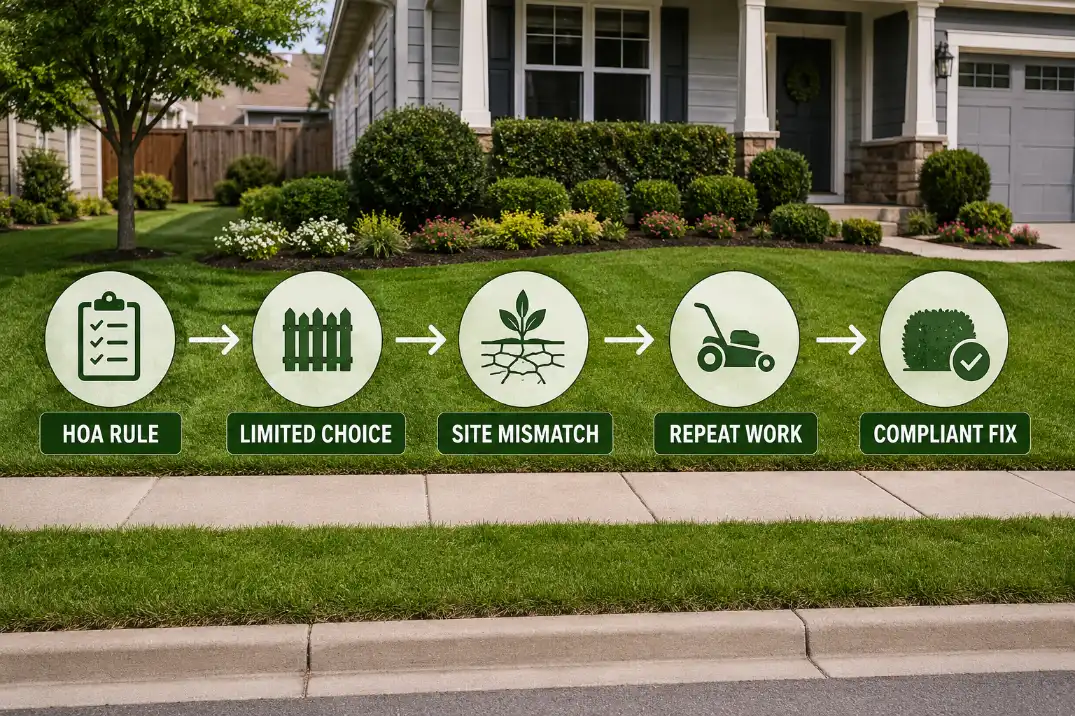
The diagnosis should not start with “fight the HOA.” It should start with the maintenance loop:
HOA rule → limited landscape choice → site mismatch → repeated maintenance burden → compliant adjustment.
Once you can name the rule behind the repeated work, the fix becomes more precise. You stop replanting, re-mulching, watering harder, or pruning more often as if effort alone will solve it. Instead, you adjust the allowed element so it still fits the rules, but no longer fights the yard every week.
Why HOA Rules Can Make Front Yard Maintenance Harder
The first test is simple: is the maintenance problem coming from the yard condition, or from a rule that keeps forcing the wrong condition to remain visible?
HOA landscape rules usually aim for consistency, curb appeal, and a clean neighborhood appearance. The trouble starts when those appearance rules are applied to yards with different sun exposure, soil depth, slope, runoff, shade, and water access.
A rule may look simple on paper: keep a certain amount of turf, use approved plants, maintain shrubs below a height limit, use a specific mulch type, or get approval before changing bed lines. In the yard, that same rule can remove the easiest low-maintenance answer.
If a sunny curb strip burns out every summer but the HOA expects turf there, the homeowner inherits a watering and repair cycle. If a shrub is approved because it looks formal when clipped, but it naturally wants to grow taller than the allowed height, the homeowner inherits a pruning cycle.
If groundcovers are restricted and bare mulch is required, the homeowner inherits a weed and mulch-refresh cycle.
The point is not that every HOA rule causes problems. The point is that every repeated maintenance problem should be traced back to the rule, the site condition, or the gap between them.
| HOA rule | Limited choice it creates | Maintenance burden it can cause | Compliant adjustment |
|---|---|---|---|
| Required front lawn area | Keeps turf in weak or exposed zones | Mowing, watering, patching, weeds | Improve soil, adjust irrigation, request approved bed expansion where allowed |
| Approved plant list | Limits replacements to certain species or forms | Replanting, pest cleanup, extra watering | Choose approved plants by site condition, not just appearance |
| Shrub height limits | Forces plants to stay smaller than mature habit | Repeated shearing and awkward regrowth | Use smaller mature-size plants or wider spacing |
| Mulch or groundcover restrictions | Limits better weed or erosion control | Washout, exposed soil, bed reset | Use approved mulch depth, edging, and proposal notes for unstable beds |
| Tree and shade limits | Controls canopy, roots, and lawn exposure | Thin grass, leaf cleanup, root competition | Convert allowed shade zones or adjust ground layer where rules permit |
| Approval process | Delays durable fixes | Another season of temporary repairs | Submit problem-focused proposals with photos and maintenance logic |
Mandatory Lawn Areas Create the Most Repeated Work
Required turf becomes high-maintenance when the rule protects the look of lawn but the site cannot support healthy grass in that location.
The symptom is familiar: the lawn still needs mowing, but parts of it are thin, hot, weedy, muddy, or repeatedly patched. The homeowner seeds, waters, fertilizes, edges, and repairs. The yard looks acceptable for a short stretch, then the same weak areas return.
That does not always mean the lawn is being under-maintained. It may mean turf is being required where turf is the wrong ground layer.
Start with the location of the failure. A strip between sidewalk and street may be dealing with reflected heat, foot traffic, shallow soil, road splash, and irrigation gaps. A shaded area under a required or protected tree may never receive enough light for thick turf. A low corner may stay damp after rain. A slope may dry at the top and erode at the bottom.
These are different causes, even when they all show up as “bad grass.”
If the HOA requires visible lawn, the first compliant move is usually not to remove all turf. It is to separate the turf that can realistically perform from the turf that is being forced into a losing condition.
For a weak but salvageable lawn zone, soil improvement can matter more than another round of seed. Compaction, shallow topsoil, and weed pressure can make required turf look neglected even when it is being watered and mowed.
If the same area keeps reverting to thin grass and weeds, the deeper issue may belong with patchy grass and weed pressure in poor front yard soil rather than with the HOA rule alone.
For a turf zone that repeatedly fails because of heat, shade, runoff, or access, the better HOA conversation is narrower: can a small approved bed expansion, approved turf alternative, reinforced edge, or watering-zone correction reduce the visible maintenance problem while preserving the required front-yard appearance?
That is a stronger fix than reseeding the same weak strip every season.

The first check is location, not seed type
Before changing seed, fertilizer, or watering frequency, check whether the failing lawn area sits next to pavement, under shade, on compacted soil, near a drainage path, or outside the practical reach of irrigation.
A required turf rule can make the lawn visible. It cannot make every lawn location equally suitable.
Approved Plant Lists Can Still Create the Wrong Plant in the Wrong Place
An approved plant list only solves one problem: whether the plant is allowed. It does not prove the plant belongs in that exact spot.
This is where many HOA maintenance loops begin quietly. A plant is approved because it fits the community’s look. It may have the right shape, color, or form. But the list may not account for blazing afternoon sun near a driveway, reflected heat from concrete, shallow soil near tree roots, compacted soil by the street, wet soil near a downspout, or deep shade from the house.
The symptom is repeated correction. The plant survives but always looks stressed. It needs extra watering compared with the rest of the bed. It gets pest damage first. It drops leaves, browns at the edges, grows unevenly, or needs replacement sooner than expected.
From the curb, that can look like poor care. In reality, it may be an approved plant in a mismatched location.
The mistake is choosing from the approved list by appearance only. A better method is to filter the approved list by the actual condition first: sun exposure, soil moisture, mature width, maintenance tolerance, root space, and heat exposure. That keeps the homeowner inside the rule set while reducing the chance of repeated replanting.
When the approved list is broad enough, the maintenance fix may be as simple as choosing a slower, tougher, better-scaled plant from the same list. When the list is narrow, the proposal may need to explain why the replacement still preserves the intended front-yard appearance while solving the recurring maintenance problem.
This page should not become a plant-selection guide, but the principle matters. The yard becomes easier to maintain when approved choices are filtered through site conditions before planting.
For a deeper plant-choice process, use a separate guide to choose front yard plants by site conditions instead of letting the HOA list do all the decision-making.
The warning sign is uneven performance
If the same approved plant looks good in one part of the yard but struggles in another, the plant itself may not be the problem. The location is probably different.
That distinction matters because replacing the weak plant with the same approved plant often repeats the failure. A better compliant replacement should match the failing spot, not just the HOA list.
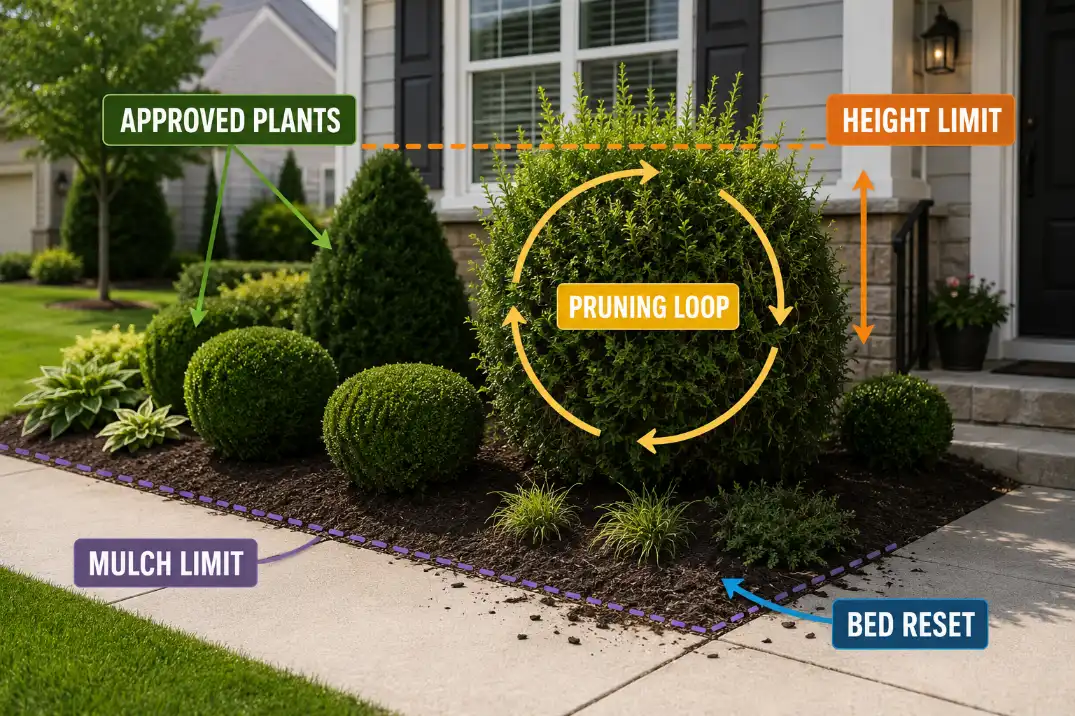
Height Limits Can Turn Shrubs Into Pruning Chores
A shrub height rule becomes a maintenance problem when the allowed height is smaller than the plant’s natural habit.
That mismatch is easy to miss at planting time. A young shrub may look tidy and compliant for the first season. Then it reaches its real growth pattern, pushes above the allowed height, spreads into a walkway, blocks a window edge, or starts crowding a porch or driveway sightline.
The homeowner can keep it compliant, but only by cutting it back again and again.
That kind of maintenance is not a sign of a low-care front yard. It is a sign that the plant’s mature size and the HOA limit are fighting each other.
Repeated shearing can also make the shrub look worse over time. The outside stays dense, the inside gets woody, the shape becomes stiff, and fast new growth pushes out after each cut. The more formal the HOA wants the shrub to look, the more obvious the regrowth can become.
Spacing adds another layer. Even a compliant shrub becomes high-maintenance when it is planted too close to a walkway, meter, porch edge, window, or driveway. The rule may say “keep it below this height,” but the real workload comes from height plus width plus clearance.
The compliant adjustment is not always a different style. It is often a better-scaled version of the same idea: smaller mature-size shrubs, more space between plants, lower layered forms, or approved plants that naturally stay closer to the required height.
A shrub that has to be corrected every few weeks is not low-maintenance just because it is allowed.
Mulch, Groundcover, and Irrigation Limits Can Keep Beds Unstable
Bed rules create maintenance when they control the surface look but not the surface behavior.
Some HOAs restrict mulch color, mulch type, rock, gravel, visible drip lines, edging styles, or groundcovers. Those rules may create a consistent neighborhood appearance, but they can also remove the material or method that would solve the actual site condition.
A bare mulch bed on a slope may keep washing out. A hot bed with widely spaced shrubs may keep growing weeds because groundcovers are not allowed.
A dry foundation bed may need more hand-watering because visible irrigation changes are restricted. A bed near runoff may need stronger edging, but the approved edging style may be too weak to hold the material.
The visible symptom is repeated cleanup: mulch pulled back from the sidewalk, exposed soil after storms, weeds returning through open areas, dry plant edges, or beds that need refreshing long before the rest of the yard does.
This is where the diagnosis should stay practical. The problem is not “mulch is bad” or “groundcovers are always better.” The problem is that the allowed surface treatment may not match slope, water movement, shade, heat, or plant spacing.
If mulch keeps moving after every storm, the issue may be less about neatness and more about bed stability. A separate diagnosis of mulch that keeps washing out can help when the main failure is runoff, slope, or weak edging rather than the HOA rule itself.
The fix should target the bed behavior
A compliant bed can often be improved without changing its whole design. Better mulch depth, cleaner edge definition, tighter plant spacing where allowed, buried drip under mulch where permitted, or a small runoff-control adjustment may reduce the reset cycle.
The proposal language matters. “I want a different look” is weaker than “this approved bed surface is washing into the walkway, and this adjustment keeps the same appearance with less cleanup.”
Tree and Shade Rules Can Shift the Maintenance Problem to the Lawn
Tree rules often show up as lawn problems first.
Some communities require street trees, limit removal, restrict canopy pruning, or control replacement species. Others limit tree height, shape, or placement. Those rules may be reasonable from a neighborhood perspective, but they still change what happens underneath.
The most common maintenance shift is shade over required turf. A lawn area that once performed well may thin as a tree matures. The homeowner keeps watering and patching, but the real change is light. If the HOA still expects turf in that zone, the maintenance loop moves from the tree to the grass.
Roots create another quiet burden. They compete for moisture, reduce available soil volume, and make shallow planting beds harder to keep even. The surface may look like a lawn problem or a plant problem, but the underlying pressure is the tree-root zone.
Canopy rules can also create awkward pruning. If a tree has to stay within a certain form or sightline, pruning may reduce shade in one place while increasing stress in another. If the ground layer is not adjusted to match the changed light and root conditions, the maintenance burden keeps shifting around the yard.
The compliant adjustment is usually modest: respect the root zone, avoid forcing thirsty plants under heavy competition, request approved shade-tolerant ground layer changes where allowed, or convert a failing strip into a permitted planting bed rather than repairing weak turf indefinitely.
When the tree condition changes, the ground layer may need to change too. A rule that freezes the ground layer while the tree keeps maturing often creates repeat maintenance.
Approval Delays Turn Small Corrections Into Seasonal Problems
An approval delay is not just paperwork. In a front yard maintenance problem, it can mean one more season of keeping a failing condition presentable.
A homeowner may already know the turf strip needs soil work, the bed needs edging, the shrub needs replacement, or the mulch area needs a better surface. But if the change requires approval, the yard may go through another summer of watering, another storm season of washout, or another growing season of pruning before the durable fix is allowed.
This is why vague proposals create hidden maintenance costs. A request that simply says “replace shrubs” or “expand bed” may look like a design preference.
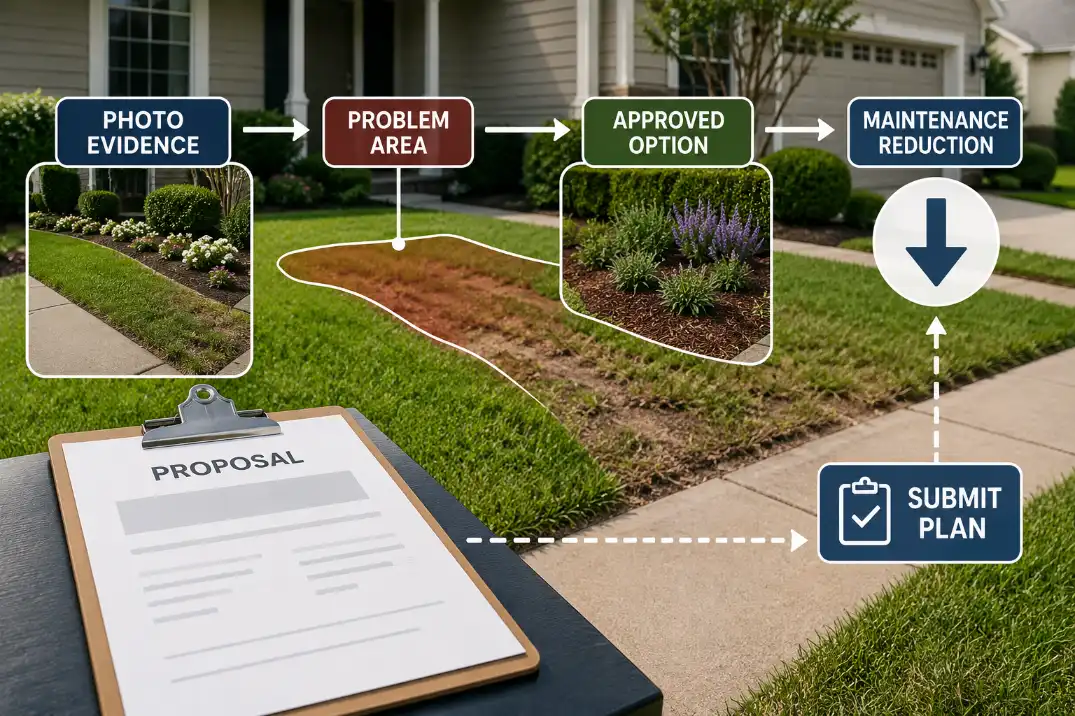
A stronger proposal shows the visible maintenance problem the HOA can understand: repeated dieback, sidewalk mulch washout, required turf thinning, over-height shrubs, or constant pruning to preserve clearance.
The proposal should connect the adjustment to compliance. The goal is not to ask for an exception just because the homeowner wants less work. The goal is to show that the current compliant condition is producing a visible maintenance problem and that the proposed adjustment keeps the front yard cleaner, healthier, and easier to maintain within the rule intent.
A simple compliant adjustment path:
- Photograph the recurring problem at the same spot: thin turf, overgrown shrub, mulch washout, dry bed, or repeated weeds.
- Identify the HOA rule involved: turf requirement, approved plant list, height limit, mulch rule, irrigation restriction, or approval requirement.
- Choose the smallest adjustment that reduces the maintenance loop while keeping the intended appearance.
- Submit the request with the problem, the rule, the approved alternative, and the expected maintenance reduction.
- Maintain the corrected condition so the HOA sees the fix as a stability improvement, not a design drift.
This is also where a broader design-constraint page can help. If the issue is less about day-to-day maintenance and more about how the whole front yard must be shaped around plant approvals, setbacks, and appearance rules, route that decision to front yard design constraints created by HOA plant rules instead of trying to solve the entire design plan inside this maintenance diagnosis.
How to Reduce Maintenance Without Breaking the Rules
The strongest HOA-friendly fix is usually the smallest change that breaks the maintenance loop while preserving the rule’s visual intent.
If required turf is the burden, improve the soil and watering pattern before assuming the entire lawn must change. If a specific turf area fails because of heat, slope, shade, or root pressure, ask whether a small approved bed adjustment would reduce the visible problem better than another round of patch repair.
If approved plants are the burden, filter the list by location. A plant near pavement needs different tolerance than the same plant in a protected foundation bed. A plant under tree roots needs different expectations than one in open sun. The approved list is only useful after the yard condition is known.
If pruning is the burden, compare allowed height with mature size. A shrub that naturally grows far above the permitted height will keep asking for correction. Replacing it with a smaller approved form is often more compliant over time than shearing it into submission.
If mulch and bed cleanup are the burden, look at movement. Does the mulch wash toward the sidewalk? Do weeds appear because bare areas are too wide? Does the bed dry out because irrigation is limited or uneven? The fix may be edging, spacing, mulch depth, hidden drip where allowed, or a clearer request for a more stable approved material.
Maintenance note:
The lowest-maintenance HOA yard is not always the most minimal-looking yard. It is the yard where every approved element is matched tightly enough to the site that it does not need constant correction.
If drought-tolerant changes are the burden because the HOA limits alternatives, keep the argument practical. Do not frame the proposal as a full philosophical shift.
Frame it as a way to keep the front yard alive, clean, and consistent during summer stress. When water use is the real driver, a separate look at low-water front yard strategies can support the next decision without turning this page into a drought-landscaping guide.
A good adjustment does not say, “I do not want to maintain this.” It says, “This specific rule-created condition is producing repeated maintenance, and this approved change keeps the yard more stable.”
When the Problem Belongs on Another Page
Not every HOA-related maintenance problem should be solved here. This page is for diagnosing how the rule creates the burden.
If the real problem is choosing plants for sun, shade, soil, mature size, or exposure, use a plant-selection route. If the real problem is required turf failing because of compacted soil or weeds, use a soil and turf diagnosis. If the real problem is drought pressure, water limits, or summer survival, use a low-water route.
If the problem is bed material moving after storms, the next step is not a full HOA design plan. It is a surface-stability diagnosis.
And if the real issue is that the entire front yard layout is shaped by HOA planting constraints, that belongs on a design-constraint page, not inside a maintenance loop article.
The clean decision is simple: name the rule, name the mismatch, name the repeated work, then choose the smallest compliant adjustment that breaks the cycle. A front yard does not become easier to maintain because the HOA rule disappears. It becomes easier when the allowed choices finally match the actual yard.
For plant and landscape performance, University of Minnesota Extension explains the practical value of matching plants to growing conditions in its guide to landscape design and plant selection.