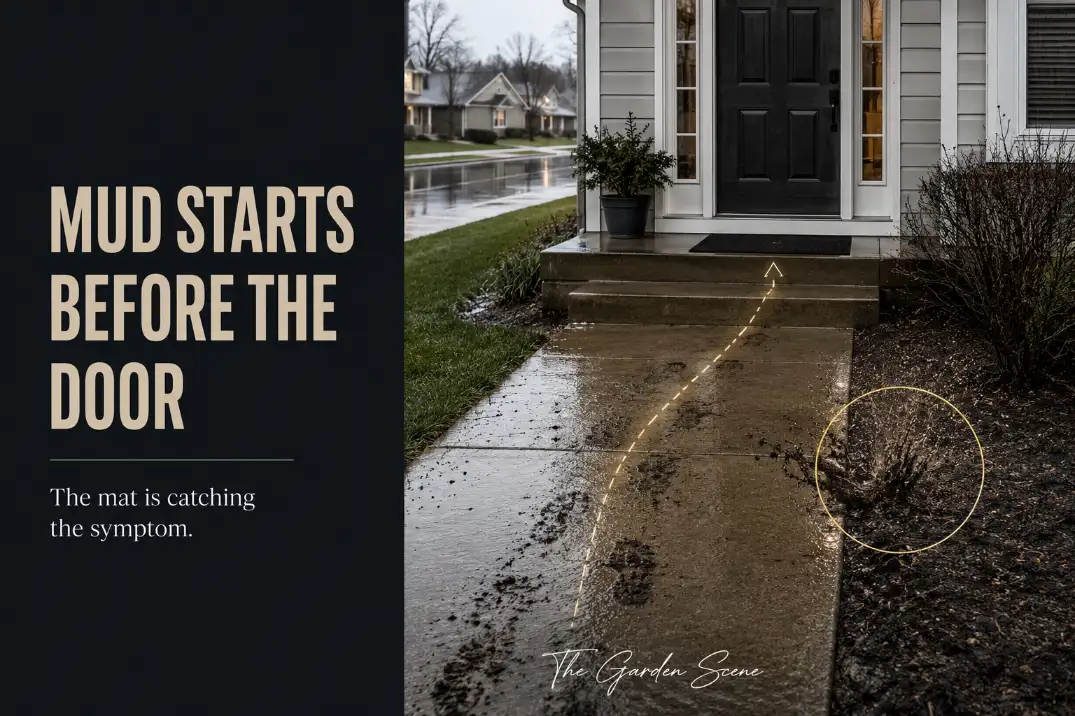
Mud at a front entry usually starts 5 to 15 feet before the door, not on the doormat. The fastest improvement is to cover exposed soil, stop bed material from washing onto the path, and keep the landing dry enough that shoes are not stepping through a damp pause zone.
Check three things first: bare soil within 6 to 12 inches of the walkway, brown splash marks on risers or siding, and a landing that stays wet more than 24 hours after rain.
The important distinction is mud versus loose dirt. Dry grit often points to dust, decomposed mulch, or gravel fines. Mud after rain points to exposed soil, splashback, poor edge control, or water that lingers.
A mat can reduce what comes inside, but if the route keeps loading shoe soles before they reach the door, the mat is already too late.
Mud Starts Before the Door
The front door gets blamed because that is where the mess becomes visible. But the mechanism usually begins where shoes first touch wet soil or where rain throws soil particles onto the walking surface.
Fast control vs the real fix
A fast control is worth doing after the next storm: sweep the path before mud dries into grit, move loose mulch away from the walkway edge, and use a scraper mat that can drain. If bare soil is exposed, even a temporary layer of coarse mulch or angular gravel can reduce the next round of tracking.
The real fix is different. It means finding why soil keeps reaching the walking route. That may be a high bed edge, a thin lawn shoulder, a crowded pause zone, a downspout dumping near the entry, or a walkway that invites people to step off the hard surface.
The first dirty contact matters most
A person does not need to step into a planting bed to bring mud inside. If the path edge is soft, the lawn shoulder is thin, or the planting bed sits slightly higher than the walkway, one half-step off the hard surface can load shoe soles with wet soil. After that, the mat is only catching what the yard already created.
A cleaner entry starts by protecting the first contact zone: the walkway edge, the last turn before the landing, and the place where people pause to unlock the door.
If that pause zone is cramped, visitors often step sideways into the bed or lawn, especially when carrying groceries or packages.
That is why mud control often overlaps with Front Door Landing Clearance instead of staying a simple cleaning issue.
Cosmetic dirt is not the same as a recurring source
A dusty mat, a few dry leaf stains, or mulch crumbs after yard work are cosmetic. Muddy shoe prints after every rain are more structural.
The difference is recurrence. If the entry looks clean after sweeping but gets muddy again within the next storm cycle, the source is still active.
A practical threshold: if the same dirty strip appears after two or three rains in a row, treat it as a site problem. Washing the porch, replacing the mat, or adding another decorative planter may improve the look for a day, but it will not change the route water and soil are taking.
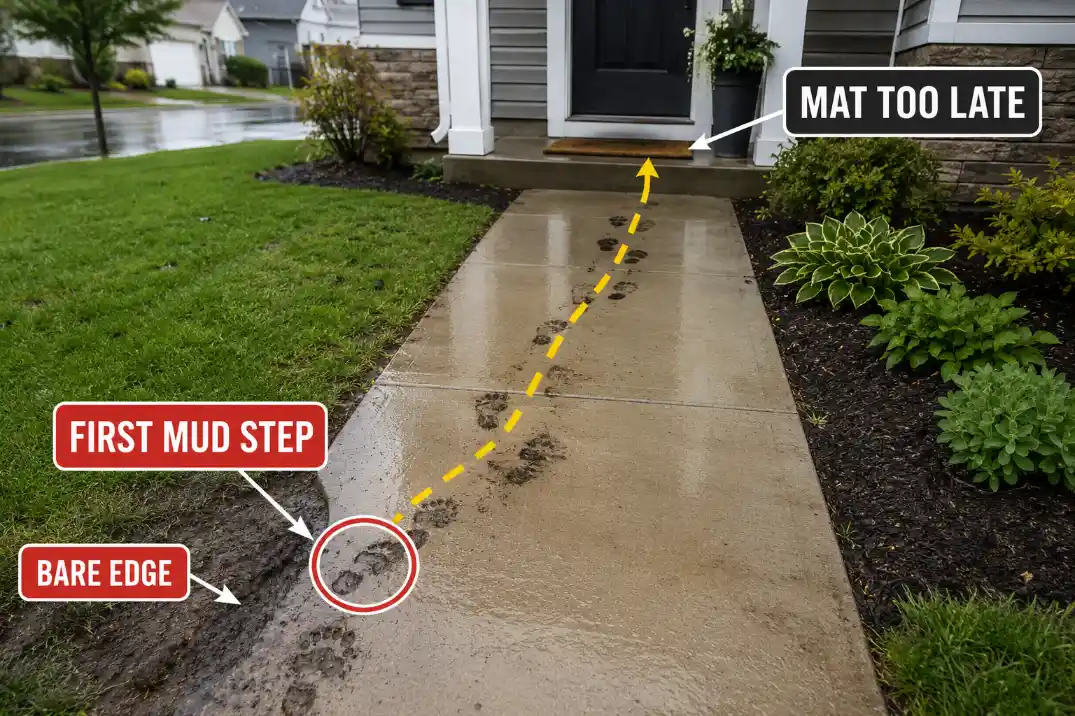
Bare Soil Near the Path
Bare soil is the most common mud source because it fails in two ways at once. It sticks to shoes, and it breaks apart under raindrop impact. A narrow exposed strip only 2 or 3 inches wide can be enough to dirty the path if it sits beside the walking line.
Why a small exposed edge causes a large mess
Rain does not have to flow like a stream to move soil. Raindrops hit bare ground, loosen particles, and bounce them onto nearby hard surfaces.
On a front walk, that splash zone often reaches 6 to 12 inches from the bed edge. In heavy rain, it can reach farther if the bed surface is high, compacted, or sloped toward the path.
This is where homeowners often overestimate mulch and underestimate soil contact. A fresh 1-inch dusting of mulch looks finished, but it does not always absorb impact or hold the surface in place.
For entry mud control, a better target is usually 2 to 3 inches of stable mulch, groundcover, or planted cover over exposed soil, with the surface held below the path edge rather than piled against it.
Choose the material by failure pattern
Mulch is good when the main problem is raindrop splash on bare bed soil. It is weaker when water crosses the bed like a shallow flow path. Gravel can help in narrow, high-traffic strips, but rounded decorative stone scatters easily and can make the walkway feel gritty.
Low groundcover is often the cleanest long-term surface, but it needs time to fill in and should not be expected to solve mud in the first week.
Edging is not a decoration in this situation. It is a control line. If bed material keeps appearing on the walkway, the edge is failing even if the planting looks attractive. A low metal, stone, or concrete edge can keep material out of the walking line, but it should not trap water against the path.
Pro Tip: After a rain, look at the path before sweeping. The direction of the dirt tells you more than the amount of dirt.
For front yards where the official walkway is not the route people actually use, mud control also depends on behavior.
A worn shortcut across the lawn will keep feeding dirt into the entry even if the bed edges are clean, which is why Front Yard Visitor Path Mistakes can matter more than another layer of mulch.
Splashback From Beds
Splashback is easy to misread because it looks like the bed is simply messy. The real issue is impact. Rain hits exposed or loose material, throws it sideways, and the hard surface records the pattern.
The splash line is the clue
A low brown fan on the walkway, porch riser, siding, or bottom of the door trim usually means splashback. A muddy streak that follows the lowest point of the path means runoff. Those are different fixes.
Splashback needs cover, distance, and edge control. Runoff needs grading, diversion, or drainage. If you treat runoff like splashback, you keep adding mulch that washes away. If you treat splashback like drainage, you may overbuild a solution for a problem that needed better surface cover.
| Visible pattern | More likely source | Better first fix | When it is not enough |
|---|---|---|---|
| Brown specks on risers or siding | Rain splash from bare bed soil | Cover soil and lower the bed surface | If water also flows across the path |
| Mud strip along one path edge | Bed edge too high or unstable | Add edge restraint and stable cover | If the bed drains toward the walkway |
| Wet landing after 24 hours | Drainage or grading issue | Move water away first | If the landing slopes back to the door |
| Mulch floating onto walkway | Water crossing the bed | Redirect flow or change material | If roof runoff feeds the bed |
| Muddy side-step marks | Weak pause zone or route | Clear or widen the standing area | If people still avoid the official path |
| Grit without wet mud | Loose fines or decomposed material | Sweep and replace unstable surface | If the material keeps breaking down |
Bed height changes the result
A bed sitting 1 to 2 inches above the walkway is more likely to shed soil onto the path. That height difference may look minor when dry, but after rain it turns the bed into a source.
A better entry edge often leaves the bed surface slightly below the walkway or separated by a clean retaining edge.
This is also where a common fix stops making sense: repeatedly topping off mulch. If the bed keeps losing material after storms, the problem is not mulch quantity.
It is water movement, bed height, or edge design. The same pattern appears in yards where Front Yard Mulch Washes Away Every Season because the material is being asked to resist a flow path it was never meant to handle.
Drainage Around the Landing
Mud control near the front door becomes a drainage issue when water lingers. A wet mat, slick landing, or damp concrete edge the next morning after rainfall usually means the area is staying wet long enough to keep soil active.
Drying time is a decision rule
After a normal rain, a front walkway should begin drying within a few hours once rain stops, depending on shade, humidity, and temperature.
In humid climates such as Florida, drying may take longer, but standing water or soft soil after 24 hours is still a warning sign. In northern states, that same wet entry can become a freeze-thaw hazard when temperatures drop below 32°F.
If the landing slopes back toward the house, even slightly, the mat becomes a wet sponge. If the walkway meets a bed that drains toward the door, soil and moisture collect where people step hardest. A healthy entry sheds water away from the threshold; a failing one stores it near the pause zone.
When mulch and edging are no longer enough
Mulch, edging, and mats make sense when the problem is splash, loose soil, or a weak border. They stop making sense when water keeps arriving from somewhere else.
If runoff crosses the path, if a downspout empties near the entry, or if the landing remains damp the next morning, the priority shifts from surface cleanup to water movement.
That is the point many homeowners underestimate. They notice mud on the mat, but the stronger clue is a wet route. If the entry cannot dry, every surface material has to work harder than it should.
Downspouts and roof edges often matter more than the bed
A planting bed beside the entry may look like the source, but water from a roof valley, short downspout, or overflowing gutter may be loading that bed during every storm. That is the higher-priority check before replacing plants or mats. If roof water is hitting the entry zone, surface fixes will keep failing.
For a broader drainage pattern, compare the entry with the rest of the yard. If water is also cutting across the front walk, collecting near the house, or carrying mulch downhill, the entry is part of a larger runoff issue.
In that case, Yard Drainage Problems From Soil, Slope, and Runoff is the more useful diagnosis than treating the doorway as an isolated cleaning problem.
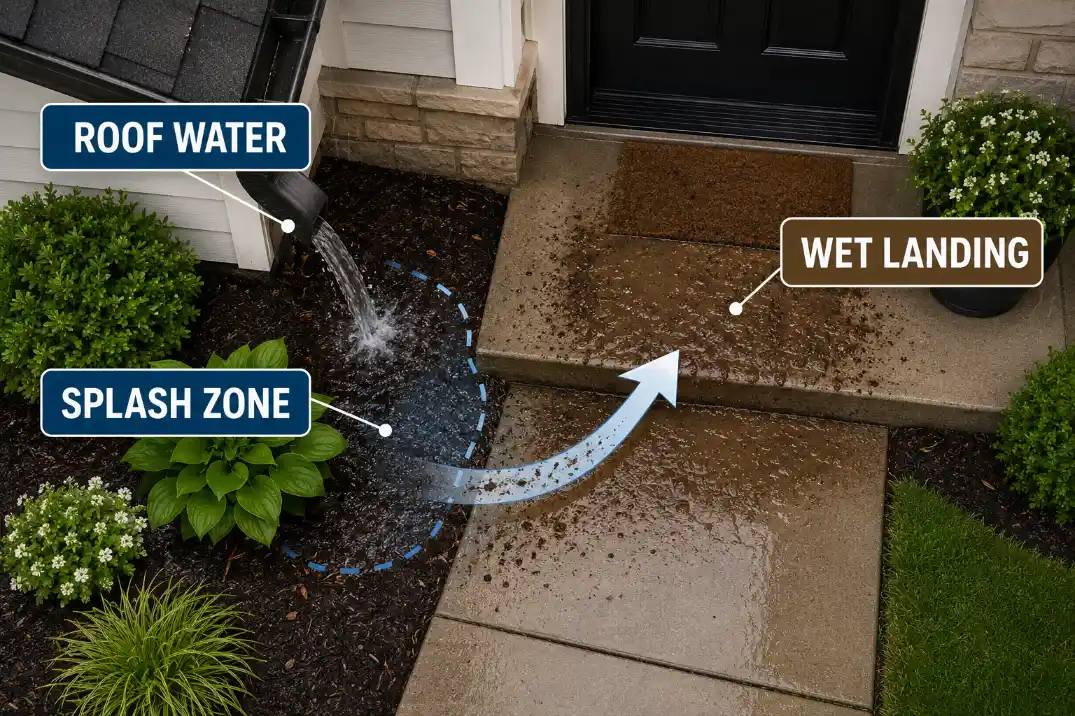
Mats Are Not the Whole Fix
A mat is useful at the very end of the system. It is not the system. The mistake is expecting one absorbent layer at the door to solve soil exposure, poor drainage, weak edges, and awkward stepping behavior.
What a mat can actually do
A good exterior mat removes loose grit and some moisture from shoe soles. It works best when shoes are already coming from a stable surface. It performs badly when every visitor steps through wet grass, exposed soil, decomposed mulch, or a puddle before reaching it.
The healthier comparison is simple: a clean entry uses a stable walking route first and a mat second. A failing entry uses a mat as the first serious line of defense.
That is why doubling the mat size often disappoints. It catches more mud, but it also stays wet longer and can make the landing feel dirtier.
Dogs, kids, and delivery traffic change the load
Front entries with dogs, kids, frequent package delivery, school-morning traffic, or driveway-to-door shortcuts need more than a decorative doormat. Repeated trips press the same wet edge again and again.
Even a small muddy corner becomes a daily source when it gets stepped on 10 or 20 times between storms.
This is where homeowners commonly overestimate the mat and underestimate the route. If traffic naturally cuts across a soft lawn shoulder or narrow bed edge, the entry will keep getting dirty until that route is hardened, redirected, or blocked with a clear planting edge.
When the mat becomes part of the problem
A thick mat on a shaded landing can hold moisture for 24 to 48 hours after rain. If the underside stays damp, it can leave a dark rectangle on concrete or pavers and keep fine soil stuck at the threshold.
On tight landings, an oversized mat can also force people to step around it, sending them into the bed edge or lawn shoulder.
Entry usability matters here. If the landing is crowded by planters, packages, or a door swing, people will not use the mat cleanly. A cleaner layout often comes from removing one obstacle rather than buying one more product.
That same logic appears in Front Entry Usability Ideas, where the entry has to support real movement before decorative details matter.
Pro Tip: Use the mat as the final wipe point, not as the place where mud control begins.
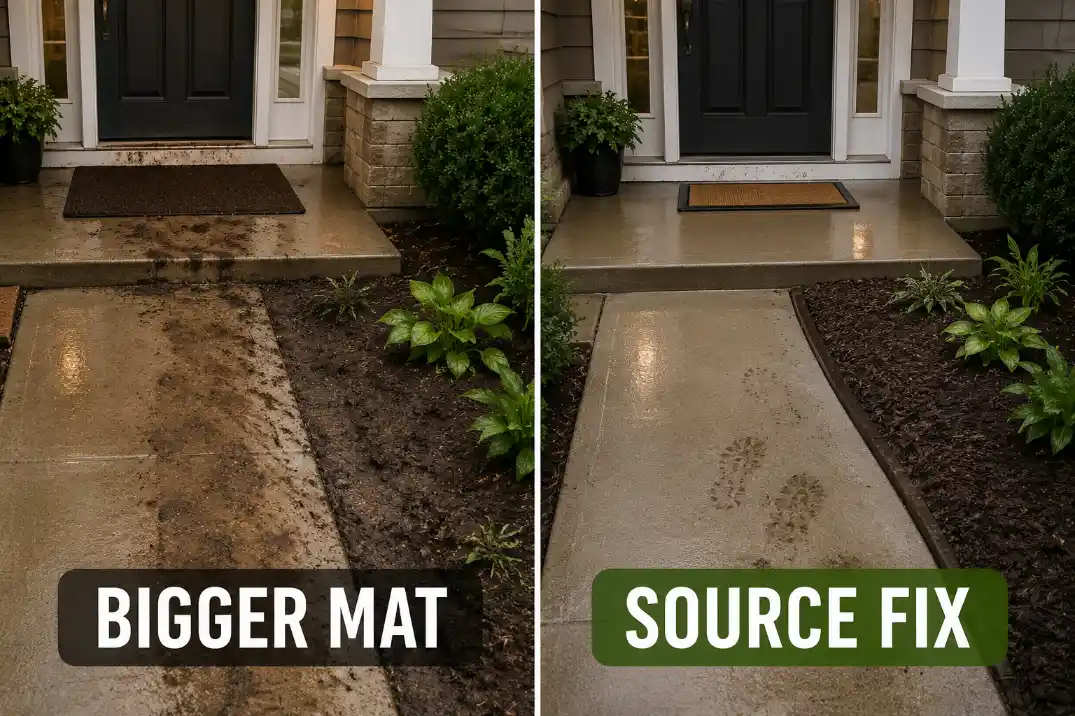
A Cleaner Entry After Rain
The best fix is usually layered, but not complicated. Start with the source closest to the first muddy step, then move outward only if the pattern continues.
First, cover exposed soil
Eliminate bare soil within at least 12 inches of the walking surface. Use stable mulch, low groundcover, gravel in the right context, or planted cover that can handle splash and foot traffic pressure. Avoid leaving small exposed pockets near path corners; those are often the spots shoes touch first.
If you need an immediate fix before the next storm, cover the exposed area temporarily rather than waiting for a full landscape project. Even a small protected edge can reduce how much mud reaches the mat.
Second, control the edge
If bed material keeps appearing on the walkway, add a physical edge or lower the bed surface. The goal is not to make the edge look formal. The goal is to stop loose material from crossing into the walking line.
A 1-inch height correction can change how water and mulch move after rain. This is especially useful beside narrow front walks where there is no extra room for people to avoid a messy edge.
Third, move water away from the pause zone
Check the landing, downspout, gutter outlet, and path slope. If water is arriving from above or from the side, solve that before replacing surface materials.
Downspout discharge near a walkway is especially easy to miss because the mess may appear several feet away from the outlet.
When roof water crosses the entry route, Front Yard Drainage Downspout and Walkway Problems becomes a better next step than another cleaning routine.
Fourth, use the right mat in the right place
Use an outdoor scraper mat before the threshold and keep it on a surface that drains. If the landing is shaded or slow to dry, choose a mat that allows air movement underneath.
A second interior mat can help, but only after the outside route has stopped loading shoes with wet soil.
Once the first muddy contact is removed, the mat finally works the way it was supposed to: as the last wipe point, not the main fix.
Quick Diagnostic Checklist
- Mud starts before the mat, not only at the threshold.
- Bare soil sits within 6 to 12 inches of the path.
- Brown splash marks appear on risers, siding, or walkway edges.
- The landing stays damp more than 24 hours after rain.
- Mulch or soil returns after every storm, even after sweeping.
- People step off the path because the landing or route feels tight.
- A larger mat gets dirtier but the entry does not stay cleaner.
Questions People Usually Ask
Is gravel better than mulch for front entry mud control?
Gravel can help where splash and foot traffic are constant, but it is not automatically cleaner. Fine gravel can migrate onto the walkway, and rounded gravel can scatter under shoes.
Near a front entry, angular gravel or compacted crushed stone may behave better than loose decorative stone, but only if water is not crossing the area.
Should I remove the planting bed beside the front walk?
Usually, no. The bed does not need to disappear; it needs a cleaner edge, covered soil, and better water behavior. Removing the bed may solve splashback, but it can also make the entry look bare and expose more hard surface to runoff.
How soon after rain should I judge the problem?
Look once while the rain is ending, again 2 to 4 hours later, and again the next morning. The first look shows flow and splash.
The later checks show drying time. If the same mud line remains after the surface should be drying, the source is still active.
For broader official guidance on how mulch helps reduce soil splash and erosion, see the University of Minnesota Extension.