
Front door landing clearance usually fails when the space is judged as a porch surface instead of a working entry zone.
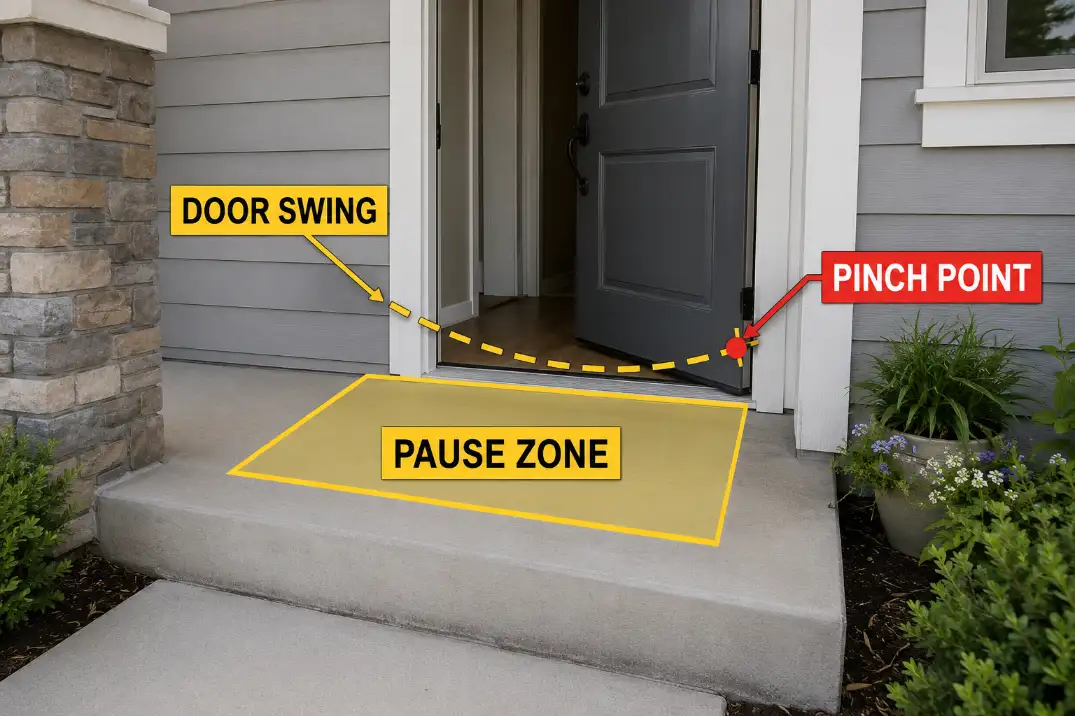
A basic 36-inch landing can still feel tight once the door swing, latch-side stance, planter spread, railing, mat, and package drop are counted.
The first checks are simple: can the door open fully, can one person pause for 5–10 seconds while unlocking it, and is there a clear walking line before the first step or turn?
This is different from a “small porch” problem. A small porch can work well if the door swing, pause zone, and walking path stay separate. A larger landing can feel worse if every object sits exactly where someone needs to stand.
The goal is not to make the front entry empty. The goal is to protect the few inches that actually decide whether the door is easy to use.
The Door Needs Breathing Room
A front door landing has three jobs before decoration begins: it must let the door move, let the body pause, and let the route continue. Most clearance problems happen because these jobs are stacked on top of each other.
Code Minimum Is Not Comfort Clearance
Residential codes commonly treat a landing at least as wide as the door and at least 36 inches deep in the direction of travel as the baseline. That number matters, but it should not be mistaken for comfortable everyday clearance.
A 36-inch-deep landing may satisfy the basic idea of a landing and still feel crowded if a storm door, planter, railing return, or package drop pushes into the working area.
Code logic asks, “Is there a landing?” Daily use asks, “Can someone actually stand, open, turn, and enter without stepping backward?”
The swing zone comes first
The door swing is the first priority because it is not optional. If the front door opens outward, the landing needs a clean arc before anything decorative is placed nearby.
A planter outside the swing path may be fine. A planter that clips the arc by 4–6 inches can turn a normal entry into a shuffle.
Even when the main door opens inward, the landing still needs exterior clearance because the person is standing outside while using the handle, holding keys, or managing a bag.
The visible symptom is crowding. The underlying mechanism is blocked body movement at the latch side.
The latch side matters more than the balanced side
The latch side is where the hand, body, bag, and footwork usually happen. If the handle side is pinched by a pot, railing return, package box, or side table, the landing feels tight even when the opposite side looks open.
A useful working standard is to preserve at least 18 inches of side breathing room near the handle side when possible. The number is not the whole point. The handle side should not be the place where decoration steals the final usable inches.
Where People Pause
People rarely move through a front door in one perfect line. They stop, turn slightly, reach for keys, wait for a child, shift a grocery bag, or avoid a package. A landing that only works for one empty-handed adult walking straight through is not really working.
That is why Front Entry Usability Ideas connects so closely to this topic: the entry has to support arrival, not just frame the door.
The 5-second test
Stand where a guest naturally stops before opening the door. Stay there for 5 seconds while holding a bag or pretending to unlock the door.
If your foot lands partly on the threshold, partly on the step edge, or sideways against a planter, the landing is not giving enough working room.
This test catches problems that photos miss. A small landing may photograph cleanly because the mat is centered and the planter looks intentional. In real use, the person is forced to stand off-center or step backward while the door opens.
One person versus two people
A single person can often manage a 36-inch route. Two people arriving together need more judgment. If the landing is only deep enough for one person to stand directly in front of the door, the second person gets pushed onto the step, walkway, or planting edge.
That matters more in freezing northern winters, where one backward step onto an icy tread can be risky. In rainy climates, the same tight landing can force people to pause on a wet first step instead of the safer flat surface.
Steps, Railings, and Turns
Steps and railings make landing clearance less forgiving because they remove recovery space. A flat landing with a tight planter is inconvenient. A tight landing beside a step edge can become uncomfortable quickly because there is no easy backward correction.
The first step should not be the waiting area
The landing should let someone stand before using the step. If the first step becomes the place where people wait, the design is already overloaded.
A practical warning sign is when guests naturally stand with one foot on the landing and one foot on the top step while opening the door.
That split stance usually means the landing is too shallow, the door side is crowded, or the route turns too soon. It is often a layout problem before it is a material problem.
Threshold drops make tight landings worse
A small height change at the threshold or just outside the door may not look dramatic, but it changes how people move.
When the landing is lower than the interior floor or drops quickly toward a step, the user has to manage the door, the handle, the threshold, and the foot placement at the same time.
This is where a routine decoration fix stops making sense. A smaller planter will not solve a landing that forces people to balance at the edge every time they enter.
Turns need more than a walking strip
A straight 36-inch path can feel adequate until it turns immediately at the landing. When a walkway approaches from the side, the body needs room to rotate before facing the door.
If the railing, planter, or column sits tight against that turn, the landing starts acting like a corner instead of a welcome point.
This is where Front Yard Landscape Ideas for Walkway and Front Door supports the same decision: the walkway should arrive into usable space, not aim people into the tightest part of the entry.
Planters Near the Landing
Planters cause more clearance problems than their size suggests because plants grow into the entry over time. A 14-inch pot may be acceptable in spring. By late summer, foliage can spread 8–12 inches beyond the rim and push into the handle side or walking line.
Size the plant, not the container
The container footprint is not the real clearance number. The mature plant width is. If a plant grows to 24 inches wide, it needs to be placed as a 24-inch object from the beginning. This matters most near small porches, where a little overhang can change how the entire landing feels.
Pro Tip: Use the mature spread as the clearance measurement, then add a few inches for leaning stems after rain or irrigation.
Symmetry often wastes the best space
Matching planters on both sides of the door look finished, but they often steal the exact side space the entry needs. One strong planter on the non-working side is usually better than two smaller planters that make both sides tight.
Homeowners commonly overestimate the value of visual balance here. They underestimate the value of one clean standing side. A front landing does not need perfect symmetry as much as it needs a clear way to arrive, stand, open, and leave.
When planters stop making sense
If the landing is already less than about 4 feet deep, a large floor planter near the door often stops making sense. Wall-mounted decor, a narrow vertical accent, or planting beside the walkway can give the entry character without occupying the standing rectangle.
For privacy or softening near the entry, Privacy Planters for Front Yards and Patios is more useful when the planter can sit beside the approach rather than directly on the working landing.
Small Porches Feel Tight Fast
Small porches become uncomfortable quickly because several small conflicts stack together: a deep doormat, an outward-swinging screen or storm door, a package, a planter, and a turn from the walkway. None of these looks like the whole problem alone. Together, they remove the entry’s working space.
| Landing condition | What it usually means | Better priority |
|---|---|---|
| Door hits package or planter | Swing zone is being used for storage | Clear the door arc first |
| Guest stands on top step | Landing is too shallow or crowded | Restore a flat pause zone |
| Handle side feels awkward | Latch-side clearance is blocked | Move decor away from handle side |
| Walkway turns tightly at door | Arrival line has no rotation space | Open the turn before decorating |
| Porch looks nice but feels crowded | Visual balance outranks movement | Reduce objects, not just size |
The doormat is not the whole landing
A doormat often tricks the eye into thinking the entry has a defined standing zone. But a standard mat may be only 18–24 inches deep, which is not enough room for real arrival if the landing is already shallow.
The mat should mark the entry, not consume it. When the mat, package drop, and planter all compete for the same rectangle, the entry becomes harder to use even before anyone notices why.
Packages expose weak clearance
Delivery boxes are useful diagnostic objects because they show where extra space does or does not exist. If a small box blocks the door, the landing has no spare zone. If a medium box forces people to step around the railing or onto the first step, the landing is being asked to do too many jobs.
A better setup gives deliveries a side target away from the swing and standing zone. Front Yard Package Delivery Zone Ideas fits naturally here because a package zone should protect the entry, not become another obstacle at the door.

Clearance Before Decoration
The best front door landing fix is usually subtraction before replacement. Move objects first. Then decide whether the landing still needs a new planter, wider step, different railing, or better package spot.
Start with the working rectangle
Clear everything from the landing except the mat. Open the door fully. Stand at the handle side. Turn toward the walkway. Step back once. If those movements feel natural, the landing itself may be fine. The problem was crowding.
If it still feels tight after everything is removed, the issue is more structural: shallow depth, awkward turn, step placement, railing position, threshold drop, or a landing that was built too small for the way the entry is used.
Fix the most likely problem first
For most homes, the more likely problem is object placement, not a permanently undersized porch. Planters, packages, mats, side tables, seasonal decor, and railings visually compress the landing long before a rebuild is necessary.
The less likely but more serious problem is a landing that forces people to stand on a step or rotate at the edge every time they enter. That is when cosmetic fixes stop helping. A smaller planter will not solve a landing that needs more flat depth or a safer turn.
Keep the approach connected
A landing does not work alone. If the driveway, walkway, and front door fight each other, the landing becomes the pressure point. This is common where guests approach from the driveway at an angle and meet the door sideways.
In that situation, Front Yard Design for Driveway and Front Door Access becomes more relevant than adding another decorative object at the door. The route needs to deliver people into the landing, not into a side collision with the threshold, railing, or planter.
Quick Clearance Checklist
Use this before adding anything new near the front door:
- Can the door open fully without touching decor, packages, or furniture?
- Is there about 36 inches of clear approach before the landing tightens or turns?
- Can one person pause for 5–10 seconds at the handle side without standing on a step?
- Does the mature plant spread stay outside the walking line and door arc?
- Is there a side package spot that does not block the mat or swing?
- Does the landing still work after rain, snow, or low evening visibility?
The Better Rule
A front door landing should be judged by what it lets people do, not by how much decoration it can hold. The right order is door swing first, pause zone second, walking turn third, decoration last.
That order may feel less exciting than buying a new planter or changing the mat, but it changes the outcome faster.
Once the landing has enough breathing room, even simple decoration looks more intentional because it is no longer fighting the entry’s main job.
For official residential code context, see the International Code Council exterior door landing section.