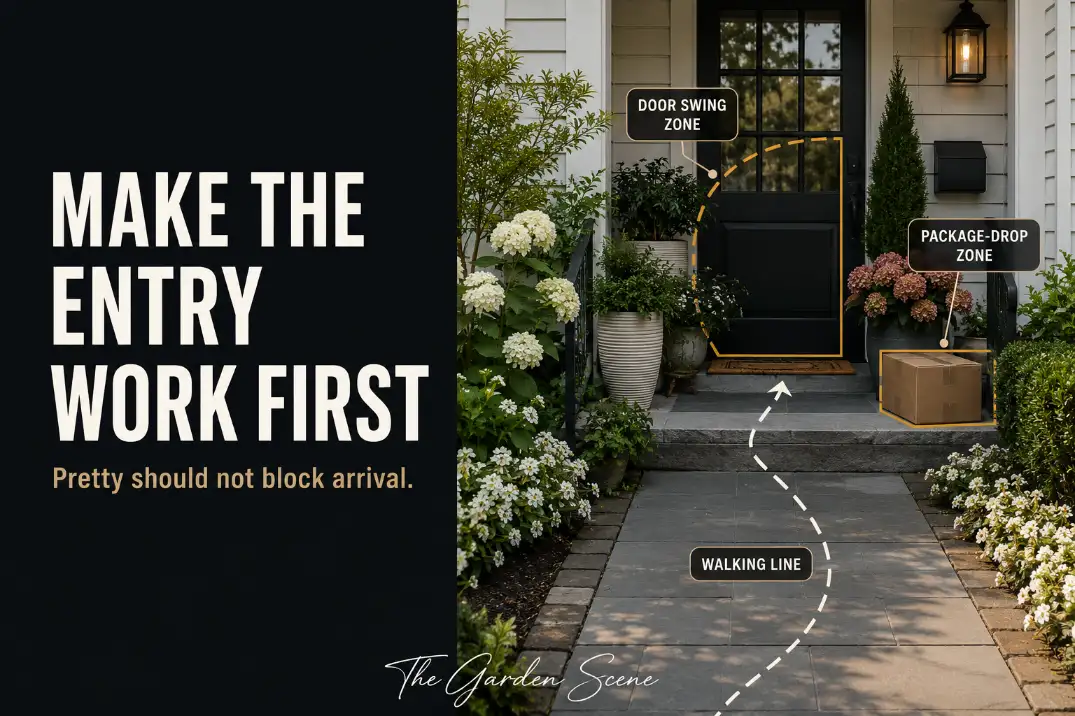
A front entry does not need more decoration before it needs a clearer job. Most awkward entries fail because the same small area is being asked to handle the first step, door swing, guest pause, package drop, mat, planter, and nighttime visibility all at once.
If the first 3 to 5 feet near the door feel crowded, the smartest idea is usually not another pot, bench, rug, or light. It is a better arrival layout.
Start with three checks: is there about 36 inches of clear walking width to the door, can two people pause for 10 to 15 seconds without one stepping back onto a stair, and can a package sit nearby without blocking the swing path?
If those three things fight each other, the entry has a usability problem, not a curb appeal problem.
The best front entry ideas do not try to make the space busier. They make the door easier to approach, easier to read, and easier to use every day.
The 3-Zone Entry Rule
Walk line, stand zone, drop zone
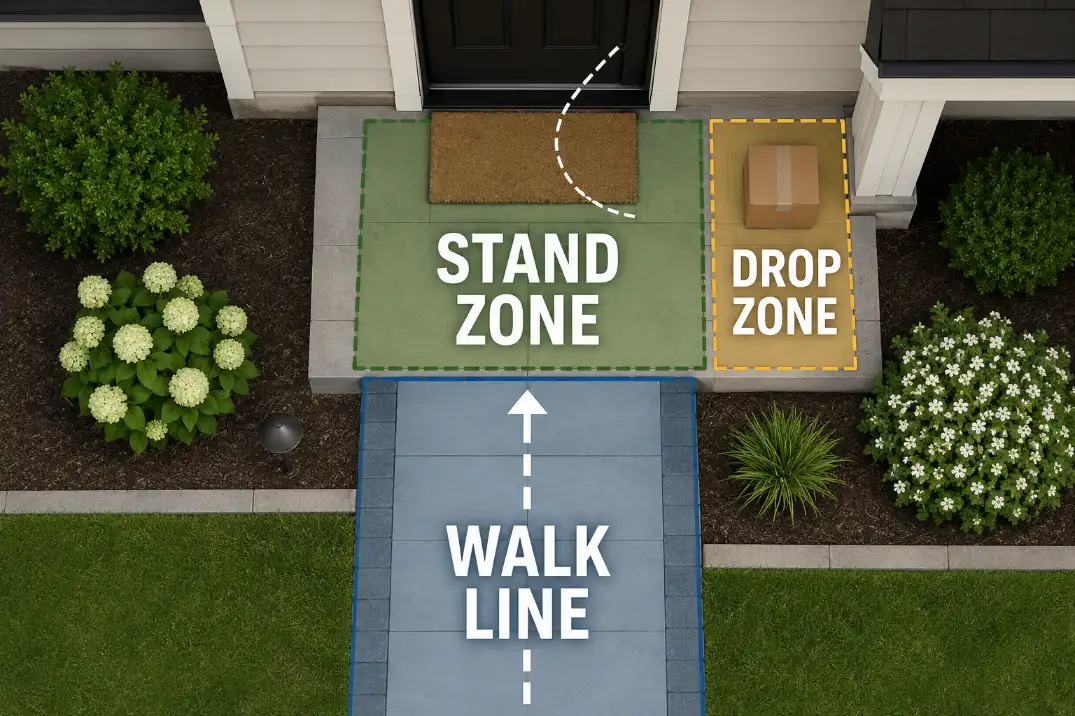
A usable front entry has three working zones: the walk line, the stand zone, and the drop zone. Once you see the entry this way, a lot of confusing design choices become easier.
The walk line is the route people actually take to the door. The stand zone is where they pause to unlock, wait, greet someone, or turn around. The drop zone is where a package, bag, or delivery can sit without blocking either of the first two zones.
Most front entry mistakes happen when these three zones overlap too much. A planter steals part of the walk line. A package lands in the stand zone. A bench takes the drop zone. A storm door pushes people backward because the stand zone is too shallow.
That is why the best ideas below are not decorative themes. They are small layout moves that separate these three jobs.
The entry should explain itself
A good front entry should tell people where to go without making them think. The front walk should lead cleanly to the door, the landing should feel like a place to pause, and the area beside the door should not look like a storage spillover.
When the walkway itself is unclear or arrives at the door from an awkward angle, the whole entry feels weaker even if the stoop looks nice.
For homes where the walk-to-door relationship is the deeper problem, Front Yard Landscape Ideas for a Walkway to the Front Door is the stronger supporting guide.
Front Entry Ideas That Solve the Real Bottleneck
1) Treat a tiny stoop like a threshold, not a porch
This is the idea that fixes many small entries immediately. If the stoop is under 4 feet deep, stop trying to make it act like a porch. It is not a mini outdoor room. It is a threshold.
That means the goal is not to fit seating, layered decor, two planters, a seasonal display, and a mat. The goal is to make arrival feel finished without stealing working room.
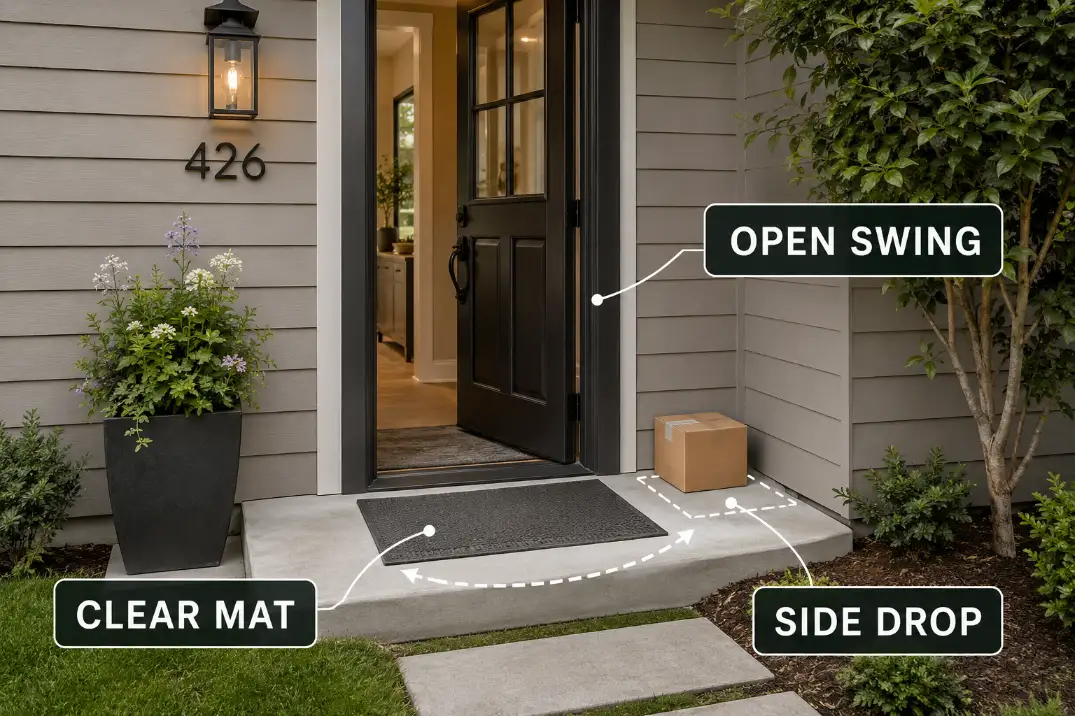
Use one side planter instead of two. Keep the handle side clear. Choose one clean mat instead of layered rugs. Let the door area breathe.
If the entry is only a small slab with no real porch, the same rule applies even more strongly. Do not fake a porch with furniture. Make the slab feel intentional: visible house number, clean mat, one side planter, and a small side drop spot if packages are common.
The bright move is simple: one softened edge, one working edge. That often looks sharper than a crowded attempt at symmetry.
2) Build a side package pocket, not a front obstacle
A modern front entry needs a package idea. Not a giant storage solution. Not a bulky box in the middle of the porch. Just a predictable side pocket where deliveries can land without blocking the door.
For smaller entries, even an 18-by-24-inch side landing can change the way the door works. On a covered porch with frequent deliveries, closer to 24 by 36 inches may be more realistic.
The exact size matters less than the placement: the package should sit beside the arrival path, not directly in front of the threshold.
This is one of the most useful ideas because it solves a daily irritation without making the entry look more complicated. The door opens. A guest can still stand. A box has a home. That is the whole win.
3) Widen the last move, not the whole walk
When people approach from the driveway, the awkwardness often happens in the last few feet. The route may be fine until the body has to turn toward the door. That final turn is where bags, car doors, garage dominance, steps, and planting all start to compete.
The clever idea is to widen the last move instead of redesigning the whole front walk. A 36-inch route may work along the main approach, but the final turn often feels better when it opens to about 42 to 48 inches.
That extra width does not need to run across the entire yard. It only needs to show up where people turn, pause, and choose the door.
This works especially well on suburban houses where the garage visually overpowers the entry. The front door does not always need a bigger landscape gesture.
It may need a more generous landing moment. If the driveway-to-door relationship is the main source of friction, Front Yard Design for Driveway and Front Door Access goes deeper into that layout problem.
4) Keep the handle side open
The handle side of the door is the most underrated piece of front entry space. It is where the body reaches, turns, waits, and enters. If that side is filled with a tall pot, lantern, chair, package box, or seasonal display, the entry may look styled but feel clumsy.
This is why a front entry does not need perfect visual balance. It needs a clear working side. If one side must hold planting or decor, keep it away from the handle-side movement zone.
The entry will often feel calmer with one strong planted side and one open working side than with two matching objects crowding the door.
A good test is simple: can someone hold a bag, reach the handle, open the door, and step inside without shifting their feet twice? If not, the handle side is not clear enough.
Ideas for Guests, Privacy, and the Door Pause
Give guests a place to stand beside the door
A guest should not have to stand on the step, half in the walkway, or directly in front of the swing path. If that keeps happening, the entry does not need more styling. It needs a better stand zone.
This matters most on small stoops, raised entries, and front doors with storm doors. A landing that is only 30 inches deep may look acceptable until someone has to step back while a door moves toward them.
Around 48 inches of usable depth near the threshold usually feels much more comfortable for daily arrival. Where accessibility or aging-in-place is part of the plan, a 60-inch turning zone is far more valuable than decorative edging that narrows the landing.
Privacy can help the pause zone feel calmer, but only if it does not close down the entry. A screen, planter, or low fence should protect the feeling of arrival, not squeeze the person standing there.
For that balance, Front Entry Privacy That Does Not Feel Closed Off is the closest companion topic.
Use privacy as a side shield, not a front wall
If the front entry feels exposed, the instinct is often to place something tall near the door. That can work, but only when it shields the right view. If it blocks the approach, hides the handle side, or narrows the landing, it creates a more irritating problem than the one it solved.
A better privacy idea is often a side shield. Place the screening element where it protects the guest pause or softens the view from the street without standing in the walk line.
A low planted edge, angled planter, or narrow side screen can make the entry feel less exposed while still letting the door remain easy to find.
The useful order is access first, privacy second, softness third. When planting is expected to screen views without blocking daily movement, Front Yard Privacy, Access, and Planting Priorities gives that same conflict a wider front-yard frame.
Planting Ideas That Frame Without Crowding
Use one planted edge to guide the route
Planting near the front door works best when it guides the body without touching the body. A planted edge can make the walk feel intentional, soften the stoop, and pull the eye toward the door. It should not brush legs, hide the first step, or make people squeeze past leaves.
The mistake is judging plants at installation size. A small shrub may look harmless when planted, but if it matures to 30 to 36 inches wide, it can quietly eat the edge of a narrow walk.
If the path itself is only about 36 inches wide, even modest plant spread can make the entry feel pinched after one or two growing seasons.
Near the landing, leave 12 to 18 inches of breathing room from the hard edge when possible. That space is not wasted. It is the buffer that lets planting look intentional instead of intrusive.
Make one bold plant move instead of three weak ones
A useful entry does not need plants everywhere. It needs planting in the one place where softness changes the experience.
That might be a single substantial pot set off the handle side. It might be a low planted strip that leads the eye toward the door. It might be one clipped evergreen that marks the entry without blocking the landing. It might also be removing the second pot so the door finally feels usable.
This is where many front entry ideas go wrong. They add equal decoration to both sides when the space only has room for one strong move. The more constrained the entry, the more selective the planting should be.
Weather and Night Ideas That Make Arrival Easier
Light the decision points, not the decorations
Night usability is not about making the entry bright from the street. It is about making the important decisions easy before someone reaches the threshold: where to walk, where the first step is, where the handle is, and what number belongs to the house.
A row of glowing path lights can still fail if the step edge disappears from 6 to 8 feet away. That is a classic false fix. The fixture is visible, but the walking surface is not readable.
A small light near the door, a clear house number, and a calmer surface pattern can solve more than another decorative fixture. If the route includes steps, slopes, or darker walkway edges, Path Lighting for Steps, Slopes, and Walkways connects the lighting choice to safer movement.
Fix slow drying before adding more style
If the landing or mat stays damp more than 24 hours after ordinary rain, the entry has a performance problem. Adding a prettier mat does not fix that. Adding another pot may make it worse if it traps shade and blocks airflow.
The cause may be exposure, roof runoff, poor slope, shade, surface texture, or planting too close to the threshold. In humid parts of Florida, shaded dampness can turn into slick mildew.
In northern states, a wet edge can become a freeze-thaw hazard. In coastal areas, moisture may linger long enough that the entry always feels a little tired.
The smartest idea is sometimes subtraction: fewer objects near the threshold, a faster-drying mat, a clearer edge, and a surface that lets the first step stay visible and usable.
The Entry Ideas Worth Keeping
If it does not protect a zone, question it
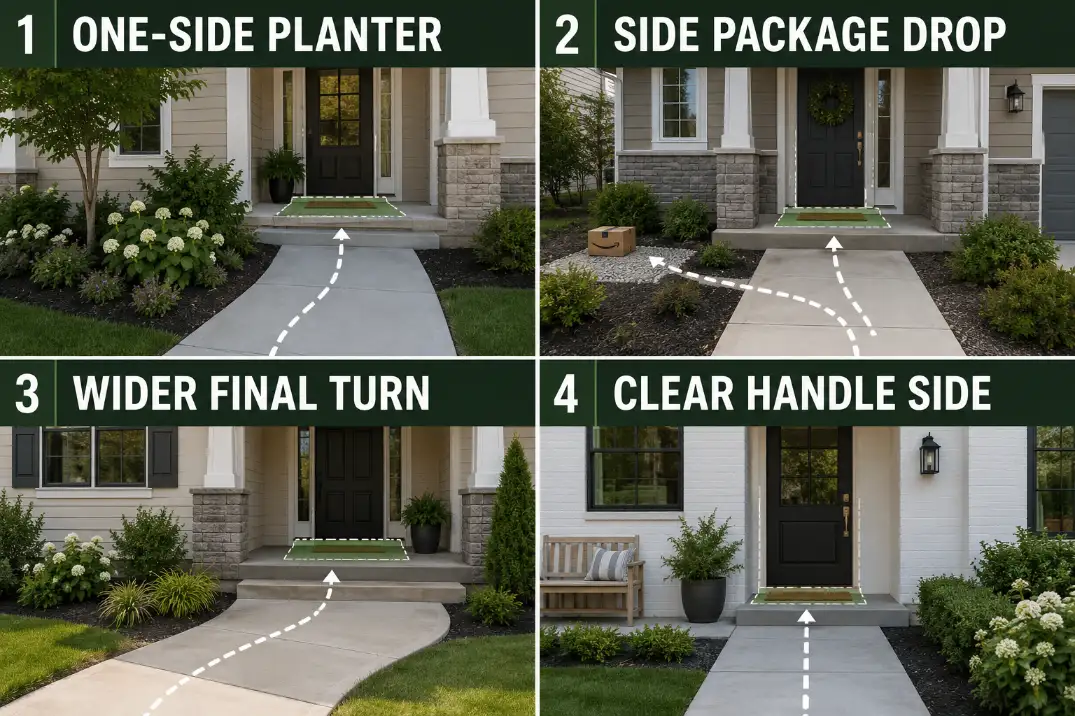
The best front entry ideas earn their place by protecting one of the three working zones. A one-side planter protects the walk line. A side package pocket protects the stand zone.
A wider final turn protects the arrival path from the driveway. A clear handle side protects the door swing. A visible step edge protects nighttime movement.
That is the filter. If an idea does not improve the walk line, stand zone, or drop zone, it may still be pretty, but it is not solving the entry.
Quick idea check before you buy anything
Use this quick check before adding planters, furniture, lights, rugs, edging, or seasonal decor:
- Keep about 36 inches of clear walking width to the door.
- Aim for roughly 48 inches of usable pause depth where space allows.
- Keep the handle side open before styling the rest of the entry.
- Give packages a side drop zone, not the threshold.
- If people arrive from the driveway, improve the last turn before rebuilding the whole walk.
- Judge plants by mature width, not current pot size.
- If the landing stays wet more than 24 hours, fix drying before adding decor.
- If the first step disappears at night from 6 to 8 feet away, the lighting is not solving the right problem.
A front entry does not need more things to feel finished. It needs a sharper order: walk line first, stand zone second, drop zone third. Once those three work, even a small entry can feel intentional, calm, and surprisingly smart.
For broader official guidance on accessible entry and door clearances, see the U.S. Access Board guide to entrances, doors, and gates.