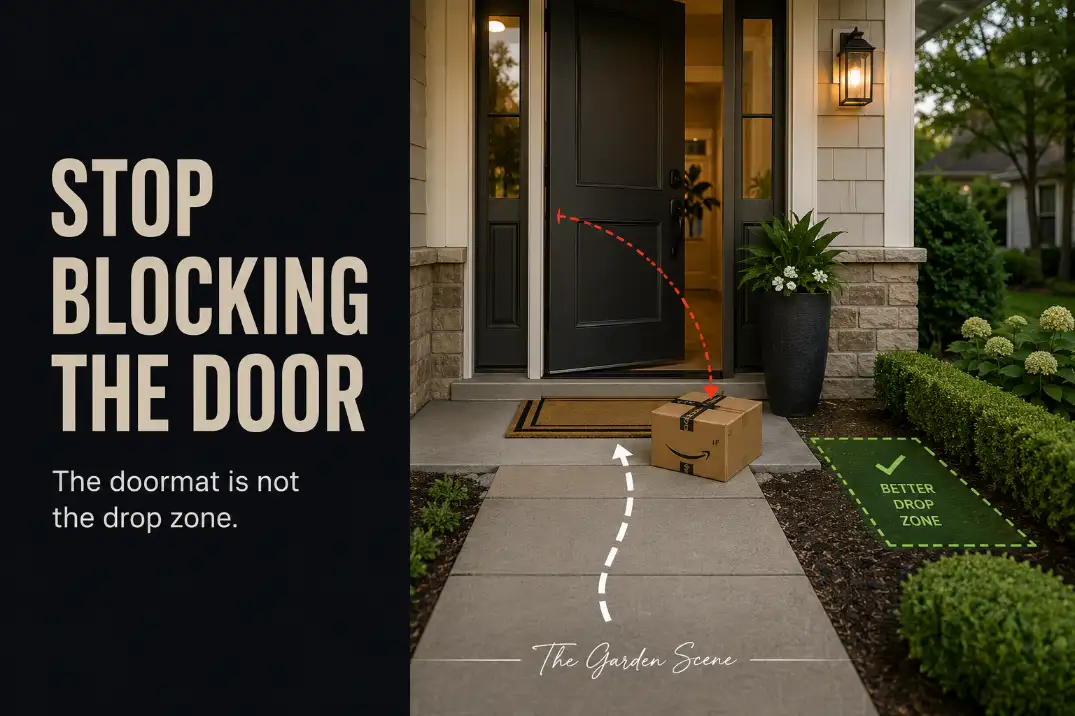
A good front yard package delivery zone has to solve three problems at once: the carrier must recognize it quickly, the door must still open, and the package should not sit fully exposed from the street.
If a 14-by-18-inch box keeps landing on the doormat, the problem is usually not “bad delivery.” It is that the doormat is the most obvious target.
Start with three checks: where packages actually land, whether the door or storm door can open a full 90 degrees, and whether a person still has about 30–36 inches of clear standing space.
If packages wait outside for 3–6 hours, security becomes part of the layout too, not a separate accessory. This is different from a pure porch-theft problem.
Theft is about what happens after the drop. A poor delivery zone is about the 10–15 seconds when the carrier decides where the package belongs.
Where Packages Actually Land
The Doormat Is Usually the Symptom
Most package zones fail because the doormat becomes the default target. It is centered, visible, flat, and directly connected to the walkway. That makes it the easiest drop point, even when it is the worst place for the homeowner.
A package on the mat is the symptom. The mechanism is usually that no other surface looks more intentional. If the side of the door has mulch, a crowded planter, a narrow step, or an uneven strip of stone, the carrier will choose the cleanest, most obvious surface. That is usually the mat.
A useful delivery zone should be close enough to the door to feel official, but not so centered that it interrupts entry. On many small stoops, the best target is within 18–30 inches of the handle side or the wall side, depending on which side stays clear when the door opens.
Read the Delivery Photos Before Buying Anything
Before adding a bench, box, or tray, look at the last few delivery photos. The important question is not “Where would I like packages to go?” It is “Where did the carrier naturally stop?”
If packages land in the same place three or more times, that spot has visual power. It may be the widest flat surface, the brightest area, or the only place that does not require stepping into a planting bed. Work with that clue unless it creates a door conflict.
If packages scatter between the mat, step, planter edge, and walkway, the entry is visually unclear. That is when a stronger landing cue helps more than a larger container.
Keep the Door Swing Clear
The Door Needs a Working Bubble
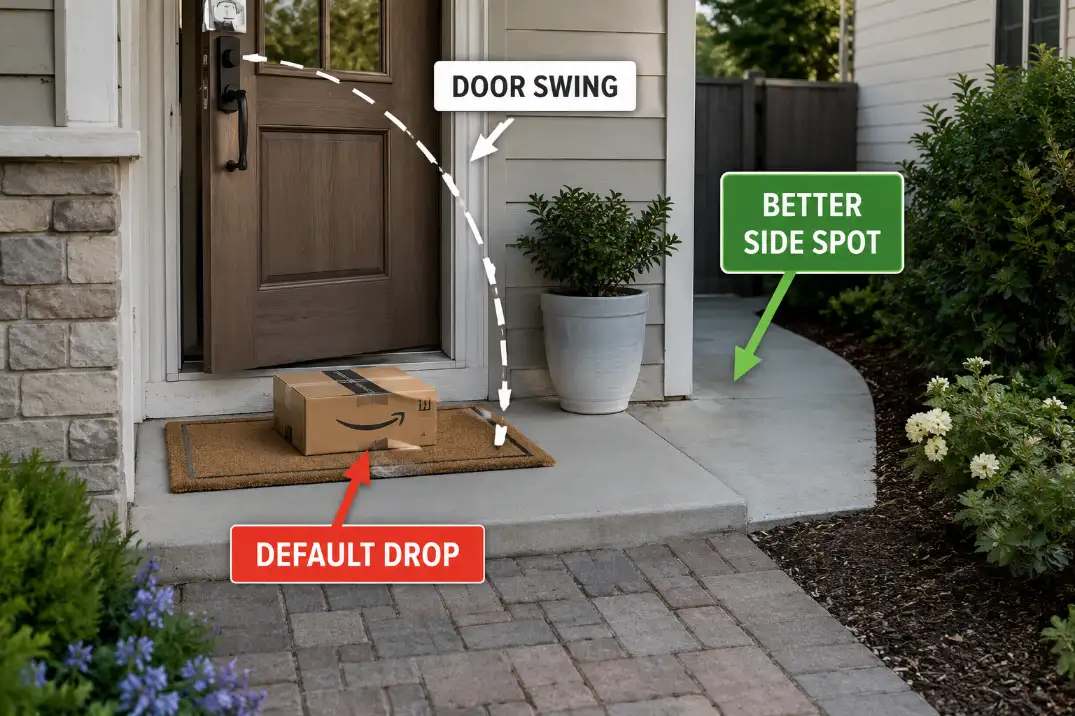
The most important space is not the package footprint. It is the door’s working bubble. A front door that opens outward, a storm door, or a screen door can turn a harmless-looking box into a daily annoyance. Even an inward-swinging main door often has an outward storm door in rainy, snowy, or windy regions.
Use 36 inches as a practical comfort benchmark, not because every front stoop is an accessibility route, but because narrow entries stop feeling usable fast once a box, planter, or storm door enters the space.
If the clear standing area drops below about 30 inches, most people start stepping around objects instead of simply arriving.
A 10-inch-tall package may not look like a major obstruction, but if it sits against the threshold, the homeowner still has to reach around the door, step backward, or push the box with the door edge. That is a layout failure, not a package-size problem.
The Fix That Often Wastes Time
Buying a larger decorative package box often disappoints when it goes in the same conflict zone. A storage box that occupies the door swing, blocks the handle side, or narrows the final step below about 30 inches simply makes the problem more permanent.
The better move is usually smaller and sharper: create a clear side landing first, then choose the container. A low bench, wall-side tray, recessed shelf, or slim deck box only works if it respects the arrival route.
The same entry logic appears in Front Entry Usability Ideas, where the door area has to work before the decoration matters.
Pro Tip: Test the zone with an empty shipping box before buying anything. If the door, your foot, or your hand hits the box during normal entry, the permanent solution will feel wrong too.
Rain, Shade, and Street Exposure
Weather Protection Beats Full Hiding
People often overestimate hiding and underestimate weather. A package that is hidden but soaked is not in a good delivery zone.
In humid Florida conditions or coastal California moisture, cardboard can soften quickly if it sits on wet concrete or against damp mulch. In northern states, snowmelt creates the same problem from below even when the package is technically under cover.
A good zone should stay visibly dry after a normal rain. As a practical check, look at the surface 24 hours after rainfall. If water still beads, stains, or pools where the package would sit, that is not a dependable drop area.
A roof overhang helps, but it does not need to cover the entire entry. Even 12–18 inches of overhead protection can improve performance if the package sits tight to the wall and outside the splash line.
What matters is whether wind-driven rain reaches the surface, not whether the area looks covered from the street.
Security Is a Layout Decision Too
Security matters most when packages sit outside for several hours, the entry faces a busy sidewalk, or the package is visible from the street before a visitor reaches the walkway. A fully exposed package zone may still work for low-value deliveries, but it is not a strong everyday system.
The mistake is trying to hide the package so well that the carrier cannot confidently use the spot. A better arrangement is carrier-visible and street-softened.
The driver should see the landing zone during the last 6–10 feet of approach, while a planter, porch column, low wall, or side angle reduces the direct street view.
A lockable delivery box makes sense when packages are frequent, valuable, or left out for 3–6 hours on normal weekdays. It does not solve a bad entry layout by itself. If the box blocks the door, sits in a wet corner, or feels like an awkward detour, carriers may still default to the mat.
Delivery Path From the Walkway
The Carrier Chooses the Fastest Believable Route
A package zone fails when the carrier has to decode it. If the walkway aims straight at the mat, the mat wins. If a side drop area sits slightly off the path but looks flat, open, and intentional, it starts winning.
The route should have three readable parts: walk line, stop point, and drop point. The walk line should stay about 36 inches wide where possible.
The stop point should let a person set a package down without stepping into a bed. The drop point should be obvious enough that it does not need a long sign.
A small landing pad can work better than a large box if it is positioned correctly. A 20-by-24-inch flat surface beside the door is enough for many everyday parcels. The pad should look like part of the entry, not like a random stone left near the foundation.
Tiny Stoop Rule
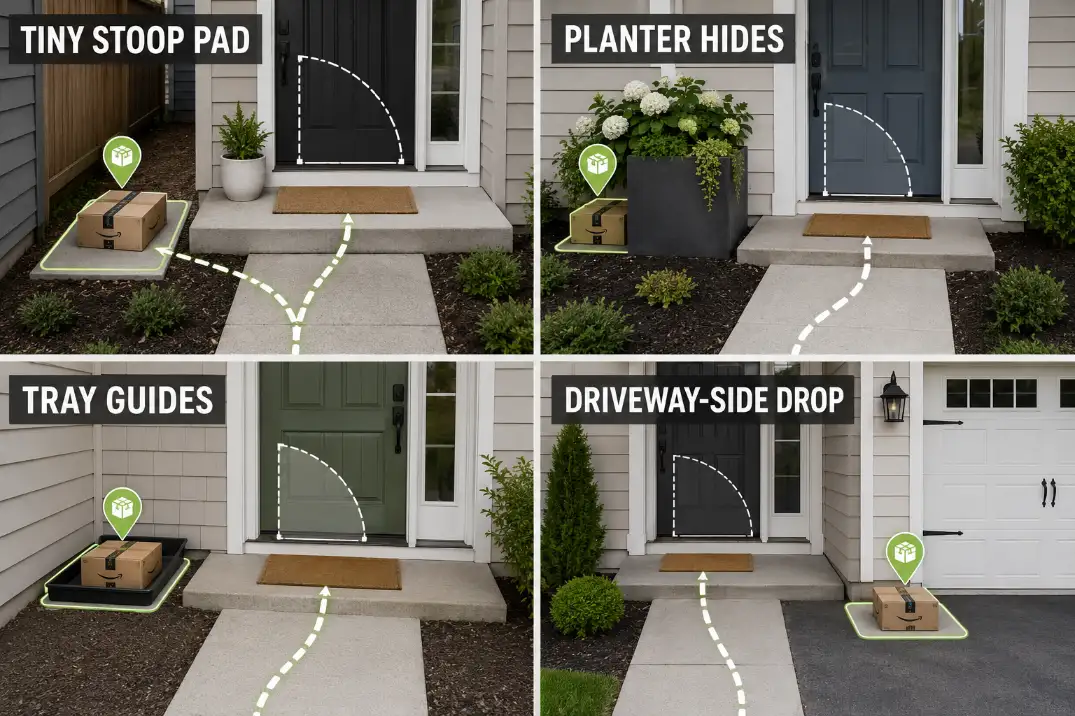
If the stoop is too small, do not force the package zone onto the step. Move the drop target one step before the stoop, beside the final walkway turn, or along the wall where the carrier naturally pauses.
This is especially useful for no-porch entries where the front door opens directly onto a small slab. The package does not need to touch the threshold to feel delivered.
It needs to sit close enough to the door, dry enough to survive weather, and obvious enough that the carrier does not ignore it.
For homes where the driveway is the practical approach instead of the sidewalk, the delivery path may need to connect parking to door rather than front walk to door.
That overlap is similar to the access issue covered in Front Yard Design for Driveway and Front Door Access, where the real arrival route matters more than the formal one.
Planters That Get in the Way
Pretty Containers Can Steal the Best Drop Spot
Planters are often added to make the entry feel finished, then packages start landing in worse places. The reason is simple: the planter takes the best side position. The remaining open space is the mat.
A planter beside the door should not occupy the only dry, flat, visible package spot. If the planter is wider than about 16–18 inches on a very small stoop, it can easily consume the side landing.
A tall container can also hide the drop surface from the carrier’s eye line, especially when the approach is angled.
This does not mean planters are wrong. It means they should frame the package zone, not compete with it. A narrow planter on one side and a low drop surface on the other often works better than symmetrical planters flanking the door.
Planter Hides, Tray Guides
The strongest use of a planter is not full concealment. It is partial screening. The planter softens the street view, while the tray, pad, or bench tells the carrier where the package belongs.
This is the part many entries get backward. A tall planter may hide the package from the sidewalk, but if it also hides the target from the carrier, the mat stays in control.
For front yards already using containers for privacy, Privacy Planters for Front Yards and Patios can support the same principle: the planter should define space without blocking the working route.
Symmetry is another common trap. Matching planters look clean in photos, but front entries are not used symmetrically. People approach from one direction, open the door from one side, and receive packages in the easiest visible spot. If the stoop is under 5 feet wide, give one side a job and let the other side carry the visual weight.
Make the Drop Zone Match the Delivery Instruction
The Physical Cue and Online Note Should Say the Same Thing
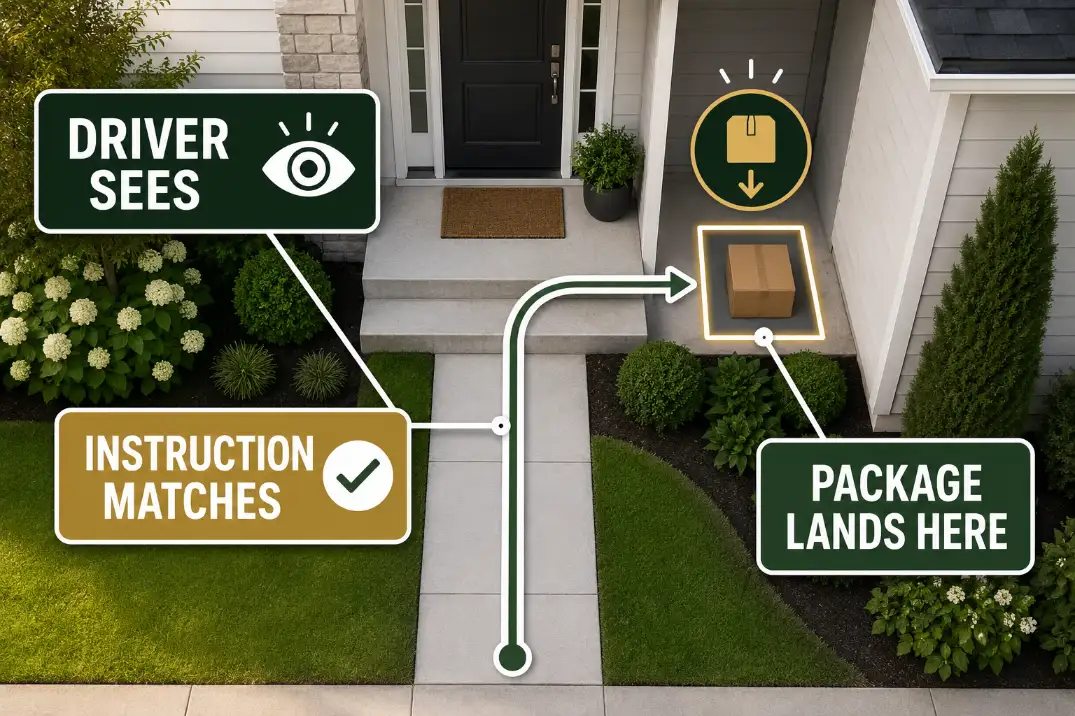
A delivery instruction only works when the physical scene supports it. If the note says “leave packages on the side bench,” but the side bench is hidden behind a planter and the doormat is bright, centered, and clear, the carrier may still choose the mat.
The wording should match the visible cue. “Please leave packages on the black side tray to the right of the door” is better than a long instruction about hiding, theft, rain, and preferences. Aim for 8–12 words that identify one object and one side.
The physical cue should be just as direct. A clean tray, low bench, stone pad, or small sign that says “Packages Here” can be enough. The goal is not to decorate the carrier into compliance. It is to make the right drop feel like the easiest move.
Photo-Proof the Landing Zone
Many deliveries now include a confirmation photo. That photo should clearly show the package in a recognizable place without exposing it too much from the street. A wall-side tray, porch corner, or driveway-side pad can work well because the photo captures the front door or house number while the street sees less of the box.
A good test is simple: stand where the carrier would stand and take a phone photo. If the package location, door, and house identity are clear in one frame, the zone is photo-friendly. Then step back toward the sidewalk. If the box becomes the first thing you notice from 30–40 feet away, add partial screening or shift the target slightly.
This is where entry landscaping should support arrival rather than compete with it. The planting and walkway ideas in Front Yard Landscape Ideas for the Walkway and Front Door work best when they make the entry more readable, not just more decorated.
A Drop Zone That Looks Intentional
Use a Surface, Boundary, and Cue
The strongest package delivery zone has three parts. First, it has a flat surface large enough for a normal box. Second, it has a boundary that makes the zone feel deliberate. Third, it has a cue that tells the carrier this is the right place.
The surface can be a low bench, stone pad, slim deck box, wall tray, or porch corner. The boundary can be a planter, wall, railing, column, or change in paving. The cue can be as subtle as a clean open rectangle beside the door. If a sign is needed, keep it short. “Packages Here” works better than a paragraph of instructions.
Do not overbuild the zone. A large locker can look secure but feel hostile at a small front entry. A bench can look welcoming but fail if it is too deep. For most compact entries, a depth of 14–20 inches is enough to hold packages without stealing the standing zone.
When Each Package Zone Idea Works
| Problem | Best delivery zone idea | Why it works | Avoid |
|---|---|---|---|
| Package blocks storm door | Hinge-side or wall-side pad | Keeps the door swing clear | Box centered on the mat |
| No porch, only a small step | Landing strip before the stoop | Gives the carrier a target before the threshold | Package on the step edge |
| Street-visible entry | Planter-screened tray | Visible to carrier, softer from street | Fully hidden spot carriers miss |
| Driveway approach | Driveway-side drop zone | Matches the real arrival route | Sidewalk-only cue |
| Frequent valuable packages | Lockable box near natural stop | Adds security without changing behavior too much | Oversized box in the door path |
Quick Check Before You Commit
Use this short test before buying a container or moving planters:
- Can the front or storm door open without touching the package zone?
- Is there still about 30–36 inches of clear standing and walking space?
- Would a carrier notice the drop spot within the last 6–10 feet of approach?
- Does the surface stay dry or dry out within 24 hours after rain?
- Can a medium box sit there without being fully visible from the street?
- Does the physical cue match the delivery instruction?
If the answer is no to two or more of these, the issue is still layout, not styling.
Make It Feel Like Part of the Entry
The package zone should borrow from the entry’s materials. A black metal tray near a black lantern, a stone pad aligned with walkway pavers, or a low wood bench that matches the door tone will feel planned. Random plastic bins rarely do unless they are hidden inside a cleaner frame.
This is the same reason small front entries need restraint. Too many helpful objects can turn the landing into an obstacle course.
If the yard has limited setback, Front Yard Design With Minimal Setback Space is a useful companion idea because the first few feet near the house have to carry several jobs without becoming crowded.
Questions People Usually Ask
Should a package box go beside the door or near the walkway?
Beside the door is better when the entry has enough clear standing space and some weather protection. Near the walkway is better when the stoop is too small, the door swings outward, or the driveway approach makes a side drop more natural. The box should match the carrier’s route, not just the homeowner’s preferred hiding spot.
Is it better to hide packages behind plants?
Only if the carrier can still see the drop zone easily. A package area that is too hidden often gets ignored, especially by substitute drivers or seasonal delivery help. Use plants to soften the view from the street, not to hide the zone from the person making the delivery.
What is the smallest useful delivery zone?
For many homes, a 20-by-24-inch flat surface is useful. Smaller trays can still help with envelopes and small parcels, but they will not change the behavior for larger boxes. The key is keeping that surface outside the door swing and off the main footpath.
When is a lockable package box worth it?
A lockable box is worth it when packages are valuable, frequent, or left outside for several hours. It is less useful when the entry problem is really door clearance, wet placement, or a confusing carrier route. In that case, fix the landing logic first, then choose the security layer.
For official guidance on setting package drop preferences before delivery, see the USPS Delivery Instructions guidance.